
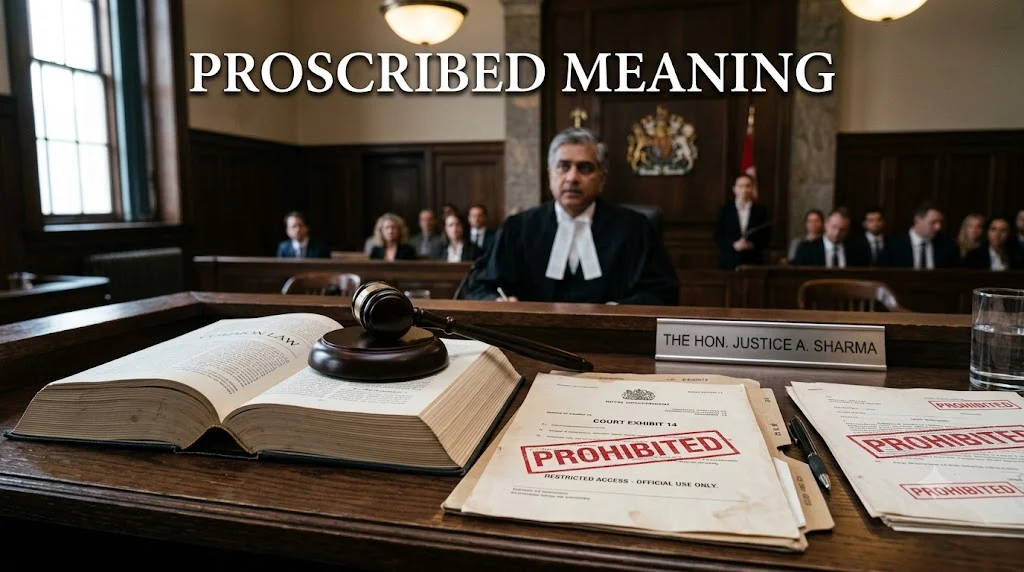

Definition
An aura is the emotional or spiritual impression a person or thing creates without speaking or doing anything specific.
An aura is the distinctive feeling, presence, or atmosphere that surrounds a person, place, or thing.
Have you ever come across the word proscribed in a news article, legal document, or government notice and wondered what it actually means? Many people confuse it with prescribed because the two words look almost identical. However, their meanings are completely different. Understanding this distinction can help you avoid a common English mistake.
In this guide, we’ll explain the proscribed meaning in English using clear examples and simple language. You’ll learn how dictionaries define proscribed, explore the official proscribed definition, and understand the related term proscription meaning. Drawing on trusted English dictionaries and real world usage, this article breaks down the word in a way that’s easy for students, writers, professionals, and everyday readers to understand. By the end, you’ll know exactly when and how to use proscribed correctly with confidence.
What Does Proscribed Mean? The Core Definition
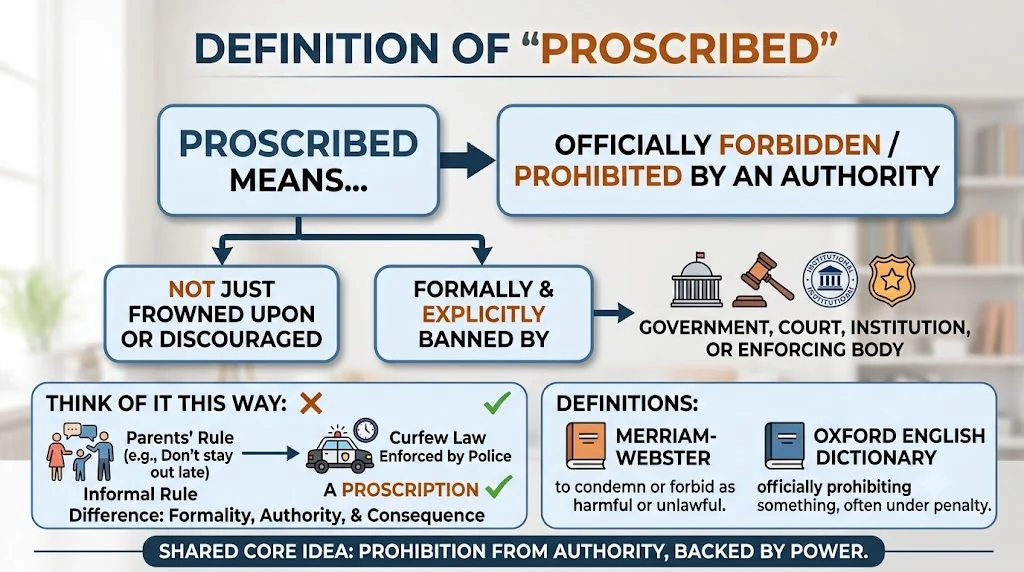
Start with the simplest possible version. Proscribed means officially forbidden or prohibited by an authority. When something is proscribed, it hasn’t just been frowned upon or discouraged. It’s been formally, explicitly banned by a government, court, institution, or other body with the power to enforce that ban.
Think of it this way. Your parents telling you not to stay out late is a rule. A curfew law enforced by police is a proscription. The difference is formality, authority, and consequence.
Merriam-Webster defines “proscribe” as: to condemn or forbid as harmful or unlawful.
Oxford English Dictionary describes it as: officially prohibiting something, often under penalty.
Both definitions share the same core idea this is prohibition coming from above, from authority, backed by power.
The Full Word Family
You can’t fully understand “proscribed” without knowing the whole word family it belongs to.
| Form | Word | Example Sentence |
|---|---|---|
| Verb | Proscribe | The legislature moved to proscribe the organization immediately |
| Adjective | Proscribed | Membership in a proscribed group is a criminal offense |
| Noun | Proscription | The proscription came into effect within 48 hours |
| Agent noun | Proscriber | Rarely used in modern English |
The form you’ll encounter most often is the adjective “a proscribed organization,” “proscribed conduct,” “proscribed substances.” That’s the form that shows up in legal documents, news reports, and official government communications.
How to Pronounce Proscribed Correctly
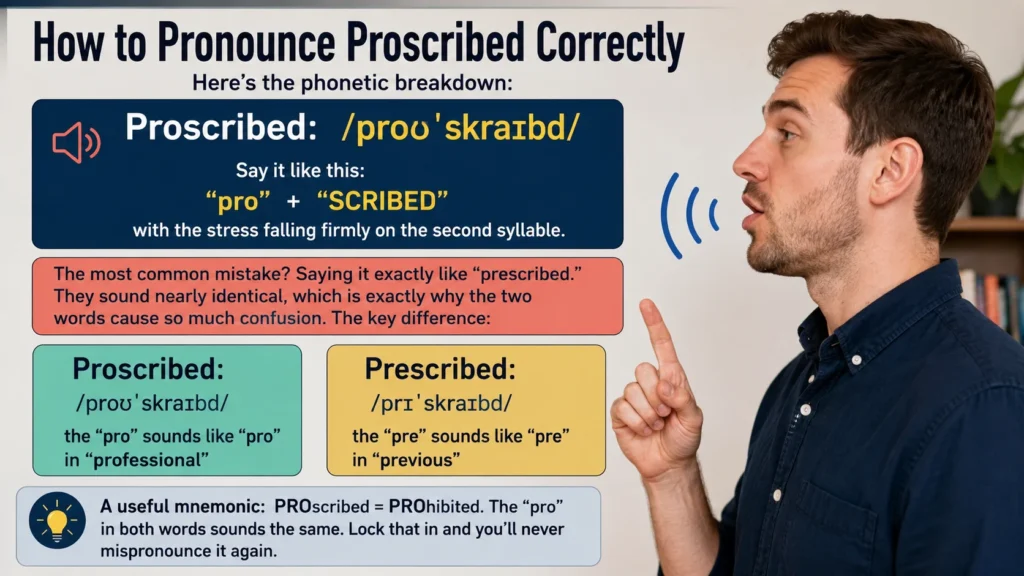
Don’t let this word trip you up at the wrong moment. Here’s the phonetic breakdown:
Proscribed: /proʊˈskraɪbd/
Say it like this: “pro” + “SCRIBED” with the stress falling firmly on the second syllable.
The most common mistake? Saying it exactly like “prescribed.” They sound nearly identical, which is exactly why the two words cause so much confusion. The key difference:
- Proscribed: /proʊˈskraɪbd/ the “pro” sounds like “pro” in “professional”
- Prescribed: /prɪˈskraɪbd/ the “pre” sounds like “pre” in “previous”
A useful mnemonic: PROscribed = PROhibited. The “pro” in both words sounds the same. Lock that in and you’ll never mispronounce it again.
The Origin of Proscribed: A Word With Ancient, Deadly Roots
This word didn’t start out as legal jargon. It started as something far more visceral.
“Proscribed” comes from the Latin verb proscribere, which combines two elements:
- Pro meaning “before” or “publicly”
- Scribere meaning “to write”
Literally translated: to write publicly. And in ancient Rome, that’s exactly what happened with terrifying consequences.
The Roman Proscription Lists
In 82 BC, the Roman dictator Sulla introduced a system of political terror that became known as the Sullan Proscriptions. His government would post written lists in the Roman Forum public spaces where anyone could read them. If your name appeared on that list, the consequences were immediate and brutal:
- Your property was confiscated by the state
- Anyone could kill you without legal penalty
- A reward was even offered for turning you in
- Your descendants were barred from public office
It wasn’t accusation. It was a posted name and a death sentence rolled into one.
The Second Triumvirate Octavian, Mark Antony, and Lepidus repeated this in 43 BC, proscribing approximately 2,300 Roman knights and 300 senators. Among those killed was the great orator and statesman Cicero.
Over centuries, the word evolved. The meaning shifted from “publicly condemned to death” toward the broader sense of “officially prohibited.” But the core idea remained: formal authority, publicly declared, with serious consequences for violation.
That history matters. When you use the word “proscribed” today, you’re carrying 2,000 years of legal and political weight in a single term.
Proscribed vs Prescribed: The Confusion That Trips Nearly Everyone
Let’s address the elephant in the room. These two words look almost identical, sound nearly the same, and yet mean almost exactly opposite things in practice. Mixing them up in a legal document, an academic essay, or a professional communication is the kind of error that changes meaning entirely.
Here’s the full breakdown:
| Feature | Proscribed | Prescribed |
|---|---|---|
| Spelling | P-R-O-scribed | P-R-E-scribed |
| Pronunciation | /proʊˈskraɪbd/ | /prɪˈskraɪbd/ |
| Core Meaning | Officially forbidden | Officially required or recommended |
| Origin | Latin proscribere (to publicly condemn) | Latin praescribere (to write before / direct) |
| Common Contexts | Law, government, regulation | Medicine, rules, procedures |
| Example | “The conduct was proscribed by statute” | “The doctor prescribed antibiotics” |
| Effect | Prohibits something | Mandates or recommends something |
See the contrast? Prescribed tells you to do something. Proscribed tells you not to do something.
Here’s a sentence pair that shows both in action within a legal context:
“The regulations prescribed a specific safety procedure for all employees while simultaneously proscribing any deviation from that procedure.”
In other words: follow this exact process (prescribed), and don’t vary from it (proscribed). Both words. One sentence. Completely different jobs.
The memory trick: Think of a doctor’s prescription that’s something given to you, something you’re directed to take. Now flip it. A proscription? That’s something taken away from you, something you’re forbidden to have or do. Pre = get. Pro = gone.
Proscribed Meaning in Law: Where This Word Has Its Greatest Impact
In everyday English, “proscribed” is relatively uncommon. In legal English, it’s a word of enormous consequence. Understanding its legal meaning isn’t just an academic exercise it’s practically important for anyone working in law, journalism, policy, security, or compliance.
The Legal Definition of Proscribed
In a legal context, proscribed means explicitly prohibited by a statute, regulation, judicial order, or other binding legal instrument. The key distinction from casual prohibition is enforcement. Proscribed conduct isn’t just frowned upon violating a proscription typically results in criminal prosecution, civil penalties, asset seizure, or other formal legal consequences.
Courts and legislators use the word deliberately. When a law says conduct is “proscribed,” it signals:
- The prohibition is formal and enforceable
- The conduct falls outside the bounds of what is legally permissible
- Penalties for violation are defined elsewhere in the same statute or related regulations
Proscribed Organizations: When Membership Becomes a Crime
One of the most significant applications of this word in modern law involves the designation of proscribed organizations groups that a government has formally banned.
In the United Kingdom, the Terrorism Act 2000 gives the Home Secretary the power to add organizations to an official proscribed list. The consequences of that designation are severe:
- Being a member of a proscribed organization is a criminal offense
- Supporting the organization financially, materially, or verbally is a criminal offense
- Wearing clothing or displaying articles that suggest support is a criminal offense
- Arranging meetings that support the group is a criminal offense
As of recent years, the UK’s proscribed list includes over 80 organizations, spanning terrorist groups, far-right extremist organizations, and internationally designated entities.
In the United States, the equivalent mechanism is the Foreign Terrorist Organization (FTO) designation, maintained by the State Department under the Immigration and Nationality Act. “Knowingly providing material support or resources” to a designated FTO carries a federal prison sentence of up to 20 years.
Australia uses the Criminal Code Act 1995 to list terrorist organizations. Canada uses the Criminal Code of Canada Section 83.05. The European Union maintains its own terrorism list under Council Common Position 2001/931/CFSP.
The underlying principle across all these systems is the same: the state exercises its authority to proscribe a group, and that single act of formal designation transforms previously legal behavior (joining a club, donating money, attending meetings) into criminal conduct.
Proscribed Activities and Conduct
The word isn’t limited to organizations. “Proscribed conduct” and “proscribed activities” appear across a wide range of legal frameworks:
Criminal Law Proscribed conduct in criminal law describes behavior that a statute explicitly makes illegal. The language often appears in judicial opinions when courts analyze whether a defendant’s actions fall within the scope of what a law was designed to prohibit.
International Humanitarian Law The Geneva Conventions and their Additional Protocols explicitly proscribe certain methods of warfare torture, targeting civilians, using chemical or biological weapons, executing prisoners of war. These proscriptions are binding on signatory states under international law.
Employment and Professional Codes Many employment contracts and professional standards documents use “proscribed” to identify specific behaviors that warrant termination or professional sanction. A lawyer, doctor, or financial advisor may face regulatory action for engaging in proscribed conduct defined by their governing body.
Controlled Substances In pharmaceutical and drug law, “proscribed substances” refers to drugs listed under controlled substance schedules. The scheduling system essentially constitutes a formal proscription not just a recommendation to avoid something, but a legal prohibition backed by criminal penalties.
Academic Institutions Universities and schools use “proscribed conduct” in academic integrity policies to define behaviors like plagiarism, cheating, and unauthorized collaboration. Engaging in proscribed academic conduct typically triggers formal disciplinary proceedings.
Proscribed Lists: How Governments Use Formal Designation
A proscribed list is an official, government-maintained register of entities organizations, individuals, or materials that have been formally prohibited. These lists serve as the mechanism through which the abstract legal concept of proscription becomes practically enforceable.
Key examples of proscribed lists in operation today:
| List | Maintained By | Covers |
|---|---|---|
| Proscribed Terrorist Organizations List | UK Home Office | Terrorist groups banned under the Terrorism Act 2000 |
| Foreign Terrorist Organization List | US State Department | International groups designated as terrorist organizations |
| OFAC Specially Designated Nationals List | US Treasury Department | Individuals and entities subject to sanctions |
| UN Security Council Sanctions List | United Nations | States, groups, and individuals under international sanctions |
| EU Terrorist List | European Council | Organizations and individuals subject to EU restrictive measures |
| Listed Terrorist Organizations | Australian Home Affairs | Groups proscribed under Australian law |
Being added to any of these lists triggers immediate, serious consequences: asset freezing, travel bans, financial restrictions, and criminal liability for anyone who knowingly provides support or assistance.
Proscribed in a Sentence: Real Usage Examples Across Different Contexts
Seeing a word used correctly multiple times, across different contexts is the fastest way to internalize it. Here are examples organized by the context in which “proscribed” appears.
General Usage
- The school’s academic integrity policy explicitly proscribed any use of unauthorized materials during examinations.
- Several proscribed books were seized at the border crossing by customs officials.
- The homeowners’ association proscribed the construction of outbuildings without prior written approval.
Legal and Governmental Usage
- Membership in a proscribed organization carries a maximum sentence of ten years under the current legislation.
- The international treaty proscribed the development, production, and stockpiling of chemical weapons.
- Her conduct fell squarely within the proscribed behaviors outlined in her employment contract.
- The court found that the regulation proscribed the precise activity the defendant had engaged in.
Historical Usage
- Roman senators lived in daily terror of finding their names on Sulla’s proscribed lists.
- The regime proscribed all opposition political parties within three months of seizing power.
- Under colonial rule, the local language was effectively proscribed in schools and government offices.
Medical and Regulatory Usage
- The compound remained proscribed under Schedule I of the federal controlled substances framework.
- That surgical technique was proscribed by the medical board after a series of adverse patient outcomes.
- The regulatory authority proscribed the use of the additive in food products intended for children.
Academic and Formal Usage
- The professor’s course policy proscribed the submission of AI-generated content as original work.
- Collaboration between students was proscribed during the individual assessment phase of the project.
Notice the pattern across all of these. In every case, “proscribed” signals a formal, authoritative act of prohibition not personal preference, not suggestion, not cultural expectation. Always an institution, a rule-maker, a government, or a court.
Proscribed Synonyms: Other Words That Carry Similar Meaning
English gives us plenty of words for “forbidden” but they’re not interchangeable. Each carries a slightly different shade of meaning, a different weight, a different connotation. Here’s how the most common synonyms of “proscribed” compare:
| Synonym | Core Nuance | Best Used When… |
|---|---|---|
| Forbidden | Broad moral or legal prohibition | General contexts, slightly more informal |
| Prohibited | Formal, rule-based ban | Signs, regulations, official notices |
| Banned | Public, often high-profile removal | Books, substances, public figures |
| Outlawed | Made explicitly illegal by law | Criminal contexts, legislative action |
| Barred | Excluded or blocked from access | Legal proceedings, physical entry |
| Placed on a list of undesirables | ||
| Disallowed | Ruled not permissible | Sports rulings, formal proceedings |
| Interdicted | Formally prohibited, often by military or judicial authority | Military operations, judicial orders |
| Illicit | Contrary to law or custom | Drugs, trade, activities |
| Verboten | Strictly forbidden (loanword from German) | Informal, emphatic contexts |
A critical distinction: “Proscribed” is consistently the most formal and authoritative of this group. It implies a documented, official act something was reviewed, deliberated upon, and formally prohibited by a body with legal standing to do so. “Forbidden” might describe your parents’ rules. “Proscribed” describes government action.
Proscribed Antonyms: The Other Side of the Coin
Just as important as knowing what proscribed means is knowing its opposites the words that describe what has been allowed, approved, or formally authorized.
| Antonym | Meaning | Example in Context |
|---|---|---|
| Permitted | Allowed by authority | “The activity is fully permitted under local zoning law” |
| Authorized | Officially approved | “Authorized personnel may access the restricted area” |
| Sanctioned | Formally approved by a governing body | “The event was sanctioned by the national athletics board” |
| Prescribed | Officially required or recommended | “The prescribed procedure must be followed in all cases” |
| Legalized | Made legal through legislative action | “The substance was legalized for recreational use in 2023” |
| Endorsed | Publicly supported or formally recommended | “The method was endorsed by the regulatory authority” |
| Condoned | Accepted or overlooked without punishment | “The behavior was effectively condoned by management” |
| Licensed | Permitted under specific conditions through formal authorization | “The practice is licensed and regulated by the state” |
Here’s a quick illustration of antonyms at work in the same legal paragraph:
“Activities explicitly proscribed under the statute include unauthorized disclosure and data misuse. Permitted activities are limited to those authorized under the licensing agreement, subject to prescribed reporting requirements.”
Same document. Four different legal terms. Four completely different relationships with authority.
Proscribed Across Different Fields: Context Changes Everything
One of the most useful things to understand about “proscribed” is how it functions differently depending on the field in which it appears. The core meaning stays constant formally forbidden but the implications vary significantly.
Criminal Law
In criminal law, “proscribed conduct” describes behavior that a statute explicitly designates as illegal. When a court says that a defendant’s actions were “within the scope of proscribed conduct,” it means the law was designed to cover exactly that kind of behavior and that guilt can be established.
International Law
The Geneva Conventions and their Additional Protocols represent one of the most comprehensive systems of proscription in existence. Proscribed methods and means of warfare include:
- The use of biological, chemical, and nuclear weapons
- Attacks deliberately targeting civilian populations
- Torture or inhumane treatment of prisoners
- The use of children under 15 as soldiers
- Deliberate destruction of civilian infrastructure
Violations of these proscriptions constitute war crimes under international humanitarian law and can be prosecuted before international tribunals including the International Criminal Court.
Counter-Terrorism
This is where the word appears most frequently in modern news coverage. Counter-terrorism law is built around proscription as a tool. Governments proscribe organizations to:
- Cut off their funding streams
- Criminalize membership and support
- Justify surveillance and law enforcement action
- Signal international alignment on security threats
The word “proscribed” in a terrorism context carries an immediate, serious implication someone or something has been formally designated as a threat to national security or public safety.
Employment and Professional Standards
Doctors, lawyers, financial advisors, and engineers all operate under professional codes that use “proscribed conduct” to define behavior that will trigger disciplinary action. For a licensed professional, engaging in proscribed conduct can mean:
- Suspension or revocation of their license
- Financial penalties
- Civil or criminal liability
- Permanent disbarment from their profession
Education
Academic integrity policies at universities around the world use “proscribed academic conduct” to describe cheating, plagiarism, fabrication, and related offenses. The language is deliberately formal it signals that the institution treats these violations with the same seriousness that a legal system applies to prohibited behavior.
Why “Proscribed” Is One of the Most Consequential Words in Legal English
Some words carry weight proportional to their frequency. “Proscribed” is relatively rare in everyday conversation but enormously consequential when it appears. Here’s why precision with this word matters:
A single word can define criminal liability. The difference between a “restricted” substance and a “proscribed” substance in a statute can determine whether possession is a civil infraction or a felony. Courts routinely adjudicate on the precise meaning of statutory language and “proscribed” carries specific legal weight that “restricted” or “discouraged” do not.
Context collapse is dangerous. When journalists, students, or professionals encounter “proscribed” and assume it means merely “frowned upon” or “not recommended,” they can seriously misrepresent the actual legal or regulatory situation. A proscribed organization isn’t just controversial association with it is potentially criminal.
Legal language enters everyday usage gradually. Words like “sanction,” “liable,” and “competent” mean different things in law than in casual English. “Proscribed” is firmly in that category. Recognizing it when you encounter it and using it accurately when you write is a mark of genuine language competence.
“The limits of my language mean the limits of my world.” Ludwig Wittgenstein
In legal English, that observation is unusually literal. Not knowing what “proscribed” means when you encounter it in a regulatory document or a legal notice isn’t just an intellectual gap. It can lead to real-world consequences.
Proscribed Meaning for Students: The Simple Breakdown
If you’re studying for an exam, building your English vocabulary, or simply want a clear summary you can actually remember, here it is.
Three sentences that capture everything:
- Proscribed means officially forbidden or banned by an authority such as a government, court, or institution.
- It’s not the same as “prescribed” prescribed means officially required or recommended, while proscribed means officially forbidden.
- In legal contexts especially, something that is proscribed carries formal penalties for violation it isn’t just discouraged, it’s prohibited by law.
The memory shortcut:
PROscribed = PROhibited. If you can remember that “pro” links both words, you’ll never confuse proscribed with prescribed again.
A Note on Proscription in History: Beyond Rome
Rome gave us the word but it didn’t keep it. Proscription as a concept formal public designation of forbidden persons, groups, or things appears throughout history.
Medieval Europe saw the Catholic Church issue formal condemnations of heretical texts, effectively proscribing books and ideas. The Index Librorum Prohibitorum (Index of Forbidden Books) maintained by the Vatican from 1559 until 1966 was a proscription list of nearly 4,000 titles.
Colonial administrations across the British Empire used proscription orders to ban political organizations agitating for independence. The Indian National Congress faced proscription orders in various provinces at different points during the independence movement.
20th century authoritarian regimes extensively used proscription banning opposition parties, proscribing newspapers, outlawing religious groups, and designating political opponents as enemies of the state.
The modern counter-terrorism use of proscription sits within this long historical tradition. The specific mechanism is different democratic governments operating under rule of law, with judicial oversight and appeal processes. But the core function is the same: the state uses formal, public designation to prohibit and penalize.
Quick Reference Summary Table
Everything you need, in one place.
| Category | Detail |
|---|---|
| Word | Proscribed |
| Part of Speech | Adjective / Past Participle of “to proscribe” |
| Pronunciation | /proʊˈskraɪbd/ |
| Core Meaning | Officially forbidden or banned by authority |
| Legal Meaning | Prohibited by statute, regulation, or court order |
| Most Common Contexts | Law, government, counter-terrorism, regulatory compliance |
| Opposite Of | Prescribed, permitted, authorized, sanctioned |
| Common Synonyms | Forbidden, prohibited, banned, outlawed, barred |
| Common Antonyms | Permitted, authorized, legalized, prescribed, endorsed |
| Word Family | Proscribe (verb), proscription (noun), proscribed (adjective) |
| Latin Root | Proscribere to write publicly / publicly condemn |
| Most Common Mistake | Confusing with “prescribed” |
| Key Distinction | Implies formal, authoritative prohibition with legal consequences |
| Historical Origin | Roman proscription lists public condemnations carrying death and seizure |
FAQs
Q: Is proscribed the same as illegal?
Not exactly, but they often overlap. Something can be proscribed officially forbidden without being a criminal offense (for example, proscribed conduct in an employment contract).
Q: Can a person be proscribed?
Yes, historically and in some modern legal systems. In ancient Rome, individuals were literally proscribed publicly condemned.
Q: What’s the difference between proscribed and restricted?
Restriction usually implies regulated access under certain conditions something restricted can still be done with the right permission. Proscription is absolute prohibition.
Q: Can “proscribed” be used outside legal contexts?
Yes, though it’s rare. You might encounter it in academic writing, formal institutional policies, or historically informed journalism. It always implies formal, authoritative prohibition regardless of context.
Q: Is “proscription” common in modern law?
Very much so, particularly in counter-terrorism law, international humanitarian law, regulatory compliance, and professional standards frameworks.
Conclusion:
Go back to where this guide started. That scenario about joining an organization, attending meetings, donating money. The word “proscribed” is what transforms that ordinary story into a legal crisis. Not the actions themselves. The formal designation attached to the group.
That’s the real lesson here. “Proscribed” occupies a unique space in language it’s the word governments and courts use when they want to make absolutely clear that something isn’t just frowned upon or discouraged. It’s off-limits. Formally. Officially. With consequences.
Understanding this word precisely its definition, its pronunciation, its etymology, its legal implications, and its distinction from “prescribed” gives you something genuinely useful. You can read a legal document or a news report and know exactly what that designation means. You can use the word correctly in your own writing without confusing your reader. And you can appreciate why language, especially legal language, demands precision.
Words carry power. In the case of “proscribed,” that power has been present since a Roman dictator first posted a list in a public square more than two thousand years ago. The stakes were different then. But the core idea has never really changed: some authority has decided that something is forbidden, declared it formally, and put it in writing.
That’s what proscribed means. And now you know it completely.
Discover More Related Articles:
- Grifter Meaning | Slang, Politics & Everyday Language In 2026
- Masochist Meaning | Signs, Traits & Relationship In 2026
- FUPA Meaning | What Does It Stand For In 2026