


Definition
A grifter is someone who builds your trust just to take your money, your time, or your support. They do not use a gun. They use charm. They do not break the law in obvious ways. They dance right up to the line and wave at you from the other side.
Have you ever seen someone online calling a celebrity, influencer, or politician a “grifter” and wondered what they actually mean? The word appears everywhere on social media, in news stories, and in everyday conversations. Yet many people still confuse it with a scammer, hustler, or con artist.
If you’re searching for the grifter meaning, you’re in the right place. In this guide, we’ll explain the grifter definition in simple English, define grifter with real life examples, and answer what is a grifter in different contexts. We’ll also cover the grifters meaning, the grifter meaning slang users often see online, the grifter def used in dictionaries, the grifters definition for the plural form, and the grifting meaning behind the action itself. Our explanations are based on standard English usage and modern slang, making this guide accurate, beginner friendly, and easy to understand.
What Is a Grifter?
Let us cut through the noise.
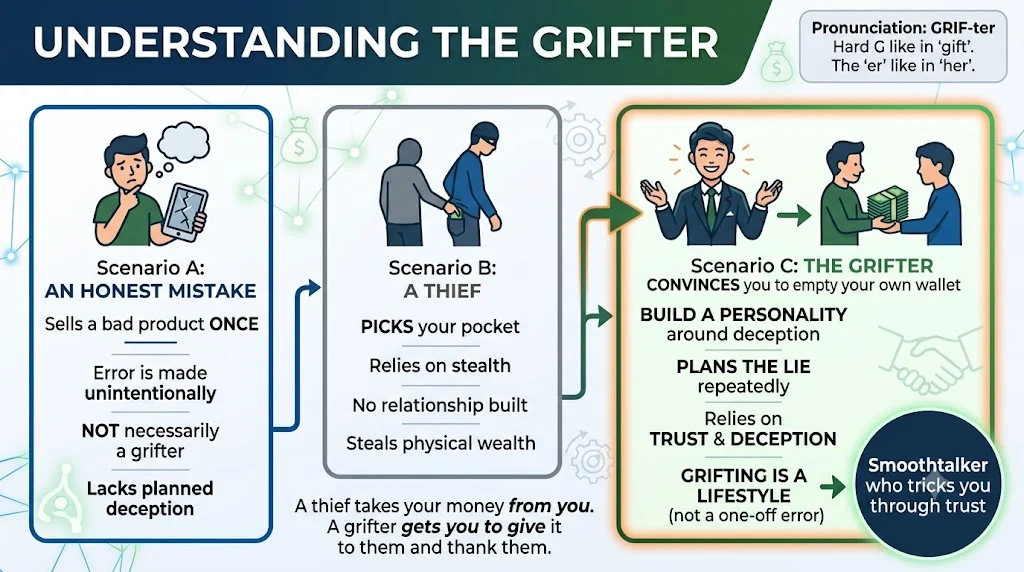
Here is the simplest way to remember it.
A thief picks your pocket. A grifter convinces you to empty your own wallet and thank them for the privilege.
Grifter meaning in simple words: A smooth talker who tricks people repeatedly through trust and deception.
Pronunciation: GRIF ter. Hard G like in “gift.” The “er” like in “her.” Say it out loud. Grifter. Sounds sharp because it is.
Now contrast that with an honest mistake. Someone might sell you a bad product once. That is not necessarily a grifter. A grifter plans the lie. They build a whole personality around the deception. Grifting is a lifestyle, not a one time error.
Where Did the Word Grifter Come From? A Short History Lesson
Words have origins. The word grifter came from American carnival slang in the early 1900s.
Traveling carnivals had all kinds of characters. Some ran legitimate games. Others ran something called a “grift.” A grift was a small scam. Maybe a card game you could not win. Maybe a shell game where the pea vanished.
The people running those scams became known as grifters.
During the Great Depression, the term exploded in popularity. Why? Because desperate times create desperate people. And desperate people make easy targets. A grifter could offer a “sure thing” job or a “secret” way to make money. Hungry families believed them.
So the word grifter carried a specific image. A sharp dressed stranger. A fast talker. Someone who never stayed in one town too long.
Today the grifter still exists. They just moved online.
Grifter etymology quick facts:
| Time Period | Grifter Activity |
|---|---|
| 1910s 1920s | Carnival and street cons |
| 1930s 1940s | Depression era schemes |
| 1950s 1970s | Door to door sales fraud |
| 1990s 2000s | Infomercial gurus |
| 2010s today | Social media influencers and crypto promoters |
The method never changed. Only the backdrop.
Grifter vs Scammer vs Con Artist vs Hustler: Stop Confusing Them
People mix these terms up all the time. They are not the same.
Let me break it down with a table. Then I will give you real examples so you never confuse them again.
| Term | Time Span | Main Tactic | Example |
|---|---|---|---|
| Grifter | Weeks to years | Builds ongoing trust and rapport | Fake mentor who posts daily for a year then sells a $3k course |
| Scammer | Minutes to days | Quick lie or fake identity | Phishing email saying “Your bank account is locked” |
| Con Artist | Days to months | Elaborate story with multiple characters | Fake heiress pretending to need bail money |
| Hustler | Ongoing | Aggressive but often legal work | Someone flipping furniture or reselling sneakers |
Now let me explain each one so it sticks.
Grifter
The grifter wants a relationship with you. They comment on your posts. . Then one day they mention a “private opportunity.” That is the pivot. That is the trap.
Scammer
The scammer does not care if you like them. They send a million texts. One person bites. They take the money and disappear. No relationship. No follow up. Just a transaction.
Con Artist
The con artist builds a whole movie around the lie. They might rent an office. T The goal is one big score. Then they vanish like smoke.
Hustler
The hustler works hard. They might exaggerate. They might push boundaries. But most hustlers stay legal. A hustler selling bootleg T shirts is not a grifter. A grifter sells you a T shirt that never arrives.
The real difference: Grifters play the long game. You might genuinely like a grifter for months before the mask slips. That is what makes them so dangerous. You do not see the betrayal coming.
Clear Signs You Are Dealing With a Grifter
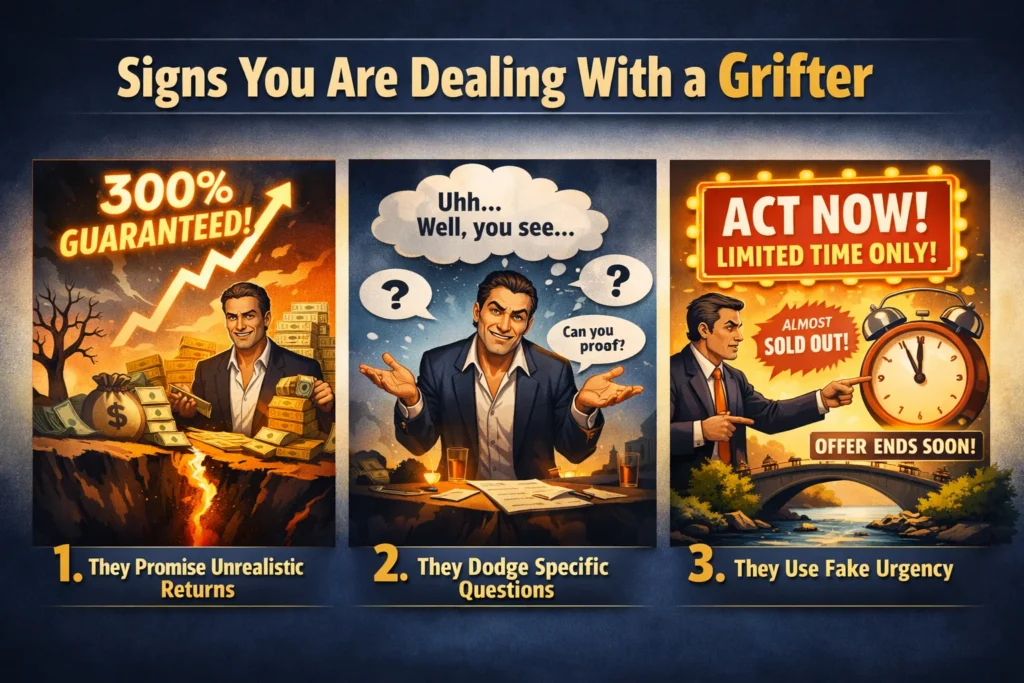
You do not need a detective degree to spot a grifter. You need a checklist.
Here are five reliable signs. If someone hits three or more, walk away.
Sign 1: They Promise Unrealistic Returns
“Turn 500into50,000 in 30 days.”
“My secret system makes money while you sleep.”
“I made $2 million last year. You can too.”
Real opportunities do not sound like lottery tickets. Grifters know that hope sells better than honesty. So they offer the moon. Then they blame you when you do not reach it.
What an honest person says: “You might make 10 to 20 percent if you work hard and get lucky.”
What a grifter says: “Everyone succeeds. You cannot fail.”
Sign 2: They Dodge Specific Questions
Ask a grifter a direct question. Watch them dance.
“How exactly does your system work?”
“Great question. Let me tell you a story about my mentor.”
“What is your success rate?”
“I prefer to focus on mindset instead of numbers.”
Grifters hate specifics because specifics can be checked. A grifter deals in feelings. They sell you a warm glow. When you ask for facts, they change the subject.
Sign 3: They Use Fake Urgency
“This price disappears in two hours.”
“Only ten spots left.”
“I am closing enrollment forever tonight at midnight.”
Grifters rush you because rushed people do not think. A real opportunity will still exist tomorrow. A real mentor will answer your questions for a week. Only a grifter needs your credit card right now.
Quick checklist for yourself:
- Does this person show proof of their own success? (Real bank statements, not rented cars)
- Can you find people who succeeded without paying more money?
- Do they offer a straightforward refund policy?
- Have they been doing this for years without scandals?
If you answer no to most of these, trust your gut.
Real Life Grifter Examples You Will Recognize
Let me give you names and patterns. Not to shame specific living individuals without proof. But to show you how grifters operate across different arenas.
The Fake Crypto
You see them on TikTok or YouTube. Young. Confident. Standing next to a rented Lamborghini. They flash a screenshot of a trading account with millions.
They say, “I made this in three months. Join my group for $299 a month and I will show you how.”
The truth? The Lamborghini costs $1,500 a day to rent. The trading screenshot is fake or from a demo account. The real money comes from your subscription fees. They do not trade. They teach trading. Big difference.
Estimated scale: Some fake grift make $200,000 per month from courses alone. Their actual trading account? Often negative.
The Political Grifter
This one cuts across all parties. A candidate or activist raises millions from passionate supporters. They promise to fight the establishment. They sell hats, flags, books, and memberships.
Then they lose the election. Or they win and accomplish nothing.
But here is the grift. They go on a speaking tour. Their lifestyle improves dramatically. Their voters see no change.
Hard fact: In a recent election cycle, one candidate raised over $50 million from small donors. After losing, less than 5 percent of that money went to any political cause. The rest paid “consulting fees” to the candidate’s own businesses.
That is textbook political grifting.
The Self Help Grift
You have seen this person. Kind voice. Inspiring quotes. A tragic backstory about bankruptcy or divorce.
They sell a $2,000 weekend retreat. They promise transformation. You cry during a workshop.
Then you go home. Nothing changed.
How you know it is a grift: Just new courses. New brands. New promises. Old results never materialize.
The Pickup Artist Instructor
A grifter favorite. Target lonely men. Promise dating success. Sell $5,000 “boot camps.”
The instructor approaches women in public. He gets rejected ninety nine times. On the hundredth try, a woman gives her number. He films that one success. He edits out the ninety nine failures.
Then he sells that video as proof his system works.
Reality check: Most pickup artist grifters cannot maintain a single healthy relationship. Their own romantic lives are disasters. But they are excellent at selling hope to desperate people.
The Celebrity Grifter
Some celebrities launch products they clearly do not use. A singer sells a skincare line but has a dermatologist on payroll. An actor promotes a crypto exchange that later collapses.
Fans lose money. The celebrity issues a vague apology. Then they do it again six months later.
The pattern: The celebrity never invests their own money. They just license their name. When the scam fails, they walk away clean. You do not.
Is Grifter a Bad Word? Yes. Here Is Why.
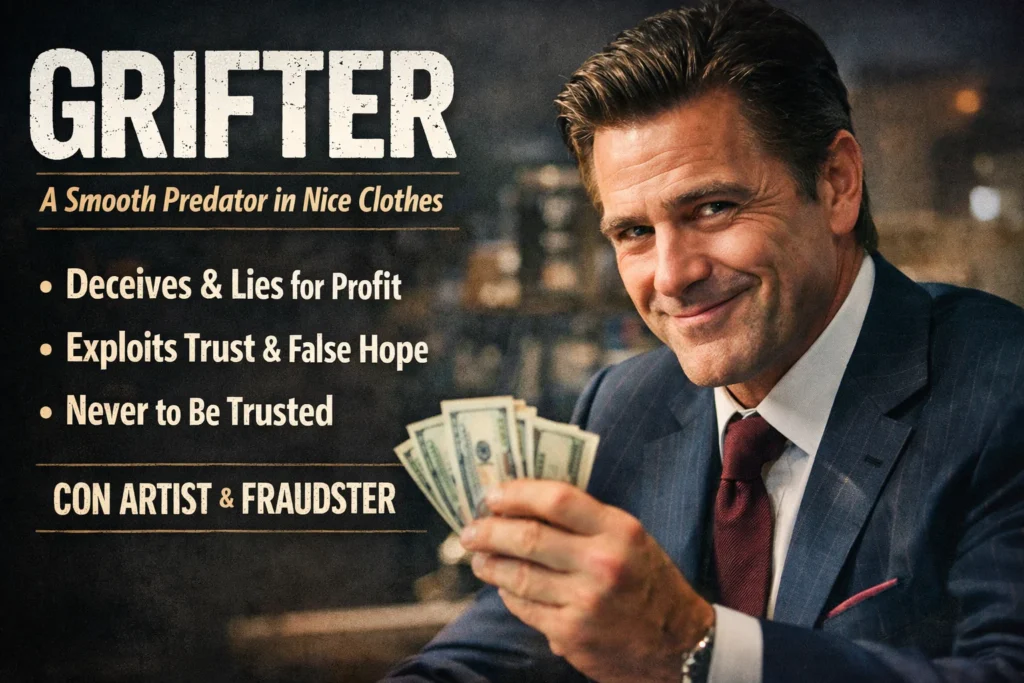
Short answer: Absolutely negative.
You do not call someone a grifter as a compliment. You call them a grifter to warn others. The word carries moral weight. It says: this person exploits trust for personal gain.
But here is a nuance worth understanding.
Some hustlers become grifters when they cross into lying. A street performer who exaggerates their skill is not a grifter. A person who claims to heal cancer with prayer absolutely is.
The line sits at intent. Does this person know they are lying? Do they continue lying when confronted with facts? Do they profit from false hope?
If yes to all three, you have a grifter.
Grifter slang meaning in one sentence: A smooth predator in nice clothes.
Urban Dictionary defines grifter accurately but crudely. We will skip the crude part. The core idea stands. A grifter is someone you should never trust with your wallet or your future.
How to Use Grifter in a Sentence: Real Examples
Theory is fine. Practice is better. Here are five real sentences using the word grifter correctly.
Example 1
“That influencer sold a $500 course on making money with Amazon FBA. Then he filed for bankruptcy himself. Total grifter.”
Example 2
“She trusted the life coach for two years. She attended every retreat. Then she realized he was just a grifter in yoga pants with no credentials.”
Example 3
“Do not confuse a hardworking salesperson with a grifter. One delivers value. The other delivers excuses and a payment plan.”
Now you try. Look at someone who over promises and under delivers. Ask yourself: do they profit from my hope? If yes, you found a grifter.
Grifter vs Legitimate Entrepreneur: The Honest Checklist
This comparison matters. Because grifters hide among real entrepreneurs. They use the same words. “Hustle.” “Grind.” “Disruption.” But the actions tell the truth.
Let me give you a side by side.
| Behavior | Legitimate Entrepreneur | Grifter |
|---|---|---|
| Shows proof of past success | Yes, with real documents | Only rented luxury and vague claims |
| Offers refunds | Yes, with clear terms | Never. “All sales final.” |
| Tells you what failed | Openly. Lessons matter. | Never mentions failure. Only wins. |
| Answers hard questions | Patiently and directly | Changes subject or attacks |
| Lives within their means | Often modest lifestyle | Flashy spending. Debt fueled. |
| Has returning customers | Yes, for years | High churn. Always needs new marks. |
| Takes legal responsibility | Registered business, taxes paid | Offshore accounts, shell companies |
The one question test: “Can you show me three people who succeeded with your help without paying you any more money?”
A real entrepreneur can. They might even introduce you. A grifter cannot. Because their only success story is themselves.
Where Grifters Hide Right Now
Grifters evolve. Here is where you will find them today.
Social Media Grifter
Platforms like Instagram, TikTok, and Twitter (X) are grifter paradise. Why? Because algorithms reward engagement, not accuracy. A wild claim gets shared. A boring fact gets ignored.
Social media grifter tactics:
- Posting screenshots of large bank transfers (often fake)
- Livestreaming from airports to imply constant travel
- Using “humble” language while showing off (“Not to flex but…”)
- Blocking critics so their feed looks like a fan club
The Fake Investor
A new breed. They claim to invest in startups. They ask for a small fee to “review your business plan.” Thousands of hopeful founders pay $500 each. The “investor” never funds anyone. The fee was the whole scam.
Scale: Some fake investor operations collect over $2 million per year. No investments made. Zero.
The Recruitment Grifter
You see posts like “Work from home. Make $15,000 per month. No experience needed.”
You message them. They say you need to buy a $200 “starter kit.” Then you need to recruit friends. Then your friends need to buy kits.
That is a pyramid scheme. And the person at the top? A grifter.
Legal status: Many pyramid schemes stay just legal enough. They call themselves “multi level marketing.” But the math never works. Ninety nine percent of participants lose money. Only the grifter at the top wins.
The Wellness Grifter
This one makes me angry. Someone sells unproven cancer cures. Or essential oils that “replace vaccines.” Or detox teas that do nothing.
Desperate people spend their last dollars. The grifter gets rich. The sick person gets sicker.
Hard number: The global wellness grift industry is worth over $50 billion annually. Most products do nothing. Some cause real harm.
The Psychology of a Grifter: How They Think
Let me walk you inside the grifter’s mind. Not to excuse them. To understand them. Understanding helps you spot them faster.
Grifters share three psychological traits.
Trait 1: Low Empathy
They do not feel your pain. They see your vulnerability as an opportunity. When you cry over lost savings, they feel annoyance. Not guilt. Your loss is just a cost of doing business.
Trait 2: High Charisma
Most grifters are genuinely charming. They remember your name.
That charm is a tool. Not a personality trait. Turn it off like a switch when you stop paying.
Trait 3: Justification Machine
Grifters never see themselves as bad people. They say things like:
“I gave them hope. That is worth something.”
“They were greedy too. They wanted easy money.”
“Everyone does this. I am just better at it.”
These justifications let them sleep at night. While you lie awake worrying about rent.
How to Protect Yourself From Grifters
You have the knowledge. Now here is the action plan.
Step 1: Slow Down
Grifters rush you. So you do the opposite. Wait 48 hours before any purchase over $100. Wait a full week before any “investment opportunity.” A real offer will still be there. A grifter will move on to an easier target.
Step 2: Do the Reverse Image Search
Take the person’s profile picture. Run it through Google Images or TinEye. Grifters often steal photos from models or other influencers. If the same face shows up with ten different names, you found a grifter.
Check Public Records
In the US, many business lawsuits are public. Search the person’s name + “lawsuit” or “complaint” or “BBB.” A pattern of unresolved complaints is a giant red flag.
Talk to Former Customers
Find people who bought from this person six months ago. Not the testimonials on their website. Those are cherry picked. Find real humans on Reddit, X, or Facebook groups. Ask bluntly: “Did you get what you paid for?”
Trust Your Gut
This sounds soft. It is not. Your brain notices inconsistencies before your conscious mind does. That uneasy feeling is data. Listen to it. You can always say yes tomorrow. You cannot unsend money today.
FAQs
Let me answer the most common questions directly. No fluff. Just answers.
What does grifter mean in slang?
In modern slang, a grifter is someone who fakes expertise to sell you something worthless. Usually online. Usually with a smile.
Is grifter a bad word?
Yes. Strongly negative. Calling someone a grifter accuses them of deliberate, ongoing deception for profit.
What is an example of a grifter?
A social media “mentor” who rents an Airbnb, films themselves “working from a mansion,” and sells a $2,000 course on wealth. They are not wealthy. Their course has no unique information. Their only skill is selling the dream.
What is the difference between a grifter and a con artist?
Nearly the same. But grifters often work smaller, recurring scams. Con artists aim for one big score.
Can a grifter be legal?
Unfortunately yes. Many grifters never break criminal laws. But they stay just inside legal boundaries. That is why “grifter” is a moral judgment more than a legal charge.
Where did the word grifter come from?
Early 1900s American carnival slang. Traveling fair workers used “grift” to mean a small scam. The person running the scam became a grifter.
What does grifter mean on TikTok?
On TikTok, “grifter” usually describes finance or dating advice creators. They promise easy results. They deliver paid programs. Their own results are fake or exaggerated.
Why is grifter a popular term right now?
Because social media created a generation of fake experts. Everyone has a course. Everyone has a secret. People got burned. So they needed a word for the burner. That word is grifter.
Conclusion
A grifter is someone who tricks or deceives others for personal gain, often through scams, manipulation, or dishonest schemes. The term is commonly used to describe people who profit by misleading others rather than through legitimate work.
Today, the word appears frequently in news stories, social media discussions, and online commentary. It can refer to anyone from small-time scammers to public figures accused of exploiting trust for money, influence, or attention.
The meaning of grifter has expanded over time and is now often used in both literal and figurative ways. Sometimes it describes actual fraud, while in other cases it is used as a criticism of someone viewed as dishonest or opportunistic.
Understanding the meaning of grifter helps you recognize how the term is used in modern conversations. Whether discussing scams, online personalities, or deceptive behavior, the word generally suggests a lack of honesty and a focus on personal profit.
Discover More Related Articles: