

Definition
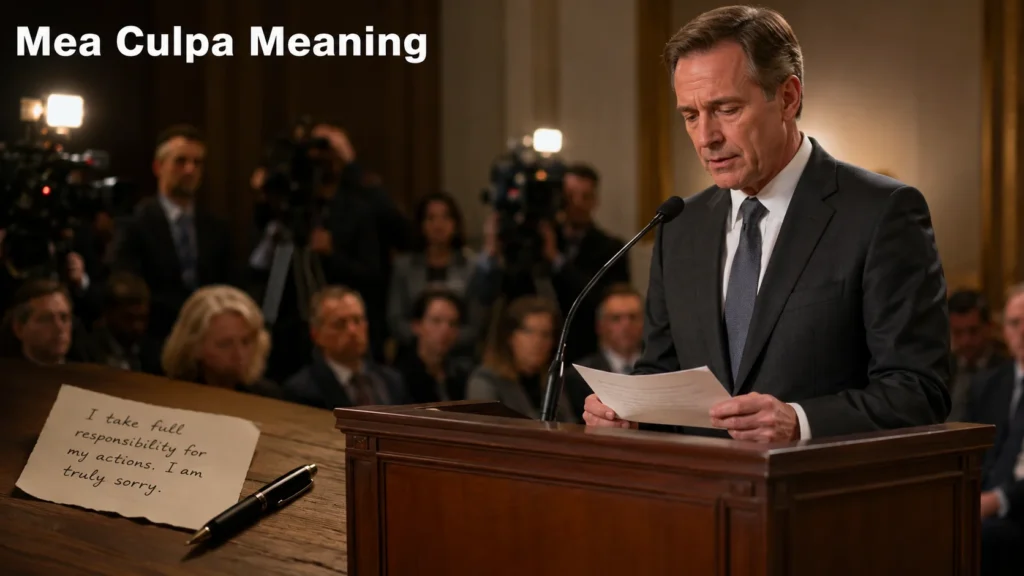
Mea culpa is a Latin phrase that means “my fault” or “through my own fault.” It is used when someone admits responsibility for a mistake, wrongdoing, or error and acknowledges that they are to blame.
You just sent an email to your entire team with the wrong attachments. Or maybe you forgot your partner’s birthday. Or worse, you made a call at work that cost your company time and money. Now you have to own it. You could say “my bad” and hope that covers it. But you know it doesn’t. Not really.
That’s where understanding the mea culpa meaning becomes genuinely useful. This isn’t just another fancy Latin phrase people throw around to sound smart. It’s a specific tool for accountability. A way to say “I messed up and I know it was my fault” with the weight those words deserve.
In this guide, we’ll break down everything about this phrase. You’ll learn its precise mea culpa definition, where it came from, how to pronounce it correctly, and exactly when to use it. We’ll explore real examples from politics, business, and everyday life. By the end, you’ll know not just what does mea culpa mean but how to use it effectively in your own communication.
Let’s get into it.
What Is the Mea Culpa Meaning Exactly?
Let’s start with the most direct answer. The mea culpa meaning is “through my fault” or “through my own error.” It comes from Latin. Meā means “my” and culpā means “fault” or “guilt.” Put them together and you get a straightforward admission of personal responsibility.
Think of it as the grown-up version of “my bad.” But there’s a difference. Saying “my bad” feels casual, almost dismissive. A mea culpa carries more weight. It signals you understand the seriousness of what happened. You’re not just acknowledging a mistake. You’re accepting full ownership without excuses or deflection.
The phrase functions in a few ways in English. You can use it as a noun, like when someone says “The CEO issued a public mea culpa.” You can also use it as an interjection, the way you might say “Sorry!” For example, you could drop your coffee and immediately say “Mea culpa!” to the barista.
In modern usage, people employ this phrase across formal and informal settings. You’ll hear it in courtrooms, boardrooms, and sometimes even at dinner tables. The meaning of mea culpa has expanded beyond its religious origins to cover any situation where someone admits fault.
Here’s what makes it special. Most apologies focus on the mistake itself. “I’m sorry I broke your vase.” But a mea culpa focuses on the person making the mistake. “I broke your vase and that’s my fault entirely.” See the shift? The spotlight stays on you. That’s what makes this phrase so powerful in building trust.
How to Pronounce Mea Culpa
Let’s tackle pronunciation first. Nothing ruins a sincere apology like butchering the Latin. The most common American English pronunciation is MAY-uh CULL-puh. The first word rhymes with “day” and “uh.” The second word sounds like “cull” with a short “uh” at the end.
Some people use the more classical pronunciation may-ah KOOL-pah. That’s closer to how it sounds in ecclesiastical Latin. Both are acceptable in modern English. What matters is that you speak clearly and with confidence.
Here’s where people stumble. Don’t rush through it. Don’t mumble. The phrase has three syllables in each word, and they deserve their moment. Avoid saying “me-uh COO-luh” which sounds sloppy. Also avoid “may-uh CULL-puh” said too quickly. Slow it down.
If you’re nervous about getting it right, practice in front of a mirror. Say it a few times. “Mea culpa.” “Mea culpa.” Once you’ve got the rhythm, it becomes second nature. The confidence in your delivery matters almost as much as the words themselves.
The Origin Story of Mea Culpa
The history behind this phrase makes it richer and more interesting. The mea culpa origin goes back centuries. Specifically, it comes from the Catholic Mass. Worshippers used to recite it during the Confiteor, a prayer of confession.
Here’s how it worked. People would beat their chests three times while saying:
“Mea culpa, mea culpa, mea maxima culpa.”
That translates to “Through my fault, through my fault, through my most grievous fault.” Each repetition emphasized the weight of their wrongdoing. It wasn’t just an acknowledgment. It was a ritual of humility and repentance.
Geoffrey Chaucer, the famous medieval poet, used the phrase in his work Troilus and Criseyde around 1385. This tells us the expression was already familiar to English speakers by the 14th century. It had moved beyond church walls into everyday literature.
There’s also a historical practice from 1220 in Siena, Italy. Murderers doing public penance had to throw themselves on the ground three times. They repeated “Mea culpa; peccavi; Domine miserere mei.” That’s Latin for “Through my fault; I have sinned; Lord have mercy on me.” Imagine that scene. A public admission of guilt, physically enacted, for everyone to witness.
The first recorded use of mea culpa in English comes from 1602. According to Merriam-Webster’s records, that’s over 400 years ago. So this phrase has been part of the English language for centuries. It’s not some trendy new import. It’s an established part of how we talk about guilt and responsibility.
Why Understanding the Mea Culpa Definition Matters Today
You might wonder why we need a Latin phrase when we already have “I’m sorry.” That’s a fair question. The answer lies in the nuance.
Mea culpa definition includes an element that a simple apology often lacks. Specificity. When you say “I’m sorry,” that could mean anything. It might mean you feel sad about the situation. It might mean you regret what happened. But it doesn’t necessarily mean you accept blame.
Mea culpa leaves no room for ambiguity. You are saying, clearly and directly, “This was my fault.” There’s no weaseling out. No blaming circumstances or other people. No passive voice hiding the agent of the action.
Consider these two statements:
- “Mistakes were made.” (Passive, avoids responsibility)
- “Mea culpa. I made those mistakes.” (Active, owns responsibility)
The first one sounds like a politician deflecting. The second sounds like someone mature enough to admit they’re human. That’s the power of this phrase.
In a world where everyone seems eager to shift blame, issuing a mea culpa makes you stand out. It tells people you’re trustworthy because you don’t run from your errors.
How to Use Mea Culpa in a Sentence
Knowing the definition isn’t enough. You need to see how this phrase works in practice. Let’s look at some real examples.
Formal Contexts
The CEO issued a public mea culpa after the data breach.
The newspaper ran a mea culpa on page one, admitting their sources were wrong.
The senator’s mea culpa came during a press conference where she faced tough questions.
Everyday Contexts
Who left the fridge door open? Mea culpa on that one.
I forgot to pick up the dry cleaning. Mea culpa.
Mea culpa for missing your call. I had my phone on silent.
Professional Contexts
The project manager offered a mea culpa for underestimating the timeline.
My mea culpa was well received. The team appreciated my honesty.
In my mea culpa email, I outlined exactly what went wrong and how I’d fix it.
Written Communication
The company’s annual report included a mea culpa for the supply chain issues.
His mea culpa appeared in the staff newsletter.
The editor’s mea culpa acknowledged the factual errors in last week’s feature.
Notice how the phrase adapts to different situations. It remains formal enough for serious contexts but flexible enough for casual ones.
Synonyms and Related Expressions
English has many ways to admit fault. Some are formal, some casual, and some fall somewhere in between.
Formal Synonyms for Mea Culpa
Admission of guilt works well in legal settings. Acknowledgment of fault sounds professional and measured. Confession of wrongdoing carries a heavier moral weight. Statement of remorse emphasizes the emotional component.
Informal Equivalents
“My bad” is the most common casual alternative. “That’s on me” works in sports, business, and daily life. “I messed up” is direct and honest. “I take full responsibility” sounds intentional and mature.
Related Latin Phrases
Mea maxima culpa means “through my most grievous fault.” It’s an even stronger admission. You might use this when you’ve caused serious harm and want to emphasize the depth of your error.
Culpa itself is the root word. It appears in English words like “culpable” meaning deserving blame and “culprit” meaning someone guilty of a crime.
Here’s a useful comparison table:
| Phrase | Formality Level | Best Used When |
|---|---|---|
| Mea culpa | Formal | You want to sound sincere and educated |
| My bad | Very casual | With friends or in low-stakes situations |
| I take full responsibility | Professional | At work or in serious discussions |
| I’m sorry | Neutral | For everyday apologies |
| Mistakes were made | Evasive | Honestly, never use this |
When You Should Actually Use Mea Culpa
Knowing how to use it is one thing. Knowing when to use it is another. Here are the situations where a mea culpa works best.
Professional Mistakes That Impact Others
You made an error that affected your team. Maybe you gave incorrect instructions. Perhaps you missed a deadline. Or you shared wrong information. In these cases, a mea culpa shows leadership.
Your colleagues don’t need excuses. They need honesty and a plan to fix things. Starting with “mea culpa” sets the right tone. It says you understand the impact and you’re not hiding from it.
Public or High-Stakes Situations
When you’re in the spotlight, every word matters. Politicians, celebrities, and executives use mea culpa when they need to restore public trust.
A genuine mea culpa can defuse anger. It can shift the narrative from “You messed up” to “You owned it.” People respect that, even if they’re upset about the original mistake.
When You Want to Emphasize Accountability
Sometimes a simple “I’m sorry” doesn’t cut it. You need to signal that you understand the seriousness of what happened. Mea culpa carries that weight.
It says “I’m not just apologizing because it’s expected. I genuinely understand this was my responsibility.”
Personal Relationships
You hurt someone you care about. Maybe you were careless with their feelings. Maybe you broke a promise. Using mea culpa in a heartfelt apology shows you’re taking it seriously.
But be careful here. Don’t use it to sound pretentious. If your partner prefers plain English, “I was wrong and I’m sorry” might work better. Read the room.
When You Should Avoid Mea Culpa
Not every mistake calls for Latin. Here’s when you should skip it.
Minor Everyday Errors
You spilled coffee on the counter. You forgot to take out the trash. Saying “mea culpa” here sounds ridiculous. It’s like showing up to a picnic in a tuxedo.
Save it for moments that actually matter. For small stuff, a casual “oops” or “my bad” works just fine.
When You’re Not Actually at Fault
This is crucial. Don’t use mea culpa to take blame you don’t deserve. It might feel noble in the moment. But it’s ultimately dishonest.
Taking responsibility for someone else’s mistake prevents real accountability. The person who actually messed up learns nothing. And you’ll build resentment over time. Be honest about who’s responsible.
In Casual Settings With People Who Don’t Know It
Not everyone knows what does mea culpa mean. If you’re talking to someone unfamiliar with Latin phrases, using it can sound pretentious or confusing.
Know your audience. If you’re with academics or Latin enthusiasts, go for it. If you’re at a backyard barbecue with neighbors, stick to plain English.
For Serious Betrayals
Here’s a hard truth. A mea culpa is not enough for major violations of trust. Cheating on a partner, committing fraud, or causing serious harm requires more than a Latin phrase.
In those cases, you need a full apology. Specific acknowledgment of the harm. Reparations. Changed behavior over time. A mea culpa can be part of that process. But it’s not the whole thing.
The Psychology Behind Saying Mea Culpa
Why does this phrase work so well? The answer lies in human psychology.
When someone admits fault, we naturally trust them more. It’s counterintuitive. You might think people would trust you less when you admit you’re wrong. But research shows the opposite.
Admitting mistakes signals honesty. It shows you value truth over ego. It demonstrates self-awareness and emotional maturity. These are qualities people admire.
There’s also something specific about using a formal phrase. When someone takes the time to use precise language, it signals effort. A casual “my bad” takes no thought. A considered mea culpa suggests you’ve reflected on your actions.
In psychology, this relates to something called “the pratfall effect.” This is the idea that people who are competent become more likeable when they show vulnerability. Admitting mistakes makes you more relatable. It humanizes you.
Issuing a mea culpa triggers this effect. You’re showing you’re not perfect. You’re not pretending to be above error. That’s refreshing in a world full of people who never admit they’re wrong.
Mea Culpa in Popular Culture
The phrase has made its way into movies, music, and literature. It appears in everything from political dramas to comic books.
In Marvel’s Daredevil, characters frequently use mea culpa in confessional scenes. The Catholic imagery fits perfectly with the character’s background.
Musicians have used it in song titles. Recording artists from pop to metal have albums or tracks named “Mea Culpa.” The phrase carries emotional weight that translates well into creative work.
In movies, you often hear characters use it during dramatic confessions. It adds gravitas to the scene. Compare “I’m sorry” with “Mea culpa” in a film. The second one feels more significant. More intentional.
This cultural presence helps cement the phrase in our collective vocabulary. Even people who don’t know Latin recognize it as a serious acknowledgment of fault.
How to Make Your Mea Culpa More Effective
Saying “mea culpa” is a good start. But you can take it further. Here’s how to make your admission of fault actually land.
Be Specific About What You Did Wrong
Don’t just say “mea culpa” and stop. Name the mistake. Describe the impact. Show you understand what happened.
A weak mea culpa sounds like “I’m sorry for whatever I did.” A strong one sounds like “I apologize specifically for sharing the wrong sales numbers with the client. I know this caused confusion and damaged our credibility.”
Explain Why It Happened
You can explain context without making excuses. There’s a difference between “Here’s what led to the error” and “Here’s why it’s not really my fault.”
Focus on the process. What factors contributed to the mistake? What will you do differently next time? This shows you’ve thought about prevention, not just apology.
Outline Your Plan to Fix It
A mea culpa without action is hollow. What are you doing to make things right? How will you prevent this from happening again?
When you follow your apology with a concrete plan, you rebuild trust faster. People see you’re not just talking. You’re acting.
Don’t Overdo It
Excessive self-flagellation feels performative. Be sincere. Be direct. Then move forward.
Constant apologies or repeated “mea culpa” declarations can actually undermine your credibility. People start to wonder why you keep making the same mistakes.
Common Mistakes People Make With Mea Culpa
Let’s look at what goes wrong. These are the pitfalls to avoid.
Using It Too Casually
“Mea culpa” is not for every small error. If you say it for spilling your drink, you sound like you’re trying too hard. Save it for moments that actually matter.
Mispronouncing It
We covered this earlier. Practice before you use it in public. It’s better to say “I’m sorry” than to stumble through a butchered Latin phrase.
Following It With an Excuse
This is the biggest mistake. You say “mea culpa” and then immediately add “but…” The “but” kills everything. It undoes the accountability you just claimed.
A genuine mea culpa has no buts. No explanations that shift blame. No justifications for why it’s not really your fault.
Using It When You Don’t Mean It
Sarcastic apologies don’t work. People can tell when you’re not sincere. If you’re going to use mea culpa, mean it. Otherwise, stick to something else.
Examples of Powerful Mea Culpa in Action
Let’s look at some scenarios where this phrase shines.
Corporate Apology
The CEO messed up. A product launch failed. Customers are angry. She issues a statement:
“Mea culpa. I approved the timeline despite our engineering team’s concerns. The rushed launch was my decision. I take full responsibility for the buggy release. We’re offering refunds to affected customers. And we’re implementing a new quality review process before future launches.”
This works. It names the specific decision.
Political Confession
A public official misstated facts during a speech. The press catches it. Instead of deflecting, he says:
“Mea culpa. I relied on outdated information in my briefing materials. I’ve instructed my team to double-check every fact before I speak publicly going forward.”
This defuses the controversy. The media has less appetite for outrage when the person admits fault directly.
Personal Relationship
You forgot your anniversary. Not good. Your partner is hurt. You say:
“Mea culpa. There’s no excuse for forgetting this. I should have marked it on my calendar and planned something special. I know I hurt you. I’ve already booked a dinner for Saturday to make it up to you.”
This shows you understand the pain. You’re not defensive. And you’re taking action to fix it.
How Mea Culpa Compares to Similar Phrases
Let’s put mea culpa next to other ways of admitting fault. This helps clarify when to use each one.
| Phrase | What It Communicates | When to Use |
|---|---|---|
| Mea culpa | Formal accountability, deep sincerity | Serious mistakes, public apologies |
| My bad | Casual, low-stakes admission | Small errors with friends |
| I’m sorry | General regret, may or may not include blame | Everyday apologies |
| I apologize | Formal but less specific | Professional or polite situations |
| I was wrong | Direct admission of error | Any setting where you want clarity |
| I take responsibility | Ownership without emotional display | Leadership contexts |
Notice how mea culpa sits at the intersection of formality and sincerity. It’s not as stiff as “I apologize” and not as casual as “my bad.” It occupies a useful middle ground.
The Cultural Significance of Saying Mea Culpa
Different cultures handle apologies differently. In some countries, admitting fault is expected. In others, it’s seen as losing face.
The mea culpa meaning in English-speaking cultures typically signals strength, not weakness. Leaders who apologize effectively often see their approval ratings rise. People respect honesty.
In Latin American cultures, the phrase carries religious weight. Many people know it from Catholic traditions. Using it there feels more serious and meaningful.
In Asian cultures that emphasize saving face, a public mea culpa might be harder to issue. But it can also be more powerful when done correctly. It shows you’re breaking cultural norms to be honest.
The key is understanding your cultural context. When in doubt, err on the side of sincerity. Most people respond well to genuine admissions of fault, regardless of their cultural background.
What Makes a Sincere Mea Culpa
A real mea culpa has specific ingredients. Here’s what separates the meaningful from the hollow.
No deflection. You own the mistake without blaming others. No “I was just following orders” or “Everyone else was doing it.”
Specificity. You name the exact error. Vague apologies feel dismissive.
Empathy. You acknowledge how your mistake affected others. You show you understand their perspective.
Change. You outline how you’ll do better next time. Words without action feel empty.
Timeliness. The sooner you apologize, the better. Delaying makes you seem like you’re hiding something.
Sincerity. You mean what you say. People can tell the difference.
Real-World Applications for Mea Culpa
In Business Communication
Companies use mea culpa in press releases, annual reports, and investor communications. When business leaders admit mistakes early, they often avoid bigger problems later.
Customers appreciate honesty. A brand that says “We messed up, here’s how we’ll fix it” earns more loyalty than one that pretends nothing went wrong.
In Legal Settings
Defendants sometimes use mea culpa in court statements. It can demonstrate remorse and lead to more lenient sentencing. Judges respond positively when someone genuinely takes responsibility.
In Journalism
Newspapers and media outlets run corrections. Sometimes they publish full mea culpa articles explaining how they got a story wrong. This builds credibility with readers.
In Personal Development
Admitting fault is a sign of emotional maturity. People who practice mea culpa regularly tend to have better relationships. They’re more self-aware. They grow from their mistakes instead of repeating them.
How to Write a Mea Culpa Statement
Sometimes you need to put it in writing. Here’s a template that works.
Start with a clear admission:
“Mea culpa. I made a mistake when I [specific action]. This was my responsibility and mine alone.”
Acknowledge the impact:
“I understand this caused [specific harm]. I know it affected [specific people or groups].”
Explain what happened:
“Here’s the context without making excuses. I [explain the situation that led to the error].”
Present a solution:
“Going forward, I will [specific action to fix and prevent recurrence]. I have already [step taken toward repair].”
Close with sincerity:
“I deeply regret this error. Please accept my apology. I’m committed to earning back your trust.”
This structure covers everything. It’s specific, honest, and forward-looking.
The Power of Accountability
Understanding the mea culpa meaning gives you a tool for better communication. But more than that, it gives you a mindset. A way of approaching life that builds trust and respect.
Nobody’s perfect. Everyone makes mistakes. The difference between trustworthy people and untrustworthy ones often comes down to how they handle those mistakes. Do they hide them? Blame others? Or do they say “mea culpa” and move forward honestly?
People want to work with, live with, and trust people who own their errors. It’s that simple. A well-delivered mea culpa can preserve a relationship, save a career, or restore a reputation.
So next time you mess up, consider reaching for this phrase. Not as a gimmick. Not to sound smart. But because it communicates exactly what you mean. “This was my fault. I see that. And I’m going to make it right.”
That’s the real power of mea culpa. It’s not just a phrase. It’s a commitment.
FAQs
1. What does mea culpa mean?
Mea culpa is a Latin phrase that means “my fault” or “I am to blame.” It is used to admit responsibility for a mistake.
2. Is mea culpa the same as an apology?
Not exactly. A mea culpa is an acknowledgment of fault, while an apology also expresses regret and asks for forgiveness.
3. Where does the phrase mea culpa come from?
The phrase comes from Latin and was originally used in religious contexts as a confession of wrongdoing.
4. How is mea culpa used in a sentence?
You can say, “The manager issued a mea culpa after the project failed due to poor planning.”
5. Is mea culpa still used today?
Yes, it is commonly used in news, politics, business, and everyday conversations when someone admits a mistake.
6. Can mea culpa be used in professional settings?
Yes, professionals often use the term to acknowledge errors and take responsibility for them.
7. Is mea culpa formal or informal?
Mea culpa is generally considered a formal expression, though it may also appear in casual conversations.
8. What are some synonyms for mea culpa?
Common synonyms include admission of guilt, acknowledgment of fault, confession, apology, and acceptance of responsibility.
Conclusion
The mea culpa meaning goes deeper than “through my fault.” It’s a cultural touchstone. A bridge between formal and everyday language. A way to take responsibility with grace and sincerity.
We’ve covered a lot here. You now know the mea culpa definition, pronunciation, origin, and modern usage. You understand when to use it and when to avoid it.
More importantly, you understand why it matters. In a world full of deflections and excuses, being someone who can say “I was wrong” sets you apart. It builds trust. It shows character.
Whether you’re crafting a formal apology at work or just want a better way to admit fault in your personal life, mea culpa gives you the vocabulary you need.
Now go use it wisely. Be sincere. Be specific. And remember that the best apology is followed by better behavior. The words matter. But what you do next matters even more.
Discover More Related Articles:
- Cringe Mean | Why Some Content Makes People Uncomfortable In 2026
- Collate Meaning | Sorting & Organizing Data In 2026