
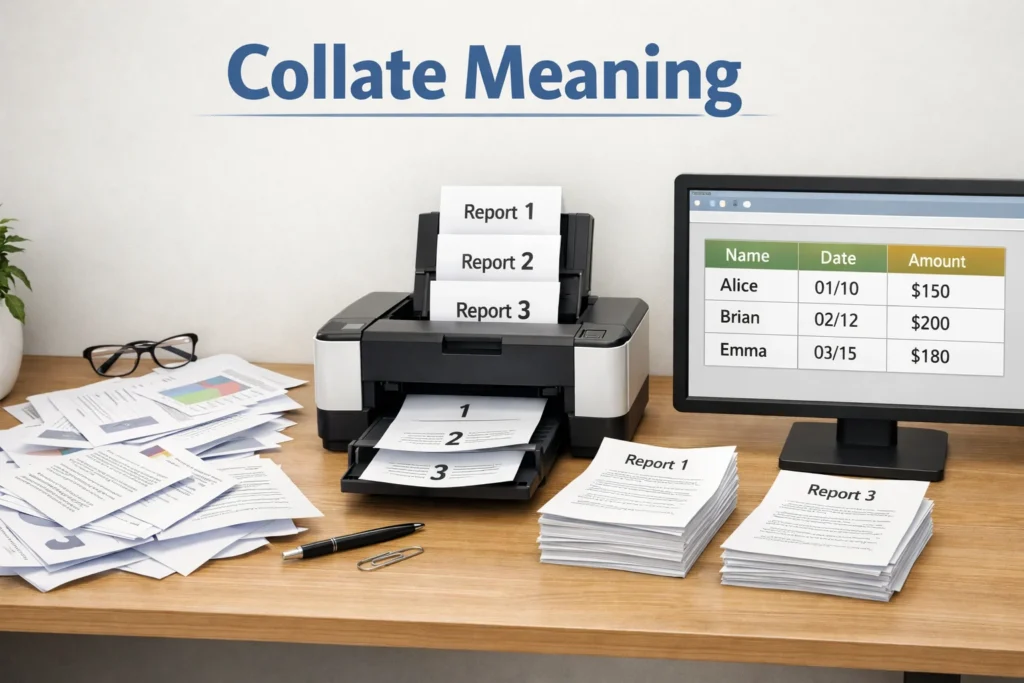

Definition
Collate means to gather separate items together and arrange them in a correct, logical, or proper order.
Collate (verb): to collect and combine separate pieces of information, documents, or items, arranging them in their proper or required sequence.
Have you ever clicked “Print,” watched the little dialog box pop up, and stared at a checkbox labeled “Collate” with absolutely no idea what it does? You’re not alone. Thousands of people search for this word every single day, and most of them land here for one reason: their printer just asked them a question they couldn’t answer.
So let’s clear this up right away, in plain English, before we go anywhere else.
That’s it. That’s the heart of it. Everything else in this article is just unpacking what that means in different situations, whether you’re talking about printing a 50 page report, organizing research data, or sorting through a stack of paperwork on your desk.
Stick around, though, because the printing context is only one piece of the puzzle. Collate shows up in offices, research labs, libraries, courtrooms, classrooms, and even casual conversation between friends planning a trip. It’s one of those words that sounds slightly formal at first glance, yet once you understand it, you’ll start noticing it everywhere, from project management meetings to academic papers to that one annoying printer popup.
Think of this as the only resource you’ll need to fully understand collate, in every context where it actually matters.
Collate Meaning
Let’s get the dictionary stuff out of the way fast, because nobody wants to wade through three paragraphs to find a simple definition.
Here’s the breakdown:
| Detail | Information |
|---|---|
| Part of speech | Verb |
| Pronunciation | kuh-LAYT (rhymes with “relate”) |
| Past tense | Collated |
| Present participle | Collating |
| Noun form | Collation |
| Adjective form | Collated |
Quick example so you can see it in action: “Before the meeting, Sarah collated all the survey responses into one organized spreadsheet.”
Notice what happened there? Sarah didn’t just gather the responses into a pile. She put them into order, grouped them logically, and made them usable. That ordering piece is what separates collate from a bunch of similar sounding words, and we’ll dig into that distinction later in this guide.
Here’s a small grammar reference table to keep handy:
| Form | Example |
|---|---|
| Base form | I need to collate these pages. |
| Present tense | She collates the files every Friday. |
| Past tense | He collated the survey results last week. |
| Present participle | They are collating the documents right now. |
| Past participle | The reports have been collated already. |
| Noun (collation) | The collation of data took three full days. |
Understanding these forms matters more than you’d think, especially if English isn’t your first language or if you’re writing something formal, like a resume, report, or academic paper, where grammatical precision genuinely counts.
Where Does Collate Come From?
Words rarely show up out of nowhere, and collate has a pretty satisfying origin story if you’re curious about that sort of thing.
The word traces back to the Latin term collatus, which is the past participle of conferre, meaning “to bring together” or “to confer.” You can actually see traces of this Latin root in other English words too, like “confer” and “collation” (which, fun fact, originally referred to a light meal served at a gathering, before it evolved into the more formal meaning we use today).
By the time the word entered English usage in the late 16th century, it had picked up the specific meaning we still use now: bringing things together in a deliberate, organized way rather than just dumping them in a heap. Scholars and librarians were among the earliest groups to use the term regularly, since comparing manuscripts and arranging pages in correct order was a huge part of their daily work long before printers existed.
Librarians took this concept further during the centuries that followed, using collation techniques to verify that bound books contained all their pages in the correct order before they went onto library shelves. In fact, in bibliography (the study of books as physical objects), “collation” still refers specifically to the technical process of examining a book’s physical structure, page by page, to confirm nothing is missing, duplicated, or misplaced.
So in a strange way, this word has been associated with paperwork and document organization for centuries, long before photocopiers, computers, or laser printers ever existed. The printer setting on your laptop is basically carrying on a tradition that’s been around since before the printing press was even common, just at a much faster and far less labor intensive pace.
Collate Meaning in Everyday English
Outside of office jargon and printer menus, collate still pops up in regular conversation more often than you’d think. People use it when they’re talking about organizing thoughts, research, schedules, or even photographs.
Here’s the key idea to hold onto: collating always involves both gathering AND arranging. If you just throw things into a pile without any order, that’s collecting. Collating adds a layer of structure on top.
Let’s look at a few natural, everyday examples:
- “I need to collate my notes from the last three meetings before I write this report.”
- “The teacher collated the test scores by class period so the principal could compare results easily.”
- “Can you collate the customer feedback forms by date received?”
- “We collated the wedding photos chronologically before printing the album.”
Notice how each sentence implies a before and after. Before collating, things are scattered and disorganized. After collating, they’re grouped, sequenced, and ready to actually be useful. That transformation is the whole point of the word.
“To collate is not simply to gather, but to gather with purpose, placing each piece exactly where it belongs in relation to the others.”
This idea of purposeful arrangement is what makes collate such a precise and useful word, especially in professional and academic settings where vague organization just won’t cut it.
Common Mistakes People Make With This Word
Even native English speakers stumble over this word from time to time, so don’t feel bad if you’ve made one of these mistakes before.
The first common error is using collate when you really just mean collect. If you’re grabbing a random assortment of items with zero intention of organizing them in a specific order, “collect” is the better, more accurate choice. Saving “collate” for situations where sequence and structure genuinely matter keeps your writing precise.
The second mistake involves the spelling. Some people accidentally write “collate” as “collated” even in contexts where the base verb form is required, or they drop a letter and write “colate,” which isn’t a recognized English word at all. Double check your spelling, particularly in formal writing like emails, reports, or resumes, since this isn’t a word spell checkers always flag correctly depending on context.
The third mistake is mispronunciation, which we touched on earlier. Remember, the stress goes on the second syllable: kuh-LAYT, not COL-ate.
Collate Meaning When Printing
Alright, here’s the section most of you came here for. Let’s talk about what collate actually means when you see it sitting there in your printer settings, because this is genuinely where most confusion happens.
Picture this scenario. You’ve got a 10 page document, and you need 5 copies printed for a meeting. You hit print, set the copies to 5, and now you’re staring at a checkbox that says “Collate.” Should you check it or not? What actually changes?
Here’s exactly what happens in both cases.
If Collate is turned ON:
Your printer will output complete, full sets of the document, one after another, in the correct page order. So you’ll get pages 1 through 10 as a complete set, then pages 1 through 10 again as the second complete set, and so on until all 5 sets are finished.
If Collate is turned OFF (uncollated):
Your printer will print all the copies of page 1 first, then all the copies of page 2, then all the copies of page 3, and so forth. You end up with 5 stacks of page 1, 5 stacks of page 2, all the way through page 10, and you’d have to manually sort and assemble them into complete sets yourself.
Let’s visualize this side by side, because seeing it laid out makes the difference click instantly.
| Setting | Output Order | What You Get |
|---|---|---|
| Collated | 1,2,3,4,5,6,7,8,9,10, 1,2,3,4,5,6,7,8,9,10 (repeated) | Complete, ready to distribute sets |
| Uncollated | 1,1,1,1,1, 2,2,2,2,2, 3,3,3,3,3 (and so on) | Stacks of identical pages, needs manual sorting |
This is also exactly where the term uncollated comes from, and it’s basically just the direct opposite of collated. Uncollated printing skips the sorting step entirely and leaves you with raw stacks that need to be assembled by hand.
So why would anyone ever choose uncollated printing? It’s not as useless as it sounds. A few legitimate reasons:o
- Double sided printing limitations. Some older or simpler printers handle uncollated jobs faster when duplex printing is involved.
- Stapling and binding workflows. Certain finishing equipment in print shops actually requires uncollated input because the machine itself does the sorting and binding in a single pass.
- Speed on certain printer models. A handful of high volume printers process uncollated jobs marginally faster since they don’t need to switch page order repeatedly.
For the vast majority of everyday users though, collated printing is the way to go, because it saves you from manually sorting through stacks of paper afterward. That’s exactly why most printers default to collated mode automatically when you’re printing multiple copies of a multi page document.
Why Offices Default to Collated Printing
Think about the math here. If you’re printing 20 copies of a 15 page report, that’s 300 total pages coming out of the printer. Without collation, you’d be standing at the printer for ten or fifteen minutes manually sorting 20 stacks into the correct order, which is tedious and genuinely error prone (it’s incredibly easy to lose track of which stack you’re on).
With collation turned on, the printer does that organizational work for you, spitting out 20 ready to staple, ready to hand out, complete sets. This single setting saves offices an enormous amount of time daily, which is exactly why it’s become the default behavior in almost every modern printer and print driver.
Industries That Rely Heavily on Collation
While anyone with a printer benefits from understanding collation, a handful of industries genuinely couldn’t function efficiently without it.
Legal offices deal with this constantly. Court filings, contracts, and case files often require dozens or even hundreds of identical copies, each one needing to be complete and correctly ordered before distribution to clients, opposing counsel, or the court itself. A single misplaced page in a legal document can cause serious problems, so collation here isn’t just convenient, it’s essential.
Educational institutions also depend heavily on this feature. Teachers printing handouts, exam packets, or course materials for entire classrooms need every single copy to be identical and complete. Imagine a teacher with 30 students needing a 12 page packet each. Without collation, that’s 360 individual pages requiring manual sorting into 30 separate stacks, which would eat up an enormous chunk of prep time.
Print shops and copy centers build entire workflows around collation settings, often combining them with finishing options like stapling, hole punching, and binding. Commercial printing equipment frequently includes specialized collation trays or sorting mechanisms specifically designed to handle large volume jobs efficiently.
Corporate offices preparing reports, presentations, or training materials for meetings rely on collation daily, since handing out a disorganized, unsorted stack of paper to clients or executives looks unprofessional and wastes everyone’s time.
How to Use the Collate Option on Your Printer
Good news here: even though printer interfaces vary slightly between brands and software, the general process for finding and using the collate setting stays pretty consistent across the board.
Here’s a simple step by step walkthrough that applies to most situations, whether you’re printing from Microsoft Word, Adobe Acrobat, Google Docs, or directly from your computer’s print dialog.
- Open the document you want to print and select File, then Print (or use the keyboard shortcut, usually Ctrl+P on Windows or Command+P on Mac).
- Look for the Copies field and enter the number of copies you need.
- Locate the Collate checkbox or dropdown, which usually sits near the copies field or under an “Advanced” or “More Settings” section.
- Check the box if you want complete, organized sets (recommended for most documents).
- Uncheck it only if you have a specific reason for needing uncollated output, such as a binding machine that requires it.
- Confirm your settings and hit Print.
A few practical notes worth mentioning here. Most word processors and PDF readers, not just physical printer drivers, include this setting natively. So you’ll find a collate option inside the print menu of Word documents, Excel spreadsheets, and PDFs even before the file ever reaches your actual printer hardware.
Also worth knowing: this setting typically only matters when you’re printing more than one copy. If you’re only printing a single copy of a document, collate and uncollated will produce the exact same result, since there’s nothing to sort between identical sets in the first place.
Troubleshooting Common Collation Problems
Sometimes the collate setting doesn’t behave the way you’d expect, and a few common issues pop up frequently enough to deserve a mention here.
The collate option is grayed out or missing entirely. This usually happens when you’re only printing one copy, since collation has nothing to do in that scenario. It can also happen with certain printer driver versions that don’t support the feature, in which case updating your printer driver software typically resolves it.
Your printed pages came out in the wrong order despite collate being checked. This is often a driver or software glitch rather than a hardware problem. Try restarting the print job, double checking that your document itself doesn’t have pages out of order internally, or updating your printer’s driver software to the latest version.
Collated printing seems noticeably slower than uncollated. This is actually normal and expected with certain printer models, especially older inkjet printers, since the print head or mechanism has to reset position more frequently when constantly switching between different pages rather than printing the same page repeatedly.
The setting reverts back to default every time you print. Many printer drivers don’t save your preferences permanently unless you specifically set them as the default in your printer’s properties or preferences menu, rather than just adjusting them within a single print dialog box.
Collate Meaning Beyond Printing
While printing is probably the context that brought most readers here, collate gets heavy use in plenty of other professional and academic fields too. Let’s walk through a few of the most common ones.
Collating Data
Researchers, analysts, and business professionals collate data constantly. This usually means pulling information from multiple sources, files, surveys, or databases and organizing it into one unified, structured format that’s actually usable for analysis.
For example, imagine a market researcher collecting survey responses from 500 different customers. Before any meaningful analysis can happen, those responses need to be collated, meaning grouped by question, sorted by date, or categorized by demographic information, so that patterns and trends become visible.
“Raw data without collation is just noise. Collation is what turns scattered numbers into a story you can actually tell.”i
Collating Records and Files
In office administration and document management, collating refers to organizing paperwork, contracts, invoices, or files into a logical, accessible order. This could mean arranging files alphabetically, chronologically, by department, or by project number.
Here’s a practical, real world example: a human resources department collating employee files before an audit. That process likely involves gathering scattered documents (tax forms, performance reviews, contracts) and arranging them into individual, complete employee folders in a consistent order.
Collating in Computer Terms
In computing and database management, collation takes on a slightly more technical flavor. Here, collation often refers to a set of rules that determines how text strings get compared and sorted, particularly important in databases and programming languages.
For instance, database systems use something called a “collation sequence” to decide whether uppercase and lowercase letters get treated as identical or different during sorting and searching operations. This matters enormously for search accuracy, alphabetical sorting, and even basic string comparisons within software applications.
While this technical usage is more specialized than the everyday meaning, it still relies on the same core concept: organizing items (in this case, text characters or strings) according to a consistent, logical set of rules.
Collate vs Compile vs Collect: What’s the Difference
These three words get mixed up constantly, and honestly, it’s understandable why. They’re all about gathering things together. But each one carries a distinct shade of meaning that matters quite a bit in formal or professional writing.
Let’s break it down clearly.
| Word | Core Meaning | Implies Order? | Example |
|---|---|---|---|
| Collect | Gather items together | No | “She collected stamps from around the world.” |
| Collate | Gather AND arrange in proper sequence | Yes | “He collated the pages before binding the report.” |
| Compile | Gather and combine into a single finished product | Sometimes | “They compiled the data into a final summary report.” |
Here’s a simple way to remember the distinction:
Collect is the most basic of the three. It just means bringing things together, with no requirement for order or structure whatsoever. You can collect a messy pile of receipts and that’s perfectly fine usage.
Collate adds that crucial layer of order. You’re not just gathering things, you’re putting them in their correct, logical place relative to each other. This is why collate shows up so often in contexts involving pages, documents, and records, since sequence genuinely matters there.
Compile goes one step further than both. It typically implies you’re not just gathering and ordering items, but actually combining them into something new, like a final report, a compiled list, or a finished document built from multiple smaller sources.
So if you’re sorting pages into the correct order for printing, that’s collating. If you’re gathering a pile of unsorted invoices, that’s collecting. And if you’re taking data from twelve different spreadsheets and merging it into one master report, that’s compiling.
More Examples to Cement the Difference
Sometimes seeing several examples side by side makes a distinction click far better than any explanation alone. Here are a handful of sentence pairs showing how subtly the meaning shifts depending on which word you choose.
“I collected feedback forms from everyone in the room” simply means gathering them, with no implication about order whatsoever. They could be in any arrangement at all.
“I collated feedback forms from everyone in the room” implies the forms are now arranged in some specific, useful order, perhaps alphabetically by name or grouped by department.
“I compiled feedback forms from everyone in the room into a final summary report” goes a step further still, suggesting the individual forms have been combined and synthesized into one new, finished document, rather than simply existing as separate, ordered pieces.
This same logic applies across nearly every context where these words might appear, whether you’re talking about documents, data, research, or even physical objects like photographs or receipts.
Synonyms for Collate
Knowing a few solid synonyms helps you avoid repeating the same word over and over, especially in formal writing where variety matters. Here are genuine alternatives, along with notes on when each one fits best.
- Arrange. A general purpose synonym, useful in casual or formal contexts alike. “Arrange these files by date” works just as naturally as “collate these files by date.”
- Sort. Slightly more casual and commonly used in everyday speech. Works great for simple, informal tasks like sorting laundry or mail.
- Assemble. Implies putting pieces together to form a complete whole, often used for physical documents or reports.
- Organize. A broader, more general term that doesn’t necessarily imply strict sequencing the way collate does.
- Sequence. A more technical synonym, often used in scientific, academic, or computing contexts where strict order matters enormously.
A quick note on tone: “collate” itself carries a slightly more formal, procedural feel compared to casual alternatives like “sort” or “organize.” You’ll see it far more often in office memos, academic writing, and technical documentation than in relaxed, everyday conversation. That said, it’s not so formal that it sounds stiff or unnatural when used correctly in regular speech either.
Antonyms of Collate
Knowing the opposite of a word often clarifies its meaning just as much as knowing its synonyms. A few genuine antonyms for collate include:
- Scatter. The complete opposite of organized arrangement, implying things are spread out randomly with no order at all.
- Disorganize. A direct opposite, suggesting a deliberate or accidental breakdown of existing order.
- Jumble. Implies a chaotic, mixed up state with zero logical sequence.
- Mix up. A casual phrase suggesting items have lost their correct order or placement.
These antonyms reinforce exactly what makes collate special in the first place. It’s specifically about creating order out of separate pieces, so anything implying chaos, randomness, or disorder sits at the opposite end of the spectrum.
Quick Recap: Collate in Simple Words
Let’s bring this all together in a tight, memorable summary you could screenshot and keep handy.
Collating means gathering separate things together and putting them in the correct, proper order, not just piling them up randomly. Whether you’re talking about printer settings, research data, office paperwork, or even casual conversation, that core idea stays exactly the same: gather, then arrange.
The opposite is uncollated, which just means things have been gathered but left unsorted, requiring manual organization afterward.
And remember the key distinction from compile and collect: collecting has no order requirement, collating absolutely requires order, and compiling usually means combining everything into one finished, unified product.
FAQs
What does collate mean when printing?
When printing, collate means producing complete, correctly ordered sets of a multi page document for each copy requested, rather than printing all copies of each individual page together in separate stacks.
What’s the difference between collated and uncollated?
Collated printing produces complete, ready to use sets in the correct page order. Uncollated printing groups identical pages together instead, leaving you to manually sort and assemble the complete sets yourself afterward.
Is collate the same as collect?
No, not exactly. Collect simply means gathering things together with no particular order required, while collate specifically means gathering items and arranging them in a correct or logical sequence.
How do you pronounce collate?
Collate is pronounced “kuh-LAYT,” with the stress falling on the second syllable. It rhymes with the word “relate.”
What does collate mean in computer terms?
In computing, collation usually refers to the rules that determine how text strings or characters are compared and sorted, which matters heavily for database searching, sorting operations, and string comparisons within software systems.
What does collate mean in office work?
In an office setting, collating typically refers to organizing documents, files, reports, or records into a proper, logical, and accessible order, often by date, alphabetically, or by category.
Why use collate when printing multiple copies?
Using collate saves significant time when printing multi page, multi copy documents, since it eliminates the need to manually sort through stacks of pages afterward to assemble complete, correctly ordered sets.
What does collate mean for students?
For students, collating usually means gathering notes, research sources, or assignment pages and arranging them in a clear, logical order before submitting work or studying for an exam. It’s a skill that becomes especially valuable when writing longer papers that draw from multiple sources.
Conclusion:
Words like this one prove that even seemingly small vocabulary choices carry real weight in professional and academic communication. Saying you “collated” something rather than just “collected” it tells your reader something specific and useful: that you didn’t just gather materials, you organized them with intention and care.
Whether you’re configuring a printer for a big meeting, organizing research for a thesis, or just trying to sound a bit more precise in an email to your boss, you now have a complete grasp of what this word means, where it came from, and exactly how to use it correctly. That’s a small but genuinely useful piece of vocabulary to carry forward.
Discover More Related Articles:
- Foist Meaning | Business, Law & Daily Conversations In 2026
- Per Se Mean | English Grammar & Writing In 2026