
Definition
A goon is a foolish, silly, or clumsy person who behaves in an awkward or unintelligent way.
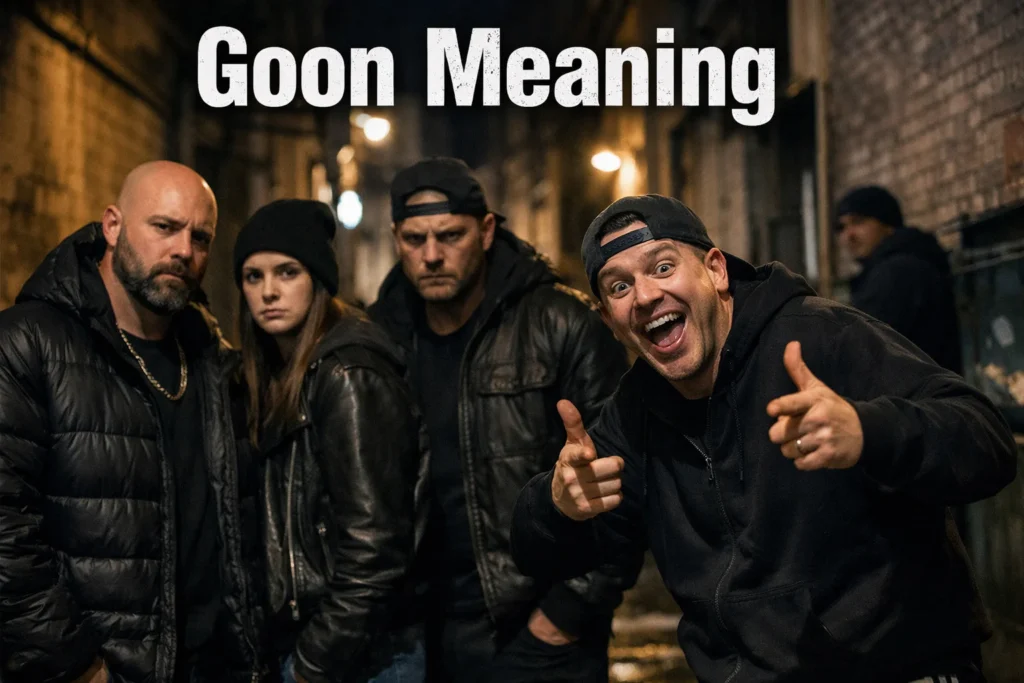
A goon can also mean a hired thug or enforcer used to intimidate or scare people, especially in groups or gangs.
You’re scrolling through a group chat or watching a hockey game, and someone drops the word “goon.” Maybe a friend calls you a goon after you trip over your own shoelaces. Maybe a sports commentator uses it to describe a player who seems more interested in throwing punches than scoring goals. So what’s actually going on here? Why does one tiny word seem to carry so many different meanings depending on who says it and where?
That’s exactly what this guide untangles. We’ll walk through every major sense of goon, where the word came from, how people use it today across texting, gaming, movies, and everyday conversation, and how it stacks up against similar words like thug and henchman. By the end, you’ll know exactly what someone means the next time they call you, or someone else, a goon.
What Does Goon Mean
At its core, goon is an informal English word with three main meanings that have evolved over roughly a century. Depending on the context, a goon can be:
- A hired thug or enforcer, typically muscle for hire who intimidates or threatens people on someone else’s orders
- A foolish, clumsy, or silly person, often used affectionately among friends
- In modern internet slang, someone acting goofy or over the top, frequently in a lighthearted or self deprecating way
Merriam Webster defines a goon primarily as a foolish person, or alternatively as a thug hired to intimidate or harm opponents. That dual definition is the key to understanding this word. It genuinely means two almost opposite things depending on tone and setting, and only context tells you which one applies.
Here’s a simple way to picture the split. If a mob boss in a movie says “send the goons,” he means tough, scary men who’ll rough someone up. If your buddy calls you a goon for accidentally walking into a glass door, he’s teasing you for being a clumsy oaf. Same word, completely different vibe.
Meaning of Goon: A Quick Breakdown
Let’s simplify things even further with a snapshot table, since sometimes a quick visual makes a word click faster than paragraphs of explanation.
| Meaning | Tone | Common Setting | Example |
|---|---|---|---|
| Hired thug or enforcer | Negative, threatening | Crime, gangs, organized labor disputes, action movies | “The loan shark sent two goons to collect the debt.” |
| Foolish or clumsy person | Negative or playful | Everyday conversation, comedy | “Stop being such a goon and tie your shoes.” |
| Silly or over the top (internet slang) | Affectionate, joking | Texting, social media, memes | “He’s such a goon, he showed up in a full costume for a Zoom call.” |
| Aggressive enforcer in sports | Neutral to negative | Hockey, sometimes other contact sports | “That team’s goon spent more time in the penalty box than on the ice.” |
Notice something interesting here. Three out of four uses aren’t really about violence at all. The word has softened quite a bit since its rougher, mid century origins, and a lot of younger speakers today use it almost exclusively in the goofy, harmless sense.
Goon Definition According to Dictionaries
If you want the formal version, dictionaries generally define goon along these lines:
Goon (noun): 1. A foolish person. 2. A man hired to intimidate or harm opponents, especially one hired by a racketeer, businessman, or politician.
That’s essentially the wording you’ll find across most major English dictionaries, give or take a few phrasing choices. The definition hasn’t changed much over the decades, even though everyday usage has expanded well beyond what the dictionary captures.
A few additional details worth knowing about the formal definition:
- Goon functions as a noun, though informally people have turned it into a verb too (more on that later)
- It’s classified as informal or slang in nearly every dictionary entry, meaning you won’t typically see it in formal writing, legal documents, or academic papers
- The word carries a generally negative connotation in its traditional sense, though modern slang has added a more neutral or even fond shade to it
- Pronunciation guides list it simply as “goon,” rhyming with “spoon” or “moon”
Goon Slang Meaning Explained
Here’s where things get genuinely fun, because slang is where goon really shows its range. In casual conversation, calling someone a goon rarely means you think they’re a violent criminal. Instead, it’s become a go to word for describing someone who’s a little ridiculous, a bit clumsy, or just doing something silly enough to earn some good natured teasing.
Think about how often friend groups develop their own shorthand for “you’re being weird right now, and I love it.” Goon fits perfectly into that slot. It’s blunt, it’s short, and it somehow manages to sound both insulting and endearing at the same time. That’s a rare combination for any word to pull off.
How Goon Slang Meaning Differs From the Original Definition
The original mid twentieth century definition leaned heavily toward danger and intimidation. Picture old gangster films where a wealthy businessman snaps his fingers and a couple of broad shouldered men in suits appear to “handle” a problem. Those were goons in the truest, scariest sense of the word.
Modern slang has stripped away most of that menace for everyday use. Nowadays, when someone calls their roommate a goon for eating cereal at 2 AM while watching cartoons, there’s zero threat implied. It’s closer to calling someone a goofball, a dork, or a weirdo, just with a slightly rougher edge to it.
Goon Meaning in Slang on Social Media and Texting
If you’ve seen the word pop up in your DMs, group chats, or comment sections, you’re witnessing the most modern evolution of goon in real time. Social media, especially platforms popular with younger users, has taken the word and run with it.
Goon Meaning in Text Messages
In texting, goon almost always falls into the lighthearted category. Common ways people use it include:
- Teasing a friend for doing something embarrassing or silly
- Describing someone who’s overly enthusiastic or dramatic about something small
- Using it as a playful insult between close friends where no real offense is intended
- Captioning a funny photo or video of a friend acting out of character
A typical text exchange might look like this: “Did you see Jake trip over the dog leash again? Such a goon.” Nobody reading that thinks Jake is dangerous. They think Jake is clumsy and a little funny.
Goon Meaning in Online Conversations and Memes
On social platforms, goon has also picked up momentum through meme culture. You’ll see phrases like “goon squad” used to describe a tight knit group of friends who do ridiculous things together, almost like an inside joke badge of honor. It’s flipped from describing dangerous hired muscle to describing your chaotic but lovable friend group.
There’s also a more adult, informal slang usage of the word circulating in certain corners of the internet, particularly tied to compulsive or excessive behavior around a specific activity. This usage exists and shows up frequently enough that it’s worth being aware of if you encounter the word in unfamiliar online contexts, especially among younger internet users.
Goon Urban Dictionary Meaning
Crowdsourced slang dictionaries capture language in a way traditional dictionaries can’t always keep up with, since anyone can submit a definition the moment a new usage starts trending. On these sites, you’ll typically find a mix of definitions for goon, including:
- A foolish or clumsy person, often used jokingly between friends
- A tough, intimidating person or hired enforcer, echoing the traditional definition
- Someone who acts a fool on purpose for laughs, sometimes described as a “lovable idiot”
- Regional or community specific definitions that pop up depending on where the slang trend originated
The crowdsourced nature means definitions can vary wildly depending on who wrote them and when, but the throughline across nearly all of them is that goon describes either danger or silliness, almost never anything in between. That’s honestly one of the more interesting things about this word. There’s no real middle ground definition floating around. You’re either dealing with intimidating muscle or a goofy friend, and the context around the sentence makes that distinction obvious almost every time.
What Is a Goon: Breaking Down the Core Idea
So if someone asks you point blank, “What is a goon?”, here’s the cleanest possible answer. A goon is a person, almost always identified by their behavior rather than any physical trait, who either:
- Acts as muscle or an enforcer for someone else, often in a criminal or intimidating context
- Behaves in a silly, clumsy, or socially awkward way that others find amusing
The word essentially captures two extremes of how a person can stand out from a crowd. One version stands out because they’re scary. The other stands out because they’re funny. What unites them is that a goon is rarely seen as fully independent. Hired goons follow someone else’s orders. Goofy goons often act the way they do for an audience, even if that audience is just their close friends.
Goon Word Meaning and Etymology: Where Did It Come From
Word origins are always more interesting than people expect, and goon has a genuinely unusual backstory. The term traces back to the early 1920s in American English, originally derived from a word called “gooney” or “gony,” which referred to a simpleton or a foolish person. Sailors had also used “gony” much earlier, around the 1580s, to describe a clumsy, awkward bird, specifically the albatross, known for its ungainly movements on land despite being graceful in flight.
That bird connection matters more than you’d think, since it explains the “fool” meaning that came first, decades before the tougher, more violent meaning showed up.
The Comic Strip Connection
Here’s where things get really interesting. In 1933, a character named Alice the Goon appeared in the Popeye comic strip, created by E.C. Segar. Alice was part of a whole lumbering, somewhat frightening creatures who lived on Goon Island. These characters were big, intimidating, and not especially bright, which blended both existing meanings of the word into one pop culture reference that millions of readers encountered.
Around the same time, in the late 1930s, labor disputes in the United States were getting increasingly tense, and companies sometimes hired physically imposing men to intimidate striking workers or rival union members. These hired men became known as goons, almost certainly influenced by the popularity of the Popeye comic strip’s Goon Island characters. From that point forward, the word carried strong associations with hired muscle, especially in the context of organized crime, labor disputes, and gang activity.
Goon Meaning Timeline
To make the etymology easier to follow, here’s a simple timeline:
| Time Period | Meaning | Context |
|---|---|---|
| 1580s | Clumsy or awkward (originally describing albatrosses) | Sailor slang |
| 1921 | foolish person | American college and general slang |
| 1933 | Large, intimidating, simple minded creature | Popeye comic strip (Alice the Goon) |
| Late 1930s | Hired thug or enforcer | Labor disputes, organized crime |
| Mid 20th century onward | Aggressive enforcer in sports, especially hockey | Sports commentary |
| 21st century | Silly, clumsy, or over the top person (often affectionate) | Internet slang, texting, memes |
What’s remarkable is how the word essentially looped back to its earliest meaning. It started as a word for a foolish person, picked up a tougher meaning in the middle of the century, and then swung back toward the original “silly person” meaning once internet culture got hold of it.
Goon Pronunciation
Pronunciation rarely trips people up with this word, but it’s worth covering quickly for anyone learning English or simply double checking. Goon is pronounced exactly how it looks: “goon,” rhyming with words like spoon, moon, and balloon. It’s a single syllable word, and the “oo” sound is long and drawn out, similar to the vowel sound in “food” or “room.”
There’s no regional variation worth noting here. Whether you’re hearing it in American English, British English, or Australian English, the pronunciation stays consistent. The meaning shifts depending on region far more than the pronunciation does.
Goon Example Sentence: Seeing the Word in Action
Sometimes the fastest way to understand a word is to see it used in a handful of different sentences that show off its range. Here’s a list covering each major meaning:
- “The casino owner kept a few goons around to make sure nobody cheated at the tables.” (hired enforcer)
- “I can’t believe you forgot your own birthday, you absolute goon.” (foolish or silly person)
- “He’s such a goon, he tried to microwave a metal spoon.” (clumsy or absent minded)
- “The hockey team’s goon picked a fight in the third period.” (aggressive sports enforcer)
- “Our friend group is basically a goon squad at this point, nothing but chaos and inside jokes.” (lighthearted internet slang usage)
Notice how the tone of each sentence shifts the meaning almost entirely. The hired enforcer sentence feels serious and a little ominous. The birthday sentence feels warm and joking. That’s the beauty, and the challenge, of a word like goon. You genuinely can’t define it without paying attention to who’s saying it and why.
Goon Synonym Options
If you’re searching for alternative words to use depending on which meaning of goon you’re going for, here’s a breakdown split by category.
Synonyms for the hired thug or enforcer meaning:
- Thug
- Henchman
- Enforcer
- Hired muscle
- Bruiser
- Heavy
- Mobster
- Gangster
Synonyms for the foolish or clumsy person meaning:
- Fool
- Oaf
- Dolt
- Knucklehead
- Doofus
- Blockhead
- Dork
- Goofball
Splitting synonyms this way matters because using the wrong category in a sentence can completely confuse your reader. Calling someone a “doofus” instead of a “goon” when you mean hired muscle obviously doesn’t work, and the reverse is just as awkward.
Goon vs Thug: What’s the Real Difference
These two words get lumped together constantly, and for good reason since they overlap heavily in the “hired enforcer” sense of goon. But there are subtle differences worth knowing.
Thug almost always implies genuine violence, criminal intent, or a history of aggressive behavior. It’s a heavier, more serious word with essentially no playful or affectionate usage anywhere in modern English. Nobody calls their clumsy friend a thug as a joke.
Goon, on the other hand, carries that dual personality we’ve talked about throughout this guide. Sure, it can mean a violent enforcer, but it just as easily describes a harmless, goofy friend. That flexibility is the single biggest difference between the two words.
| Feature | Goon | Thug |
|---|---|---|
| Can be used affectionately | Yes, frequently | Almost never |
| Always implies criminal behavior | No | Usually yes |
| Common in casual teasing | Yes | Rarely |
| Common in crime or gang contexts | Yes | Yes |
| Used in sports commentary | Yes | No |
If someone calls you a goon at a party because you spilled a drink, that’s a joke. If someone calls you a thug, that’s a much more serious accusation, and it probably won’t be said in a friendly tone.
Goon vs Henchman: Spotting the Difference
Henchman is another word that overlaps with goon, particularly in fiction, movies, and comic books. A henchman is typically a loyal follower or assistant to a villain or powerful figure, someone who carries out orders without question.
The key distinction comes down to loyalty and structure. A henchman usually has an ongoing, somewhat personal relationship with the person they serve, almost like a sidekick with a darker job description. A goon, by contrast, is often more disposable, hired for a specific task or short term job rather than serving as a long term right hand man.
Think about classic villain setups in movies. The main villain often has one or two henchmen who get actual names, personalities, and screen time. Behind them, there’s usually a faceless crowd of goons who exist purely to get knocked out in fight scenes. That’s the practical difference in a nutshell.
There’s also a hierarchy element worth pointing out. Henchmen tend to sit a notch above goons in terms of rank within a fictional criminal organization. A henchman might give orders to a group of goons, coordinate their movements, or report directly back to the villain after a job goes wrong. Goons, meanwhile, rarely get that kind of authority or screen presence. They show up, do the physical work, and disappear from the story once their scene ends.
Goon Meaning in Movies and Comics
Pop culture has shaped how most people understand this word just as much as any dictionary has. Movies and comic books love using goons as background characters, typically appearing in groups to surround the hero before getting defeated in a single action sequence.
Common Goon Tropes in Film
A few patterns show up again and again across decades of movies:
- The faceless mob: A group of identical looking goons in suits or uniforms who exist purely to be defeated by the protagonist
- The comic relief goon: A hired enforcer who’s surprisingly clumsy, dim witted, or easily outsmarted, providing humor in otherwise tense scenes
- The loyal but doomed goon: A minor antagonist who gets more screen time than expected, only to be eliminated before the final confrontation with the main villain
- The reformed goon: A character who starts out working for the villain but eventually switches sides or helps the hero
Heist movies, mob dramas, and superhero films all lean heavily on these tropes. Even animated films and comic books, going all the way back to the original Popeye strips, have used goons as a reliable shorthand for “obstacle the hero needs to get past.”
Goon Squad as a Pop Culture Phrase
The phrase “goon squad” deserves its own mention since it’s become a recognizable piece of pop culture language on its own. Originally describing groups of hired enforcers, particularly in labor disputes and organized crime, the phrase has since been adopted more loosely in music, sports, and casual conversation to describe any tight knit group operating together, often with a slightly mischievous or rebellious edge.
Goon Meaning in Gaming
Gamers have their own relationship with this word, and it shows up across multiple gaming contexts in ways that are worth breaking down separately.
- In strategy and shooter games, goons often refer to weak, generic enemy units that exist in large numbers, designed to be easily defeated compared to tougher, named bosses or elite enemies
- In multiplayer and online gaming communities, players sometimes use goon as a lighthearted insult or nickname for teammates who make silly mistakes during a match
- In certain online communities and forums, particularly ones tied to specific games, the word has developed niche meanings tied to community culture, inside jokes, and shared terminology that wouldn’t make sense outside that specific group
- In extraction shooters and survival games, players sometimes use the term to describe particularly tough or relentless AI enemies that show up in groups and pose a serious challenge despite lacking the personality or backstory of a named boss character
This last point matters quite a bit if you’re a gamer who’s encountered the word in an online forum or Discord server and noticed it being used in a way that seems oddly specific. Gaming communities frequently develop their own slang ecosystems, and a word like goon, already flexible in mainstream usage, becomes even more elastic once a tight community starts using it as an inside reference.
Voice chat and competitive gaming have also pushed the word toward becoming a verb in some circles, with players occasionally describing reckless or overly aggressive play styles as gooning it up or simply gooning around, borrowing the same energy as the ice hockey usage where acting like a goon means playing aggressively and picking fights rather than focusing on strategy.
Goon Meaning in British English
British English speakers generally use goon in ways that overlap closely with American usage, though there are a couple of regional flavors worth noting.
In the UK, goon has historically been associated with The Goon Show, an enormously popular British radio comedy program that ran through the 1950s, starring Spike Milligan, Peter Sellers, and Harry Secombe. That show leaned heavily into absurd, silly humor, and it reinforced the “foolish person” meaning of goon for British audiences for decades.
Beyond that cultural reference, British speakers use goon in casual conversation much the same way Americans do, ranging from a teasing insult between friends to a more serious term for hired muscle, depending entirely on tone and context. The hired enforcer meaning shows up less frequently in everyday British conversation compared to American English, where organized crime and labor dispute history gave the word a stronger foothold in that sense.
Is Goon a Bad Word
This is one of the most common questions people have, and the honest answer is: it depends entirely on context, tone, and who’s saying it.
When it’s not particularly offensive:
- Used playfully between close friends
- Used to describe a sports enforcer in a neutral, descriptive way
- Used in casual texting or social media as a lighthearted tease
When it carries a genuinely negative or serious weight:
- Used to describe someone involved in organized crime or violence
- Used as a direct insult toward a stranger, implying they’re dangerous or threatening
- Used in a historical or labor dispute context, where it referenced real intimidation tactics against workers
Generally speaking, goon isn’t considered a slur, a profanity, or an especially harsh insult in modern usage. It sits firmly in the category of mild slang, similar in weight to words like “dork” or “weirdo” in most casual settings. That said, context always has the final say, and using it toward a stranger in a serious tone carries a very different weight than using it with a close friend who knows you’re joking.
Is Goon an Insult
Technically, yes, goon started life as an insult and still functions as one in plenty of situations. But the severity of that insult varies enormously based on context, which is honestly true of a lot of slang words in English.
Calling a stranger a goon during a tense confrontation reads as a genuine insult, implying they’re either dangerous or unintelligent depending on which meaning you’re leaning into. Calling your best friend a goon after they do something silly reads as affectionate teasing, barely registering as an insult at all.
This dual nature isn’t unique to goon, by the way. Plenty of English words work this way. “Idiot,” “fool,” and even “weirdo” can shift from genuinely hurtful to playfully affectionate depending entirely on tone, relationship, and delivery. Goon just happens to have an unusually wide swing between its harshest and gentlest possible meanings.
How Do You Use Goon in a Sentence
If you want a few quick rules of thumb for using this word naturally, keep these in mind:
- Pick your meaning first. Decide whether you’re going for the hired thug meaning or the silly person meaning before building your sentence, since the surrounding words need to match that tone.
- Watch your audience. Among close friends, goon works fine as a playful jab. With strangers or in professional settings, it can come across as oddly informal or even confrontational.
- Pair it with context clues. Words like “hired,” “sent,” or “enforcer” nearby signal the thug meaning. Words like “clumsy,” “silly,” or “tripped” signal the foolish person meaning.
- Consider your medium. Texting and social media lean heavily toward the lighthearted, affectionate usage, while news articles or crime reporting almost always use the more serious, traditional definition.
What Are Synonyms for Goon
We touched on this earlier, but here’s a consolidated reference list covering the full range of synonym options depending on context, since having options on hand makes your writing or conversation feel less repetitive.
For dangerous or criminal contexts: Thug, henchman, enforcer, hired muscle, mobster, gangster, bruiser, heavy, hooligan, ruffian
Having this range available helps avoid repeating the same word over and over in writing or conversation, and it also lets you fine tune exactly how harsh or playful you want your word choice to land.
Why Do People Say Goon: Understanding the Appeal
It’s worth stepping back and asking why this particular word has stuck around for over a century and managed to pick up entirely new meanings along the way instead of just fading out of use like so much old slang does.
Part of the answer is sound and rhythm. Goon is short, punchy, and fun to say. Single syllable insults and nicknames tend to survive in casual language because they’re easy to drop into conversation without breaking the flow of a sentence.
Another part of the answer is flexibility. Few words manage to cover both “scary criminal” and “lovable doofus” without feeling contradictory. That range gives speakers a lot of room to use the word creatively, which keeps it relevant across completely different generations and contexts, from 1930s labor disputes to 2020s group chats.
Finally, there’s the pop culture reinforcement angle. Between Popeye’s Goon Island, decades of mob movies, hockey commentary, and a British radio comedy that ran for years, the word has been kept alive through constant cultural references rather than just everyday conversation alone. That kind of repeated exposure across different media keeps a word firmly embedded in the language long after it might otherwise have faded away.
There’s one more piece worth mentioning, and it’s the role social media algorithms play in reviving older slang. Plenty of words that once felt dated to younger generations get a second life once they show up in a viral video, a popular meme format, or a trending audio clip. Goon fits that pattern almost perfectly.
Goon Meaning Explained Simply
If you need the shortest possible summary to remember everything covered in this guide, here it is:
- Goon usually means either a hired thug or a silly, clumsy person
- The word started out meaning “fool” in the 1920s, picked up the tougher meaning through 1930s comics and labor disputes, and has swung back toward a playful, affectionate meaning in modern internet slang
- It’s rarely considered a serious insult today, sitting closer to words like “dork” or “doofus” in most casual conversations
- Context, tone, and relationship between speakers always determine which meaning applies
- You’ll encounter it in texting, social media, sports commentary, movies, comics, and gaming communities, each with its own particular flavor of usage
Goon and Informal English Vocabulary More Broadly
Stepping back from goon specifically, it’s worth understanding why English has so many words like this one, terms that swing wildly between insult and affection depending entirely on tone. Informal vocabulary tends to develop this kind of flexibility because casual speech relies so heavily on delivery, body language, and shared history between speakers, things a dictionary definition simply can’t capture on its own.
Slang dictionaries exist precisely because formal dictionaries move slowly and cautiously, often waiting years before adding new senses of a word or acknowledging a shift in tone. Crowdsourced platforms move much faster, capturing usage in near real time, even if that speed sometimes comes at the cost of accuracy or consistency.
A few other English words follow a similar pattern to goon, swinging between genuinely negative and surprisingly affectionate depending on context:
- Fool: can be a harsh insult or a term of endearment, as in “you silly fool”
- Beast: can describe something monstrous or, in modern slang, describe someone impressively skilled
- Animal: can describe someone uncivilized or, in sports and fitness contexts, describe someone with incredible drive and intensity
Understanding this pattern helps explain why goon doesn’t need to pick a single lane. English is full of words that thrive precisely because they refuse to settle into one fixed meaning, and that flexibility is a big part of why slang stays interesting generation after generation.
FAQs
What does goon mean in texting?
In texting, goon almost always refers to someone acting silly, clumsy, or over the top, used affectionately between friends rather than as a serious insult.
Is goon a bad word?
Not typically. It’s considered mild slang in most casual contexts, though it can carry a more serious, negative weight when used to describe someone involved in violence or organized crime.
What is a goon in slang?
In slang, a goon is either a foolish or clumsy person, used jokingly, or a hired enforcer, used more seriously, depending entirely on context.
What is the difference between a goon and a thug?
A goon can be used affectionately or jokingly, while a thug almost always implies genuine violence or criminal behavior with little to no playful usage.
Where did the word goon come from?
It traces back to 1920s American slang derived from “gony,” an older word for a simpleton, originally used by sailors to describe a clumsy bird.
What does goon mean on the internet?
Online, it generally describes someone behaving in a silly, exaggerated, or goofy way, often used as a lighthearted tease among friends or within meme culture.
What does goon mean on the internet?
Online, it generally describes someone behaving in a silly, exaggerated, or goofy way, often used as a lighthearted tease among friends or within meme culture.
Conclusion:
Few words in English manage to stretch across as wide a range as goon does. It’s gone from describing a clumsy bird, to a foolish college student, to terrifying hired muscle in mob movies, to your goofy best friend who can’t walk past a doorway without bumping into it.
That kind of journey through a century of slang evolution is genuinely rare, and it’s exactly what makes this word worth understanding properly instead of guessing at meaning based on a single encounter.
Next time you hear someone called a goon, whether it’s in a movie, a hockey rink, or your own group chat, you’ll know exactly which version of the word is in play, and you’ll be able to read between the lines just as easily as the people using it.
Discover More Related Articles:
- Foist Meaning | Business, Law & Daily Conversations In 2026
- Per Se Mean | English Grammar & Writing In 2026