

Definition
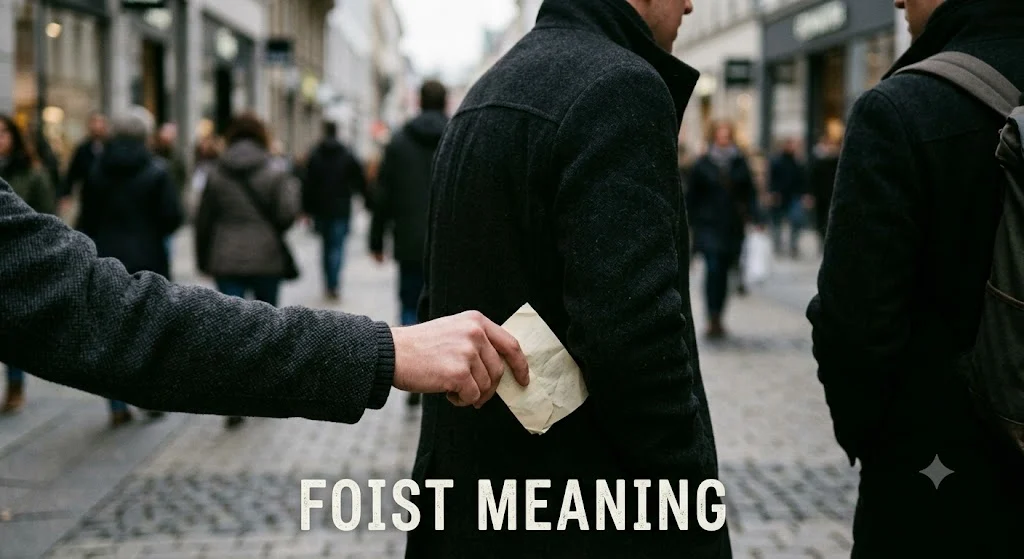
Foist is a verb that means to force, impose, or pass something unwanted, inferior, or deceptive onto someone, often without their full knowledge or consent.
To make someone accept something that they do not want, or to introduce something in a dishonest or unfair way.
Ever had a neighbor drop off a broken blender at your doorstep with a cheerful “thought you could fix this”? Or a coworker slide a messy spreadsheet onto your desk five minutes before a deadline?
That’s not generosity.
You didn’t ask for the blender. You didn’t volunteer for the spreadsheet. But somehow, someway, the unwanted thing became your problem. And the person who gave it to you walked away smiling.
Let’s break down the foist meaning so you never miss it again. You’ll learn to spot it, say it, and use it like someone who actually owns their vocabulary.
What Does Foist Mean? The Simple Truth
Here’s the foist definition in plain language.
Foist is a verb. It means to force someone into accepting something they don’t want. You usually do it through trickery, pressure, or manipulation.
| Element | Detail |
|---|---|
| Word type | Transitive verb (needs an object) |
| Core idea | Unwanted + deceptive or forceful transfer |
| Everyday phrase | “Palm off,” “saddle with,” “push onto” |
Think of a used car salesman hiding engine trouble under a fresh coat of wax. He doesn’t ask if you want the problem. He foists the whole mess onto you.
The meaning of foist always carries a whiff of dishonesty. You can impose a rule openly. You can inflict pain obviously. But foisting? That’s sneaky. That’s the handshake that hides a thumbtack.
Pronunciation matters too. Say it out loud: foist. Rhymes with moist and hoist. One quick syllable. Hard ‘f’ at the front. Don’t stretch it. Don’t add an extra ‘t’. Just foist.
A Quick Story That Sticks
Imagine a street vendor selling “genuine leather” wallets. You hand over twenty bucks. Three days later, the “leather” peels off like old paint. The vendor knew. He smiled while he did it. He foisted a counterfeit onto you.
That’s the emotional core of this word. It’s not just a transaction. It’s a small betrayal.
Now you won’t forget.
Where Did Foist Come From? A Sneaky Origin Story
The word didn’t fall out of thin air. Foist etymology takes us back to the 1500s.
It comes from the Dutch word vuisten, which means “to take into one’s hand.” Picture a con artist palming a fake coin. That’s the original image.
Here’s the timeline:
| Era | Development |
|---|---|
| 16th century | English picks up foist from Dutch or Low German |
| 1580s | First written uses appear, always linked to fraud |
| 1700s | Meaning broadens beyond physical objects to ideas, tasks, blame |
| Today | Any unwanted thing pushed onto anyone through trickery or pressure |
Old scam artists would foist counterfeit coins onto unsuspecting merchants. They’d hide the fake in their palm. Then they’d swap it during payment. By the time the merchant noticed, the scammer was gone.
That physical hiding evolved into the modern foist meaning we use today. You can foist a chore, a lie, a broken product, or even an unwanted opinion.
No hidden hand needed anymore. The sneaky intent remains.
How to Pronounce Foist Without Sounding Awkward
Let’s settle this fast.
IPA: /fɔɪst/
Break it down:
- Start with an F sound, like fun
- Add the oy sound, like boy or toy
- End with st, like last or fast
Say it three times: foist. foist. foist.
Common mistakes:
- Adding an extra syllable: “foist-ed” (only past tense uses foisted)
- Softening the ‘f’ into a ‘v’ (no, it’s not voist)
- Dragging it out like “fo-ist” (one syllable, not two)
Here’s a trick: say moist then change the M to F. Moist → foist. Gross but effective.
Foist Synonyms and Antonyms
Not all synonyms work equally. Let’s separate the good from the bad.
Closest Synonyms
| Synonym | When to use it |
|---|---|
| Palm off | Physical fake goods or low quality items |
| Saddle with | Unwanted responsibility or burden |
| Thrust upon | Sudden, aggressive foisting |
| Pass off fraudulently | Legal or formal contexts |
| Push onto | Casual conversation |
Example swaps:
- “He foisted his old laptop on me.” = “He palmed off his old laptop on me.”
- “They foisted the blame onto the intern.” = “They saddled the intern with the blame.”
Weaker Synonyms
| Word | Why it fails |
|---|---|
| Give | No pressure, no trickery |
| Assign | Too neutral, too official |
| Transfer | Zero emotional weight |
| Offer | Willing participation on both sides |
If the receiver says “yes please,” you can’t use foist.
Antonyms
There’s no perfect one word opposite. But here’s the closest you’ll get.
| Antonym phrase | Meaning |
|---|---|
| Willingly offer | Give without pressure |
| Freely present | No hidden agenda |
| Suggest politely | Receiver can decline easily |
| Voluntarily accept | The other side of the transaction |
Foist synonym hunting gets tricky because the deception piece is rare. No other common English verb packages “unwanted + deceptive + forceful” quite like foist does.
Foist in a Sentence: Five Distinct Contexts
Let’s see this verb in action. Each example uses a different setting. Notice the pattern.
Everyday Life
“Don’t let the cashier foist that extended warranty on you. It’s pure profit for them.”
Short and punchy. You can say this at any checkout counter.
Literature
“The villain foists a cursed locket onto the hero. She wears it for three chapters before realizing it drains her memory.”
Writers love foist for dramatic irony. The reader knows it’s bad. The character doesn’t.
Business
“Software companies often foist auto renewals onto customers through tiny fine print.”
No comma before onto here. Keep it clean.
Legal Context
“The arbitration clause foists all legal costs onto the consumer, even when the company violates the law.”
Legal foist meaning shows up in contracts. Watch for language that transfers liability without real consent.
Technology
“That free update foisted three browser extensions onto my machine. I didn’t agree to any of them.”
Tech foisting happens constantly. Free software hides paid garbage.
Pro tip: Always use on or upon after foist. Never say “foist someone something.” That’s wrong. Say “foist something on someone.”
Correct: “They foisted the task on me.”
Incorrect: “They foisted me the task.”
Foist vs Impose vs Inflict: Stop Confusing Them
These three verbs live in the same neighborhood but on different streets.
Here’s the breakdown.
| Verb | Intent | Transparency | Receiver’s feeling | Example |
|---|---|---|---|---|
| Foist | Deceptive or sneaky | Low (hidden) | Cheated, trapped | “Foisted a broken printer on me.” |
| Impose | Authoritative but open | Medium to high | Restricted, ruled | “Imposed a 10pm curfew.” |
| Inflict | Harmful or painful | High (obvious harm) | Suffering, injured | “Inflicted their terrible singing on us.” |
Think of it this way:
- A boss imposes a dress code. You know it’s happening. You don’t like it, but nobody hid it.
- A scammer foists fake insurance on you. You didn’t see it coming. The deception is the point.
- A bully inflicts a black eye. Physical harm. No confusion about whether it hurts.
You can impose a rule without foisting it. You cannot foist something without some level of dishonesty or pressure.
What does foist mean compared to impose? Foist hides. Impose announces.
Real Signs Someone Is Foisting Something On You
Learn to spot the pattern before you get stuck.
Here’s what foisting looks like in real time.
The Verbal Cues
Listen for these phrases:
- “I know you’ll handle this better than me.”
- “Consider this a favor.”
- “You’re so good at this stuff anyway.”
- “It’s just a small thing.”
The Behavioral Signs
- The person leaves before you can say no
- They frame it as a gift or opportunity
- They mention a fake deadline to rush you
- They target you because you’re nice or new
The Emotional Hit
- You feel confused about how you got stuck
- You didn’t explicitly agree to anything
- You feel resentment but also guilt
- You wonder if you’re being unreasonable
That confusion is the fingerprint of foisting. A clean request leaves you clear. A foisted obligation leaves you foggy.
Foist Meaning in Business: The Hidden Fee Epidemic
Businesses foist costs onto customers every single day. They’ve turned it into an art form.
Let’s name the biggest offenders.
| Industry | How they foist | Example |
|---|---|---|
| Airlines | Seat selection fees after booking | “Your ticket doesn’t include a seat.” |
| Software | Auto renewal with one click cancellation labyrinths | “We couldn’t process your cancellation because you used a different browser.” |
| Banking | Overdraft “protection” that charges fees | “We’ll cover you for $35 each time.” |
| Retail | Extended warranties at checkout | “For just $9.99 more…” |
| Real estate | Junk fees added to closing costs | “Administrative processing compliance fee.” |
None of these are optional in practice. But companies present them as small extras. That’s the deception. That’s the foist meaning in action.
A 2023 consumer report found that the average American household pays $650 per year in fees they didn’t knowingly agree to. That’s not a mistake. That’s systematic foisting.
Foist in Literature: Where Writers Hide This Verb
Writers love foist for its sharp, critical edge. It’s not a neutral word. It judges the foister.
Here are three famous uses.
Charles Dickens
Dickens used foist in Oliver Twist to describe how Fagin pushes stolen goods onto the boys. The word fits the sneaky, manipulative tone perfectly.
George Orwell
In *1984*, the Party foists rewritten history onto citizens. They don’t ask. They don’t explain.
Modern Thrillers
Lee Child’s Jack Reacher novels use foist when describing how corrupt officials push blame onto innocent soldiers. One sentence: “They foisted the whole operation onto him and disappeared.”
Foist meaning in literature always signals betrayal. No author uses it for a fair deal.
Memory Tricks That Actually Work
Want to lock this word in your brain forever? Try these.
The Fist Trick
Picture a fist holding something gross or broken. Someone shoves that fist toward you. You don’t want what’s inside. But they open their fingers and drop it into your hands anyway.
Foist sounds like fist holding something you didn’t ask for.
The Moist Connection
Rhymes help. Foist rhymes with moist. Both words make you slightly uncomfortable. That discomfort is the feeling of being foisted upon.
The Backwards Acronym
Forced
Onto
Innocent
Someone
Today
It’s silly. It works.
The Scene Method
Close your eyes. See a market stall. The seller grins. He hands you a “gold” ring. You pay. Later you discover it’s brass. That’s foisting. Anchor that image.
Retrieval practice: Next time someone pushes an unwanted task onto you, whisper “foist” under your breath. The word will stick because the emotion already does.
Common Mistakes Writers Make With Foist
Even experienced writers trip on this verb. Don’t be one of them.
Mistake 1: Forgetting the Preposition
Wrong: “He foisted me the work.”
Right: “He foisted the work on me.”
Also right: “He foisted the work upon me.” (More formal)
You cannot skip on or upon. Ever.
Mistake 2: Using Foist for Neutral Transfers
Wrong: “She foisted a compliment onto me.”
Why it’s wrong: Compliments aren’t unwanted burdens. No deception. No pressure.
Right: “She foisted her outdated opinions onto the whole meeting.”
Mistake 3: Past Tense Confusion
Wrong: “They foist the problem on me yesterday.”
Right: “They foisted the problem on me yesterday.”
Foist is present. Foisted is past. Foisting is ongoing.
Mistake 4: Mispronouncing in Public
You can write it perfectly. But if you say “foysted” with an extra syllable, people will notice. Just foist and foisted. Clean and quick.
Foist Meaning for Students: How to Remember for Exams
If you’re studying vocabulary tests or the SAT, here’s what you need.
The One Sentence Definition
Foist means to force an unwanted thing onto someone through trickery or pressure.
The Example Sentence They’ll Like
“The textbook publisher foisted an expensive new edition onto students by changing only three pages.”
Teachers appreciate real world relevance.
The Memory Hook for Tests
Foist = Force + Coist (sounds like “coerced”)
Forced + coerced = foist.
Sample Quiz Question
Which word best replaces the blank?
“The salesman tried to _____ a useless protection plan onto every customer.”
A) offer
B) present
C) foist
D) suggest
Answer: C
Foist in Politics and Media: The Hidden Agenda Play
Politicians and pundits foist narratives onto the public constantly. They just use prettier words like “framing” or “messaging.”
Here’s how it works.
A political operative wants to shift blame for a failed policy. They don’t say “we messed up.” Instead, they foist the failure onto the previous administration, the media, or a scapegoat.
The pattern:
- Identify the unwanted thing (blame, cost, responsibility)
- Hide the true source
- Push it onto a target
- Act innocent
Foist definition in political terms: the art of making someone else hold the bag.
Real example from 2022: A major social media platform foisted content moderation costs onto smaller fact checking organizations. The public never saw the memo. The small groups just got the bill.
How to Stop People From Foisting Things On You
Knowing the word is good. Knowing how to block it is better.
Here’s a practical playbook.
At Work
The Pause: When someone tries to hand you a task, say “Let me check my plate first. I’ll get back to you in an hour.”
The Redirect: “I can’t take that on, but here’s who might help.”
The Receipt: “Can you send that request in an email? I want to make sure I understand the deadlines.”
With Salespeople
The Script: “I don’t add anything at checkout. Just the item.”
The Repeat: When they push again, say the exact same words. Broken record technique works.
The Walk Away: If they won’t stop, leave. No purchase is worth the manipulation.
With Friends and Family
The Gentle No: “I appreciate you thinking of me, but I can’t take that.”
The Question: “Are you asking or telling?” (This stops foisting cold.)
The Boundary: “From now on, please ask before you assume I’ll take something.”
Blocking a foist isn’t rude. Foisting is rude. You’re just defending your own time and space.
Quick Reference Table: Foist at a Glance
Here’s everything you need in one place.
| What you need | The answer |
|---|---|
| Foist meaning | Force something unwanted onto someone through trickery or pressure |
| Pronunciation | /fɔɪst/ (rhymes with moist, hoist) |
| Part of speech | Verb (transitive) |
| Past tense | Foisted |
| Required preposition | On or upon (never omit) |
| Closest synonym | Palm off, saddle with |
| Opposite concept | Willingly offer |
| Warning sign | If no deception or pressure, don’t use foist |
| Common error | “Foist me something” (wrong) → “Foist something on me” (right) |
Practice Quiz: Test Your Foist Knowledge
No fluff. Just five questions. Check your answers at the bottom.
1. Which sentence uses foist correctly?
A) The teacher foisted a gold star onto the student.
B) The teacher foisted extra homework onto the class right before break.
C) The teacher foisted the students a compliment.
2. True or false: Foisting always involves some level of dishonesty or hidden pressure.
3. What preposition must follow foist?
4. Which is the closest synonym?
A) Offer freely
B) Palm off
C) Suggest politely
5. Fill in the blank: “The car dealer _____ a useless rust protection package onto every buyer.”
(Answers below – no peeking.)
Answers:
- B (Extra homework = unwanted. A gold star is welcome. C is missing “on.”)
- True (Deception or strong hidden pressure is the core of foist meaning.)
- On or upon
- B (Palm off)
- Foisted (Past tense)
FAQs
1. What does foist mean?
Foist means to force or unfairly pass something unwanted or fake onto someone else, often in a dishonest way.
2. Is foist a negative word?
Yes, foist is usually negative because it involves tricking or forcing something onto another person.
3. How do you use foist in a sentence?
Example: “They tried to foist a broken product on the customer.”
4. What is the synonym of foist?
Some synonyms include impose, force, palm off, and pass off.
5. Can foist be used in formal writing?
Yes, foist is commonly used in both formal and informal writing to describe unfair actions.
6. Does foist always mean cheating?
Not always cheating, but it usually involves some level of deception or unfairness.
7. What is the noun form of foist?
The noun form is “foistation” is not commonly used; instead, the verb “foist” is mainly used.
8. Is foist used in daily English?
It is not very common in daily conversation but is often seen in writing, news, and formal contexts.
Conclusion
“Foist” means to force, pass off, or unfairly put something on someone else, usually something unwanted, fake, or of low quality. It often carries a negative sense, showing that something is being imposed in a dishonest or sneaky way.
In simple terms, when someone “foists” something, they are trying to make another person accept it without their full agreement or knowledge. This can apply to ideas, products, responsibilities, or even blame.
The word is commonly used in situations where there is some level of trickery or deception involved. For example, someone might foist a bad product on a customer by pretending it is good or valuable.
Overall, “foist” highlights an unfair action where one person shifts something undesirable onto another. It is not a neutral word; it usually implies manipulation or dishonesty in the act.
In conclusion, understanding the meaning of “foist” helps you recognize situations where something is being unfairly imposed or passed off. It is a useful word for describing deceptive or forced actions in both everyday language and formal writing.
Discover More Related Articles:
- Blue Collar Meaning | Jobs, Salaries & Future In 2026
- ICYMI Meaning | Understanding This Popular Internet Slang In 2026