


Definition
“In lieu of” is a formal English phrase that means “instead of” or “in place of something.”
It is used when one thing is substituted for another.
Have you ever read a formal email or legal document and paused at the phrase “in lieu of”? You’re not alone. Many people search for the in lieu of meaning, wonder what does in lieu of mean, or even mistype it as “in loo of.” The good news is that the phrase is much simpler than it sounds. In everyday English, in lieu of means “instead of” or “in place of.” Understanding this expression can help you read contracts, workplace emails, and official notices with greater confidence.
You might also come across phrases like in lieu of the meeting, in lieu of the above, or in lieu of this meaning in business and legal communication. Knowing the correct in lieu of definition helps you understand that something is being substituted or replaced. We’ll also explain in lieu of vs in light of, since these commonly confused expressions have completely different meanings and should not be used interchangeably.
In this guide, you’ll learn the exact in lieu meaning, see real-life examples, discover when to use in lieu of correctly, and avoid common mistakes. Whether you’re writing a professional email, reading a contract, or simply improving your English, this easy-to-follow explanation will make the phrase clear and practical.
“In lieu of” is often used in professional, legal, and written contexts because it sounds more precise and formal than “instead of.” However, the meaning remains simple and easy to understand once you know it refers to substitution.
What Does In Lieu Of Mean? The One Sentence Answer
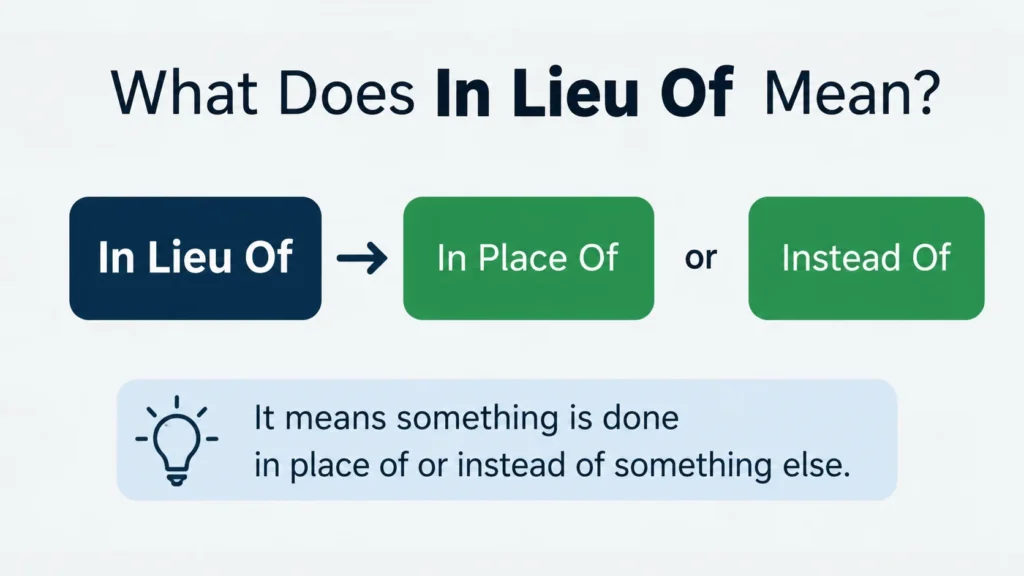
In lieu of means “in place of” or “instead of.” That’s it. Three words replace four.
You’ll spot this phrase everywhere. Employment contracts use it. Legal agreements love it. Even your boss might drop it in an email about time off.
But here’s the thing. Most people guess what it means. They nod along. Then they quietly hope no one asks them to explain it.
Let’s fix that right now.
How to Pronounce In Lieu Of Correctly

Say it like this: in LOO of
The word lieu rhymes with blue and through. No hard sounds. No tricky syllables.
Some people accidentally say “in lee-oo of” or “in loo-ee of.” Both are wrong. Keep it simple: two quick syllables then “of.”
Try it out loud. In LOO of. Feels natural once you say it twice.
Where Does In Lieu Of Come From?
French gave us this phrase. Lieu means “place” or “location.” So in lieu of literally translates to “in place of.”
English borrowed it during the Middle Ages. Lawyers grabbed it first. Then business writers followed. Today it sits firmly in formal English.
You won’t hear a child say “I want juice in lieu of milk.” That sounds silly. But you will see it on contracts, offer letters, and official correspondence.
Think of it as a formal tool. Keep it in your back pocket. Pull it out when you need precision or professionalism.
The Core Definition: In Lieu Of Meaning Across Different Contexts
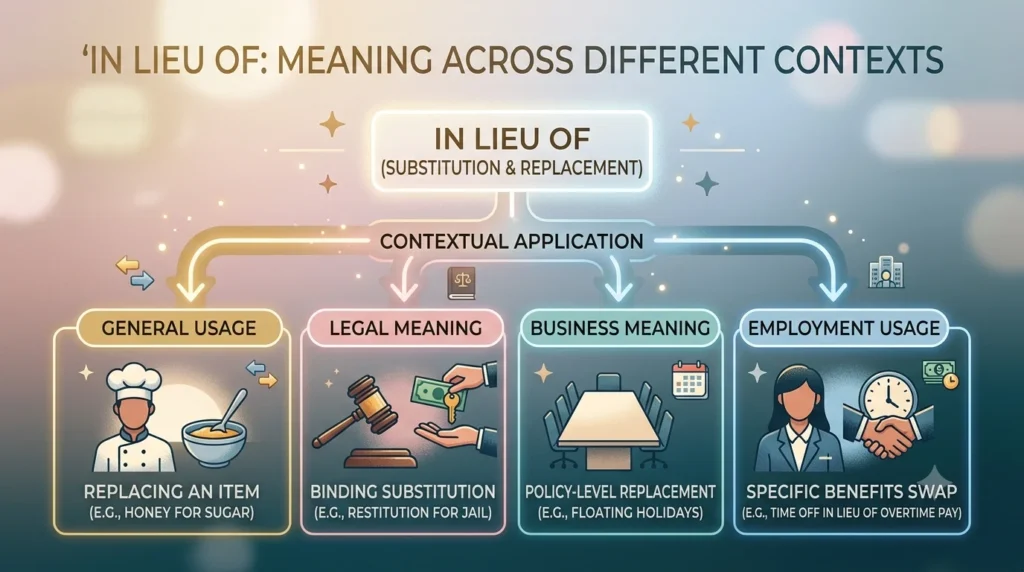
Let’s break this down by where you’ll actually see the phrase. No fluff. Just real usage.
General English Definition
In standard English, in lieu of means substituting one thing for another. The replacement carries equal weight. You’re not downgrading or upgrading. You’re swapping.
Example: “The chef used honey in lieu of sugar.” Same sweetness. Different source.
Another: “She sent a video message in lieu of attending the meeting.” Same communication goal. Different method.
Legal Meaning of In Lieu Of
Courts and contracts use this phrase constantly. In legal writing, in lieu of creates a binding substitution. One obligation replaces another.
Example: “The defendant paid restitution in lieu of jail time.” The money replaces incarceration.
Contract example: “The tenant may provide a security deposit in lieu of a co-signer.” The deposit replaces the second signature.
Legal professionals rely on this phrase because it leaves no room for confusion. Both parties know exactly what replaces what.
Business Meaning of In Lieu Of
Corporate communication uses in lieu of for policy documents, HR memos, and compensation discussions. It signals formality without sounding ancient.
Example: “We offer remote work options in lieu of a dedicated office desk.”
HR example: “Employees receive floating holidays in lieu of specific religious observances.”
Business writers like this phrase because it sounds professional but remains clear. Your team won’t need a dictionary.
In Lieu Of Meaning in Employment
This is where most people encounter the phrase. Job offers, severance agreements, and time off policies all use in lieu of.
Payment in lieu of notice: Your employer ends your job immediately but pays you for the notice period. You don’t work those weeks. You just get the money.
Time off in lieu (TOIL): You work a holiday or extra hours. Instead of overtime pay, you receive future paid time off.
Benefits in lieu: The company offers cash or alternative perks instead of traditional benefits like health insurance.
Payment In Lieu Of Notice: The Complete Breakdown
Let’s go deep here because this topic gets searched constantly.
Payment in lieu of notice appears when an employment relationship ends. The employer says “your last day is today” but still pays you for the required notice period.
How it works:
A standard notice period might be two weeks, four weeks, or longer depending on your contract. When the employer waives that working period, they owe you payment instead.
Real example:
Your contract says four weeks notice. The company fires you on Monday. They give you four weeks of pay but don’t ask you to come back. That’s payment in lieu of notice.
Why companies use it:
| Reason | Explanation |
|---|---|
| Security concerns | They don’t want a disgruntled employee accessing systems |
| Speed | They need the role filled immediately |
| Confidentiality | They worry about data or client theft |
| Simplicity | Paying out is cleaner than managing a departing employee |
Tax implications:
Payment in lieu of notice often gets taxed as regular income. But some jurisdictions treat it differently. It might count as wages. It might count as damages. Check local laws.
What employees should know:
You don’t have to accept the first offer. Some contracts require garden leave instead. That means you stay employed but don’t work. Different rules apply.
Negotiate payment in lieu terms before signing any employment agreement. Once you sign, the terms lock in.
Time Off In Lieu: Your Guide to TOIL
Time off in lieu means you earn future vacation by working extra now. Employers call this TOIL for short.
Common TOIL scenarios:
You work a public holiday. Your office closes for Christmas but you’re on call. You cover a weekend event. In each case, you could ask for TOIL instead of overtime cash.
How TOIL differs from overtime pay:
| Feature | Time Off In Lieu | Overtime Pay |
|---|---|---|
| Payment form | Future paid days off | Immediate money |
| Best for | People who value flexibility | People who need cash now |
| Tracking | HR system or timesheet | Payroll system |
| Expiration risk | Yes, some policies expire | No, money doesn’t vanish |
Watch out for expiration dates.
Many companies force you to use TOIL within a set window. Three months is common. Six months happens sometimes. Use it or lose it.
How to request TOIL:
“I worked six extra hours on Saturday. I’d like time off in lieu instead of overtime pay. Can we add one day to my PTO balance?”
Most managers say yes. TOIL costs them less than cash overtime in many cases.
In Lieu Of vs Instead Of: Spot the Difference
These phrases feel similar but serve different situations.
Instead of works everywhere. Casual. Neutral. Safe for text messages, emails, and conversations.
In lieu of works in formal settings. Contracts. Policies. Official letters.
Here’s a table to make it crystal clear.
| Situation | Use Instead Of | Use In Lieu Of |
|---|---|---|
| Text to a friend | “I had tea instead of coffee” | No, sounds weird |
| Job offer letter | “We offer equity instead of bonus” | “We offer equity in lieu of bonus” |
| Legal contract | Rarely appropriate | “The tenant pays a fee in lieu of repairs” |
| Casual workplace chat | “Let’s meet instead of emailing” | “Let’s meet in lieu of emailing” (too formal) |
| HR policy document | “Take training instead of a written test” | “Take training in lieu of a written test” |
Quick rule: When in doubt, use instead of. It’s never wrong. Reach for in lieu of only when you need formal precision.
In Lieu Of Example Sentences You Can Steal
Real sentences. Real contexts. No textbook nonsense.
Legal and Contract Examples
- The court accepted 50 hours of community service in lieu of a $500 fine.
- Both parties agree to arbitration in lieu of a jury trial.
- The landlord takes the security deposit in lieu of last month’s rent.
- She signed a non disclosure agreement in lieu of a non compete clause.
- The settlement provides a lump sum payment in lieu of future royalties.
Employment and HR Examples
- Your final paycheck includes two weeks of pay in lieu of notice.
- The company offers gym membership in lieu of a health insurance stipend.
- He received five extra vacation days in lieu of his unused sick leave.
- They gave her stock options in lieu of a signing bonus.
- You can take Friday off in lieu of working the company picnic.
Business Communication Examples
- Please submit a written summary in lieu of the live presentation.
- We accept digital signatures in lieu of handwritten ones.
- The committee approved a recorded video in lieu of a keynote speech.
- Send a PDF invoice in lieu of a printed paper copy.
- Use this online form in lieu of the previous spreadsheet.
Everyday Life Examples
- We used crushed crackers in lieu of breadcrumbs for the meatballs.
- She sent a voice message in lieu of typing a long text.
- He brought store bought cookies in lieu of homemade ones.
- I used a water bottle in lieu of a rolling pin. Don’t judge.
- They parked on the street in lieu of paying for the garage.
Financial and Tax Examples
- The city accepted a land transfer in lieu of back property taxes.
- Investors received shares in lieu of a cash dividend.
- The contractor took building materials in lieu of final payment.
- She offered consulting hours in lieu of a refund.
- The bank waived fees in lieu of closing the account.
In Lieu Of Synonyms: Your Swap List
Sometimes you need alternatives. Maybe you’ve already used in lieu of three times. Maybe the phrase feels too stiff.
Use this table to find the right replacement.
| Synonym | Formality Level | Best Used For |
|---|---|---|
| Instead of | Neutral | Almost everything |
| In place of | Semi formal | Physical replacements |
| As a substitute for | Formal | Products or roles |
| In exchange for | Neutral | Mutual swaps |
| Rather than | Neutral | Preferences |
| As an alternative to | Semi formal | Choices or options |
| Replacing | Neutral | Active changes |
Example swap:
Original: “The chef used almond flour in lieu of wheat flour.”
Replace with: “The chef used almond flour instead of wheat flour.”
Same meaning. Less formal. Works fine for blogs, emails, and casual writing.
When not to swap:
Never replace in lieu of in a legal contract without a lawyer. Some documents define the phrase specifically. Changing it could break the agreement.
Common Mistakes People Make With In Lieu Of
Let’s clear up the errors that make you look unprepared.
Mistake 1: Adding “To” After In Lieu Of
Wrong: “She accepted cash in lieu of to working the weekend.”
Right: “She accepted cash in lieu of working the weekend.”
In lieu of works like instead of. You never add to. Never.
Mistake 2: Using It for People
Wrong: “John came in lieu of his manager.”
This sounds cold. You’re treating a person like a replaced object. Use instead of or on behalf of for people.
Better: “John came instead of his manager.”
Even better: “John represented his manager at the meeting.”
Mistake 3: Overusing It in Casual Writing
Wrong: “I had eggs in lieu of cereal for breakfast.”
Technically correct. But why? You sound like a legal document describing toast.
Right: “I had eggs instead of cereal.”
Save in lieu of for formal moments. Let it breathe. It works best when used sparingly.
Mistake 4: Forgetting the “Of”
Wrong: “Payment in lieu notice” or “Time off in lieu working”
Right: “Payment in lieu of notice” and “Time off in lieu of working”
The of matters. Drop it and the phrase breaks.
Mistake 5: Hyphenating Incorrectly
Wrong: “She received an in-lieu-of payment.”
Right: “She received a payment in lieu of notice.”
Hyphens appear only when the phrase acts as a single adjective before a noun. Even then, most style guides say skip them.
In Lieu Of in Legal Documents: What You Must Know
Legal writing uses in lieu of as a precision tool. Courts interpret it strictly. One wrong placement changes obligations.
Common legal uses:
- In lieu of bail: The defendant posts property or a bond instead of cash bail.
- In lieu of damages: One party accepts a specific performance or settlement instead of monetary damages.
- In lieu of foreclosure: The borrower gives back the property voluntarily instead of going through foreclosure proceedings.
- In lieu of testimony: A sworn affidavit replaces in court testimony.
Warning for non lawyers:
Never draft a contract clause using in lieu of without professional help. Small wording differences create big legal gaps.
Example of a risky clause:
“The employee may take vacation in lieu of overtime.”
Does that mean one hour of vacation replaces one hour of overtime pay? Or one day replaces one day? Unclear. A court would have to decide.
Clear version:
“The employee may accrue one hour of paid time off in lieu of each hour of overtime worked, up to a maximum of 40 hours per year.”
See the difference? Specificity protects everyone.
In Lieu Of in Business Writing: When and How
Business communication lives on a spectrum. Casual at one end. Formal at the other. In lieu of belongs on the formal side.
Good places to use it:
- Employee handbooks
- Policy memos
- Offer letters
- Severance agreements
- Formal proposals
- Board meeting minutes
Bad places to use it:
- Slack messages
- Quick team emails
- Client check ins
- Meeting summaries
- Internal chat threads
Example of appropriate business use:
“Effective immediately, the company will provide remote work stipends in lieu of commuter benefits for fully remote employees.”
Example of inappropriate use:
“Hey team, we’ll do a Zoom in lieu of the all hands this week.”
Just say “instead of.” No one will think less of you.
In Lieu Of in Contracts: Key Clauses to Know
Contracts love this phrase. Here are the clauses where you’ll most likely see it.
Payment in lieu of notice clause:
“The Company may terminate this Agreement without cause by providing the Employee with four weeks of base salary in lieu of the notice period described in Section 4.”
Benefits in lieu clause:
“The Contractor receives a flat monthly fee in lieu of health insurance, retirement contributions, or other employee benefits.”
Performance in lieu clause:
“The Supplier may provide refurbished units in lieu of new units, provided the refurbished units meet all original specifications.”
Delivery in lieu clause:
“Digital delivery of documents serves in lieu of physical delivery for all notice requirements.”
Each of these clauses creates a clear substitution. No ambiguity. No debate.
In Lieu Of Meaning in Everyday Conversation
Can you use this phrase without sounding like a robot? Yes but carefully.
Natural uses:
“I’m giving you comp time in lieu of overtime. That fair?”
“The hotel put us in a suite in lieu of our original room. Upgrade actually.”
Forced uses that sound strange:
“Would you like water in lieu of soda?” No. Just ask “water or soda?”
“I’ll take the stairs in lieu of the elevator.” Fine but weird. Say “instead of.”
The test: Read your sentence out loud. If you sound like a character from a legal drama, swap it out.
In Lieu Of vs In Light Of: Don’t Confuse These
People mix these up constantly. They mean totally different things.
| Phrase | Meaning | Example |
|---|---|---|
| In lieu of | In place of | “Cash in lieu of vacation days” |
| In light of | Because of or considering | “In light of the weather, we canceled” |
Wrong: “In lieu of the budget cuts, we froze hiring.” That means you replaced budget cuts with hiring freeze. Makes no sense.
Right: “In light of the budget cuts, we froze hiring.” Because of the cuts, you froze hiring.
Memory trick: Lieu = place. Light = brightness or consideration. Different words. Different meanings.
The History of In Lieu Of: Why We Still Use It
English borrowed lieu from French around the 13th century. French got it from Latin locus meaning “place.”
The phrase in lieu of appears in English legal texts as early as the 1500s. Back then, most official business happened in French or Latin. Lieu stuck around because lawyers never let go of a useful word.
By the 1800s, in lieu of had spread to business writing. Industrial contracts used it constantly. Employment agreements adopted it.
Today the phrase survives because no perfect replacement exists. Instead of works most of the time but feels less precise. In place of works but sounds clunky. So in lieu of stays.
Think of it as a formal tool that refuses to retire. Not bad for a 700 year old phrase.
In Lieu Of Meaning in Different English Dialects
American English uses in lieu of most often in legal and HR contexts. You’ll rarely hear it on the street.
British English uses it slightly more often. Leave in lieu appears in UK employment contracts. Pay in lieu of notice follows UK labor laws.
Australian English mirrors British usage. Canadian English leans American but with more French influence.
Global tip: Stick to instead of when writing for an international audience. In lieu of translates poorly in some cultures. Non native speakers may not recognize it.
How to Teach In Lieu Of to Someone Else
Explaining this phrase well means giving examples and a simple rule.
The simple rule: In lieu of = formal instead of
The examples: Pick three from the list above. One legal. One business. One everyday.
The test: Ask them to fill in the blank.
“The company gave her cash _______ vacation days.”
Answer: in lieu of
The warning: Tell them not to overuse it. One per document is plenty.
Quick Reference Table: In Lieu Of at a Glance
| Question | Answer |
|---|---|
| What does it mean? | In place of or instead of |
| How do you pronounce it? | in LOO of |
| Where does it come from? | French lieu meaning place |
| Is it formal? | Yes, very formal |
| Can I use it daily? | You can but don’t |
| What’s the opposite? | No direct opposite |
| Does it need a hyphen? | Almost never |
| Is it outdated? | No, still current in legal and business |
Final Checklist: Using In Lieu Of Correctly
Run your sentence through these five checks.
Check one: Does the context demand formality? If not, use instead of.
Check two: Did you include the word of after lieu? Always.
Check three: Is the thing being replaced a noun or noun phrase? Good. Never a verb.
Check four: Does the sentence sound natural out loud? If it feels stiff, rewrite.
Check five: Have you used this phrase already in the same paragraph? Vary your language.
Pass all five checks and you’re golden.
In Lieu Of Meaning: What You Actually Need to Remember
Here’s the truth. Most people never need this phrase. They get by fine with instead of.
But when you do need it, you need it right. Contracts demand precision. HR policies require clarity. Formal writing expects correct usage.
So remember three things.
First: In lieu of means in place of. Simple.
Second: Use it for formal situations only. Contracts. Policies. Official letters.
Third: Never drop the of. Never add to. Keep it clean.
That’s it. You’re done. Go use the phrase correctly or keep it in your back pocket until the right moment arrives.
Either way, you won’t freeze next time you see in lieu of on a document. You’ll nod. You’ll understand. And you might even impress someone with your clear explanation.
Additional Examples by Category
Need more inspiration? Here are extra examples broken down by where you’ll use them.
Workplace Policies
The company offers mental health days in lieu of sick days for stress related absences.
Employees may take unpaid leave in lieu of using their remaining PTO balance.
The remote work policy allows home office stipends in lieu of commuting reimbursements.
Financial Transactions
The lender accepted a short sale in lieu of full foreclosure proceedings.
The bond issuer offered convertible notes in lieu of traditional debt instruments.
The merchant provided store credit in lieu of a cash refund for returned items.
Everyday Problem Solving
She used a binder clip in lieu of a broken zipper pull. Worked for three months.
He stacked books in lieu of a missing table leg. Not elegant but functional.
They used a group chat in lieu of email for quick decision making.
FAQs
1. What does “in lieu of” mean?
“In lieu of” means instead of or in place of something. It is used when one thing is substituted for another.
2. How do you use “in lieu of” in a sentence?
You use it to show replacement. For example: She took a day off in lieu of overtime pay.
3. Is “in lieu of” formal or informal?
It is mostly formal, often used in legal, business, or professional writing.
4. Can “in lieu of” be replaced with “instead of”?
Yes, in most cases “in lieu of” can be replaced with “instead of”, but “in lieu of” sounds more formal.
5. What is a simple example of “in lieu of”?
A simple example is: He received gift vouchers in lieu of cash.
6. Is “in lieu of” commonly used in daily English?
No, it is not very common in daily conversation. People usually prefer “instead of.”
7. Does “in lieu of” have a legal meaning?
Yes, it is often used in legal and official documents to indicate substitution or compensation.
8. What is the origin of “in lieu of”?
It comes from the French word “lieu”, which means “place,” so it literally means “in place of.”
Conclusion
“In lieu of” is a formal English phrase that simply means “instead of” or “in place of.” It is often used in written and professional contexts where more formal wording is preferred. Although it may sound complex, its meaning is quite straightforward and easy to understand once you break it down.
This phrase is commonly used in legal documents, official letters, and workplace communication. For example, someone might receive payment in lieu of notice, meaning they are paid instead of being required to work during a notice period. It helps express substitution in a clear and formal way.
In everyday English, people usually prefer simpler words like “instead of,” but “in lieu of” is still important to recognize, especially when reading formal texts. Understanding it can improve comprehension in academic, legal, and professional settings.
Overall, “in lieu of” is just a more formal way of showing replacement or substitution. Learning such phrases helps improve your English vocabulary and makes it easier to understand different styles of writing.
Discover More Related Articles:
- Grifter Meaning | Slang, Politics & Everyday Language In 2026
- Masochist Meaning | Signs, Traits & Relationship In 2026
- FUPA Meaning | What Does It Stand For In 2026