

Definition
Dovetail means to fit together perfectly, work smoothly together, or complement each other. It can be used both literally (in woodworking) and figuratively (in ideas, plans, or activities).
The word dovetail is used in many different situations, from woodworking and business to everyday conversations. While it originally described a type of strong interlocking joint used in carpentry, the term has evolved to mean two or more things that fit together or work together perfectly. Whether you come across “dovetail” in a meeting, an article, or a casual conversation, understanding its meaning can help you interpret the message more accurately.
In this guide, you’ll learn the dovetail meaning, its definition, pronunciation, origin, synonyms, and how to use it correctly in sentences. We’ll also explore real-life examples from work, communication, and daily life so you can confidently recognize and use the word in the right context.
What Does Dovetail Mean? A Word Worth Knowing
Most people have used the word “dovetail” at least once in a meeting, in an email, maybe in casual conversation. But few stop to ask: where does it actually come from? What does it really mean? And why does it feel more precise than just saying “match” or “align”?
Here’s the thing. “Dovetail” carries something the others don’t. It’s not just about two things agreeing or fitting loosely together. It implies a kind of structural fit the way two pieces lock into each other so well that the connection itself becomes the strength. That’s a powerful idea, and it’s no accident the word has endured for over four centuries.
This guide breaks down every dimension of the dovetail meaning. You’ll get the grammar, the etymology, the woodworking science behind it, the professional usage, and a full arsenal of examples. By the end, you won’t just know what dovetail means you’ll know how to use it, and why it works.
Dovetail at a Glance: Quick Reference
Before diving deep, here’s your fast snapshot.
| Feature | Detail |
|---|---|
| Word | Dovetail |
| Part of Speech | Verb, Noun, Adjective |
| Pronunciation | /ˈdʌv.teɪl/ |
| Core Meaning | To fit together neatly; to connect harmoniously |
| Origin | Late 16th century English carpentry |
| Register | Formal and informal; widely used professionally |
| Related Forms | Dovetailed (past tense), dovetailing (present participle) |
That’s the skeleton. Now let’s put flesh on it.
Dovetail Definition: Breaking Down Every Word Form
The word “dovetail” does more than one job grammatically. Depending on context, it can serve as a verb, a noun, or an adjective and each form carries a slightly different weight.
Dovetail as a Verb
This is how most people use it. As a verb, dovetail means to fit together or cause to fit together in a neat, harmonious, and mutually reinforcing way. The emphasis is on the result of the connection not just proximity, but genuine complementary fit.
Think of it like puzzle pieces. Two puzzle pieces can sit next to each other without truly connecting. But when they dovetail, they lock in. Neither can move without the other.
Examples:
- “Her research background dovetails perfectly with the team’s current needs.”
- “The new marketing strategy dovetails with our Q3 expansion goals.”
- “Their schedules finally dovetailed, giving them time to collaborate.”
- “His technical skills dovetail beautifully with her creative instincts.”
Notice how in each case, it’s not just about matching it’s about mutual reinforcement. That’s the verb’s real power.
Tense forms of dovetail (verb):
| Tense | Form | Example |
|---|---|---|
| Present | Dovetail / dovetails | “The plans dovetail nicely.” |
| Past | Dovetailed | “The timelines dovetailed last quarter.” |
| Present Participle | Dovetailing | “We’re dovetailing our efforts.” |
| Past Participle | Dovetailed | “The strategies have dovetailed well.” |
Dovetail as a Noun
As a noun, dovetail refers to one of two things. Either it’s the fan-shaped, wedge-like interlocking joint used in woodworking, or it describes the shape itself the spread tail of a dove, which is exactly what the joint resembles.
Examples:
- “The carpenter cut a precise dovetail into the drawer front.”
- “A well-made dovetail is a mark of a skilled craftsman.”
- “The dovetail at the corner of the box held without a single nail.”
You’ll mostly encounter the noun form in woodworking, carpentry, and furniture-making contexts.
Dovetail as an Adjective
Less common, but real. Used almost exclusively in technical contexts to describe something that has the shape or function of a dovetail.
Examples:
- “A dovetail saw has a fine-toothed blade designed for precision cuts.”
- “Install the shelf using a dovetail slot for a seamless finish.”
- “The dovetail router bit creates the characteristic angled cut.”
Dovetail Meaning in Everyday English: The Figurative Power
Here’s where the word gets genuinely interesting. When most people say “dovetail,” they’re not talking about woodworking at all. They’re using it figuratively to describe two things, ideas, schedules, or people fitting together with unusual precision and harmony.
Why “Dovetail” Beats “Match” or “Align”
You could say “our plans match” or “our goals align.” Both are fine. But “dovetail” communicates something extra. It suggests:
- Structural complementarity | not just similarity, but interdependence
- Timing and sequence | things coming together at the right moment
- Effortless connection | the fit feels natural, not forced
- Mutual reinforcement | each side makes the other stronger
That’s a lot packed into one word. No wonder writers, executives, and speakers keep reaching for it.
When People Use It in Conversation
You’ll hear “dovetail” most in professional and semi-formal contexts team meetings, business writing, planning sessions. But it also pops up in everyday conversation when someone wants to express that things clicked together unexpectedly well.
“It’s one of those words that sounds formal but isn’t stiff. It actually feels warm like things worked out.”
Real-world figurative examples:
- “Her experience in logistics dovetails with exactly what this supply chain project demands.”
- “The community outreach program dovetails with the company’s social responsibility goals.”
- “Their personalities dovetail she’s the big-picture thinker, he’s the detail person.”
- “The budget proposal dovetails with the priorities the board outlined last month.”
- “As luck would have it, my vacation time dovetailed with the office renovation.”
Dovetail Meaning in Text and Informal Writing
In texts and casual messages, “dovetail” is rare. People tend to keep it in professional contexts. But it does appear in thoughtful informal writing a well-crafted email, a thoughtful LinkedIn post, a long-form personal essay.
When someone uses “dovetail” in an informal context, it signals that they’re choosing their words carefully. That’s part of the word’s appeal it elevates the sentence slightly without sounding pretentious.
Where Does “Dovetail” Come From? The Full Etymology
The origin story of “dovetail” is surprisingly visual. Once you know it, you’ll never forget it.
The Literal Root: A Bird’s Tail
A dove’s tail fans outward in a distinctive wedge shape narrow at the base, wide at the tip. Medieval woodworkers looked at that shape, then looked at the joint they were cutting, and made the connection. The joint they created mimicked that spreading, tapered form perfectly.
The earliest recorded use of “dovetail” in English dates to the late 16th century, primarily in carpentry texts. It referred specifically to the joint the physical thing a craftsman cut into wood.
Fun linguistic fact: The joint was also called a “swallowtail joint” in some European woodworking traditions, referencing a different bird but the same visual idea. Both names capture that characteristic spread.
From Workshop to Everyday Language
The leap from technical carpentry term to figurative everyday usage happened gradually through the 19th century. As industrialization spread and carpentry became more widely understood, the mental image of two interlocking pieces fitting snugly together translated naturally into metaphor.
This is actually a common path for technical words to travel. Consider:
- Blueprint | from architectural drafting to “a detailed plan”
- Framework | from physical construction to “a conceptual structure”
- Nail it | from hammering nails to “executing something perfectly”
- Dovetail | from woodworking joints to “fitting together harmoniously”
Each one brought its physical clarity into abstract territory. And that’s precisely why these metaphors work they give abstract ideas a concrete image to anchor to.
Frequency in Modern English
By the 20th century, the figurative use of “dovetail” had firmly overtaken the literal. Today, in most professional and literary writing, you’re far more likely to encounter it used figuratively than in a woodworking context. Corpus data from major English language databases confirms that “dovetail” appears most frequently in business, journalism, and academic writing not carpentry manuals.
Dovetail in Woodworking: The Literal Meaning Explained
Before it was a metaphor, it was a marvel of engineering. The dovetail joint is one of the most celebrated techniques in all of woodworking. Understanding it actually deepens your appreciation of the figurative meaning.
What Is a Dovetail Joint?
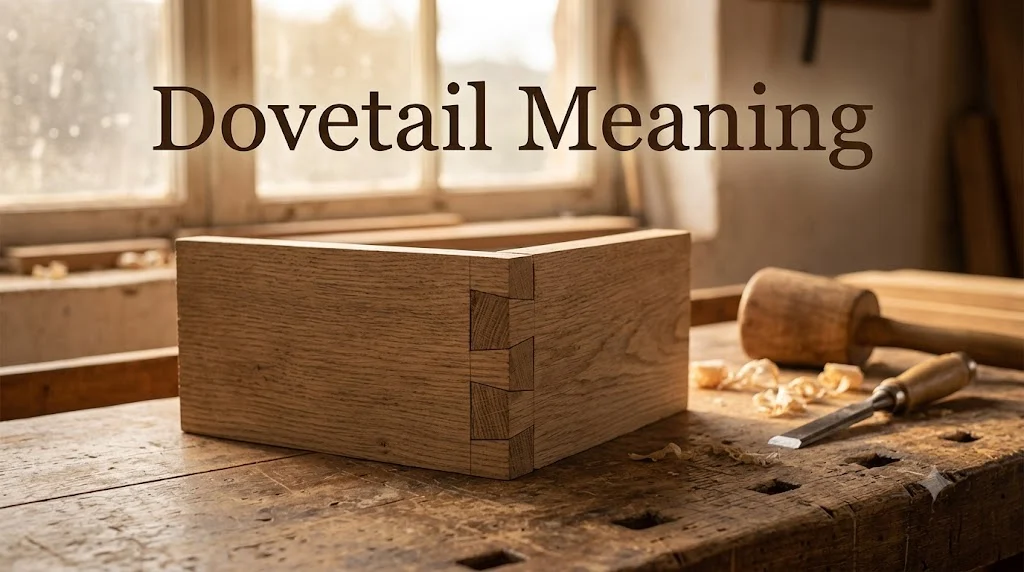
A dovetail joint consists of interlocking wedge-shaped cuts in two separate pieces of wood. One side has fan-shaped “tails” cut into it. The other has matching “pins.” When the two pieces slide together, the geometry of the wedge shape means they can’t pull apart not without dismantling the joint entirely.
No glue required. No nails. The shape itself holds everything together. That’s the engineering brilliance, and it’s the exact idea that the figurative meaning carries into everyday language.
Types of Dovetail Joints
There isn’t just one dovetail there’s a whole family of them. Each serves a different purpose depending on how visible the joint needs to be and how much stress it’ll bear.
| Joint Type | Key Feature | Common Application |
|---|---|---|
| Through Dovetail | Visible from both sides | Box corners, drawer backs, blanket chests |
| Half-Blind Dovetail | Hidden from the front face | Drawer fronts, kitchen cabinets |
| Full-Blind (Secret Mitre) Dovetail | Completely concealed | Fine furniture, high-end cabinetry |
| Sliding Dovetail | One piece slides into a channel | Shelving units, structural framing |
| Compound Dovetail | Angled on two axes | Decorative boxes, specialty furniture |
The Tools Behind a Dovetail
Cutting a dovetail joint by hand is a benchmark skill for any serious woodworker. It requires:
Hand tools:
- Dovetail saw (fine-toothed, low kerf)
- Sharp bench chisels (typically 6mm and 12mm)
- Marking gauge
- Sliding bevel or dovetail marker
- Mallet
Power tools and jigs:
- Router with a dovetail bit
- Dovetail jig (for consistent, repeatable cuts)
- Table saw with a dovetail sled
Why Craftsmen Still Love This Joint
In an age of pocket screws, biscuit joiners, and construction adhesive, the dovetail joint has absolutely no practical reason to dominate. And yet it does especially among fine furniture makers and custom cabinetmakers. Here’s why:
- Mechanical strength | the wedge geometry resists pulling forces without relying on adhesive
- Longevity | dovetail joints in antique furniture have lasted 200 years and counting
- Beauty | a visible through-dovetail at a box corner is considered decorative as much as functional
- Craft status | a hand-cut dovetail signals mastery; it’s the benchmark by which woodworkers judge each other
“Show me your dovetails and I’ll show you your skill level.” a sentiment you’ll hear in any serious woodworking community.
The cultural weight of the dovetail in craft circles is enormous. When furniture-makers want to signal quality and authenticity, they let the joint show.
Dovetail Meaning in Business and Professional Contexts
In the professional world, “dovetail” shows up constantly and for good reason. It compresses a complex idea (strategic alignment, complementary fit, mutually reinforcing goals) into a single, elegant word.
Dovetail in Project Management
Project managers love this word because projects constantly need to “dovetail.” Timelines need to mesh. Resource schedules need to align. Deliverables from Team A need to hand off cleanly to Team B.
When a project manager says “Phase 2 dovetails with Phase 1’s deliverables,” they mean:
- The handoff is clean
- The work builds directly on what came before
- There’s no gap or overlap that wastes time or creates confusion
Professional examples:
- “The software development sprints dovetail with the QA testing cycles to minimize downtime.”
- “Her onboarding schedule dovetails with the existing training calendar perfectly.”
- “The new feature release dovetails with the marketing campaign launch in October.”
Dovetail in Business Strategy
Strategic planning is full of “dovetailing.” When a company acquires another firm, analysts ask: does the acquisition dovetail with the parent company’s core competencies? When a product launches, the question is whether it dovetails with the existing portfolio.
The word does heavy lifting in strategy documents, executive presentations, and board reports because it implies intentionality. Things don’t just accidentally dovetail they do so because someone planned it that way.
Business examples:
- “The partnership dovetails with our five-year expansion into the Southeast Asian market.”
- “This product line dovetails with the premium segment we’ve been targeting since 2021.”
- “The research division’s findings dovetail with the commercial team’s market analysis.”
Dovetail in Relationships and Communication
People dovetail too. In HR, coaching, and interpersonal contexts, “dovetail” describes when two people’s strengths, working styles, or communication preferences complement each other so well that the whole becomes greater than the sum of its parts.
- “Her ability to synthesize information dovetails with his talent for execution.”
- “Their leadership styles dovetail in a way that creates real psychological safety for the team.”
- “The mentor’s experience dovetails with exactly the gaps the mentee is trying to fill.”
Dovetail in Construction and Engineering
Beyond woodworking, structural engineers and builders use “dovetail” to describe specific physical connections in masonry, concrete, and steel construction.
Dovetail wall ties, for instance, are metal connectors used in cavity wall construction. Dovetail slots appear in prefabricated concrete panels. The word carries its literal woodworking meaning into broader construction same shape, different material.
Dovetail Synonyms: Knowing Which One to Use
A thesaurus gives you a list. A good guide tells you the difference. These synonyms for “dovetail” are close but they’re not identical. Choosing the right one sharpens your writing considerably.
| Synonym | Best Context | Subtle Difference from Dovetail |
|---|---|---|
| Align | Goals, directions, strategies | More about direction than structural fit |
| Integrate | Systems, processes, departments | Implies active effort to combine |
| Mesh | Gears, personalities, informal contexts | Slightly more mechanical; less elegant |
| Correspond | Data, findings, academic writing | More about equivalence than complementarity |
| Complement | Strengths, skills, aesthetics | Focuses on mutual enhancement |
| Coincide | Timing, events, dates | Specifically temporal; doesn’t imply structural fit |
| Harmonize | Relationships, plans, creative work | Emotional resonance; musical connotation |
| Interlock | Physical systems, structures, mechanisms | Strongest physical connotation of the group |
| Synchronize | Timing, schedules, digital systems | Specifically about coordinating timing |
| Converge | Ideas, trends, paths | Suggests coming together from different directions |
Quick rule of thumb: Use “dovetail” when you want to emphasize that the fit is structural and mutually reinforcing, not just incidental or superficial. If you just mean “they agreed,” use “align.” If you mean “they enhanced each other,” use “complement.” “Dovetail” is the word for when both things are true simultaneously.
Dovetail Antonyms: The Opposite of a Perfect Fit
Understanding what dovetail isn’t helps clarify what it is. These are the true antonyms words that describe the opposite of harmonious, structural fit.
| Antonym | Meaning |
|---|---|
| Conflict | Active opposition between elements |
| Clash | Jarring incompatibility, often sudden |
| Diverge | Moving away from each other rather than together |
| Contradict | Directly opposing in logic or fact |
| Mismatch | Pairing of incompatible elements |
| Disconnect | A gap or break in continuity or relationship |
| Oppose | Working against each other |
| Differ | Simply being unalike, without necessarily clashing |
Contrasting sentence pairs:
- “Their research dovetails with our hypothesis.” vs. “Their findings contradict our hypothesis entirely.”
- “The timelines dovetail beautifully.” vs. “The timelines clash we can’t do both.”
- “Her skills dovetail with the role’s requirements.” vs. “Her background mismatches with what the position demands.”
Common Mistakes When Using “Dovetail”
Even educated writers occasionally misuse this word. Here are the most common slip-ups and how to fix them.
Mistake 1: Using it to mean simple agreement
Dovetail implies structural complementarity, not just consent or agreement.
Wrong: “We both want to grow the company. Our views dovetail.” Right: “Her financial expertise dovetails with his operational experience to drive growth.”
Mistake 2: Treating it as a synonym for “overlap”
Overlap suggests partial coincidence. Dovetail suggests purposeful interlocking fit. They’re related but not the same.
Wrong: “Our responsibilities dovetail quite a bit we’re both handling communications.” Better: “Our responsibilities overlap” (if you mean they share tasks) OR “Our responsibilities dovetail” (if you mean each one supports the other’s work).
Mistake 3: Overusing it in a single document
Because “dovetail” is distinctive, using it repeatedly makes it lose power fast. One strong use per document is usually the right ceiling.
Mistake 4: Confusing noun and verb forms
Wrong: “This is a great dovetail between departments.” (Awkward noun form doesn’t transfer well figuratively.) Right: “These departments dovetail well.” (Verb form works naturally.)
How to Use Dovetail in a Sentence: Real Examples
Nothing teaches usage like examples. Here are 20 natural, varied sentences across every context where “dovetail” lives.
Everyday Speech
- “The timing of your visit dovetails perfectly with the conference schedule.”
- “Her love of cooking and her chemistry background dovetail in fascinating ways.”
- “I didn’t plan it this way, but the two projects ended up dovetailing nicely.”
- “Fortunately, his commute dovetails with her work hours they can carpool every day.”
- “The two halves of the documentary dovetail in the final act to reveal the full story.”
Business and Professional Writing
- “The acquisition dovetails with the company’s stated goal of entering the Asian Pacific market.”
- “Phase three of the rollout dovetails with the sales team’s Q4 campaign, maximizing impact.”
- “Her expertise in behavioral economics dovetails with the research direction we’ve been pursuing.”
- “The two departments’ workflows dovetail in a way that eliminates redundant approval steps.”
- “This hiring decision dovetails with our long-term commitment to building a diverse leadership team.”
Leadership, Relationships, and Team Dynamics
- “Their management styles dovetail she handles vision, he handles execution.”
- “The mentorship program dovetails with the intern’s development goals, which is ideal.”
- “Strong partnerships don’t happen by accident. They dovetail because both sides invest in them.”
- “The team’s individual strengths dovetail to create something none of them could build alone.”
- “Their values dovetail enough to build real trust, even where their methods differ.”
Creative and Literary Writing
- “The two storylines dovetail in the final chapter with stunning effect.”
- “Her past and her present dovetail in this memoir with rare honesty.”
- “The musical themes from the first act dovetail into the finale, bringing the score full circle.”
Woodworking and Technical Contexts
- “The craftsman spent two hours cutting the dovetail before being satisfied with the fit.”
- “A properly cut dovetail requires no fasteners the geometry does all the holding.”
Dovetail Pronunciation and Spelling
Getting this one wrong is easy if you haven’t heard it spoken.
Pronunciation: /ˈdʌv.teɪl/
Break it down:
- “Dʌv” | rhymes with “love,” “above,” “shove”
- “teɪl” | rhymes with “sail,” “fail,” “trail”
So: DUV-tail. Not “DOVE-tail” with a long O. The “dove” (the bird) is actually pronounced with a short U sound in English /dʌv/. Many non-native English speakers get tripped up here.
Spelling tip: It’s one word “dovetail” not two (“dove tail”) and not hyphenated (“dove-tail”). The single-word spelling is standard in both American and British English.
Dovetail Quick Reference Summary
Here’s everything condensed into one place for easy reference.
Verb: To fit together neatly and harmoniously, in a mutually reinforcing way
Noun: A fan-shaped interlocking joint used in woodworking; also the shape itself
Adjective: Describing a tool, slot, or element that has the characteristic dovetail shape
Pronunciation: /ˈdʌv.teɪl/ | “DUV-tail”
Origin: Late 16th century English carpentry; named after the spread shape of a dove’s tail
Tone: Professional, precise, slightly elevated but never stiff or stuffy
Best synonyms: mesh, integrate, complement, align, harmonize
Best antonyms: conflict, clash, diverge, mismatch
Avoid when: You simply mean “agree” or “overlap” without structural complementarity
FAQs
What does dovetail mean in simple terms?
Dovetail means to fit together neatly and perfectly like puzzle pieces that don’t just sit next to each other but actually lock into place.
Is “dovetail” a formal word?
It lives comfortably in both formal and informal registers. You’ll find it in board presentations, academic papers, and professional emails but it also works in casual conversation without sounding stiff.
What’s the difference between dovetail and align?
“Align” suggests that two things point in the same direction. “Dovetail” goes further it implies that the two things lock together and each makes the other work better.
Can “dovetail” be used as a noun?
Yes. As a noun, it refers specifically to the woodworking joint, or more generally to the fan shape. In figurative contexts, the verb form is far more common.
Where does the word dovetail come from?
It comes from late 16th-century English carpentry. The joint was named after its resemblance to the spread tail of a dove fan-shaped, wider at the tip than at the base.
What does it mean when two things dovetail in business?
In business, when two things dovetail, it means they fit together in a way that creates mutual value.
How do you pronounce dovetail?
/ˈdʌv.teɪl/ emphasis on the first syllable, which rhymes with “love.” So: DUV-tail, not DOH-tail or DOVE-tail with a long O.
What’s the opposite of dovetail?
The clearest antonyms are conflict, clash, diverge, and mismatch. Each describes a different kind of failure to fit: active opposition, jarring incompatibility, moving apart, or being simply ill-suited.
Conclusion
The word dovetail refers to things that fit together smoothly or work in perfect harmony. While it originally described a type of woodworking joint, today it is widely used in business, writing, education, and everyday conversations to describe ideas, plans, or actions that naturally complement one another.
Understanding the meaning of dovetail can help you communicate more clearly and recognize how the term is used in different contexts. Whether you’re reading professional documents, listening to workplace discussions, or having casual conversations, you’ll likely encounter this versatile word.
By learning its definition, synonyms, pronunciation, and real-life examples, you can confidently use dovetail in both spoken and written English. It’s a useful vocabulary word that adds precision when describing how two or more things align or work together.
Now that you know the meaning of dovetail, you’ll be able to identify and use it naturally whenever ideas, goals, or processes fit together seamlessly.
Discover More Related Articles:
- Circa Meaning | The Historical Term Everyone Sees but Few Understand In 2026
- Dichotomy Meaning | That Make It Easy to Understand In 2026