

Definition
Downing means drinking or consuming something quickly, knocking someone or something down, defeating an opponent, or causing something to fall, depending on the context.
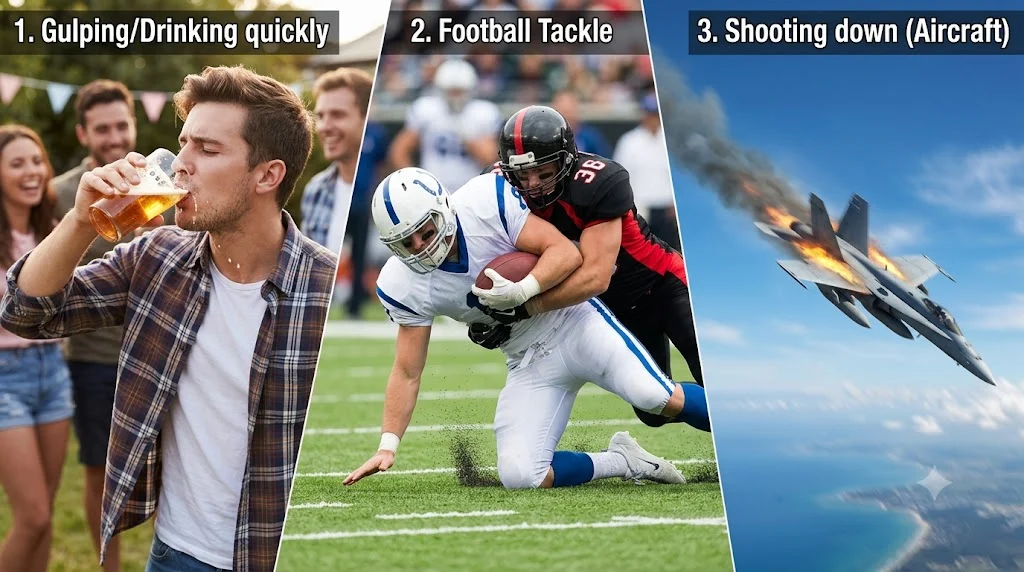
Have you ever watched someone chug an entire beer in under five seconds? Or seen a fighter jet explode mid-air in an action movie? Or witnessed an underdog team demolish the reigning champions?
All these scenarios share one common verb: downing.
This single word carries surprising weight. It describes everything from finishing a drink in one gulp to bringing down a massive opponent. The beauty of downing lies in its versatility and punchy simplicity. You don’t need fancy vocabulary when downing does the job so effectively.
The downing meaning shifts dramatically based on context. At a party, it means rapid consumption. On a football field, it means defeat. In military terms, it means destruction. Yet each usage shares a core concept: something moves from a higher position to a lower one, whether physically or metaphorically.
Understanding downing opens up new dimensions of English expression. You’ll sound more natural, more fluent, and more engaging when you master this dynamic verb. So let’s explore every facet of downing meaning, from its ancient roots to its modern slang applications.
Core Meanings of Downing
Consuming Quickly
The most common downing meaning involves rapid consumption. When someone downs a drink, they finish it quickly and often in one continuous motion. This usage dominates casual conversation, particularly in social settings.
Picture a hot summer day. You’ve just finished mowing the lawn. Sweat drips down your face. You grab a glass of ice water and down it in seconds. That refreshing feeling is the essence of downing.
Downing food works similarly. Think about a teenager rushing to school who downs a bowl of cereal in two minutes. Or a construction worker who downs his lunch quickly to get back on the job. Speed defines this meaning.
The downing meaning in this context emphasizes urgency, thirst, or enthusiasm. It’s not about savoring or appreciating. It’s about getting something inside you as fast as possible.
Key characteristics of downing for consumption:
| Aspect | Description |
|---|---|
| Speed | Fast, often continuous |
| Quantity | Usually a full portion or glass |
| Purpose | Thirst quenching, time saving, or competitive |
| Setting | Casual, social, or urgent situations |
| Vibe | Enthusiastic, informal, sometimes dramatic |
Defeating Opponents
Downing takes on a competitive flavor when it means defeating someone. In sports, commentators frequently use downing to describe victory. “The home team downed their rivals 3-1” sounds more dynamic than simply saying “they won.”
This downing meaning connects to the physical act of bringing someone down. In combat sports like boxing or MMA, downing an opponent literally means knocking them to the ground. In team sports, it means outscoring or outplaying them.
The psychological impact of downing someone adds another layer. It implies dominance, superiority, and sometimes humiliation. When you down an opponent, you don’t just beat them. You send a message.
Downing in video games has become increasingly popular. Gamers use it constantly. “I downed three players in that round” means eliminating them from the game. The downing meaning here blends defeat with destruction, creating a powerful sense of accomplishment.
Aviation and Military Contexts
In military and aviation contexts, downing carries serious weight. Downing an aircraft means shooting it down, causing it to crash. This downing meaning appears frequently in news reports about conflicts and defense operations.
The downing of a passenger plane makes international headlines. It represents tragedy, loss, and geopolitical tension. Military downing of enemy aircraft signifies tactical success and strategic advantage.
This usage traces back to the literal meaning of down as movement toward the ground. An aircraft that gets downed moves from the sky to the earth, often destructively. The word captures the abrupt, violent transition.
Weather also uses downing in this context. “The storm downed several power lines” or “High winds downed trees across the city.” Here the downing meaning indicates forceful removal from an upright position.
Downing in Slang and Informal Speech
Drinking Culture
The downing meaning has deep roots in drinking culture. Bars, parties, and social gatherings frequently feature downing challenges. “Can you down this pint?” becomes a test of skill and endurance.
Downing drinks carries social significance. It demonstrates toughness, camaraderie, and willingness to participate. Among friends, downing a shot together creates bonding moments. The shared experience of rapid consumption builds connection.
However, downing alcohol has serious implications. Rapid consumption leads to faster intoxication and increased health risks. Understanding this downing meaning includes recognizing its potential dangers. Responsible drinking means knowing when to sip rather than down.
Texting and Digital Communication
The downing meaning in text and chat has evolved with digital culture. People use downing to describe various quick actions. “I downed my coffee before the meeting” appears frequently in work chats.
In gaming communities, downing dominates vocabulary. Players discuss downing enemies, downing bosses, or getting downed themselves. This downing meaning has become so common that non-gamers often encounter it through streaming and esports.
Slang variations of downing include:
- Down the hatch: A cheerful phrase said before drinking
- Down in one: Completing a drink in a single gulp
- Down for the count: Defeated and unable to continue
Social Media Usage
Social media platforms showcase downing meaning in creative ways. TikTok videos feature downing challenges. Instagram reels show people downing colorful drinks. Twitter discussions use downing to describe political defeats or sports victories.
Influencers often exaggerate downing for entertainment. They down giant smoothies, down entire pizzas, or down massive water bottles. The downing meaning here emphasizes spectacle and engagement.
Etymology and Word Origins
Ancient Roots
The downing meaning begins with the Old English word “dūne.” This word meant “from a high place” or “downward.” It described physical movement toward the earth.
The word “down” itself has Germanic origins. Related words appear in Old Norse (“dúnn”) and Dutch (“duun”). These languages all shared the concept of descending movement.
When English speakers started turning adjectives into verbs, “down” naturally became “to down.” The downing meaning emerged from this transformation. If you could go down, you could also bring something else down.
Evolution Through Centuries
The verb form of down appeared in the late 14th century. Initially, downing meant lowering or putting down. You would down a book or down a tool. The downing meaning was purely physical.
By the 16th century, downing began acquiring figurative meanings. Downing opponents appeared in sports writing. Downing enemies appeared in military accounts. The downing meaning expanded beyond simple physical actions.
The consumption meaning emerged later. In the 19th century, “downing a drink” became common in taverns and pubs. Sailors, laborers, and merchants all used the downing meaning to describe finishing drinks quickly. This usage spread through working-class communities before entering mainstream English.
Modern Development
The 20th century accelerated downing’s evolution. Aviation created new downing meaning around aircraft. Sports broadcasting popularized downing for athletic victories. Drinking culture embraced downing as a social ritual.
Today’s downing meaning reflects centuries of linguistic development. Each era added new layers of meaning. The result is a remarkably flexible word that adapts to almost any context.
Grammar and Usage Guide
Parts of Speech
Downing functions primarily as the present participle of the verb “down.” This means it can serve multiple grammatical roles.
As a verb: “He is downing his breakfast quickly.”
As a gerund (noun): “The downing of the enemy aircraft changed the battle.”
Understanding these roles helps you use downing meaning correctly in sentences.
Conjugation
The verb down follows regular conjugation patterns:
| Tense | Form | Example |
|---|---|---|
| Present | down / downs | I down my coffee every morning. |
| Present Participle | downing | She is downing her smoothie. |
| Past | downed | He downed three beers last night. |
| Past Participle | downed | The pilot downed the enemy jet. |
The downing meaning remains consistent across all forms. Only the time frame changes.
Pronunciation Guide
American English: /ˈdaʊnɪŋ/
British English: /dˈaʊnɪŋ/
The pronunciation rhymes with “town-ing” or “clown-ing.” The “ow” sounds like the word “ouch.” The stress falls on the first syllable.
Common pronunciation mistakes include:
- Saying “dahn-ing” instead of “down-ing”
- Using a short “o” sound instead of the “ow” diphthong
- Adding an extra syllable or dropping the final “g”
Common Collocations
Certain words frequently appear with downing. These pairings create natural-sounding expressions.
For consumption:
- Down a beer
- Down a glass of water
- Down a shot
- Down your dinner
- Down a bottle
For defeat:
- Down an opponent
- Down the competition
- Down a rival
- Down the enemy
Synonyms and Alternatives
Consumption Synonyms
Several words share the downing meaning for rapid consumption. Each carries subtle differences worth understanding.
| Synonym | Nuance | Example |
|---|---|---|
| Chug | Specifically for drinks, often carbonated | He chugged the soda |
| Gulp | Emphasizes swallowing effort | She gulped the medicine |
| Knock back | Informal, often alcohol | They knocked back shots |
| Swallow | General consumption, less speed-focused | Swallow the pill |
| Devour | Food-focused, enthusiastic | He devoured the pizza |
| Ingest | Technical, formal | Ingest the medication |
Chugging specifically refers to continuous drinking without pausing. It’s the closest synonym for downing meaning in beverage contexts.
Gulping emphasizes the physical act of swallowing. It suggests difficulty or urgency.
Knocking back carries a casual, often alcohol-related vibe. It’s very informal.
Defeat Synonyms
Downing meaning in competitive contexts has many alternatives.
| Synonym | Nuance | Example |
|---|---|---|
| Beat | General victory | They beat their rivals |
| Defeat | Formal, definitive | The army defeated the enemy |
| Overcome | Triumph over obstacles | She overcame her fears |
| Conquer | Complete domination | They conquered the territory |
| Vanquish | Dramatic, literary | The hero vanquished the villain |
| Take down | Informal, decisive | He took down the champion |
Take down closely parallels the downing meaning. Both imply bringing someone from a higher to lower position.
Conquer suggests more permanent or complete victory than simple downing.
Vanquish sounds old-fashioned and dramatic. Use it for storytelling rather than everyday conversation.
Antonyms
Understanding opposites clarifies the downing meaning.
For consumption:
- Sip (drink slowly)
- Savor (enjoy gradually)
- Nurse (keep a drink for a long time)
For aviation:
- Launch (send upward)
- Land (bring down safely, not destructively)
- Recover (retrieve undamaged)
Downing vs. Drinking
The Speed Factor
The most significant difference between downing and drinking is speed. Drinking covers all consumption rates. Downing specifically indicates rapid consumption.
Think of drinking as the general category. Downing is a specific type of drinking. All downing involves drinking. Not all drinking involves downing.
When you sip wine at a restaurant, you’re drinking. When you gulp water after exercise, you’re drinking. Only the fast gulping qualifies as downing.
The Intensity Factor
Downing carries intensity that drinking lacks. It suggests urgency, enthusiasm, or challenge. Drinking feels neutral. Downing feels active.
Consider these examples:
- “She drinks coffee” (neutral, habitual)
- “She downs her coffee” (urgent, rushing)
The downing meaning adds drama and energy to the sentence. It transforms a simple action into something noteworthy.
The Social Factor
Downing often has social or competitive dimensions. Drinking can be solitary or social. Downing is frequently performative.
People down drinks to impress others. They down drinks to participate in challenges. They down drinks to demonstrate toughness or commitment. Drinking doesn’t carry these implications.
At a party, someone who downs their drink gets attention. Someone who sips their drink goes unnoticed. The downing meaning has built-in social significance.
Downing in Sports
Combat Sports
In boxing, MMA, and wrestling, downing has literal meaning. A fighter downs their opponent by knocking them to the ground. The downing meaning here connects to the physical act of falling.
Scoring systems in combat sports often reward downing. A knockdown scores points. A knockout ends the match. The downing meaning carries competitive weight.
Professional fighters train specifically to down opponents. They study techniques for disrupting balance and causing falls. Downing becomes both a goal and a strategy.
Team Sports
Team sports use downing more figuratively. A football team downs their rivals by outscoring them. A basketball team downs their opponents through superior play.
Commentators love the downing meaning for its vivid imagery. “They downed the champions” creates a stronger mental picture than “they won.” The word implies not just victory but dominance.
Statistics often track downing occurrences. Coaches analyze how teams down their opponents. Strategies develop around preventing or achieving downing.
Esports and Gaming
Video games have adopted downing enthusiastically. Players down enemies, down bosses, and down entire teams. The downing meaning in gaming combines defeat with elimination.
Battle royale games feature downing prominently. When you down an opponent, you remove them from the match temporarily or permanently. The downing meaning becomes a core game mechanic.
Competitive gaming broadcasts use downing terminology constantly. Casters describe downing in real-time. Viewers understand the stakes of each downing moment.
Downing in Aviation and Military
Combat Operations
Military aviation relies heavily on downing meaning. Downing enemy aircraft remains a primary objective in air combat. Fighter pilots train extensively for downing missions.
The downing of an aircraft involves sophisticated tactics. Pilots use missiles, cannons, and electronic warfare to down opponents. Each downing changes the battlefield balance.
Historical downing records document air superiority. Ace pilots achieve legendary status through multiple downings. The downing meaning in this context carries historical weight.
Air Defense Systems
Ground-based systems also down aircraft. Surface-to-air missiles down enemy planes. Anti-aircraft artillery down incoming threats. The downing meaning extends to defensive operations.
Modern air defense networks coordinate to down hostile aircraft. Radar tracks targets. Commanders authorize downing. Systems execute the downing automatically or manually.
Civilian air defense also exists. Some countries deploy systems to down hijacked planes. These extreme measures prevent greater tragedies. The downing meaning in these cases involves terrible necessity.
Accidental Downings
Tragically, downings sometimes happen accidentally. Misidentification causes friendly fire downings. Technical failures cause unintentional downings. Human error leads to devastating downings.
Accidental downings of civilian aircraft create international incidents. Families lose loved ones. Nations demand accountability. The downing meaning transforms from military success to human tragedy.
Investigations into accidental downings follow strict protocols. Black boxes provide evidence. Radar data reveals sequences. Criminal or civil liability may result.
Downing in Food and Drink Culture
Competitive Eating
Competitive eating showcases downing meaning in extreme form. Contestants down massive quantities of food in minutes. Hot dogs, pizza, and burgers all get downed competitively.
Major League Eating organizes professional eating competitions. Athletes train specifically to down food faster. The downing meaning becomes a competitive sport.
Records for downing food continue to fall. Joey Chestnut downed 76 hot dogs in 10 minutes. Competitive eaters down entire chickens, entire cakes, and entire watermelons. The downing meaning reaches peak intensity.
Drinking Challenges
Drinking challenges rely entirely on downing meaning. Participants down shots, down pitchers, or down specialty cocktails. Speed determines winners.
Famous drinking challenges include:
- The Centurion: Down a shot of beer every minute for 100 minutes
- The Power Hour: Down a shot of beer every minute for 60 minutes
- The Yard: Down a yard-long glass of ale
- The Irish Car Bomb: Down a pint with a shot dropped inside
Safety concerns around downing alcohol have increased. Many establishments discourage rapid consumption. Downing meaning now includes awareness of alcohol poisoning risks.
Food Culture
Normal dining occasionally features downing. Rushed workers down lunch at their desks. Students down breakfast before class. Parents down meals while chasing children.
The downing meaning in these contexts reflects modern time pressures. We down food because we lack time to savor it. Our culture values speed over experience.
Some chefs and food writers advocate against downing. They promote mindful eating and appreciation. The downing meaning becomes a target for food reform.
Downing in Medicine and Health
Medication Administration
Patients down medications daily. Pills, liquids, and supplements get downed for health reasons. The downing meaning here involves necessity rather than pleasure.
Downing medication requires technique. Swallowing pills takes practice. Liquid medications need proper measurement. The downing meaning in medicine emphasizes safety.
Healthcare providers counsel patients on proper downing. They recommend water, food, or positioning. The downing meaning in medicine involves compliance and effectiveness.
Hydration Importance
Athletes down fluids for hydration. Water, sports drinks, and electrolyte solutions get downed during exercise. The downing meaning here connects to performance.
Proper hydration involves downing enough fluids. Athletes down water before competitions. They down sports drinks during events. They down recovery beverages afterward.
The downing meaning in sports science has precise recommendations. Drink early, drink often, and down fluids strategically. Hydration protocols maximize athletic performance.
Eating Disorders
Downing takes troubling forms in eating disorders.The downing meaning becomes associated with illness.
Treatment programs address downing behaviors. Therapists help patients understand their downing triggers. Nutritionists teach healthy eating patterns. The downing meaning transforms from compulsion to control.
Public health campaigns sometimes reference downing. They discourage downing high-sugar drinks. They promote moderation over speed. The downing meaning carries health implications.
Downing in Everyday Conversation
Casual Usage
People use downing meaning constantly in casual conversation. “I downed my coffee and ran out the door” sounds natural and relatable. This usage appears in daily speech across English-speaking communities.
Workplace conversations feature downing frequently. “I downed lunch at my desk” communicates busy schedules. “We downed that project quickly” means efficient completion. The downing meaning extends beyond literal consumption.
Friends use downing meaning when sharing stories. “She downed her drink and started dancing” paints a vivid picture. “He downed the competition without breaking a sweat” shows admiration.
Professional Settings
Surprisingly, downing appears in professional contexts too. Business emails mention downing tasks. Meetings discuss downing obstacles. Presentations reference downing competitors.
The downing meaning in business suggests dynamism. Companies that down their competitors show strength. Teams that down their targets demonstrate efficiency. The word carries positive connotations of action and achievement.
Professional writers use downing meaning carefully. They balance informality with appropriateness. They recognize that downing works best in certain contexts.
Regional Variations
Different regions use downing meaning distinctively. British English frequently uses downing for drinking. American English applies downing more broadly. Australian English embraces downing in sports contexts.
Regional idioms incorporate downing meaning. “Down the hatch” appears in many regions. “Down in one” is more common in the UK.
Understanding regional variations helps language learners. The downing meaning remains constant, but usage patterns differ. Context determines appropriateness.
Downing in Literature and Media
Literary Usage
Authors use downing meaning for vivid descriptions. Downing a drink shows character urgency. Downing an opponent shows physical dominance
Classic literature contains downing references. Hemingway wrote about downing drinks. Steinbeck described downing food. Modern authors continue this tradition.
The downing meaning in literature often carries symbolic weight. Downing something represents consuming or destroying. Characters who down things show their nature.
Film and Television
Movies and shows feature downing frequently. Action heroes down drinks before fights. Villains down their enemies dramatically. Comedians down food for laughs.
The downing meaning in visual media creates memorable moments. “Down the hatch” scenes become iconic. Sports movie downing sequences generate excitement. Drinking contest downing scenes provide tension.
Television cooking competitions showcase downing. Contestants down ingredients quickly. Judges down samples for evaluation. The downing meaning adds entertainment value.
News Reporting
News outlets use downing meaning for clarity. “Military downs hostile drone” makes an effective headline. “Storms down power lines” communicates clearly. The downing meaning works well for breaking news.
Political reporting uses downing meaning metaphorically. “Candidate downs opponent in debate” describes verbal victory. “Policy downs opposition” shows legislative success. The downing meaning translates well to politics.
Journalistic standards require careful downing usage. Reporters confirm downing facts before reporting. Editors ensure appropriate downing contexts. The downing meaning must remain accurate.
Common Mistakes with Downing
Overusing the Term
Downing meaning loses impact with overuse. Using it for every consumption or defeat becomes repetitive. Skilled communicators vary their vocabulary.
Instead of “I downed my coffee,” try “I rushed through my coffee.” Instead of “We downed the competition,” try “We dominated the competition.” Variation keeps language fresh.
The downing meaning works best for emphasis. Save it for situations that genuinely involve speed or force. Use it sparingly for maximum effect.
Incorrect Contexts
Downing meaning doesn’t fit all situations. Formal writing should avoid it. Academic papers rarely use downing. Legal documents never use downing.
Sensitive situations also avoid downing. Discussing accidents or tragedies with downing seems disrespectful. Downing meaning requires appropriate emotional context.
Cultural sensitivity matters too. Some communities find downing alcohol references offensive. Understanding audience helps determine downing appropriateness.
Pronunciation Errors
Mispronouncing downing creates confusion. Saying “dawning” instead of “downing” changes meaning entirely. “Dawning” relates to sunrise, not consumption or defeat.
Regional accents sometimes affect downing pronunciation. Listen to native speakers for guidance. Practice the correct vowel sound. The downing meaning depends on proper pronunciation.
Spelling mistakes also cause problems. “Drowning” means suffocation in water, not rapid consumption. Proofread carefully to avoid embarrassing errors.
Downing in Different Dialects
American English
American English uses downing meaning broadly. Consumption, defeat, and aviation all feature. The downing meaning appears in casual and professional contexts.
American sports broadcasting popularized downing. “They downed the Jets 24-10” is standard commentary. American military reporting uses downing for aircraft. American drinking culture embraces downing.
Regional American variations exist. Southerners might use downing differently than Northerners. West Coast usage differs from East Coast. The downing meaning remains recognizable everywhere.
British English
British English frequently uses downing for drinking. “He downed his pint” sounds very British. British pubs feature downing culture prominently.
British sports use downing too, but differently. “They downed their rivals” appears less than “They beat their rivals.” Cricket and rugby have specific downing terminology.
British English pronunciation slightly differs. The vowel sound in “down” is less pronounced. The downing meaning remains clear regardless.
Australian and New Zealand English
Australian and New Zealand English embrace downing meaning enthusiastically. Drinking culture makes downing common. Sports commentary uses downing frequently.
Australian slang incorporates downing creatively. “Down a tinnie” means drink a canned beer. “Down the grog” means consume alcohol. The downing meaning adapts to local culture.
New Zealand English follows similar patterns. Rugby commentary features downing. Casual conversation uses downing naturally. The downing meaning fits Antipodean culture.
Indian English
Indian English uses downing meaning in specific contexts. Metropolitan areas reflect global usage. Traditional contexts use downing less frequently.
Indian sports commentary uses downing for cricket victories. “India downed Pakistan in the final” appears regularly. Indian drinking culture incorporates downing among younger generations.
Indian English pronunciation varies by region. Some pronounce downing with stress on the first syllable. Others stress differently. The downing meaning remains identifiable.
Downing in Popular Culture
Music References
Songs frequently reference downing. Country music mentions downing beers. Hip-hop mentions downing drinks. Pop music references downing challenges.
Lyrics using downing meaning include:
- “We downing shots, we getting loose”
- “Down the hatch, we celebrate tonight”
- “Downing sorrows, trying to forget”
Music videos visualize downing meaning dramatically. Artists down expensive drinks. Crowds down beverages in celebration. The downing meaning becomes visual entertainment.
Movie Scenes
Iconic movie scenes feature downing. James Bond downs martinis. Action heroes down whiskey. Comedians down milk for laughs.
The downing meaning in movies creates character moments. A character who downs a drink shows confidence. A character who downs food shows desperation.
Directors use downing to convey traits. Downing shots shows coolness. The downing meaning communicates character efficiently.
Video Game Culture
Video games have embraced downing meaning completely. Players discuss downing constantly. Streaming platforms feature downing moments. Esports organizations analyze downing statistics.
The downing meaning in gaming has specific mechanics:
- Downing an enemy removes them from play
- Downing a boss progresses the game
- Downing a teammate creates humor or frustration
Gaming communities have developed downing terminology. “Downed but not out” means temporary elimination. “Get downed” means suffer defeat. The downing meaning evolves with gaming culture.
The Future of Downing
Language Evolution
The downing meaning continues to evolve. New technologies create new downing contexts. Social media accelerates language change. Global communication spreads downing variations.
Future downing meanings might include:
- Downing digital files (deleting quickly)
- Downing online content (consuming rapidly)
- Downing virtual opponents (defeating in VR)
The downing meaning will adapt to new realities. The core concept of fast downward movement remains constant. New applications will emerge naturally.
Generational Differences
Younger generations use downing differently. Digital natives apply downing to tech contexts. Millennials use downing for consumption. Gen Z applies downing to social media.
Older generations favor traditional downing meanings. They down drinks and down opponents. They use downing meaning in familiar contexts. Generation gaps in usage exist but overlap.
Cross-generational understanding remains strong. Everyone recognizes downing meaning even if they use it differently. The word bridges age groups effectively.
Global Spread
English continues spreading globally. Downing spreads with it. New speakers adopt downing meaning naturally. The word joins international vocabulary.
Non-native speakers learn downing in English classes. They encounter downing meaning in media. They practice downing usage in conversation. The word becomes increasingly global.
Translation challenges exist for downing. Many languages lack exact equivalents. Cultural adaptation becomes necessary. The downing meaning sometimes requires explanation.
FAQs
1. What does “downing” mean?
“Downing” usually means drinking or consuming something quickly, especially in one go. It can also mean knocking something down or defeating someone, depending on the context.
2. Is “downing” a slang word?
Not always. “Downing” is a standard English word, but it’s often used informally when talking about quickly drinking a beverage.
3. How do you use “downing” in a sentence?
Example: He was downing a bottle of water after finishing the race.
4. Does “downing” always refer to drinking?
No. While it commonly means drinking something quickly, it can also mean bringing something down, such as a tree, an aircraft, or an opponent.
5. What is the difference between “drinking” and “downing”?
“Drinking” is a general term for consuming a beverage, while “downing” specifically suggests drinking it rapidly or all at once.
6. Is “downing” commonly used in everyday English?
Yes. It is frequently used in casual conversations, sports commentary, news reports, and everyday speech.
7. Can “downing” have different meanings in different contexts?
Yes. Its meaning depends on the situation. It may refer to drinking quickly, knocking something down, or defeating someone.
8. Is “downing” a positive or negative word?
It is generally neutral. Whether it sounds positive or negative depends on the context in which it is used.
Conclusion
The downing meaning represents English at its most versatile. This simple verb describes rapid consumption, decisive defeat, destructive force, and countless variations between. Understanding downing meaning unlocks clearer communication and more vivid expression.
Remember the key distinctions. Downing a drink emphasizes speed. Downing an opponent emphasizes dominance. Context determines meaning, and meaning enriches context.
Language evolves constantly. The downing meaning will continue growing. New technologies and cultures will add new dimensions. The core concept of downward force will remain central.
So next time you down a drink, or down an opponent, or read about downing an aircraft, you’ll understand the full weight of the word. You’ll appreciate its history, its versatility, and its power. The downing meaning connects you to centuries of English expression and countless future possibilities.
Discover More Related Articles:
- SAHM Meaning | What It Stands for & How People Use It In 2026
- Nuanced Meaning | Text, Writing & Conversation In 2026