

Definition
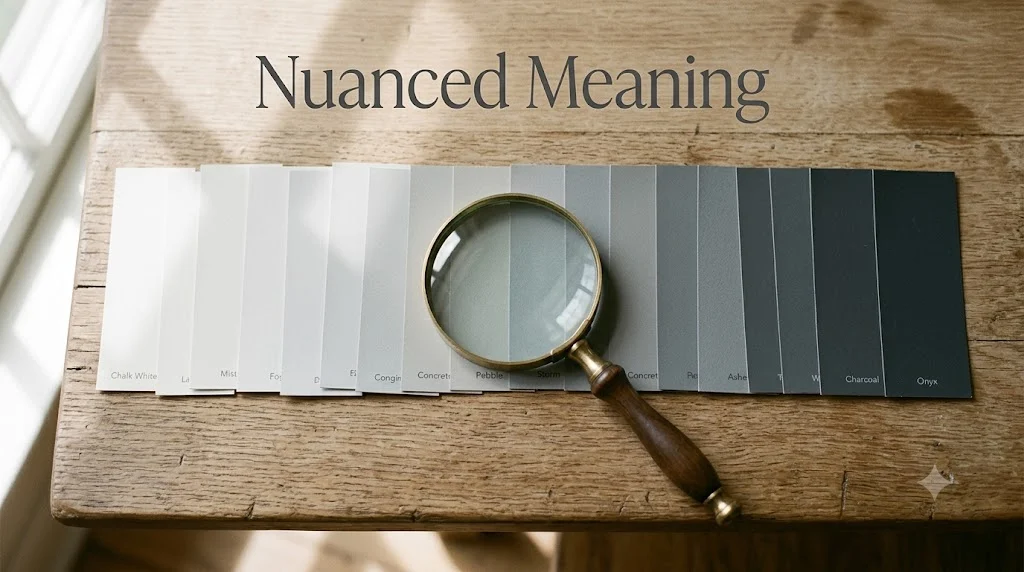
Nuanced means having subtle differences, small details, or slight variations in meaning, feeling, or expression that are important to understand. Something that is nuanced is not simple or black-and-white it has layers of meaning or complexity.
The word nuanced describes something that has subtle differences, fine details, or layers of meaning that are not immediately obvious. Instead of being simple or straightforward, a nuanced idea, opinion, or situation often requires careful thought to fully understand. You’ll commonly encounter this word in conversations about communication, literature, politics, art, and everyday decision-making.
Understanding the meaning of nuanced is valuable because it helps you recognize that not every topic has a clear-cut answer. A nuanced perspective considers multiple viewpoints, emotions, or factors rather than reducing everything to black-and-white thinking. This makes the word especially useful in writing, debates, professional discussions, and personal conversations where context matters.
In this guide, you’ll learn the nuanced meaning, its definition, pronunciation, origin, synonyms, antonyms, and how to use it correctly in sentences. We’ll also explore real-life examples, common mistakes, and related terms so you can confidently understand and use nuanced in both spoken and written English.
What Does Nuanced Actually Mean
Before we go anywhere else, we need to get crystal clear on the definition. The nuanced meaning starts with the basics.
The Dictionary Definition
Nuanced (adjective): Characterized by subtle shades of meaning or expression. A nuanced statement recognizes fine distinctions that others might miss.
Nuance (noun): A subtle distinction or variation. A delicate difference in meaning, opinion, or color.
Pronunciation: In American English, you say NOO-ahnst. In British English, you might hear NYOO-ahnst. Both are correct. The emphasis lands on the first syllable.
The Origin Story
The word traces back to the French nuer, meaning “to shade.” Think about how clouds pass over a landscape. The colors shift. The light changes. Nothing becomes wholly different. Yet everything feels altered. That is nuance in action. It is the subtle variation that transforms the whole experience.
Breaking It Down in Plain English
A nuanced view acknowledges that most things are not simple. It is recognizing that a person can be both kind and flawed. A policy can have both good intentions and bad outcomes. A piece of art can be both beautiful and unsettling.
The key insight is this: nuance does not mean being unsure. It means being accurate. You are trading oversimplified certainty for richer understanding.
Think of it like this. A child sees the world in binary terms. Good guys and bad guys. Happy endings and sad ones. Adults who develop nuanced thinking understand that life exists in the in-between spaces. The hero has weaknesses. The villain has motivations. Every story has multiple angles.
Nuanced vs Related Terms
People often confuse nuance with other similar words. They are not interchangeable. Here is the breakdown.
| Term | What It Means | How It Differs from Nuance |
|---|---|---|
| Subtle | Hard to notice; delicate | Subtle is about detectability. Nuance is about depth of meaning. Something can be obvious and still nuanced. |
| Complex | Having many interconnected parts | Complexity is about structure. Nuance is about meaning. A complex machine is not necessarily nuanced. |
| Ambiguous | Open to multiple interpretations | Ambiguity is unclear. Nuance is precise but acknowledges multiple valid angles. |
| Sophisticated | Highly developed or refined | Sophistication suggests polish. Nuance suggests perception. You can be sophisticated and still miss nuance. |
The Synonym Spectrum
Choosing the right synonym depends on context. Here are your best options.
Strong Synonyms for Most Situations:
- Layered
- Multifaceted
- Refined
- Discerning
- Insightful
- Detailed
- Delicate
Situational Synonyms:
- For opinions: qualified, measured
- For analysis: thorough, comprehensive
- For art or writing: rich, evocative
- For people: perceptive, astute
Clear Antonyms to Avoid:
- Oversimplified
- Crude
- Black-and-white
- One-dimensional
- Blunt
- Uncomplicated
- Direct
The Difference Between Nuance and Subtlety
This confusion comes up constantly. Let us settle it once and for all.
Subtlety is about size and detectability. A subtle change is small. You might miss it if you are not paying attention. A subtle flavor is faint. It sits in the background.
Nuance is about depth and meaning. A nuanced argument has many layers. Each layer connects to the others. The whole thing is richer because of the variations.
A subtle insult is easy to miss. A nuanced insult hits you from multiple angles and leaves you wondering exactly what just happened. That is the difference.
Why Nuance Matters in Every Area of Life
You might be thinking: this sounds like academic jargon. Who actually needs this? The answer is everyone. Here is why.
In Everyday Conversations
Think about the last time someone said “I’m fine” and you knew they were not. That is nuance.
The Danger of Nuance Blindness in Conversation:
When you ignore nuance in conversation, you make predictable mistakes.
You misinterpret intent. Someone sounds passionate and you read it as aggression. Someone is being careful and you read it as dishonesty. You overlook emotional states. A person says they are fine when they are struggling. You take their words at face value and miss the opportunity to connect. You miss the actual question being asked. Someone asks “Are you busy?” and you answer literally. What they really meant was “Can you help me?”
Good communicators live in the space between the words. They hear what is being said and what is not being said. That skill is what makes people feel understood.
In Professional Settings
The difference between a good leader and a great one often comes down to nuance.
A nuanced leader understands that motivation is not one-size-fits-all. What drives one team member might leave another cold.
They recognize that “we need to increase productivity” is simplistic. The real question is how to increase productivity without burning people out. That question demands nuance.
They see that a client’s “no” might mean several things:
- Not yet
- Not like that
- Not at that price
- Convince me more
- I do not trust you yet
A non-nuanced person hears “no” and moves on. A nuanced person hears “no” and keeps asking the right questions.
In Writing and Marketing:
Generic content dies. Nuanced content converts.
Instead of “Our product is the best,” which everyone says and nobody believes, a nuanced writer says “Our product solves X problem for Y type of person in Z situation.” That specificity lands differently.
Nuanced writing acknowledges objections instead of ignoring them. It speaks to the specific person reading, not a generic audience. It uses precise language instead of vague promises.
In Academic and Legal Contexts:
This is where nuance lives or dies. A nuanced legal argument considers precedent, intent, and real-world impact. It does not just apply rules mechanically. It understands the spirit behind the rules.
Academic research without nuance produces garbage conclusions. The best papers are the ones that say “It is complicated” and then show you exactly why. They do not oversimplify. They embrace complexity and guide you through it.
In Politics and Social Issues
This is where nuance matters most. And where it is rarest.
The ugly truth is that most political discourse is a nuance-free disaster. We have reduced complex problems to team sports. You pick a side. You root for your team.
Example: Healthcare
A non-nuanced view says “Universal healthcare is good” or “Universal healthcare is bad.” That is it. One simple statement.
A nuanced view says something different. “Universal healthcare could improve access for millions. But implementation challenges are significant. Some systems work better than others. Outcomes depend heavily on how you structure funding, coverage, and provider incentives. The Canadian model differs from the UK model. Neither is perfect. Both have lessons to offer.”
Which version is more truthful? The nuanced one. Which version is more useful? The nuanced one.
Why This Matters:
Nuance in politics is not about being centrist. It is not about being moderate. It is about being honest. Complex problems rarely have simple solutions. Pretending they do is how we end up with bad policy and angry people. You can have strong convictions and still acknowledge complexity. In fact, that makes your convictions stronger. They have faced the challenge and survived.
In Art, Literature, and Pop Culture
Great art is almost always nuanced. That is what makes it great.
In Film and Television:
A nuanced performance makes a character feel human. Think about Walter White from Breaking Bad. He is not simply good or evil. He is a man with understandable motivations who makes horrific choices. The show forces you to see his humanity while condemning his actions. That tension is nuance.
In Music:
Some songs hit you in a simple way. Happy song equals happy feeling. Sad song equals sad feeling. Others capture a complex emotional state. Joy tinged with sadness. Anger mixed with love. Exhaustion wrapped in hope. The latter has nuance. It lingers because it mirrors real life.
In Literature:
Great writers do not tell you what to think. They show you a situation from multiple angles. That is literary nuance. It is what separates lasting work from forgettable fluff.
In Pop Culture Criticism:
The most interesting critics are the ones who can hold two ideas at once. “This movie has problematic elements AND it is still worth watching.” “This artist made a great album AND their personal behavior is troubling.” That takes nuance. It also produces more interesting conversation than simple condemnation or praise.
How to Recognize Nuance in Writing and Speech
Now that you understand why nuance matters, let us talk about how to spot it. These are practical skills you can use right away.
The Telltale Signs of Nuanced Thinking
Look for these markers in any piece of writing or any conversation.
1. Qualifying Language
Nuanced thinkers qualify their statements. They use phrases like:
- In some cases
- This does not always apply when
- From a certain perspective
- Depending on the context
- It is worth noting that
- Under these specific conditions
These phrases are not weakness. They are precision. They show the speaker understands that context matters.
2. Acknowledging Counterarguments
Nuanced thinkers do not pretend opposing views do not exist. They address them directly and fairly. They say things like:
- I understand why someone might see it differently
- Critics of this view point out that
- There are legitimate concerns about
- The other side makes a valid point about
This does not mean they agree. It means they are honest about the landscape of disagreement.
3. Specificity Over Generality
Instead of “people like this,” they say “this specific group in these circumstances.” Instead of “this always happens,” they say “this often happens when X, Y, and Z are present.” Specificity is the enemy of oversimplification.
4. Emotional Awareness
They notice tone, not just content. They recognize that how something is said matters as much as what is said.
5. Comfort with Complexity
They do not rush to conclusions. They ask more questions before forming opinions.
The Red Flags of Nuance-Free Thinking
Watch out for these warning signs in your own thinking and in what you consume.
Absolutes: Always, never, everyone, no one, completely, totally, entirely. If someone uses these words frequently, they are probably oversimplifying.
Dismissive Phrases: “That is just…” “Obviously…” “Clearly…” “Everyone knows…” These phrases shut down inquiry. They assume the answer is so obvious that no further examination is needed.
Inability to Acknowledge Valid Points: If someone cannot grant a single valid point on the other side, they are not thinking seriously. They are performing.
Resorting to Labels: Instead of engaging with ideas, they call people names. They dismiss entire viewpoints by associating them with something negative. That is the opposite of nuanced.
Single-Cause Explanations: Complex problems have many causes. If someone points to one thing as the sole explanation, they are selling you a simplified story.
Real-World Examples
Let us look at how nuance changes the same basic idea.
| Non-Nuanced Statement | Nuanced Statement |
|---|---|
| “That movie was terrible.” | “The cinematography was stunning. The acting was solid. But the pacing felt off to me. I can see why others loved it, though.” |
| “Social media is destroying society.” | “Social media creates genuine connection for some people. It can increase loneliness for others. The effect seems to depend heavily on how you use it and your existing social situation.” |
| “You are wrong.” | “I see it differently. Here is my reasoning. What do you think? Where do we disagree specifically?” |
| “Capitalism is evil.” | “Capitalism has produced extraordinary prosperity and lifted billions out of poverty. It also creates inequality and externalizes costs. The question is not whether to have markets but how to regulate them.” |
| “All politicians are corrupt.” | “Many politicians are honest public servants working within a flawed system. Some are corrupt. The system itself creates incentives that make corruption more likely. The problem is structural as well as personal.” |
Notice the pattern. The nuanced versions are longer.
How to Develop a More Nuanced Perspective
This is the practical section. Here is how you actually build this skill.
Practice Intellectual Humility
Intellectual humility is the foundation of nuance. It is the recognition that you could be wrong. Not always. Not performatively. But genuinely.
Why This Matters:
If you assume you are right about everything, you never learn anything. You never update your beliefs. You never grow. Intellectual humility is not weakness. It is strength. It means you are confident enough to admit error.
How to Practice:
Before forming an opinion, ask yourself: “What would change my mind about this?” If the answer is nothing, you are being dogmatic. That is fine for some things. Gravity is gravity. But most things are not gravity.
Seek out perspectives you disagree with. Not to argue. To understand. Read the best version of the opposing view. Find the smartest person who disagrees with you and read what they have to say.
When you feel defensive, pause. Ask why. Often defensiveness is a sign that your assumptions are being challenged. That is a good thing. It is an opportunity to refine your thinking.
Ask Better Questions
The quality of your questions determines the quality of your thinking. Simple questions produce simple answers. Better questions produce richer understanding.
Instead of asking: Is this good or bad?
Ask: Good for whom? In what context? Compared to what alternative? At what cost? Under what conditions? For how long? For how many people?
Instead of asking: What does this mean?
Ask: What might this mean to different people?
Instead of asking: Who is right?
Ask: What can we learn from each perspective? Where do they agree? Where does the real disagreement lie? What are the stakes?
Good questions are the engines of nuance. They push you past the surface.
Slow Down Your Thinking
Most of us default to quick, instinctive judgments. This is efficient. It is also often wrong. Our brains take shortcuts. Those shortcuts are useful in many situations. They are terrible for nuanced thinking.
The Fix:
When you catch yourself making a snap judgment, take a breath. Literally. Pause for two seconds. Ask yourself: “What am I not seeing here?”
Consider the possibility that the situation is more complicated than it appears. Is there a factor you are ignoring? An angle you have not considered? An assumption you are making without evidence?
Make it a habit to check your initial reactions. “That person is rude.” Pause. “Or are they having a bad day? Or did I misinterpret what they said?” These small pauses add up over time.
Learn to Sit with Ambiguity
Our brains crave certainty. Uncertainty feels uncomfortable. It feels like a gap that needs to be filled. We rush to fill it with the first available answer.
The Reality:
Most important things are uncertain. The future is uncertain. Other people’s motivations are uncertain. The best course of action is often uncertain. This is okay. It is normal.
The Practice:
Try holding two opposing ideas in your head at once. Not to choose between them. Just to see what it feels like. This is a mental muscle that needs exercise.
Practice saying “I do not know” and actually meaning it. You do not have to have an opinion on everything. You do not have to have a definitive answer to every question.
Recognize that not having an immediate opinion is often a sign of thoughtfulness. It is not weakness. It is intellectual maturity.
Read and Write More
These two activities are the most effective ways to build nuanced thinking. They force your brain to slow down and engage with complexity.
Reading:
Read things that challenge your worldview. If you lean left, read some conservative writers. The goal is not conversion. The goal is understanding.
Pay attention to how skilled writers handle complexity. Notice when an author makes you see something in a new way. Notice what techniques they use. How do they acknowledge counterarguments?
Read slowly. Reread passages that seem important. Take notes if you want. Reading is not a race.
Writing:
Explain your own views in writing. This forces you to be precise. Vague ideas look solid in your head. They look flimsy on the page.
When you write, imagine someone reading it who disagrees with you. What would they object to? How would they challenge your assumptions? Address those challenges in advance.
Use writing to test your ideas, not just to broadcast them. Write drafts that no one else will see. Think out loud on paper. This is how you develop your thinking.
Common Mistakes and Misconceptions
Let us clear up some confusion. These misunderstandings prevent people from embracing nuance.
“Nuance Means Being Indecisive”
This is the most common mistake. People hear “nuanced” and think “wishy-washy.” Someone who cannot make up their mind. Someone who always says “it depends.”
The Truth:
Nuance has nothing to do with indecision. It is about making decisions that are informed and precise. A nuanced person can be incredibly decisive. They just have good reasons for their choices.
Think about a doctor making a diagnosis. They consider symptoms, test results, medical history, and risk factors. That is nuanced. It also leads to a clear decision about treatment. The nuance is what makes the decision accurate.
You can be nuanced and have strong opinions. The difference is how you express them and whether you acknowledge complexity. Strong plus nuanced is powerful. Strong plus simple is dangerous.
“Nuance Is for Intellectuals and Academics”
This misconception makes nuance seem elitist. Like something only philosophy professors care about.
The Truth:
Nuance matters everywhere. A mechanic diagnosing a weird engine noise needs nuance. They test one thing at a time. That is nuance in action.
A parent understanding their teenager’s mood needs nuance. The teenager says nothing is wrong. The parent notices body language and tone. They know something is up. They ask careful questions. That is nuance.
Anyone navigating relationships needs nuance.
“Being Nuanced Means Being Neutral”
People sometimes think nuance requires you to take the middle position on every issue. To say both sides are equally valid. To avoid taking a stand.
The Truth:
You can have strong opinions and still be nuanced. The difference is how you express them and whether you acknowledge complexity.
You can believe strongly in climate action while acknowledging that transition costs are real and need to be managed. You can believe strongly in free markets while acknowledging that regulation is sometimes necessary. Strong opinions and nuance are not opposites. They are complements.
“Nuance Is Just Overcomplicating Things”
This one gets it exactly backward. Real nuance clarifies. It does not muddy the waters.
The Truth:
Nuance reveals the actual contours of a situation. It shows you where the edges are. It helps you see the shape of the problem. Oversimplification is what creates confusion. It paints over the details and leaves you with an inaccurate picture.
Simple answers to complex problems are not clarifying. They are misleading. They give you the illusion of understanding without the substance.
Practical Applications of Nuanced Thinking
Let us make this concrete. Here is how to apply nuance in specific areas.
In Your Writing
Do This:
Use specific examples instead of vague generalizations. Instead of “this is a common problem,” say “this affects about 30 percent of small businesses in the manufacturing sector.” Specificity is convincing.
Acknowledge limitations and exceptions. Every argument has them. Ignoring them makes your writing weaker. Addressing them makes it stronger.
Let your reader see your reasoning process. Do not just state conclusions. Show the evidence. Show the counterarguments you considered. This builds trust
Vary your sentence structure to match the complexity of your ideas. Short sentences for impact. Longer sentences for exploration. The rhythm should match the content.
Avoid This:
Oversimplifying complex ideas because you think it makes them more accessible. It does not. It makes them inaccurate.
Using jargon when plain language works. Jargon is often used to sound smart. It usually just confuses people.
Making absolute claims without qualification. “Always” and “never” are almost always wrong. There are very few things that are always or never true.
In Your Conversations
Listen actively. Do not just wait for your turn to speak. Pay attention to what the other person is saying. Notice their tone. Notice their body language.
Ask follow-up questions. “Why do you see it that way?” “What led you to that conclusion?” “Can you tell me more about that?” These questions show you are engaged. They also help you understand the depth of their perspective.
Paraphrase back. “So you are saying…” This checks your understanding. It shows you are listening. And it often prompts the other person to clarify further.
Resist the urge to argue. You are not trying to win. You are trying to understand. If you disagree, say so thoughtfully. Do not attack. Do not dismiss. Engage with the best version of their view.
In Your Decision-Making
Gather more information. Nuance demands data. Do not make decisions based on gut feelings alone. Get the facts. Get multiple perspectives.
Consider second-order effects. What happens after your decision? And after that? What are the indirect consequences? The unintended consequences? Most decisions have ripple effects.
Weigh trade-offs honestly. Every choice has costs. A nuanced decision acknowledges them. It does not pretend the perfect option exists. It picks the best available option and understands its limitations.
Seek input from people who disagree with you. They will see things you miss. They will point out risks you overlooked. This is valuable. It is not a threat.
Nuance in Different Contexts
Let us look at how nuance shows up in specific domains.
Nuance in Language and Translation
This is where the concept begins. Language is inherently nuanced. Words carry baggage. They have connotations. They have histories.
Denotation vs Connotation:
Denotation is the literal meaning of a word. Connotation is the emotional and cultural weight it carries. The difference matters enormously.
Take the word “cheap.” Denotatively, it means low cost. Connotatively, it suggests low quality, low status, something to be looked down on. “Affordable” has a different connotation. “Inexpensive” has another. “Budget-friendly” has yet another.
Nuance in language means choosing the right word for the right context. It means understanding the weight of what you say.
Translating Across Cultures:
Nuance is extremely difficult to translate. Languages carry cultural assumptions. They have idioms that do not translate directly. They have structures that shape how people think.
A Japanese speaker might say “it is difficult” to mean “no.” An English speaker hearing that literally would misunderstand completely. That is a cultural nuance. Without understanding it, you cannot really communicate.
Sarcasm and Irony:
These depend entirely on nuance. The literal words say one thing. The tone and context say another. If you cannot detect the nuance, you cannot detect the sarcasm.
Nuance in Emotional Intelligence
Emotional intelligence is basically nuance applied to feelings.
Reading Emotions:
People do not always express emotions directly. They show them indirectly. Through tone. Through body language.
A nuanced person can read these signals. They can tell the difference between genuine anger and frustration born of exhaustion.
Managing Emotions:
Nuance helps with self-awareness too. You can recognize that you are feeling multiple things at once. You can identify the specific flavor of your emotion.
This is crucial for mental health. Many people just feel “bad.” They do not know if they are sad, angry, anxious, lonely, or something else. Nuance helps you name it. And naming it helps you handle it.
Nuance in Cultural Understanding
Different cultures have different levels of nuance. Some cultures value explicit communication. They say exactly what they mean. Other cultures value implicit communication. They expect you to read between the lines.
High-Context vs Low-Context Cultures:
In low-context cultures like the United States or Germany, communication is direct. You say what you mean. The words carry most of the meaning.
In high-context cultures like Japan or Saudi Arabia, communication is indirect. Much of the meaning comes from context, relationship, and status. What is not said is often more important than what is said.
Neither is better. They are just different. Understanding this is a form of nuance. It helps you communicate across cultural boundaries without misunderstanding.
Cultural Sensitivity:
This is applied cultural nuance. It means understanding that different groups have different histories, values, and experiences. It means recognizing that something might be offensive to one group and not to another.
Nuance in Scientific Communication
Science is full of nuance. The public often misses it.
Uncertainty and Probability:
Scientists do not say “climate change is definitely happening.” They say “the evidence overwhelmingly supports the conclusion that climate change is occurring.” There is a difference. The first is certain. The second is as certain as science gets.
Similarly, scientists do not say “this vaccine prevents COVID-19.” They say “this vaccine reduces the risk of symptomatic infection by 95 percent.” There is a huge difference. The first sounds absolute. The second is precise.
Correlation vs Causation:
This is the classic nuanced distinction. Two things can be related without one causing the other. Ice cream sales and shark attacks both go up in summer. Ice cream does not cause shark attacks. They are both caused by something else.
A non-nuanced person sees a correlation and assumes causation. A nuanced person asks questions. They look for alternative explanations. They demand evidence.
Statistical Significance vs Practical Significance:
A study might find a statistically significant result. The difference is real. It is not due to chance. But the difference might be tiny. It might not matter in real life.
A non-nuanced person sees “statistically significant” and concludes “this is important.” A nuanced person asks: how big is the effect? Does it matter practically? For whom does it matter?
The Connection Between Nuance and Critical Thinking
These two skills are deeply intertwined. You cannot have one without the other.
Nuance as the Heart of Critical Thinking
Critical thinking is often defined as thinking about thinking. It is evaluating arguments.
None of that works without nuance. You cannot evaluate an argument fairly if you cannot see its nuance. You cannot examine evidence carefully if you cannot see its context.
Common Fallacies That Kill Nuance
False Dichotomy: Presenting only two options when more exist. “Either you are with us or against us.” This is the enemy of nuance. Real situations usually have more than two possibilities.
Hasty Generalization: Drawing a conclusion based on too little evidence. “All politicians are corrupt because I know one who is.” This ignores nuance. It treats a sample as the whole.
Appeal to Extremes: Rejecting a moderate position because an extreme version is bad. “Gun control means taking everyone’s guns.” No it does not. That is an extreme version of a moderate position.
Straw Man: Misrepresenting someone’s argument to make it easier to attack. This is the opposite of nuance. It requires ignoring the complexity of what they actually said.
How Nuance Strengthens Arguments
A nuanced argument is stronger, not weaker. Here is why.
It anticipates objections. You have already thought of the counterarguments. You have addressed them in advance. This makes your argument harder to dismiss.
It builds credibility. People trust you more when you acknowledge complexity. They know you are not selling them a simple story. You are giving them the real picture.
It withstands scrutiny. Simple arguments fall apart under examination. Nuanced arguments are built to handle challenges. They have considered multiple angles. They have caveats built in.
It opens doors for conversation. A nuanced argument invites dialogue. It does not shut it down. The other person feels heard. They are more willing to listen in return.
Nuance in the Digital Age
The internet makes nuance harder. It also makes it more necessary.
The Algorithm Problem
Social media algorithms reward simple takes. They promote hot takes. They punish careful consideration.
Why This Happens:
Engagement drives algorithms. Extreme content generates more engagement. People click on things that shock them or anger them. They share things that match their existing beliefs. They get into arguments that generate comments.
Nuance does not get clicks. Careful consideration is not shareable. “It is complicated” does not go viral.
The Result:
Our online spaces reward the opposite of nuance. They push us toward oversimplification. They drown out the thoughtful ones.
How to Practice Digital Nuance
Pause before reacting. When you see something that makes you angry, wait. Read it again. Consider the source. Consider the context.
Read the full article. Do not just react to the headline. Headlines are designed to grab attention. They often oversimplify. The article itself might have more nuance. Read it before you share it.
Seek out thoughtful sources. Some publications are better than others. Look for outlets that acknowledge complexity. That include counterarguments. That do not just confirm your biases.
Resist the impulse to share. Sharing something means endorsing it. Even if you are sharing it to criticize it, you are spreading it. Ask yourself: is this worth amplifying? Is this true? Is this nuanced?
Engage with people who disagree. Online, it is easy to only interact with people who agree with you. Do the opposite. Follow people with different perspectives. Engage them respectfully. You might learn something.
The Role of Nuance in Media Literacy
Media literacy is the ability to evaluate information critically. It is crucial in the digital age.
Identifying Bias:
Every source has bias. The question is not whether a source is biased. It is how they handle their bias. Do they acknowledge it? Do they include multiple perspectives?
Evaluating Sources:
Who is writing this? Do they have expertise? Do they have a financial interest in the outcome? Are they citing their sources? Are those sources reliable?
Fact-Checking:
Do not trust something just because it sounds true. Check it. Use fact-checking websites. Follow up on the original sources. If something seems too convenient, it probably is.
What Are the Best Books on Nuance
- “Thinking, Fast and Slow” by Daniel Kahneman. This is essential reading on how our brains take shortcuts. It explains why nuance is hard and how to overcome that.
- “The Art of Thinking Clearly” by Rolf Dobelli. Practical lessons on cognitive biases. Short chapters. Easy to read. Very useful.
- “Crucial Conversations” by Patterson, Grenny, McMillan, and Switzler. Excellent for nuanced communication. How to talk about difficult things without making them worse.
- “Range” by David Epstein. Makes the case for broad, nuanced knowledge over narrow specialization. Very relevant to nuance.
- “Difficult Conversations” by Stone, Patton, and Heen. Another great book on communication. Focuses on how to navigate complex discussions.
Quick Reference Summary
Nuanced Definition: Characterized by subtle shades of meaning or expression. Recognizing fine distinctions that others might miss.
Key Synonyms: Layered, multifaceted, refined, discerning, detailed, sophisticated.
Key Antonyms: Oversimplified, blunt, black-and-white, one-dimensional, crude.
Core Principle: Nuance does not mean being indecisive. It means being accurate. It means acknowledging complexity without losing clarity.
FAQs
1. What does nuanced mean?
Nuanced means having subtle differences, details, or layers of meaning that make something more complex than it first appears.
2. How do you use “nuanced” in a sentence?
Example: Her opinion on the issue was nuanced, considering both the advantages and disadvantages.
3. Is nuanced a positive word?
Usually, yes. It often describes thoughtful, balanced, or detailed thinking rather than a simple or one-sided view.
4. What is a simple synonym for nuanced?
Common synonyms include subtle, detailed, refined, sophisticated, and complex, depending on the context.
5. What is the opposite of nuanced?
The opposite of nuanced is simplistic, obvious, one-dimensional, or black-and-white, depending on the situation.
6. Can a conversation be nuanced?
Yes. A nuanced conversation explores different perspectives and acknowledges that an issue may not have a simple answer.
7. Is nuanced the same as complicated?
Not exactly. Something complicated is difficult to understand, while something nuanced contains subtle details or distinctions that require careful attention.
8. Why is understanding nuance important?
Understanding nuance helps you communicate more effectively, avoid misunderstandings, and appreciate different viewpoints in conversations, writing, and decision-making.
Conclusion
In conclusion, nuanced describes something that has subtle differences, deeper meaning, or fine details that are not immediately obvious. Instead of being simple or one-dimensional, a nuanced idea, opinion, or situation often requires careful thought to fully understand. Recognizing nuance helps improve communication and reduces misunderstandings.
The word is commonly used in everyday conversations, academic writing, literature, business, politics, and media to describe thoughtful perspectives or complex topics. Whether you’re analyzing a story, discussing an issue, or expressing an opinion, using nuanced correctly can make your communication more precise and meaningful.
Now that you understand the nuanced meaning, you’ll be able to recognize and use the word with greater confidence. Paying attention to context and subtle differences will help you better interpret conversations, improve your writing, and communicate your ideas more effectively.
Discover More Related Articles:
- Circa Meaning | The Historical Term Everyone Sees but Few Understand In 2026
- Dichotomy Meaning | That Make It Easy to Understand In 2026