
Definition
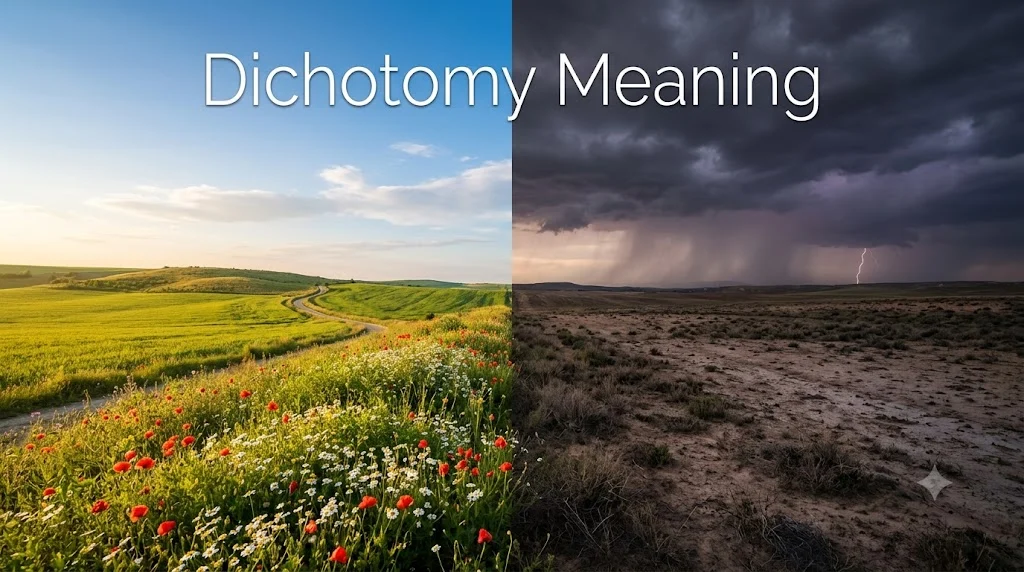
A dichotomy is a split between two contrasting, mutually exclusive categories that together cover all possibilities within a given context.
Think about the last time you faced a decision that felt like a coin flip. Not a dozen choices, not a gray area just two stark, opposing sides. Stay or leave. Trust or doubt. Fight or walk away. That moment? It had a name all along.
That’s a dichotomy.
And it shows up everywhere once you know what to look for in your relationships, in the news, in philosophy books, in therapy sessions, even in the way your brain processes a tough Monday morning. Understanding the dichotomy meaning isn’t just an academic exercise. It’s a tool that helps you think more clearly, argue more sharply, and see through manipulation more easily.
This guide covers everything. The definition, the origin, the types, the examples, the psychology behind it, how it differs from similar concepts, and why the false dichotomy might be the sneakiest trick in the persuasion playbook.
Let’s cut right in.
What Does Dichotomy Mean? The Core
At its simplest, a dichotomy is a division of something into two parts, groups, or ideas that are mutually exclusive and often sharply contrasting. If something is mutually exclusive, it means the two categories can’t overlap. You’re either in one or the other. Not both. Not neither. Just two sides, clean and complete.
Notice a few things in that definition. First, the two sides contrast they’re opposites, or at least deeply different. Second, they’re exhaustive in their context together, they account for everything relevant. That’s what makes a true dichotomy so intellectually satisfying. It’s tidy. Binary. Resolved.
Of course, reality rarely cooperates with that tidiness but more on that later.
Dichotomy in Simple Words
If the formal definition feels heavy, think of it this way. A dichotomy is when something splits cleanly into exactly two camps with nothing in between. Day and night. On and off. Alive and dead. You can’t be slightly alive. You can’t be a little bit on and a little bit off at the same time. That’s a dichotomy at work.
Dichotomy Etymology: Where the Word Comes From
Words carry history. The word dichotomy traces directly back to ancient Greek.
| Root | Greek Word | Meaning |
|---|---|---|
| First half | dicha | In two / apart |
| Second half | temnein | To cut |
| Combined | dichotomia | A cutting in two |
So a dichotomy literally means “a cutting in two.” The word entered English in the late 16th century, borrowed through Latin from Greek philosophical texts. Early uses appeared mostly in astronomy and logic, where precise binary classifications were essential.
That etymology is worth sitting with. The word doesn’t just describe a division. It implies a deliberate cut a clean separation made on purpose. That subtle edge in the word’s origins tells you a lot about how dichotomies function in real arguments and real life.
Dichotomy Pronunciation
People stumble on this one surprisingly often. Here’s the correct breakdown:
dy-KOT-uh-mee
Say it in syllables: dy · KOT · uh · mee
The stress lands on the second syllable: KOT. A common mistake is stressing the first syllable (DY-chotomy) or mispronouncing the middle as “coh-TOH” instead of “KOT-uh.”
Dichotomy as a Part of Speech
The word adapts across different grammatical contexts. Here’s how it shifts:
| Form | Word | Example Sentence |
|---|---|---|
| Noun | Dichotomy | “There’s a real dichotomy between what he says and what he does.” |
| Adjective | Dichotomous | “The survey used a dichotomous yes/no format.” |
| Verb | Dichotomize | “The debate tends to dichotomize voters into two rigid camps.” |
You’ll encounter the noun form most often in everyday writing. The adjective “dichotomous” pops up in research and academic writing, especially in statistics where a dichotomous variable has exactly two possible values.
Dichotomy Synonyms: Similar Words and Their Differences
Not all synonyms are created equal. Each word below shares something with “dichotomy” but carries its own shade of meaning. Knowing the difference makes your writing sharper.
| Synonym | How It Differs from Dichotomy |
|---|---|
| Division | Broader; a division doesn’t have to be binary or oppositional |
| Duality | Implies two aspects that can coexist rather than exclude each other |
| Polarity | Suggests two extremes on a spectrum — not necessarily a clean break |
| Contrast | Highlights difference without implying mutual exclusivity |
| Split | Casual and informal; lacks philosophical weight |
| Disjunction | More logical/formal; used in philosophy and mathematics |
| Opposition | Implies conflict more than structure |
| Partition | Suggests a physical or categorical separation, less conceptual |
| Divergence | Implies things moving apart over time, not necessarily in opposition |
The key word that separates “dichotomy” from all of these is mutual exclusivity. That’s the distinctive feature. If two things can coexist or blend, it’s probably a duality or a contrast not a true dichotomy.
Dichotomy Antonyms: What a Dichotomy Is Not
Understanding opposites sharpens definitions. The antonyms of dichotomy include:
Unity things brought together rather than split apart Convergence paths or ideas coming closer, not diverging Synthesis combining two things into something new (think Hegel’s dialectic) Harmony coexistence without opposition Continuity a seamless flow rather than a sharp break Agreement shared ground instead of opposing camps
These antonyms point to something important. A dichotomy resists middle ground. The moment you introduce synthesis, a spectrum, or harmony you’ve moved beyond the dichotomy into something more nuanced.
Dichotomy in a Sentence: Real Examples
Seeing a word in action beats any definition. Here are eight natural, varied example sentences:
- “The film explores the dichotomy between ambition and contentment through its two lead characters.”
- “She felt the painful dichotomy of loving someone she could no longer trust.”
- “In economics, the dichotomy between growth and equality shapes most policy debates.”
- “His thinking was strangely dichotomous everything was either brilliant or worthless, with nothing in between.”
- “Political pundits tend to dichotomize voters in ways that don’t reflect real opinion.”
- “The nature-versus-nurture debate remains one of psychology’s most enduring dichotomies.”
- “There’s a sharp dichotomy between the luxury storefronts on the main avenue and the poverty just two streets over.”
- “The dichotomy of freedom versus security runs through virtually every major political argument.”
Notice how the word works across emotional, political, academic, and everyday contexts. That’s the range of a genuinely useful concept.
Types of Dichotomy: A Clear Breakdown
Not every dichotomy is the same kind of split. There are four main types worth knowing.
True Dichotomy
A true dichotomy exists when the two categories are genuinely mutually exclusive and exhaustive. No middle ground. No overlap.
Examples of true dichotomies:
- Alive vs. dead (biologically speaking)
- On vs. off (a light switch, not a dimmer)
- Pregnant vs. not pregnant
- Prime vs. not prime (in mathematics)
These are satisfying because they’re airtight. Reality actually works this way in these cases.
False Dichotomy (False Dilemma)
This is the most important type to understand. A false dichotomy presents two options as if they’re the only ones available when in reality, more exist. It’s a logical fallacy and one of the most common manipulation tactics in argument, politics, and advertising.
Classic false dichotomies:
- “You’re either with us or against us.”
- “You either love your country or you hate it.”
- “It’s either this job or financial ruin.”
- “You’re either productive or you’re lazy.”
None of these are actually binary. There are countless positions between “with us” and “against us.” People can critique a country’s policies and still love it. Financial options are rarely that stark. Productivity exists on a spectrum.
False dichotomies force people into corners that don’t actually exist. Spotting them is one of the most practical critical thinking skills you can develop.
Conceptual Dichotomy
A conceptual dichotomy is a theoretical division used to organize ideas, usually in philosophy, science, or academia. These aren’t always perfectly clean splits in reality but as analytical tools, they’re incredibly useful.
Examples:
- Mind vs. body
- Theory vs. practice
- Subjective vs. objective
- Inductive vs. deductive reasoning
These conceptual frameworks help scholars analyze complex ideas, even when real life blurs the categories.
Social Dichotomy
A social dichotomy describes divisions that exist within human communities, cultures, and societies. These are culturally constructed categories that carry enormous real-world weight.
Examples:
- Public vs. private sphere
- Individual vs. society
- Insider vs. outsider
- Majority vs. minority
Social dichotomies often reveal power dynamics. Who gets placed in which category? Who defines the categories? These questions matter enormously in sociology and political science.
Dichotomy Examples Across Different Fields
This is where the concept comes alive. The meaning of dichotomy shifts in nuance depending on where you encounter it but the structure stays the same.
Dichotomy Meaning in Philosophy
Philosophy has built entire systems around dichotomies. They’re not just rhetorical devices they’re foundational frameworks.
René Descartes famously divided reality into two distinct substances: res cogitans (thinking substance, the mind) and res extensa (extended substance, the physical body). This mind-body dichotomy has dominated Western philosophy for nearly four centuries. Neuroscience still wrestles with its legacy today.
Plato drew a sharp line between the eternal, perfect world of Forms (ideals) and the imperfect, changing material world we inhabit. This form-matter dichotomy shaped Christian theology, medieval philosophy, and Renaissance thought.
Immanuel Kant distinguished between noumena (things as they truly are, unknowable) and phenomena (things as we perceive them). Another clean philosophical split with massive consequences.
What makes philosophical dichotomies interesting is that philosophers often spend careers trying to dissolve them rather than accept them. Hegel’s famous dialectic was designed to move beyond binary oppositions toward synthesis.
Dichotomy Meaning in Psychology
Psychology cares deeply about how people use dichotomies in their own thinking and how that usage can go badly wrong.
Dichotomous thinking (also called black-and-white thinking or all-or-nothing thinking) is a cognitive pattern where a person evaluates experiences, people, or themselves in absolute, binary terms.
Examples of dichotomous thinking in everyday life:
- “If I’m not perfect, I’m a complete failure.”
- “If she didn’t text back, she hates me.”
- “I made one mistake the whole day is ruined.”
- “You’re either a good person or a bad one.”
This cognitive pattern shows up prominently in several mental health conditions. It’s a core feature of Borderline Personality Disorder (BPD), where individuals often swing between idealizing and devaluing people they’re close to. It also appears frequently in depression, anxiety, and eating disorders.
Cognitive Behavioral Therapy (CBT) specifically targets dichotomous thinking. Therapists help clients identify when they’re collapsing a spectrum into a binary and practice seeing the gray areas instead.
The psychological research is clear: people who think in extremes report lower wellbeing, more interpersonal conflict, and greater difficulty solving problems. Nuanced thinking isn’t just smarter it’s healthier.
Dichotomy Meaning in Literature
Writers have always loved dichotomies. They create instant tension, drive character conflict, and build thematic depth. A story with two opposing forces at its core is naturally compelling because it mirrors a pattern the human mind already recognizes.
Binary opposition is the formal literary term for this technique. Structuralist theorists like Claude Lévi-Strauss argued that human culture is organized around pairs of opposites and that stories are the way we work through those tensions.
Some of the most celebrated works in literary history are built on dichotomies:
Robert Louis Stevenson’s “Strange Case of Dr. Jekyll and Mr. Hyde” (1886) literalizes the dichotomy between civilization and savagery, the public self and the hidden self, moral order and violent impulse. Jekyll doesn’t blend these forces he splits them entirely. That’s the point.
George Orwell’s “1984” (1949) runs on the dichotomy of freedom vs. control, truth vs. propaganda, individual thought vs. collective obedience. The Ministry of Truth exists precisely to collapse any space between the two options.
Mary Shelley’s “Frankenstein” (1818) interrogates the creator vs. creation dichotomy, along with nature vs. science and beauty vs. monstrosity.
Fyodor Dostoevsky’s “The Brothers Karamazov” (1880) pits faith against doubt as a central, irresolvable dichotomy driving three brothers toward radically different fates.
Modern literature often works to complicate dichotomies rather than accept them. Contemporary literary fiction tends to resist clean binary resolutions protagonists occupy gray zones, villains have sympathetic depths, and the “right” side isn’t always obvious. That’s a cultural and intellectual response to the limits of binary thinking.
Dichotomy Meaning in Sociology
Sociologists are interested in how dichotomies organize (and sometimes distort) social life. The categories societies create and who gets placed in which category reveal underlying power structures.
Jürgen Habermas developed the influential distinction between the public sphere (civic life, debate, institutions) and the private sphere (family, personal life, intimate relationships). This public-private dichotomy has been central to feminist scholarship, which pointed out that the split itself was politically constructed and that keeping certain things “private” often protected existing power arrangements.
Us vs. them thinking is perhaps the most fundamental social dichotomy. Sociologist Henri Tajfel’s Social Identity Theory demonstrates how quickly and powerfully humans divide into in-groups and out-groups. This binary perception of social reality underlies tribalism, nationalism, racism, and sectarianism.
Max Weber’s distinction between Gemeinschaft (community, traditional bonds) and Gesellschaft (society, impersonal modern relations) is a foundational sociological dichotomy that still frames debates about modernization and social change.
Dichotomy Meaning in Science and Nature
Science uses dichotomies as classification tools while also frequently discovering that reality is messier than the categories suggest.
Nature vs. nurture remains the defining dichotomy in behavioral and developmental science. How much of who you are comes from genetics versus environment? For decades, scientists treated this as a true binary. Today, the field of epigenetics has complicated the picture enormously genes and environment interact in ways the simple dichotomy can’t capture. Most researchers now speak of nature through nurture rather than nature versus nurture.
Particle vs. wave in quantum physics is one of the most mind-bending scientific dichotomies. Classical physics treated these as mutually exclusive categories something is either a particle or a wave. Then experiments revealed that light (and matter itself) exhibits both properties depending on how you observe it. This wave-particle duality shattered the dichotomy and forced a fundamental rethinking of physical reality.
Organic vs. synthetic in chemistry began as a clear dichotomy organic compounds came from living organisms, synthetic ones were human-made. In 1828, Friedrich Wöhler synthesized urea (an organic compound) from inorganic materials, collapsing the distinction. The dichotomy was false.
Everyday Dichotomies You Already Know
You don’t need a philosophy degree to encounter dichotomies daily. Here are real-life examples most people recognize instantly:
- Work vs. life balance
- Introvert vs. extrovert
- Logic vs. intuition
- Tradition vs. modernity
- Science vs. religion
- Good vs. evil
- Freedom vs. security
- Head vs. heart
Each of these pairs shows up in conversations, debates, self-help books, political campaigns, and dinner table arguments constantly. They’re familiar because they’re genuinely useful as starting points but problematic when people treat them as final answers.
Dichotomy vs. Similar Concepts: Clearing Up the Confusion
Dichotomy vs. Duality
This is the comparison people get wrong most often. Here’s the key difference:
A dichotomy implies mutual exclusivity. The two sides can’t coexist. You’re in one camp or the other.
A duality implies two aspects that do coexist, often within the same thing. They complement or balance each other rather than exclude each other.
| Feature | Dichotomy | Duality |
|---|---|---|
| Can both exist simultaneously? | No | Yes |
| Are the two sides in conflict? | Often | Not necessarily |
| Example | Guilty vs. not guilty | Light and shadow |
| Philosophical tradition | Western logic | Eastern philosophy (Yin/Yang) |
The Yin-Yang symbol is the most famous representation of duality. Yin and Yang aren’t in a war they’re interdependent halves of a whole. Neither is complete without the other. That’s fundamentally different from a dichotomy, where one side’s existence doesn’t require the other.
In psychology, Carl Jung worked with dualities the conscious and unconscious, the persona and the shadow that exist within every individual simultaneously. That’s not a dichotomy. It’s a dynamic, interacting duality.
Dichotomy vs. Paradox
Another common mix-up. Here’s how they differ:
A dichotomy separates two things clearly. The two sides don’t contradict each other they just exclude each other.
A paradox is a statement or situation that appears to contradict itself but may still contain truth.
Classic paradox: “This statement is false.” (If it’s true, it’s false. If it’s false, it’s true.)
Classic dichotomy: “You’re either honest or you’re not.” (Two options, no middle ground whether or not it’s a false dichotomy is a separate question.)
| Feature | Dichotomy | Paradox |
|---|---|---|
| Structure | Two opposing, separate options | Self-contradictory |
| Resolution | Pick one side | Often irresolvable |
| Example | Guilty vs. innocent | “Less is more” |
| Common in | Logic, philosophy, argument | Literature, Zen, rhetoric |
A paradox can emerge from a dichotomy. If you insist on a strict either/or and reality refuses to cooperate, you often end up with something paradoxical. That’s one reason paradoxes are so philosophically interesting.
Dichotomy vs. Spectrum
This distinction might be the most practically important one for modern thinking. A spectrum (or continuum) describes a range of possibilities between two poles, with infinite gradations in between.
Many things we habitually treat as dichotomies are actually spectrums:
- Introvert vs. extrovert | The Myers-Briggs and psychological research alike confirm this is a spectrum. Most people fall somewhere in the middle (ambiverts).
- Political ideology | “Left vs. right” simplifies a complex multi-dimensional landscape into a false binary.
- Gender | Contemporary understanding increasingly recognizes gender as a spectrum rather than a strict male/female dichotomy.
- Mental health vs. illness | The line between healthy and disordered is not a cliff edge. It’s a gradient.
Forcing a spectrum into a dichotomy is one of the most common sources of intellectual error and social conflict. It’s a tempting mental shortcut because binary thinking is faster and simpler but it often costs accuracy.
The Psychology of Dichotomous Thinking: Why Your Brain Loves Binaries
Your brain didn’t develop in a philosophy seminar. It developed in environments where fast decisions mattered more than nuanced ones. Is that rustle in the grass a snake or the wind? There wasn’t time to contemplate a spectrum. Binary thinking was survival.
That evolutionary history is precisely why dichotomous thinking is so deeply wired. The brain’s tendency to sort experiences into two categories is often called categorical perception and it operates largely below conscious awareness.
When binary thinking helps you:
- Emergencies requiring instant action (fight or flee)
- Simple, genuinely binary decisions (did the deadline pass or not?)
- Initial sorting and triage (relevant vs. irrelevant)
- Clear ethical lines (is this action harmful or harmless?)
When binary thinking hurts you:
- Evaluating complex relationships (“He’s either completely trustworthy or he’s dead to me”)
- Political and social judgments (“Either you agree with every policy or you’re the enemy”)
- Self-evaluation (“That was a failure, so I’m a failure”)
- Problem-solving (“It’s either my way or it won’t work”)
Research in cognitive psychology consistently shows that people who apply more nuanced, multidimensional thinking to problems report better outcomes in decision-making, relationships, and mental health. Cognitive flexibility the ability to hold multiple perspectives simultaneously is one of the strongest predictors of psychological resilience.
The antidote to harmful dichotomous thinking isn’t to abandon categories entirely. It’s to ask one simple question: “Am I missing anything between these two options?” That single question can dismantle a false binary in seconds.
The False Dichotomy: The Most Dangerous Type
A false dichotomy (also called a false dilemma or either/or fallacy) deserves its own detailed section because it’s everywhere in politics, advertising, interpersonal conflict, and social media and most people don’t recognize it.
The structure is always the same: two options are presented as if they’re the only options, when in reality more exist.
How to Spot a False Dichotomy
Look for these telltale signs:
Exclusive language: “Either… or,” “If you’re not… then you are…,” “You must choose between…”
Missing middle ground: Does a position exist between the two options? If yes, the dichotomy is probably false.
Emotional pressure: False dichotomies often carry an urgency designed to stop you thinking. “There’s no time to consider alternatives choose now.”
Asymmetric stakes: One option is presented as obviously terrible, forcing you toward the other.
Real False Dichotomy Examples Broken Down
Here are five common false dichotomies with analysis:
“You’re either productive or you’re lazy.” What’s missing: Rest, recovery, illness, creative incubation, learning, planning none of these are “productive” in the conventional sense, and none are “lazy.”
“If you don’t support this policy, you don’t care about people.” What’s missing: A person might care deeply about the goal but disagree with this particular method of achieving it.
“Science and religion can’t coexist.” What’s missing: Millions of scientists throughout history have been devoutly religious. The two address different domains of human experience, and many practitioners navigate both.
“You’re either a leader or a follower.” What’s missing: Most people lead in some contexts and follow in others. The categories are situational, not fixed identity labels.
“You’re with us or against us.” What’s missing: Neutrality, partial agreement, alliance on some issues but not others real political relationships are almost never that binary.
Why False Dichotomies Are So Persuasive
They work because they feel logical. Two options, clear choice. The brain loves the efficiency of binary decisions. False dichotomies exploit that preference by hiding the third, fourth, and fifth options behind a veneer of logical structure.
Politicians, advertisers, and debaters have used this tactic for centuries. Once you can name it, you’ll see it in roughly half the persuasive content you encounter.
How to Use “Dichotomy” Correctly in Your Own Writing
A few common mistakes to avoid:
Redundant phrasing: Don’t say “a dichotomy between two things.” A dichotomy is between two things by definition. Just say “a dichotomy between X and Y.”
Overuse in casual contexts: Not every contrast is a dichotomy. “There’s a dichotomy between my preference for coffee and my preference for tea” stretches the word beyond its useful range. A simple “difference” or “contrast” works better.
Confusing dichotomy with contradiction: Two contradictory things aren’t automatically a dichotomy. A dichotomy requires mutual exclusivity within a defined context.
Correct usage: “The dichotomy of freedom and security sits at the heart of every civil liberties debate.” “His public and private selves formed a striking dichotomy.”
Incorrect usage: “There’s a dichotomy in the weather lately.” (No that’s just variation.) “The dichotomy between his two favorite sports.” (No different preferences aren’t a dichotomy.)
Quick Reference: Dichotomy at a Glance
| Feature | Detail |
|---|---|
| Word | Dichotomy |
| Pronunciation | dy-KOT-uh-mee |
| Part of Speech | Noun |
| Greek Origin | dicha (two) + temnein (to cut) |
| Core Meaning | A division into two mutually exclusive, contrasting categories |
| Key Types | True, False, Conceptual, Social |
| Adjective Form | Dichotomous |
| Verb Form | Dichotomize |
| Synonyms | Division, duality, polarity, contrast, split, disjunction |
| Antonyms | Unity, convergence, synthesis, harmony |
| Related Concepts | Binary opposition, duality, paradox, spectrum |
| Common in | Philosophy, psychology, literature, sociology, science, everyday speech |
FAQs
What does dichotomy mean in simple words?
A dichotomy is when something splits into exactly two opposite groups or ideas that can’t overlap. Think alive vs. dead, or on vs. off. Two sides, no middle.
What’s a dichotomy example in real life?
One of the clearest real-life dichotomies is the legal verdict system: guilty or not guilty. There’s no partial verdict in most criminal cases. Another everyday example is a light switch on or off.
What is a false dichotomy?
A false dichotomy is when two options are presented as if they’re the only choices when more options actually exist. “You either love this plan or you hate progress” is a false dichotomy there’s plenty of space for “I like parts of the plan but not all of it.”
What’s the difference between a dichotomy and a paradox?
A dichotomy separates two things clearly they don’t contradict each other, they just exclude each other. A paradox contradicts itself. “It was the best of times, it was the worst of times” is a paradox.
What does dichotomous mean?
Dichotomous describes something that is divided into two distinct, contrasting parts. A dichotomous question has only two possible answers usually yes or no.
Is nature vs. nurture a dichotomy?
It started as one. For a long time, scientists treated it as a true dichotomy: either genes determine who you are or environment does. Modern genetics and epigenetics have mostly dissolved this binary, showing that the two constantly interact.
What’s the opposite of a dichotomy?
The clearest opposites are unity (things unified rather than split), synthesis (two things merged into something new), and convergence (things coming together rather than apart).
How do you use dichotomy in a sentence?
“The novel explores the dichotomy between ambition and contentment.” Or: “His personality presented a striking dichotomy ruthlessly competitive at work, deeply gentle at home.”
Conclusion
Remember the opening? That moment of impossible choice, two stark sides, no visible middle? That’s a dichotomy. And now you know exactly what to call it, where it comes from, how it functions across philosophy, psychology, literature, and daily life, and most critically when it’s being used against you.
The meaning of dichotomy isn’t just a vocabulary lesson. It’s a thinking tool. True dichotomies exist and they’re useful they help us classify, decide, and argue clearly. But false dichotomies are cognitive traps, and they’re built into much of the persuasive content you encounter every day.
Here’s a challenge for this week: notice one dichotomy in a conversation or piece of media you come across. Ask whether it’s a true dichotomy or a false one. Is there a spectrum hiding behind the either/or? That one question, practiced regularly, sharpens your thinking more than almost anything else.
The world isn’t always binary. But understanding when it is and when it isn’t that’s where real clarity begins.
Discover More Related Articles:
- What Does Vitamin D Do | Benefits, Functions & Importance In 2026
- What Does Matcha Taste Like | The Flavor, Texture & Aroma Guide In 2026