
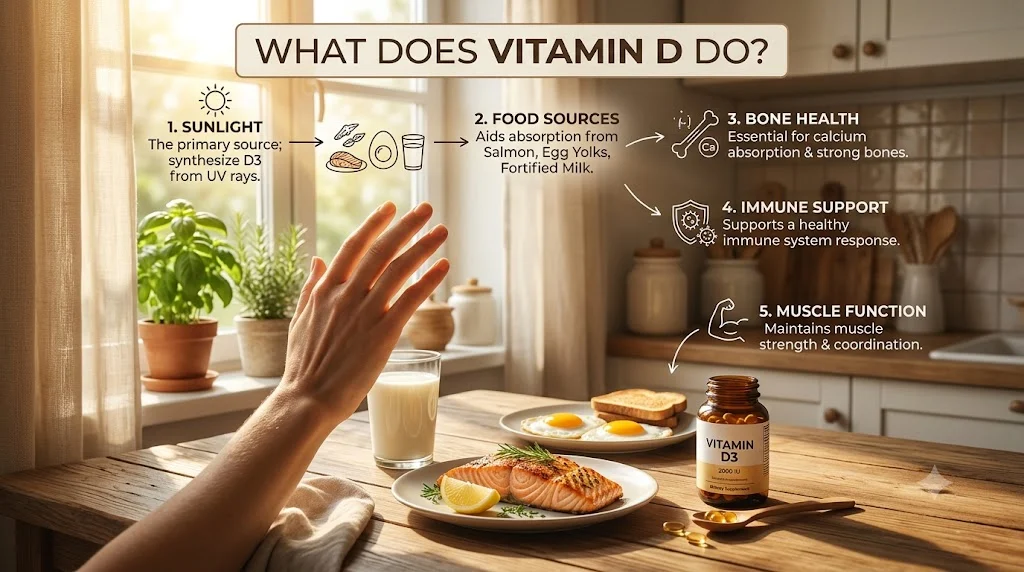

Definition
Vitamin D is a fat-soluble vitamin that helps your body absorb calcium and phosphorus, which are essential for building and maintaining strong bones and teeth. It also supports the immune system, muscle function, and overall health.
Roughly 1 billion people around the world don’t get enough vitamin D. That’s not a typo. One billion. And the frustrating part? The solution sounds almost comically simple: go outside more, eat the right foods, or take a supplement. So why is deficiency still so rampant?
Because most people have no idea what vitamin D actually does once it’s inside their body. They know it’s “good for bones.” Maybe they’ve heard it helps with immunity. But the real picture is far more interesting than that.
Vitamin D touches nearly every major system in your body. Bones, muscles, immune cells, brain, heart, skin it’s involved in all of it. Understanding what vitamin D does isn’t just trivia. It’s the kind of knowledge that might explain why you feel tired all the time, why you keep getting sick, or why your bones are weaker than they should be.
Let’s get into it.
What Vitamin D Actually Is
Here’s something that surprises most people: vitamin D isn’t technically a vitamin.
Real vitamins are nutrients your body can’t produce on its own. You have to eat them. Vitamin D is different. When your skin absorbs ultraviolet B (UVB) rays from the sun, your body manufactures vitamin D from scratch. That makes it much more like a hormone than a vitamin.
It acts like one too. Once activated, vitamin D travels through your bloodstream and binds to receptors in dozens of tissues throughout your body including your gut, bones, immune cells, muscles, brain, and kidneys. No other “vitamin” has that kind of reach.
Vitamin D2 vs Vitamin D3
There are two main forms of vitamin D you’ll encounter in supplements and food:
| Feature | Vitamin D2 (Ergocalciferol) | Vitamin D3 (Cholecalciferol) |
|---|---|---|
| Where it comes from | Plants and fungi | Animal sources and your skin |
| How potent it is | Lower potency | Higher potency |
| Raises blood levels | More slowly | More effectively |
| Used in supplements | Yes | Yes preferred form |
| Found in fortified foods | Sometimes | More commonly |
D3 is the better option if you’re supplementing. Research consistently shows it raises blood levels of vitamin D more effectively and keeps them elevated longer. When you see “vitamin D” on a supplement label without a number, check the ingredients. Ideally, it should say cholecalciferol.
How Your Body Makes Vitamin D from Sunlight
The process is more elegant than most people realize. Here’s how it works:
- UVB rays from the sun hit your skin
- A form of cholesterol in your skin converts to previtamin D3
- Your liver converts that into 25-hydroxyvitamin D (the storage form doctors test for)
- Your kidneys convert it into calcitriol the active, hormone-like form
- Calcitriol then circulates through your bloodstream and binds to vitamin D receptors throughout your body
That final active form is what does all the work. And without enough sun, food, or supplementation feeding into that chain, the whole system runs short.
What Does Vitamin D Do in Your Body? The Core Functions
This is where things get genuinely fascinating. Vitamin D doesn’t just do one thing. It performs a wide range of essential roles, and falling short in any of them has real consequences.
Vitamin D Supercharges Calcium and Phosphorus Absorption
This is arguably vitamin D’s most critical job. Without it, your gut is remarkably bad at absorbing calcium from food.
Here’s the stark comparison:
- Without vitamin D: your intestines absorb only 10 to 15 percent of the calcium you eat
- With adequate vitamin D: that number jumps to 30 to 40 percent
Nearly triples. That’s not a minor improvement it’s the difference between your body having enough calcium to function properly and being chronically short. Vitamin D controls special calcium transport proteins in your intestinal lining that physically move calcium from your gut into your bloodstream.
The same applies to phosphorus, another mineral your bones desperately need. Vitamin D increases phosphorus absorption in the gut and reduces how much your kidneys excrete.
“Vitamin D is the master regulator of calcium homeostasis. Without it, even a calcium-rich diet cannot protect skeletal health.” Endocrinology and Metabolism Clinics of North America
Vitamin D Builds and Protects Your Bones
Most people know this one but they don’t know how it actually happens.
Vitamin D doesn’t build bone directly. Instead, it ensures the mineral supply is adequate. Without enough calcium and phosphorus circulating in the blood which vitamin D makes possible your body can’t properly mineralize bone tissue. The structural protein framework of bone (called osteoid) gets laid down, but it doesn’t harden properly without those minerals.
The conditions this causes have names:
In children: Rickets soft, weak, sometimes visibly bowed bones. Children with rickets may have enlarged wrists and ankles, delayed tooth eruption, and difficulty walking.
In adults: Osteomalacia literally “soft bones.” Adults with osteomalacia experience deep, aching bone pain (especially in the spine, hips, and legs) and muscle weakness. It’s often misdiagnosed as fibromyalgia or arthritis.
In older adults: Accelerated osteoporosis where bones become progressively more porous and fragile, dramatically increasing fracture risk.
Bone density peaks in your late 20s. What you do before that window closes including maintaining adequate vitamin D levels has lifelong consequences. But it’s never too late to slow the decline.
Vitamin D Regulates Your Immune System
Your immune system doesn’t just run on its own. Vitamin D is one of its key regulators, and this is a function most people dramatically underestimate.
Here’s what’s actually happening: T-cells your body’s primary frontline defenders against infections cannot fully activate without vitamin D. When a T-cell encounters a pathogen, it needs to upregulate vitamin D receptors and access the local vitamin D supply before it can mount an effective response. Without sufficient vitamin D, that response is sluggish and incomplete.
But vitamin D doesn’t just boost immunity it calibrates it. It also helps prevent your immune system from overreacting, which is the mechanism behind many autoimmune conditions and chronic inflammation. Studies have linked low vitamin D levels to:
- Higher susceptibility to respiratory infections (including influenza and COVID-19)
- Increased risk of autoimmune conditions like multiple sclerosis, rheumatoid arthritis, and type 1 diabetes
- Slower recovery from illness
- Higher inflammatory markers in the blood
Think of vitamin D as the immune system’s dial. Without enough of it, that dial can get stuck either too low (you can’t fight off infections well) or, in some contexts, too high (chronic inflammation).
Vitamin D Keeps Your Muscles Strong
Bones get all the attention when vitamin D is discussed. Muscles barely get a mention. That’s a mistake.
Your muscle cells have vitamin D receptors. Vitamin D directly influences how muscle fibers contract, how much force they generate, and how well they recover. Low vitamin D levels are consistently associated with:
- General muscle weakness and fatigue
- Poor balance and coordination
- Higher risk of falls especially in older adults
- Measurably lower athletic performance
For older adults, this is particularly serious. Falls are the leading cause of injury-related death among people over 65. Studies show that vitamin D supplementation in older adults with low levels reduces fall risk by up to 30 percent. That’s not a small number.
For athletes, research shows that players with low vitamin D have reduced muscle strength, slower reaction times, and higher injury rates compared to those with adequate levels.
Vitamin D and Your Mood
Here’s something your doctor might not have mentioned: your brain is packed with vitamin D receptors. Areas associated with mood regulation, including the prefrontal cortex and hippocampus, are particularly dense with them.
Multiple large studies have found a strong association between low vitamin D levels and:
- Clinical depression
- Seasonal affective disorder (SAD)
- Anxiety
- Cognitive decline in older adults
The relationship appears to run in both directions. Vitamin D deficiency may worsen mood, and depression-related behaviors (staying indoors, poor diet, reduced sun exposure) can worsen vitamin D deficiency.
That said, an important caveat deserves honest mention here: correlation is not causation. While the association is strong and consistent, most clinical trials using vitamin D supplements to treat depression have shown modest results at best. Vitamin D isn’t a substitute for proper mental health treatment. But given how common deficiency is, it’s absolutely worth testing and addressing especially in people who live in low-sunlight climates or spend most of their time indoors.
Vitamin D and Heart Health
Your cardiovascular system appears to be another target for vitamin D’s reach. The evidence here is still developing, but what researchers have found so far is worth knowing.
Vitamin D influences the renin-angiotensin system one of the body’s primary mechanisms for regulating blood pressure. People with low vitamin D levels show significantly higher rates of hypertension. Low levels are also associated with:
- Higher risk of heart attack
- Higher risk of stroke
- Elevated levels of C-reactive protein (a marker of inflammation linked to cardiovascular disease)
The honest caveat here: while the observational evidence is consistent, clinical trials testing whether vitamin D supplementation actually reduces heart disease outcomes have been mixed. The VITAL trial one of the largest vitamin D trials ever conducted found some benefits for cancer mortality but more modest effects on cardiovascular events. The science is evolving. What’s clear is that deficiency isn’t good for your heart.
Vitamin D and Cell Growth
Every cell in your body depends on proper growth and death cycles. Vitamin D plays a direct role in cell differentiation guiding cells to develop into the right type and apoptosis, the programmed death of damaged or abnormal cells.
When apoptosis doesn’t work properly, abnormal cells can proliferate unchecked. This is one of the early steps in cancer development. Observational studies have consistently found that people with higher vitamin D levels have lower rates of:
- Colorectal cancer
- Breast cancer
- Prostate cancer
- Pancreatic cancer
The VITAL trial found a 25 percent reduction in cancer mortality among participants taking vitamin D3 supplements over five years. That’s a meaningful finding. However, this doesn’t mean vitamin D prevents or treats cancer the FDA has not approved it as such. What it suggests is that adequate levels may support the body’s natural defenses against cellular abnormalities.
Vitamin D Supports Your Nervous System
Your nervous system relies heavily on calcium for nerve signal transmission, synaptic communication, and muscle control. Since vitamin D governs calcium metabolism, it plays an indirect but important role in how well your nervous system functions.
Beyond that, vitamin D has direct neuroprotective effects. Researchers studying multiple sclerosis have found significantly lower vitamin D levels in MS patients, and some evidence suggests adequate early-life vitamin D may reduce MS risk. Early-stage research on Alzheimer’s disease and Parkinson’s is similarly promising, though still inconclusive.
What Does Vitamin D Do for Specific Groups?
Vitamin D’s impact isn’t the same at every life stage. Here’s how its role shifts across different populations.
What Vitamin D Does for Children
Children need vitamin D most urgently for skeletal development. During growth, bones are constantly being remodeled and extended. Without adequate vitamin D:
- Long bones don’t calcify properly
- Growth plates become vulnerable
- Teeth may erupt late or develop abnormally
- Rickets can develop causing bowed legs, soft skull bones, and stunted growth
Breastfed infants are at particular risk. Breast milk, despite being nutritionally excellent, contains very little vitamin D (approximately 25 IU per liter, when the daily need is 400 IU). The American Academy of Pediatrics recommends vitamin D supplementation for all breastfed infants starting within the first few days of life.
Recommended daily intake for children:
| Age Group | Daily Vitamin D Recommendation |
|---|---|
| 0 to 12 months | 400 IU |
| 1 to 13 years | 600 IU |
| 14 to 18 years | 600 IU |
What Vitamin D Does for Women
For women, vitamin D plays several roles that go beyond the basics.
Bone health across the lifespan: Women lose bone density rapidly in the years following menopause due to declining estrogen. Adequate vitamin D is critical during this period to minimize fracture risk and slow osteoporosis progression.
During pregnancy: Vitamin D supports fetal bone development, influences immune function in the developing baby, and may reduce the risk of gestational diabetes and preeclampsia. Deficiency during pregnancy is also associated with lower birth weight and increased risk of respiratory illness in infants.
Hormonal conditions: Some research links low vitamin D to hormonal disruption in conditions like polycystic ovarian syndrome (PCOS), though this remains an active area of research rather than established clinical guidance.
What Vitamin D Does for Men
Men aren’t off the hook here. Low vitamin D in men is associated with:
- Lower testosterone levels | a 2011 study in Hormone and Metabolic Research found men with adequate vitamin D had significantly higher testosterone than those who were deficient
- Reduced muscle mass and strength | particularly relevant as men age and naturally lose lean body mass
- Higher cardiovascular risk | men with deficiency have higher rates of hypertension and heart disease
Vitamin D Deficiency: Signs, Causes, and Consequences
Most people with vitamin D deficiency don’t know they have it. The symptoms are common, nonspecific, and easy to dismiss as “just being tired” or “getting older.”
Common Symptoms of Vitamin D Deficiency
Watch for these patterns, especially if several occur together:
- Persistent fatigue that doesn’t improve with rest or sleep
- Bone pain | particularly in the lower back, hips, and legs
- Muscle weakness or unexplained cramping
- Frequent illness | catching colds easily or recovering slowly
- Low mood or unexplained depression, particularly in winter months
- Hair loss | telogen effluvium (a type of stress-related hair shedding) has been linked to deficiency
- Slow wound healing | vitamin D plays a role in the production of compounds that form new skin
- Bone fractures from minor impacts | a serious warning sign in older adults
Who’s Most at Risk of Deficiency?
Not everyone faces equal risk. These groups are especially vulnerable:
- People with limited sun exposure | office workers, those in northern latitudes (above 37° north latitude), people who cover skin for cultural or religious reasons
- People with darker skin tones | melanin reduces the skin’s ability to synthesize vitamin D from UVB light; darker skin can require 3 to 10 times longer sun exposure to produce the same amount as lighter skin
- Older adults | skin efficiency drops dramatically with age
- People with malabsorption conditions | Crohn’s disease, celiac disease, and those who’ve had bariatric surgery struggle to absorb fat-soluble vitamins
- Exclusively breastfed infants | as noted above
What the Numbers Mean: Vitamin D Blood Levels
The standard test is called 25-hydroxyvitamin D (also written as 25(OH)D). Here’s how to interpret your results:
| Blood Level (ng/mL) | Status |
|---|---|
| Below 12 | Deficient |
| 12 to 19 | Insufficient |
| 20 to 50 | Sufficient |
| Above 50 | Potentially excessive |
| Above 100 | Toxic range |
Most major health organizations define sufficiency as 20 ng/mL or above. However, many vitamin D researchers argue that optimal health benefits emerge at levels between 40 and 60 ng/mL. Talk to your doctor about what target makes sense for you.
How to Get Enough Vitamin D
There are three ways to raise your vitamin D levels. Most people need a combination of all three.
From Sunlight
Sunlight is still the most natural and efficient source when it’s available. A few important points:
- 10 to 30 minutes of midday sun (10 AM to 3 PM) on your arms, legs, and face, 2 to 3 times per week, is enough for most lighter-skinned people in summer months
- Darker skin tones require significantly longer exposure sometimes 60 to 90 minutes to produce the same amount
- Sunscreen blocks UVB synthesis. This is a real trade-off. A sunscreen with SPF 30 reduces vitamin D production by about 95 to 98 percent. Getting some sun before applying sunscreen is a practical middle ground
- Season and latitude matter enormously. In winter months above approximately 37° north latitude (roughly the latitude of San Francisco or Atlanta), the sun’s UVB rays are too weak to trigger significant vitamin D synthesis even on clear days
- Glass blocks UVB entirely sitting by a sunny window produces zero vitamin D
From Food
Food alone rarely provides enough vitamin D for most people, but it contributes meaningfully, especially through fatty fish and fortified options.
| Food | Approximate Vitamin D Content |
|---|---|
| Salmon (3 oz, cooked) | 570 IU |
| Swordfish (3 oz, cooked) | 566 IU |
| Rainbow trout (3 oz, cooked) | 645 IU |
| Canned tuna in water (3 oz) | 154 IU |
| Sardines in oil (2 sardines) | 46 IU |
| Fortified cow’s milk (1 cup) | 115 to 130 IU |
| Fortified orange juice (1 cup) | 100 IU |
| Egg yolk (1 large) | 44 IU |
| Beef liver (3 oz, cooked) | 42 IU |
| UV-exposed mushrooms (3 oz) | Up to 400 IU |
The mushroom entry deserves special mention. When mushrooms are exposed to UV light (either natural sun or commercially via UV lamps), they can generate significant amounts of vitamin D2. You can even do this at home place store-bought mushrooms gills-side up in direct sunlight for 15 to 30 minutes before eating them.
From Supplements
For many people especially those in northern climates, those with dark skin, older adults, and people who work indoors supplementation is the most reliable way to maintain adequate vitamin D levels.
How Much Vitamin D Do You Actually Need?
Here are the official daily recommendations from the National Institutes of Health:
| Life Stage | Recommended Daily Amount |
|---|---|
| Infants 0 to 6 months | 400 IU |
| Infants 7 to 12 months | 400 IU |
| Children 1 to 13 years | 600 IU |
| Teens 14 to 18 years | 600 IU |
| Adults 19 to 70 years | 600 IU |
| Adults over 70 years | 800 IU |
| Breastfeeding women | 600 IU |
These are the minimum targets for preventing deficiency. People who are already deficient often need higher therapeutic doses sometimes 2,000 to 4,000 IU per day for several months to restore adequate levels. This should always be supervised with blood testing.
Can You Take Too Much Vitamin D?
Yes but it’s important to put the risk in perspective. Vitamin D toxicity is real but rare, and it doesn’t come from sun exposure or food. It comes exclusively from excessive supplementation over time.
Your body has a built-in safeguard against producing too much from sunlight. Sun exposure breaks down excess previtamin D in the skin before it enters your bloodstream. Food simply doesn’t contain enough to cause toxicity.
Supplements are a different story. Here’s what you need to know:
The upper tolerable limit for most adults is 4,000 IU per day. Going significantly above this consistently, without monitoring, can cause:
- Hypercalcemia dangerously elevated blood calcium
- Nausea and vomiting
- Weakness and confusion
- Kidney damage from calcium deposits
- Heart rhythm abnormalities
Toxicity almost always develops slowly over months of very high supplementation (typically above 10,000 IU daily). The occasional higher dose is unlikely to cause harm in healthy adults. But if you’re taking high doses long-term, get your blood levels checked every 3 to 6 months.
How to Test Your Vitamin D Levels
If you haven’t tested your vitamin D, you genuinely have no idea whether you’re deficient. The symptoms are too nonspecific to rely on guesswork.
The test you want is called the 25-hydroxyvitamin D test (or 25(OH)D test). It’s a simple blood test your doctor can order, and it’s often included in standard wellness panels.
A few practical tips:
- Test in late winter (February to March in the Northern Hemisphere) for your true baseline. Levels are lowest after months of limited sun exposure. This gives you the most accurate picture of your actual vitamin D status
- Retest after 3 months of supplementation to assess whether your dose is working. Levels take time to respond
- Home test kits are available. Several lab companies now offer direct-to-consumer 25(OH)D testing via a finger-prick blood spot sample. These are accurate and convenient, especially for people tracking their levels over time
FAQs
What does vitamin D do for your body overall?
Vitamin D regulates calcium and phosphorus absorption, builds and maintains bone density, activates immune cells, supports muscle function, influences mood and brain chemistry, regulates cell growth, and plays a role in cardiovascular health.
What happens when you have low vitamin D?
Low vitamin D causes fatigue, bone pain, muscle weakness, frequent illness, low mood, hair loss, and slow wound healing in the short term.
How long does it take vitamin D supplements to work?
Blood levels of vitamin D respond slowly to supplementation. Most people see meaningful increases within 3 months of consistent daily supplementation.
What’s the difference between vitamin D2 and D3?
Vitamin D2 (ergocalciferol) comes from plants and fungi. Vitamin D3 (cholecalciferol) comes from animal sources and is the form your skin produces from sunlight.
Can vitamin D deficiency cause fatigue?
Yes. Vitamin D receptors are found in muscle tissue and the brain, and deficiency impairs both physical energy production and neurological function.
Does vitamin D help with depression?
There’s a consistent association between low vitamin D and higher rates of depression and seasonal affective disorder. The mechanism likely involves vitamin D receptors in mood-regulating brain regions.
What foods are highest in vitamin D?
The best food sources are fatty fish (salmon, swordfish, rainbow trout), followed by fortified milk and orange juice, canned tuna, egg yolks, and UV-exposed mushrooms. Fatty fish is by far the most concentrated dietary source.
What does vitamin D do for your immune system specifically?
Vitamin D activates T-cells the immune system’s primary pathogen fighters by enabling them to fully mature and respond. It also regulates inflammatory cytokines, preventing immune overreaction.
Conclusion
Vitamin D is one of the most consequential nutrients in the human body and one of the most commonly overlooked. It isn’t just a bone nutrient. It’s an active, hormone-like compound that regulates calcium absorption, powers immune defense, maintains muscle strength, influences brain chemistry, guides cell growth, and touches cardiovascular and nervous system health.
The fact that 1 billion people are deficient in something so fundamental isn’t just a public health statistic. It’s a quiet explanation for a lot of fatigue, frequent illness, low mood, and fragile bones that people write off as just part of life.
The most important next step isn’t buying a supplement. It’s getting a 25-hydroxyvitamin D blood test. Find out where you actually stand. Then with your doctor’s guidance use sunlight, food, and supplementation intelligently to get your levels into the healthy range and keep them there.
Your bones, your immune system, your muscles, and your brain will all work better for it.
Discover More Related Articles: