
Definition
Shingles is a viral infection that causes a painful skin rash, usually appearing as a band or stripe of red, blistering bumps on one side of the body or face. It is caused by the reactivation of the virus that also causes Chickenpox.
If you’ve ever felt a strange burning or tingling on one side of your body and wondered what on earth was going on, you’re not alone. That odd sensation is often the first whisper of shingles, days before anything visible shows up on your skin. By the time the rash actually appears, most people are scrambling for answers, typing some version of “what does shingles look like” into their phone at 2 AM.
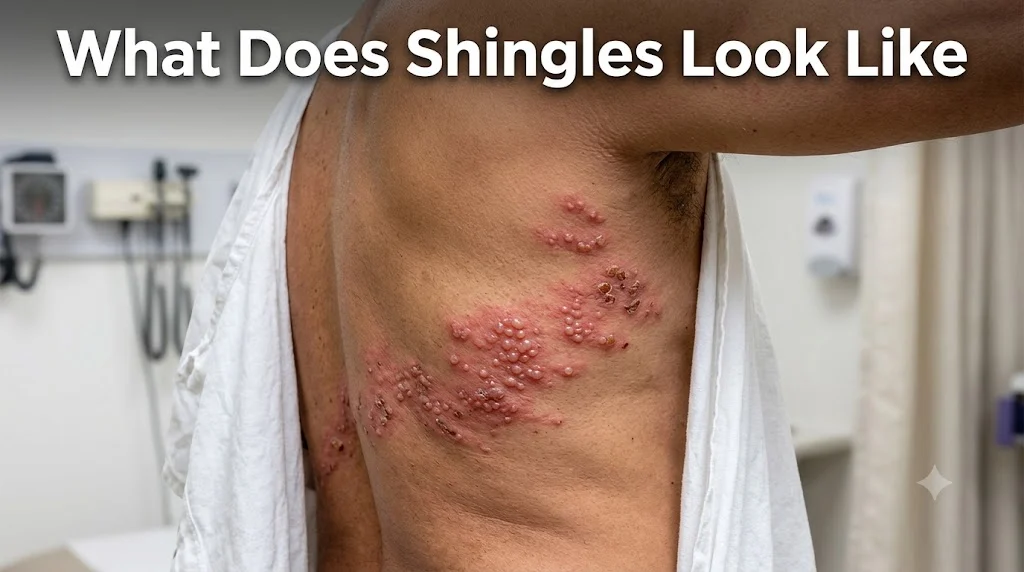
Let’s clear that up right now. Shingles starts as a red, often painful patch of skin that quickly develops into clusters of small, fluid filled blisters. It usually wraps around one side of your body in a band, following the path of a nerve. That band like pattern is the single biggest clue that you’re dealing with shingles and not some other skin condition.
This guide walks you through every stage of a shingles outbreak, where it tends to show up, how it compares to other rashes people often confuse it with, and when you genuinely need to call a doctor. No fluff, no filler, just the information you actually came here for.
What Is Shingles?
Shingles, known medically as herpes zoster, happens when the varicella zoster virus wakes back up inside your body. Here’s the twist: this is the exact same virus that causes chickenpox. Once you’ve had chickenpox, the virus doesn’t fully leave your system. It retreats into your nerve tissue and sits there quietly, sometimes for decades.
Then, for reasons doctors don’t fully understand in every case, it reactivates. Stress, aging, illness, or a weakened immune system can all flip that switch. When it does, the virus travels along a single nerve pathway to the surface of your skin, which is exactly why the rash shows up in that distinctive, localized band rather than scattered all over your body like chickenpox does.
Who’s most likely to get shingles?
- Adults over the age of 50, since immunity naturally weakens with age
- Anyone with a compromised immune system, including those undergoing chemotherapy or living with HIV
- People under significant physical or emotional stress
- Individuals who’ve had chickenpox earlier in life, which covers most adults
- Those taking immunosuppressive medications after an organ transplant
One in three people in the United States will develop shingles at some point in their life. That’s a far higher number than most people realize, and it’s part of why recognizing the early signs matters so much.
It’s also worth knowing that shingles isn’t something you can catch from another person who currently has it in the traditional sense, since it originates from a virus that’s already been living inside you. We’ll get into the contagion details a bit later, but the short version is that it works differently from how most people assume.
What Is the First Sign of Shingles? The Pre-Rash Stage Nobody Talks About
Here’s something most articles skip entirely, and it’s arguably the most useful part of this whole guide. Shingles rarely starts with a visible rash. It starts with sensation.
A few days, sometimes up to a week, before any redness appears, you might notice:
- Tingling or “pins and needles” in a specific patch of skin
- A burning sensation that feels disconnected from anything you did
- Numbness in one isolated area
- Itching that doesn’t match a bug bite or allergic reaction
- Sensitivity to touch, where even light clothing brushing against the skin feels uncomfortable
Alongside these skin sensations, you might also experience whole body symptoms that feel more like a mild flu:
- Low grade fever
- Headache
- Fatigue or general malaise
- Sensitivity to light
- Upset stomach in some cases
This combination throws people off constantly. A lot of patients assume they pulled a muscle, got sunburned, or brushed against poison ivy. The truth only becomes obvious once the rash itself shows up, which is exactly why understanding this pre-rash phase is so valuable. If you can catch shingles during this window and get to a doctor fast, antiviral treatment works far better than if you wait for the blisters to fully form.
“The pain or tingling that precedes the rash is often described by patients as one of the most confusing parts of the illness, simply because there’s nothing to see yet.”
Doctors sometimes refer to this stage as the prodromal phase. During this window, some people also report a deep, aching pain that feels different from typical muscle soreness. It can be sharp one moment and dull the next, which adds to the confusion since it doesn’t behave like a typical injury.
If you’re someone prone to migraines or nerve related conditions, it’s easy to mistake this stage for a flare up of something you’ve dealt with before, which is yet another reason early shingles often goes unrecognized until the rash itself appears.
Shingles Rash Stages: What It Looks Like Day by Day
Once the rash itself begins, it follows a fairly predictable timeline. Understanding these stages helps you track whether your case is progressing normally or whether something’s off.
Day One Through Three: Red, Blotchy Patches
The rash starts as irregular red patches on the skin. At this point, it can look similar to a mild allergic reaction or even a rash from heat. The key giveaway, though, is the pattern. Shingles follows what’s called a dermatomal distribution, meaning it traces the path of a single nerve and stays confined to one side of the body. It never crosses the midline of your chest, back, or face.
Day Three Through Five: Fluid Filled Blisters Form
This is the stage most people associate with shingles. Small, fluid filled blisters, similar in appearance to chickenpox blisters, cluster together on top of the red patches. They’re typically tender, sometimes intensely painful, and can feel hot to the touch. The blisters may continue appearing in new clusters for several days, so don’t be surprised if the rash seems to spread slightly within that same band over this period.
Day Seven Through Ten: Blisters Cloud Over and Crust
Around the one week mark, the blisters begin to change color, turning cloudy or yellowish. Many will rupture on their own, releasing fluid before starting to dry out and crust over. This stage tends to be itchy on top of the existing pain, which can make it particularly uncomfortable.
Day Ten Through Fourteen: Scabbing and Early Healing
By this point, most blisters have crusted into scabs. The intense pain usually starts to ease, though some tenderness can linger. It’s important not to pick at these scabs, since doing so increases the risk of scarring and infection.
Two to Four Weeks: Fading and Final Healing
The rash typically clears within two to four weeks from start to finish. Some people are left with mild skin discoloration or light scarring in the affected area, though this often fades over time. In a smaller number of cases, nerve pain lingers well after the visible rash disappears, a condition known as postherpetic neuralgia, which we’ll cover in more detail later.
Here’s a simple breakdown you can reference at a glance:
| Stage | Timeframe | What You’ll See |
|---|---|---|
| Pre rash | One to five days before | Tingling, burning, itching, no visible rash |
| Early rash | Days one to three | Red, blotchy patches in a band pattern |
| Blistering | Days three to five | Clusters of fluid filled blisters |
| Crusting | Days seven to ten | Blisters cloud over, rupture, and scab |
| Healing | Two to four weeks | Scabs fall away, skin gradually returns to normal |
The One Visual Clue That Sets Shingles Apart From Every Other Rash
If you remember nothing else from this article, remember this: shingles shows up in a band, and that band stays on one side of your body.
This happens because the virus travels along a specific nerve root, called a dermatome, on its way from your spinal cord to your skin’s surface. Since each dermatome covers a defined strip of skin on just one side of the body, the rash follows that exact same strip. It might wrap around your ribcage like a belt, run down one arm, or trace a line along one side of your face, but it will not jump to the opposite side.
This is genuinely the fastest way to rule shingles in or out when you’re comparing it to other rashes. Eczema, hives, contact dermatitis, and allergic reactions tend to show up more symmetrically or in patches that don’t follow this kind of strict, one sided line. Shingles does, almost without exception.
Understanding this pattern also helps explain the pain itself. Since the virus is actively traveling along and irritating a nerve, the discomfort tends to feel different from ordinary skin pain. Patients frequently describe it using words like electric, stabbing, or shock like, which lines up with the fact that nerve tissue, not just skin tissue, is involved.
Where Shingles Commonly Appears on the Body
While shingles can technically develop along any nerve pathway, certain locations show up far more often than others. Here’s a closer look at where people most commonly notice the rash and what to expect in each spot.
Shingles on the Back and Chest
This is, by far, the most frequent location. The rash typically wraps around one side of the ribcage, tracing a band that can stretch from the spine toward the breastbone. Many people describe the pain here as sharp or burning, and clothing rubbing against the area often makes it worse.
Shingles on the Face
Facial shingles deserves special attention because of the proximity to the eyes, ears, and mouth. If the rash develops near the eye, this is considered a medical emergency. Left untreated, shingles near the eye can lead to vision problems or even permanent eye damage. If you notice any rash forming around your eye, on your eyelid, or on the tip of your nose, seek medical care immediately rather than waiting to see how it develops.
This particular presentation has its own medical name, herpes zoster ophthalmicus, and it occurs when the virus reactivates in the trigeminal nerve, which supplies sensation to the upper part of the face including the forehead, eyelid, and the surface of the eye itself.
A useful early warning sign doctors look for is a cluster of blisters appearing on the tip or side of the nose, since this particular spot shares nerve supply with the eye and often signals that the eye itself may be at risk. Symptoms can include redness, swelling, light sensitivity, and blurred vision, and any combination of these alongside facial blisters warrants same day medical attention.
Shingles on the Neck
Neck shingles often follows a band along one side, sometimes extending up toward the scalp or down toward the shoulder. Pain here can sometimes be mistaken for a pinched nerve or muscle strain before the rash makes the actual cause obvious.
Shingles on the Arm or Leg
Less common than torso or facial cases, shingles can still appear along the nerves running down an arm or leg. When it does, the band tends to run lengthwise along the limb rather than wrapping around it the way it does on the torso.
Shingles on the Stomach
Similar to chest and back cases, abdominal shingles usually wraps in a band on one side, often connecting around toward the back. The skin here tends to be particularly sensitive, and even light pressure from waistbands can be uncomfortable during an active outbreak.
Shingles Symptoms Beyond the Rash
The visible rash gets most of the attention, but shingles brings a whole cluster of symptoms that go well beyond what you can see on your skin.
Pain is usually the standout symptom, and it often surprises people with its intensity. Patients commonly describe it as sharp, stabbing, burning, or like an electric shock running along the skin. In many cases, this pain is more disruptive to daily life than the rash itself.
Itching and heightened sensitivity frequently accompany the rash, particularly during the blistering and crusting stages. Even the lightest touch, like a shirt sleeve brushing the skin, can trigger discomfort.
Fever and fatigue often show up alongside the rash, especially in the early days. These symptoms tend to mirror a mild flu and can leave you feeling run down well before you notice any skin changes.
Swollen lymph nodes near the affected area are common as your immune system responds to the viral activity.
Headache and light sensitivity round out the list for many patients, particularly when the outbreak involves the face or scalp.
Mild Versus Severe Shingles: Knowing the Difference
Not every case of shingles looks or feels the same. Severity can vary quite a bit from person to person, and understanding where your case falls on that spectrum helps set realistic expectations for recovery.
Several factors influence how mild or severe a given case turns out to be, including age, overall immune health, how quickly treatment began, and even which nerve pathway the virus happens to be traveling along. Cases affecting larger nerve branches or more sensitive areas like the face tend to run a rougher course than smaller, more contained outbreaks on the torso or limbs.
Mild cases typically involve a smaller, more contained rash, manageable pain levels, and a full recovery within two to three weeks. Many people with mild cases can manage symptoms at home with over the counter pain relief and basic skin care.
Severe cases involve more widespread blistering, intense and sometimes debilitating pain, and a higher chance of complications. Severe cases are more common in older adults and those with weakened immune systems.
One of the most significant complications tied to severe or poorly managed shingles is postherpetic neuralgia, a condition where nerve pain continues long after the rash itself has healed. This happens because the virus can damage nerve fibers during the outbreak, causing them to send exaggerated or incorrect pain signals even after the skin looks completely normal again.
For some people, this pain lasts months. For others, unfortunately, it can persist for years. Postherpetic neuralgia tends to be more common and more severe in people over the age of 60, which is part of why early treatment matters so much for older adults specifically.
Shingles Versus Other Skin Conditions: A Quick Comparison
A lot of people land on this article because they’re trying to figure out if what they’re looking at is actually shingles or something else entirely. Here’s a straightforward comparison to help you tell the difference.
| Condition | Key Distinguishing Feature |
|---|---|
| Shingles | One sided, band like pattern, often painful before any rash appears |
| Chickenpox | Spreads across the entire body, intensely itchy, rarely painful beforehand |
| Eczema | Chronic and recurring, usually symmetrical, dry and scaly rather than blistered |
| Hives | Raised, swollen welts that appear and disappear quickly, no blistering |
| Contact dermatitis | Tied directly to an irritant or allergen, no significant nerve pain involved |
The pain factor is often the deciding clue. Shingles tends to hurt, sometimes intensely, before there’s anything to see. Most of the conditions it gets confused with don’t behave that way.
Is Shingles Contagious?
This is one of the most misunderstood parts of the whole condition, so let’s clear it up properly. You cannot catch shingles from someone else, since shingles itself is a reactivation of a virus already inside your own body.
However, the fluid inside shingles blisters does contain the varicella zoster virus, and that fluid can spread the virus to someone who has never had chickenpox or never received the chickenpox vaccine. If that person comes into contact with the fluid, they could develop chickenpox, not shingles.
This contagious window lasts until all the blisters have fully crusted over. Once the rash reaches the scabbing stage, the risk of spreading the virus drops significantly.
A few practical precautions during an active outbreak:
- Keep the rash covered with clothing or a loose bandage whenever possible
- Stay away from newborns and infants
- Limit close contact with anyone who has a weakened immune system
- Wash your hands frequently, especially after touching the affected area
People often ask whether they need to take time off work or avoid public spaces entirely during an outbreak. In most cases, that’s not strictly necessary as long as the rash stays covered and you’re maintaining good hygiene. The bigger concern is direct contact with vulnerable individuals rather than general proximity, so going about normal activities while keeping the affected skin covered is usually reasonable.
It’s also worth pointing out that the contagious period only applies to direct contact with fluid from the blisters themselves. Simply being in the same room as someone with shingles, without touching the affected skin or any items that have come into contact with the fluid, doesn’t pose a transmission risk in the same way.
When to See a Doctor
While many shingles cases can be managed at home with guidance from a doctor, certain situations call for immediate medical attention rather than a wait and see approach.
Seek care right away if:
- The rash appears anywhere near your eye or on your face
- The rash is spreading rapidly or covering a large portion of your body
- You’re running a high or persistent fever
- You notice signs of a secondary infection, including increasing redness, warmth, swelling, or pus
- You’re over the age of 60, since complication risk rises significantly with age
- Your immune system is already compromised due to illness or medication
Acting quickly matters here more than people expect. Antiviral medications work best when started within the first 72 hours of the rash appearing, so the sooner you get a proper diagnosis, the better your odds of a smoother recovery.
How Shingles Is Diagnosed
In most cases, a doctor can diagnose shingles simply by examining the rash. The distinctive band like pattern, combined with the pain that typically precedes it, gives doctors enough to work with in a routine visual exam.
When the presentation is unusual or the diagnosis isn’t immediately clear, doctors may order additional testing, including a viral culture or a polymerase chain reaction test, often referred to as PCR testing, which can detect the virus’s genetic material from a sample taken from the blisters. These tests aren’t always necessary, but they’re useful tools when symptoms don’t fit the typical pattern.
Treatment Options for Shingles
Treatment generally focuses on three goals: stopping the virus from spreading further, managing pain, and preventing complications.
Antiviral medications are the cornerstone of shingles treatment. These work best when started within 72 hours of the rash first appearing, which is why early recognition is so important. They help shorten the duration of the outbreak and reduce the severity of symptoms.
Pain management often involves a combination of approaches depending on severity. Over the counter pain relievers work for milder cases, while more severe nerve pain may require prescription medications specifically designed to address nerve related discomfort.
At home comfort measures can make a meaningful difference during recovery:
- Cool, damp compresses applied to the rash several times a day
- Calamine lotion to ease itching
- Loose, breathable clothing to avoid irritating the affected skin
- Oatmeal baths, which many people find soothing during the blistering stage
- Keeping the rash clean and dry to reduce infection risk
It’s worth noting that this information is meant to help you understand what to expect, not to replace an actual conversation with a healthcare provider. If you suspect you have shingles, a proper diagnosis and personalized treatment plan from a doctor remains the right next step.
For people dealing with more intense pain, doctors sometimes recommend a layered approach that combines different types of medication working through different mechanisms. This might include nerve pain specific medications alongside standard pain relievers, or in some cases short term use of stronger prescription options for the most severe flare ups.
Rest also plays a bigger role in recovery than many people expect. Your immune system is actively working to suppress the virus during an outbreak, and giving your body adequate sleep and reduced stress genuinely supports that process. Staying well hydrated and eating nutritious meals, even when appetite is low due to discomfort, can also support a smoother recovery timeline.
Can Shingles Be Prevented?
Yes, and this is genuinely one of the more encouraging parts of the shingles conversation. A vaccine called Shingrix is currently recommended for adults aged 50 and older, regardless of whether they remember having chickenpox in the past.
Shingrix has shown strong effectiveness in clinical studies, significantly reducing both the likelihood of developing shingles and the risk of postherpetic neuralgia in those who do still get it. It’s typically given as two doses, spaced two to six months apart.
Adults with certain health conditions or weakened immune systems should talk with their doctor before getting vaccinated, since individual circumstances can affect timing and suitability. For most older adults, though, the shingles vaccine represents one of the most effective tools available for avoiding this painful condition altogether.
Beyond vaccination, there are a handful of everyday habits that support a stronger immune response and may lower your overall risk, even though they’re not guaranteed prevention on their own. Managing chronic stress, getting consistent sleep, eating a balanced diet, and staying physically active all contribute to a more resilient immune system over time.
It’s also worth mentioning that having shingles once doesn’t grant lifelong immunity the way some viral infections do. Since the virus simply goes dormant again rather than being fully eliminated from the body, future reactivation remains possible, which is exactly why the vaccine is still recommended for older adults even if they’ve already had a prior shingles outbreak.
FAQs
What does the very first sign of shingles feel like?
The earliest sign is usually a localized tingling, burning, or numb sensation on one side of the body, often appearing several days before any visible rash.
How long does a shingles rash last?
Most shingles rashes run their course within two to four weeks, moving through the stages of redness, blistering, crusting, and finally healing.
Can shingles appear without a rash?
Yes, though it’s uncommon. This is known as zoster sine herpete, where someone experiences the nerve pain and other symptoms of shingles without ever developing the visible rash.
Does shingles only happen once?
Not necessarily. While many people only experience shingles a single time, it’s entirely possible to have it more than once, particularly if your immune system remains weakened or you’re advancing in age.
What does a healing shingles rash look like?
As shingles heals, the blisters dry out and form scabs, which gradually flatten and fall away over the course of one to two weeks. The skin underneath may appear pink or slightly discolored for a while before returning to its normal tone.
Can you get shingles more than once?
Yes, recurrence is possible, though it’s less common than a single occurrence. Risk factors for recurrence mirror the original risk factors, including advancing age and a weakened immune system.
Conclusion
Recognizing shingles early genuinely changes the course of the illness. The combination of one sided, band like blistering paired with burning or tingling pain that often shows up before the rash itself gives you a clear, reliable signal to watch for. If you notice these signs developing, especially anywhere near your eyes or face, don’t wait around hoping it resolves on its own. A quick conversation with a doctor in those first few days can make a meaningful difference in how smoothly your recovery goes.
At the end of the day, your skin tends to be remarkably good at telling you when something’s wrong, and shingles is one of those conditions where the visual pattern really does speak for itself once you know what to look for.
The one sided band, the progression from tingling to redness to blisters, and the timeline stretching across a few weeks all come together to form a fairly distinct picture. Trust that pattern, act on it quickly, and you’ll be in a much stronger position to manage the outbreak with as little disruption to your daily life as possible.
Discover More Related Articles:
- Razzmatazz Meaning | From Showbiz to Everyday Speech In 2026
- Luxor Meaning | Everything About Egypt’s Famous City In 2026
- Mogging Meaning | Dating, Memes & Internet Culture In 2026