

Definition
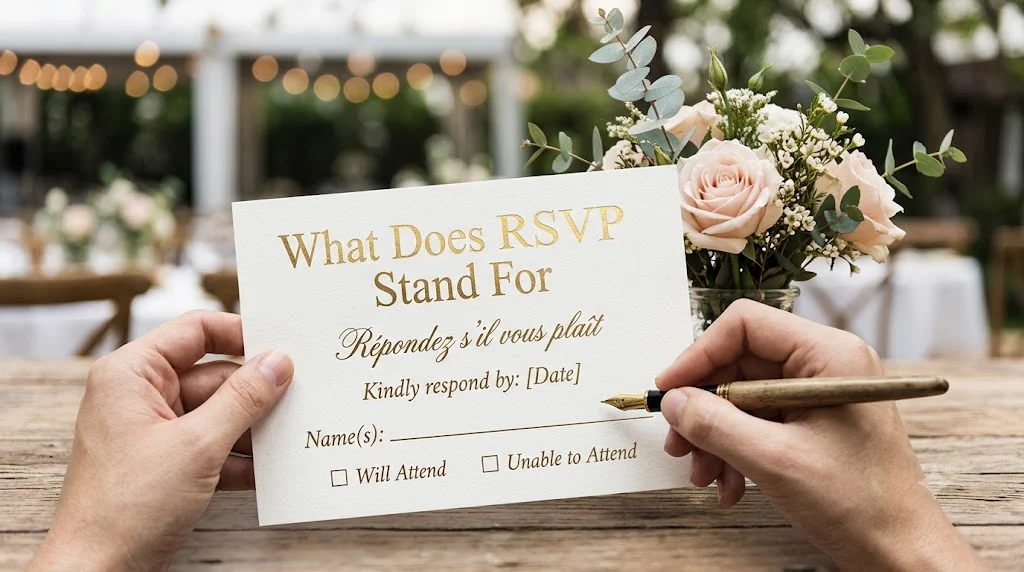
RSVP is a request for guests to confirm whether they will attend an event. The term comes from the French phrase “Répondez s’il vous plaît,” which means “Please respond.”
You open the mailbox and spot a beautiful envelope. Your name is written in elegant calligraphy. Inside, you find a stunning invitation to your friend’s wedding. Your eyes scan the details. Date, time, location, dress code. Then you see it. Four simple letters that carry so much weight: RSVP.
For such a small acronym, it sure creates a lot of confusion. Do you reply online? Send a card back? Call the host? What if you can’t attend? What if you want to bring a date? The questions keep coming.
This comprehensive guide answers everything. We’ll explore what RSVP stands for, where it comes from, why it matters, and exactly how to handle it like a pro. Whether you’re hosting a massive event or attending a casual gathering, you’ll walk away with total confidence.
The Meaning of RSVP Explained
Let’s start with the basics. RSVP is an acronym that stands for the French phrase “Répondez s’il vous plaît.”
Breaking it down piece by piece makes it easier to understand:
- Répondez translates to “reply” or “respond”
- s’il means “if it”
- vous plaît means “pleases you”
Put together, the phrase directly translates to “Reply, if it pleases you” or more simply, “Please reply.”
The French origin explains why these letters appear on invitations worldwide. During the 18th and 19th centuries, French was the language of high society and formal correspondence across Europe and North America. The term stuck around even as English became more dominant in global communication.
Many people make a common mistake. They try to create an English meaning for the letters. You might hear someone say RSVP stands for “Reply Soon Very Promptly” or “Reserve Seating Very Please.” These are incorrect. The letters refer specifically to the French phrase.
RSVP is technically an initialism rather than an acronym. An initialism uses the first letters of words and you say each letter individually. You say “R-S-V-P” rather than pronouncing it as a single word like “rasp.”
The French phrase itself requests a response. When you see RSVP on an invitation, the host asks you to confirm your attendance. This confirmation matters more than you might think.
Why French? A Historical Perspective
French dominated European diplomacy and high society for centuries. The language held prestige across royal courts and aristocratic circles. Formal events used French terminology for everything from food to fashion.
The practice of using French on invitations continued well into the 20th century. Even today, many formal invitations include French phrases. Terms like “décor” and “hors d’oeuvre” remain common in event planning.
The persistence of RSVP demonstrates how language traditions endure. People understand what the letters mean even without knowing the French translation. The acronym has become its own recognized symbol in invitation culture.
Common Misunderstandings About RSVP
Confusion about RSVP creates real problems for hosts. Let’s clear up the most frequent misconceptions.
Misconception 1: RSVP is optional. No. RSVP requests a response from every invited guest. The host needs to know who attends and who declines. Silence creates uncertainty.
Misconception 2: RSVP only applies to formal events. While RSVP originated in formal settings, the principle applies to any event requiring a headcount. Wedding receptions, birthday parties, business dinners, and casual gatherings all benefit from guest confirmations.
Misconception 3: RSVP means you will attend. The acronym only asks for a reply. Your response can be yes, no, or sometimes maybe. The host needs to know either way.
Misconception 4: You only need to respond if you attend. Actually, responding no is equally important. The host cannot assume anyone’s status without confirmation.
Why RSVP Matters for Event Success
You might wonder why hosts make such a fuss about responses. Four simple words can cause stress for event planners. Guests often delay responding. Others forget entirely. Some assume their attendance goes without saying.
Here’s the reality. Event planning involves countless moving parts. Every single component depends on knowing exactly how many people will show up.
The Planning Impact of Accurate RSVPs
Let’s examine each element that relies on guest confirmations.
Catering and Food Costs
Caterers need final counts well before the event. Food must be ordered, prepared, and served based on attendance numbers. Overestimate and you waste food and money. Underestimate and guests go hungry or the host faces embarrassment.
Many catering contracts lock in headcounts a week or two before the event. Changes after that deadline cost extra fees. A single late RSVP can trigger additional charges.
Budget Management
Every guest represents a financial commitment. Catering per person, drinks, favors, and even restroom rentals cost money. Hosts need accurate numbers to manage their budget.
| Planning Element | Why It Requires RSVPs | Consequence of Inaccurate Counts |
|---|---|---|
| Catering | Food quantities and preparation timing | Food waste or shortage |
| Seating | Table configurations and place cards | Awkward seating or family conflicts |
| Venue Capacity | Fire code compliance and comfort | Safety violations or overcrowding |
| Decorations | Centerpieces, favors, and gifts | Insufficient items for guests |
| Budget | Per-person costs and deposits | Overspending or unexpected fees |
| Staffing | Waiters, bartenders, and event coordinators | Poor service or excessive labor costs |
Staffing Requirements
Event staff get scheduled based on expected guest numbers. Waiters serve meals. Bartenders mix drinks. Valets park cars. Bathroom attendants maintain facilities. Every position requires adequate staffing.
Understaffing leads to long lines and slow service. Overstaffing wastes money and looks unprofessional. Accurate RSVPs allow proper staffing levels.
The Etiquette of Requesting RSVPs
Hosts who know how to ask for responses get better results. The wording and method matter greatly. Let’s explore the best practices for requesting RSVPs.
RSVP Wording on Invitations
The most effective invitations clearly state the response method and deadline. Vague requests confuse guests and reduce response rates.
Clear Request:
“Please respond by June 15th. You may reply online at weddingwebsite.com or call Sarah at 555-0123.”
Less Effective:
“RSVP by June 15th.”
The first example gives guests specific options. The second version leaves them wondering how to respond. Guests appreciate clear instructions.
Common RSVP Phrases and What They Mean
- “RSVP” – Please reply (standard usage)
- “RSVP by [date]” – Respond by this specific date
- “Please Respond by [date]” – Same meaning without the French acronym
- “Regrets Only” – Only respond if you cannot attend
- “Kindly Reply” – Polite request for a response
- “The favor of a reply is requested” – Very formal phrasing for elegant events
Response Options for Guests
Modern hosts offer multiple ways to respond. Each method has distinct advantages.
RSVP Cards
Traditional mailed reply cards remain common for weddings and formal events. Guests fill out the card, seal it in the provided envelope, and drop it in the mail.
Advantages: Formal and elegant, permanent record, easy to track
Disadvantages: Slow delivery, lost cards, additional printing costs
Online RSVPs
Digital response systems have surged in popularity. Guests visit a website and click their response. Many wedding websites include built-in RSVP functions.
Advantages: Instant tracking, automated reminders, cost-effective, eco-friendly
Disadvantages: Older guests may struggle with technology, less formal feel
Phone Calls
Some hosts provide a phone number for RSVPs. This works well for smaller gatherings or when guests prefer personal contact.
Advantages: Personal touch, immediate confirmation, clarification possible
Disadvantages: Time-consuming, call may go to voicemail
Text Messages
Text-based RSVPs have become acceptable for casual events. Guests send a quick text to confirm attendance.
Advantages: Fast and convenient, high open rates
Disadvantages: Less formal, potential for confusion
Email Responses
Invitations sometimes provide an email address. Guests send their response electronically.
Advantages: Easy for guests, cost-free, creates written record
Disadvantages: May get caught in spam filters
Setting an RSVP Deadline
The deadline matters tremendously. Too early and guests haven’t made plans. Too late and you can’t finalize arrangements.
General Guidelines for RSVP Deadlines
Weddings: Typically 4-6 weeks before the event. This timing allows caterers to finalize food orders.
Formal Dinners: 2-3 weeks ahead. Gives chefs adequate preparation time.
Corporate Events: 2-4 weeks before. Allows for proper business arrangements.
Casual Parties: 1-2 weeks before. Enough time for basic planning.
Large Conferences: 4-6 weeks before. Complex logistics require extended preparation.
The deadline should appear prominently on the invitation. Use bold type or a separate line to draw attention. Include the phrase “Please respond by [date]” so there’s no confusion.
What Happens When Guests Don’t Reply
Despite clear instructions, some guests ignore RSVP requests. Hosts must decide how to handle non-responsive invitees.
The standard practice involves following up. Contact the guest directly about a week after the deadline. Use phone calls, texts, or emails to ask about their attendance.
Sample follow-up message:
“I’m finalizing numbers for my party next Saturday. I noticed I haven’t received your RSVP yet. Could you let me know if you’ll be attending? Thanks!”
Most guests appreciate the reminder. Life gets busy and people forget. A gentle prompt solves the problem.
For persistent non-responders, the host may need to mark them as not attending. Every event has a cutoff point. Without a response, assume the guest cannot attend.
How Guests Should Respond to RSVP Requests
Receiving an invitation creates a responsibility. You must respond appropriately and on time. Here’s exactly how to handle any RSVP situation.
The Three Essential Elements of a Response
Every RSVP reply must contain three critical pieces of information.
Your Name
Clearly state who is responding. Even if the host sent the invitation, confirm your name in the reply. This prevents confusion when multiple guests share similar names.
Your Answer
State your attendance clearly. Use definitive words like “Yes” or “No.” Avoid vague responses like “probably” or “I’ll try.” The host needs certainty.
Your Guest Count
Indicate exactly how many people in your party will attend. If the invitation is for you only, say so. If you’re bringing a guest, confirm the total number. Don’t assume a plus-one unless specified.
Sample RSVP Responses for Different Situations
Formal Wedding Invitation
“Mr. James Henderson and Mrs. Elizabeth Henderson accept with pleasure the kind invitation for Saturday, October 14th. Two guests will attend.”
Formal Wedding Invitation (Declining)
“Mr. James Henderson regrets that he is unable to accept the kind invitation for Saturday, October 14th.”
Wedding Response Card
“Kindly respond on or before May 1st. Number attending: 2. Names: James and Elizabeth Henderson. We look forward to celebrating with you.”
Casual Party Invitation (Text)
“Hey Sarah! It’s James. Yes, I’ll be at your party on Saturday. I’ll bring my wife Elizabeth. Looking forward to it!”
Business Event (Email)
“Dear Mr. Thompson, Thank you for the invitation to the annual gala. I confirm my attendance. One guest will accompany me. Sincerely, James Henderson.”
Regrets Only Invitation
If the invitation says “Regrets Only,” simply don’t reply if you’re attending. Only respond if you cannot attend.
Regrets Only Response (Declining)
“Mr. James Henderson regrets he cannot attend the dinner on Saturday, June 3rd.”
The “M” Line Mystery on Wedding RSVP Cards
Wedding response cards frequently feature a blank line with an “M” preceding it. This simple element confuses many guests.
The “M” stands for the first letter of your formal title. You fill in:
- Mr. for men
- Mrs. for married women
- Miss for unmarried women
- Ms. for women preferring this title
- Mx. for non-binary individuals
After the title, write your full name. For example: “Mr. James Henderson” or “Mrs. Elizabeth Henderson.”
This formal title practice comes from tradition and courtesy. Some couples prefer less formality today. If you’re unsure, check how the invitation addresses you. Mirror that style in your response.
Dietary Requirements and Special Requests
Many modern invitations ask about dietary restrictions. You might see boxes for:
- Vegetarian
- Vegan
- Gluten-free
- Dairy-free
- Nut allergy
- Halal
- Kosher
- Other (with space to specify)
Always mention genuine dietary needs. The host wants to accommodate you. Don’t request special meals for preference alone unless the host offers options.
Example of a Response with Dietary Note
“Mr. James Henderson and Mrs. Elizabeth Henderson accept. Two guests attending. Mrs. Henderson has a gluten-free dietary requirement. We look forward to the celebration.”
RSVP Etiquette for Plus-Ones and Children
Navigating plus-one and child invitations requires attention to detail.
Plus-One Requests
Only bring a guest if the invitation includes “and guest” or is addressed to “James Henderson and Guest.” Don’t assume you can bring someone. Asking to bring an uninvited guest puts the host in an awkward position.
If the invitation doesn’t mention a plus-one, attend alone. The host likely made this choice due to space or budget constraints.
Children at Events
Check the invitation for child-specific wording. “No children under 12” means exactly that. “Adults only” means no children at all.
Don’t bring children to events without explicit permission. Even if you think “they won’t bother anyone,” the host has valid reasons for their policy.
Modern RSVP Trends and Technology
The digital age has transformed how people manage event responses. Understanding these changes helps both hosts and guests.
The Rise of Online RSVPs
Online RSVP systems now dominate event planning. The convenience factor drives this shift. Guests respond with a few clicks instead of mailing cards. Hosts track responses instantly through dashboards.
Popular platforms offer comprehensive features:
- Guest list management – Import and organize invitation lists
- Customizable questions – Ask about meal preferences, song requests, or attendance details
- Automated reminders – Send gentle prompts to non-responders
- Real-time tracking – Monitor response rates at a glance
- Export capabilities – Download data for vendors and planners
Benefits for Hosts
Online RSVPs eliminate paper response cards and return postage. This saves money and reduces environmental waste. Hosts also avoid lost mail scenarios. Every response appears directly in the system.
Benefits for Guests
Response takes seconds instead of minutes. No stamps required. No worry about late mail delivery. Automated confirmations provide peace of mind.
Many hosts solve these problems by offering both options. Include a website address for online responses and a phone number for guests who need alternatives.
Text Message RSVPs
SMS responses have entered the mainstream for casual and semi-formal events. Guests appreciate the speed and simplicity.
Best Practices for Text RSVPs
- Send a clear instruction in the invitation
- Provide a specific number for responses
- Include a sample response to guide guests
- Set a deadline and mention it in the text request
- Follow up with a confirmation thank you
Example Text Invitation
“You’re invited to John’s 40th birthday party on June 10th! Please text YES or NO to 555-0123 by June 1st. Need to know for catering. Can’t wait to celebrate!”
Example Guest Response
“YES! James and Elizabeth attending. Can’t wait to see everyone.”
Email RSVPs
Email remains a popular response method for business events and formal gatherings. The format allows for detailed responses.
Structure a Good Email RSVP
- Clear subject line: “RSVP for Sarah’s Wedding – James Henderson”
- Confirm attendance status
- State number of guests
- Note any dietary requirements
- Express enthusiasm or gratitude
- Include contact information if needed
Hybrid Approach: Combining Traditional and Digital
Many event planners now use hybrid methods. They send paper invitations with RSVP cards. They also create a website for electronic responses. This accommodates guests of all ages and preferences.
The trend toward digital reduces costs and improves efficiency. Yet paper invitations maintain elegance for formal occasions. Smart hosts leverage both.
QR Codes on Invitations
QR codes have made RSVPs even easier. Guests scan the code with their phone camera. The link opens directly to the RSVP page. No typing web addresses or searching for websites.
Advantages of QR Codes
- Immediate access to response page
- Reduces errors from manual URL entry
- Works seamlessly with mobile devices
- Modern and tech-forward appearance
Best Practices for QR Code RSVPs
- Place the code prominently on the invitation
- Include written instructions as backup
- Test the code before printing
- Ensure the landing page works on mobile
RSVP Etiquette for Every Occasion
Different events call for different RSVP approaches. Understanding these nuances prevents awkward moments.
Wedding RSVP Etiquette
Weddings represent the most formal RSVP occasions. The stakes feel higher because celebrations involve significant expense.
For Guests
- Respond exactly as instructed on the invitation
- Respect the deadline without exception
- Use formal titles when filling out response cards
- Indicate meal choices clearly if offered
- Don’t change your response after the deadline
- Respect plus-one limitations
- Arrange childcare if children aren’t invited
Important Wedding RSVP Tips
Always RSVP to the address or website provided. Don’t tell the bride or groom your response informally. They’re too busy to track verbal confirmations.
Write your full name on the response card, even if it seems obvious. Some families share similar names. Clarity helps the seating chart process.
Business and Corporate Event RSVPs
Professional events require professional responses. Your RSVP reflects on your reputation.
For Attendees
- Respond promptly to demonstrate professionalism
- Confirm your attendance in writing
- Inform the organizer if your plans change
- Show up if you confirm attendance
- Bring only specified guests
For Hosts
- Send invitations well in advance
- Include clear response instructions
- Set a reasonable deadline
- Follow up with non-responders
- Confirm final numbers with vendors
Birthday Party RSVPs
Birthday celebrations range from casual to formal. Adjust your response accordingly.
For Kids’ Parties
- RSVP promptly so the host buys enough party favors
- Mention any food allergies
- Confirm whether a parent stays or drops off
- Specify the number of children attending
For Adult Birthday Parties
- Respond by the requested date
- Indicate if bringing a guest
- Suggest any availability issues
- RSVP no if you cannot attend
Baby Shower and Bridal Shower RSVPs
Showers typically follow a more formal RSVP structure than casual parties.
Specific Considerations
- Gifts often accompany shower attendance
- RSVP helps hosts plan games and activities
- Dietary restrictions matter for refreshments
- Some showers request specific gift contributions
Holiday Party RSVPs
Seasonal gatherings demand earlier responses. The holiday rush creates scheduling conflicts. Hosts need accurate numbers for seasonal planning.
Key Considerations
- Respond before the holidays get too busy
- Consider travel factors when replying
- Mention if bringing children
- Note any food allergies for holiday meals
- Be aware of weather-related contingency plans
Casual Gatherings and Potlucks
Informal events still benefit from RSVPs. Even backyard barbecues need approximate numbers.
What to Include
- Confirm attendance
- Offer to bring a dish or drink
- Indicate number of people in your group
- Ask about parking or transportation
- Mention pets if relevant
Consequences of Ignoring RSVPs
Many people underestimate the impact of not responding to invitations. Let’s examine the real consequences.
For the Host
Non-response creates significant stress. Event planners lose sleep over uncertain headcounts.
Financial Waste
Ordering food without confirmed numbers wastes money. Caterers charge for unused portions. Venues require minimum guarantees. Every unconfirmed guest costs the host.
Logistical Headaches
Seating charts need finalizing. Staffing requirements need setting. Meal choices need assigning. Without RSVPs, everything remains in limbo.
Emotional Strain
Hosts feel anxious about their event. They wonder if guests care enough to respond. They worry about disappointing attendees.
Last-Minute Rush
Chasing non-responders consumes time. Event organizers spend hours tracking down information. This stress undermines the hosting experience.
For the Guest
Ignoring RSVPs affects your relationships.
Social Consequences
Hosts remember who didn’t respond. Future invitations may skip your name. People notice inconsiderate behavior.
Missed Opportunities
Maybe you planned to attend but forgot to respond. The host assumed you declined. Now you miss the event.
Strained Relationships
The host worked hard on the invitation. Your silence feels dismissive. Friendships suffer from perceived disrespect.
For Other Guests
Your non-response affects everyone.
Limited Seating
If the host underestimates attendance, late additions disrupt seating arrangements. Table assignments get thrown into chaos.
Insufficient Food
Caterers prepare based on confirmed numbers. Extra guests mean less food for everyone.
Uncomfortable Atmosphere
Overcrowding or empty seats create awkward experiences. Both scenarios stem from inaccurate RSVPs.
RSVP Regrets Only and Other Special Cases
Some invitations use alternative phrasing. These variations require specific responses.
“Regrets Only” Explained
“Regrets Only” means you only need to respond if you cannot attend. The host assumes you’ll be there otherwise.
When to Use This Approach
- Smaller gatherings where most invitees attend
- Events with flexible capacity
- Situations where response fatigue creates problems
Best Practices for Guests
- Only contact the host if declining
- Include your name in the regrets message
- Explain why you can’t attend (optional but appreciated)
- Send regrets as soon as you know
Sample Regrets Only Response
“Dear Sarah, I’m so sorry I can’t make it to your dinner on Saturday. I’ll be out of town. Hope you have a wonderful celebration! – James”
“Regrets and Requests” Explained
Some invitations ask for two pieces of information. They want regrets (who can’t attend) and requests (who will attend).
Sample Wording:
“Regrets and requests. Please inform us by June 1st.”
Best Practices
- Send your response regardless of attendance
- Clearly indicate your status
- Include all relevant details
“M” Line Variations
Some invitations modify the “M” line. You might see:
- “Name(s)” – Simply write your full name
- “Guest Name” – Include the primary guest’s name
- No title indicator – Use your preferred style
Digital RSVP Platforms and Tools
Technology has revolutionized event response management. Let’s explore popular options.
Top RSVP Platforms
Wedding-Specific Platforms
- The Knot – Comprehensive wedding planning with built-in RSVPs
- Zola – All-in-one wedding website and guest management
- WeddingWire – Guest tracking and response management
- Minted – Design services with RSVP integration
- Joy – Free wedding website with digital RSVP capabilities
Event Planning Platforms
- Evite – Digital invitations with response tracking
- Paperless Post – Elegant digital invitations with RSVP
- Eventbrite – Ticketing and event registration
- RSVPify – Dedicated RSVP management tool
- Greenvelope – Sustainable digital invitations
Small Business Solutions
- Google Forms – Simple but effective RSVP collection
- Facebook Events – Integrated invitation responses
- WhatsApp Groups – Quick response tracking
- Slack – Business event response coordination
Features to Look For in RSVP Tools
| Feature | Why It Matters |
|---|---|
| Guest List Import | Add guests quickly from spreadsheets |
| Custom Questions | Collect meal preferences |
| Automated Reminders | Prompt non-responders without manual effort |
| Real-Time Tracking | Monitor response rates instantly |
| Export Data | Share with vendors and planners |
| Design Customization | Match your event theme |
| Mobile Optimization | Respond from any device |
| Security Features | Protect guest information |
Cost Considerations
- Free Options: Evite basic, Google Forms, Facebook Events
- Mid-Range: RSVPify Pro, Paperless Post Premium (under $50)
- Premium: Full-service wedding websites with RSVP ($100+)
- Enterprise: Eventbrite for large conferences (variable pricing)
Cultural Differences in RSVP Usage
RSVP originated in France and Western Europe. The concept has spread globally with cultural variations.
RSVP in Different Countries
France
The original term still appears on French invitations. “Répondez s’il vous plaît” remains standard phrasing. French event planners expect prompt, formal responses.
United Kingdom
RSVP commonly appears on invitations. British etiquette emphasizes prompt responses. The “M” line appears on wedding response cards. Formal language remains important.
United States
Widespread RSVP usage across all event types. Digital RSVPs have become mainstream. Casual events often use alternative phrasing like “Please reply.”
Asian Countries
Japan often uses “ご出欠のご返事” (response to attendance). Korea uses “참석 여부” (attendance confirmation). The RSVP concept exists but local phrasing prevails.
Middle Eastern Countries
Formal invitations often request responses verbally or through intermediaries. Family networks relay attendance information.
Regional Etiquette Variations
- European events – Expect more formal response requirements
- American events – Accept more casual response methods
- Asian events – Emphasize family coordination in responses
- Latin American events – Extended families often included together
Common RSVP Mistakes and How to Avoid Them
Even well-meaning guests make errors. Let’s prevent the most frequent mistakes.
Guest Mistakes
Mistake 1: Forgetting to Respond
The most common error involves forgetting entirely. Set a reminder in your phone when you receive the invitation.
Solution: Immediately note the RSVP deadline on your calendar. Respond as soon as you know your schedule.
Mistake 2: Responding Vaguely
“I’ll try to make it” doesn’t help the host. They need definitive responses.
Solution: Check your schedule before responding. Only use “maybe” if the host explicitly permits it.
Mistake 3: Assuming Attendance
Some people think they don’t need to RSVP because “everyone knows they’ll attend.” This causes planning problems.
Solution: Always respond, regardless of how close you feel to the host.
Mistake 4: Late Responses
Responding after the deadline creates problems for the host.
Solution: Respond at least a week before the deadline if possible. This gives the host breathing room.
Mistake 5: Not Updating the Host
If your plans change after you respond, inform the host immediately.
Solution: Contact the host as soon as you know about any changes.
Mistake 6: Bringing Uninvited Guests
Showing up with extra people puts the host in a difficult position.
Solution: Only bring guests specifically included in the invitation. Ask ahead if you need clarification.
Mistake 7: Not Mentioning Dietary Restrictions
Guests with allergies sometimes forget to mention them.
Solution: Always note genuine dietary needs on the response card. This helps the host prepare properly.
Host Mistakes
Mistake 1: Not Setting a Clear Deadline
Vague response timing reduces response rates.
Solution: Always include a specific date and time for responses.
Mistake 2: Making It Difficult to Respond
Complicated response processes discourage replies.
Solution: Provide easy options like online forms or simple reply cards.
Mistake 3: Setting an Unreasonable Deadline
Too early or too late creates problems.
Solution: Follow standard timing guidelines for your event type.
Mistake 4: Not Following Up
Assuming everyone who hasn’t responded will attend.
Solution: Contact non-responders a week after the deadline.
The Psychology Behind RSVP Behavior
Understanding why people respond helps hosts improve their response rates.
Why People Delay
Procrastination
Humans naturally delay tasks. RSVPs feel low-stakes, so they get postponed.
Decision Anxiety
People struggle with commitment. They worry about making the wrong choice.
Forgetting
Life gets busy. RSVPs slip minds amidst competing priorities.
Assumed Attendance
People believe their attendance is obvious. They don’t realize hosts need confirmation.
Social Anxiety
Some guests feel awkward declining. They avoid responding rather than saying no.
How Hosts Can Improve Response Rates
Create Urgency
Set clear deadlines and mention them prominently.
Make It Easy
Provide simple response options with clear instructions.
Follow Up
Gentle reminders significantly improve response rates.
Show Appreciation
Thank guests for responding. Positive reinforcement encourages future compliance.
Provide Context
Explain why RSVPs matter for the event. Guests respond better when they understand.
The Impact of RSVP Wording
Research on invitation psychology reveals surprising findings.
| Wording Style | Response Rate | Guest Perception |
|---|---|---|
| “Please respond by June 1st” | 68% | Standard, clear request |
| “We kindly request your response by June 1st” | 72% | Polite, positive feeling |
| “Your response is required by June 1st” | 75% | Clear authority, higher compliance |
| “Please let us know if you can attend” | 58% | Vague, easier to ignore |
| “Please RSVP by June 1st” | 71% | Recognizable, effective |
The most effective wording balances politeness with clarity. Direct requests produce better results.
RSVP Etiquette Timeline
Follow this timeline for proper RSVP management.
8-12 Weeks Before the Event (Host)
- Finalize guest list and invitation design
- Choose RSVP method (digital, paper, hybrid)
- Set reasonable response deadline
- Print invitations with clear instructions
6-8 Weeks Before the Event
- Send invitations
- Verify response method works properly
- Test digital RSVP links and forms
4 Weeks Before the Event (Guests)
- Receive invitations
- Check your calendar for conflicts
- Decide whether you’ll attend
- Plan to respond promptly
2-3 Weeks Before the Event
- Most guests should have responded
- Host sends gentle reminders to non-responders
1-2 Weeks Before the Event
- Final deadline arrives
- Host contacts remaining non-responders
- Catering counts finalized
- Seating chart completed
1 Week Before the Event
- Vendors receive final numbers
- Guest list confirmed
- No changes accepted for most events
FAQs
What does RSVP mean in English?
RSVP translates from French to “Please reply” in English. The French phrase “Répondez s’il vous plaît” requests a formal response to an invitation.
Is RSVP only for weddings?
No. RSVP appears on invitations for weddings, birthday parties, business events, holiday celebrations, and any gathering requiring accurate attendance counts.
What is the correct way to RSVP?
Follow the instructions on the invitation exactly. Provide your name, clear attendance confirmation, and number of guests in your party. Respond by the deadline using the specified method.
Should I say yes or no if I’m not sure?
Contact the host directly if you’re uncertain. Ask if a “maybe” response is acceptable. Most hosts prefer honesty over silent uncertainty.
Can I RSVP by text?
Yes, if the invitation provides a phone number and instructs you to respond by text. Otherwise, use the specified method.
What happens if I don’t RSVP?
The host may assume you’re not attending. Some hosts follow up with non-responders. Others mark you as declining and finalize numbers without you.
How far in advance should I RSVP?
Respond as soon as you know your availability. Always respond before the stated deadline.
What does “RSVP by” mean?
This indicates the date by which you must respond. Responses received after this date cannot be guaranteed.
Conclusion:
RSVP is a widely used term on invitations that helps hosts know who plans to attend an event. It comes from the French phrase “Répondez s’il vous plaît,” which means “Please respond.” Whether it appears on wedding invitations, business events, parties, or formal gatherings, RSVP plays an important role in event planning and organization.
Understanding the meaning of RSVP helps guests follow proper etiquette and show respect for the host’s efforts. By responding on time, attendees make it easier for organizers to arrange seating, food, accommodations, and other event details. A simple reply can greatly contribute to the success of any gathering.
In today’s world, RSVP responses can be sent through phone calls, emails, text messages, websites, or online forms. No matter the method, replying promptly remains an important courtesy. Knowing what RSVP stands for and using it correctly ensures clear communication and smoother event experiences for everyone involved.
Discover More Related Articles:
- Razzmatazz Meaning | From Showbiz to Everyday Speech In 2026
- Luxor Meaning | Everything About Egypt’s Famous City In 2026
- Mogging Meaning | Dating, Memes & Internet Culture In 2026