

Definition
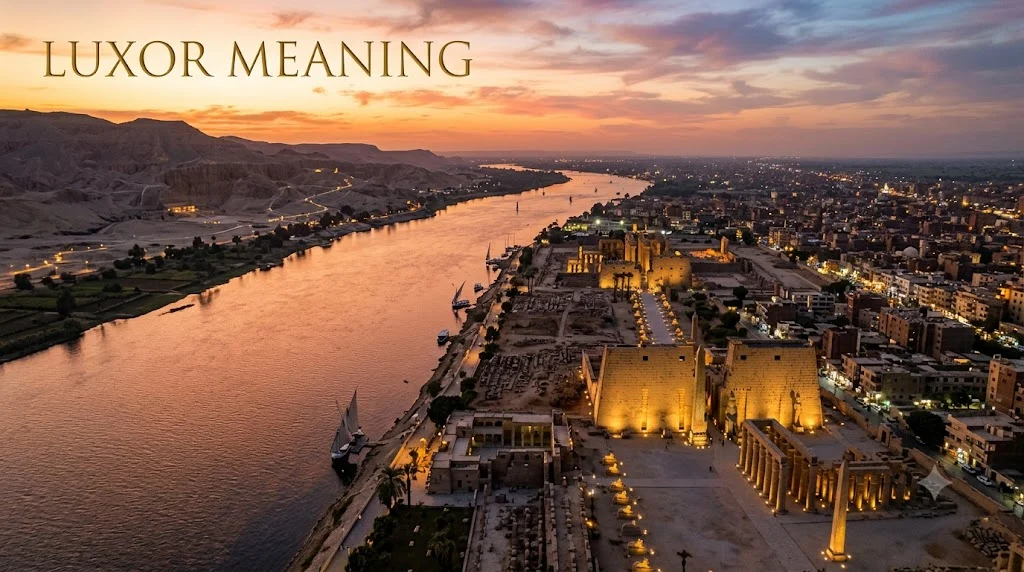
Luxor derives from the Arabic phrase “Al-Uqsur” (الأقصر), which translates to “The Palaces” or “The Castles” in English.
Imagine standing before a structure so colossal, so impossibly ancient, that your brain struggles to process it as real. That’s what Arab settlers felt when they first arrived in what we now call Luxor. They looked at towering stone pylons, rows of sphinx statues, and crumbling temple walls stretching as far as the eye could see. Their reaction? They called it Al-Uqsur “The Palaces.” And honestly, you can’t blame them.
That single Arabic phrase gave birth to one of the most recognizable city names on Earth. But the meaning of Luxor goes so much deeper than a translation. It’s a name that carries three thousand years of civilization, dozens of pharaohs, and a religious legacy that shaped the ancient world. So let’s unpack it all from etymology to archaeology, from ancient Thebes to modern tourism.
This guide covers everything: what Luxor means in Arabic, what it was called before, why it matters historically, and what makes this city a living archaeological wonder unlike anything else on the planet.
What Does Luxor Mean? The Core
Let’s start with the most direct answer.
The word “uqsur” is the plural form of “qasr” (قصر), the Arabic word for palace, castle, or fortified structure. When Arab settlers arrived in Upper Egypt during the 7th century CE, they encountered the sprawling ruins of what had once been the most powerful city in the ancient world. The sheer scale of the stone temples and monumental gateways reminded them of great palaces. So that’s what they called the place.
It wasn’t a calculated historical label. It was a visceral, spontaneous reaction to overwhelming architecture.
Over time, “Al-Uqsur” passed through different linguistic filters. European travelers and colonizers anglicized it, softening the Arabic sounds into the smoother, more marketable “Luxor” we use today.
“In Luxor, every stone whispers the name of a god or a king. It’s the only city on Earth where the past doesn’t feel past at all.” A sentiment shared by countless historians and travelers across centuries.
So when you ask what Luxor means, the short answer is: The Palaces. But the long answer fills entire books.
How Do You Pronounce Luxor Correctly?
Before going deeper, let’s clear this up. Mispronunciation is surprisingly common.
English pronunciation: LUCK-sor (rhymes with “luck” + “sor”)
Arabic pronunciation: Al-UQ-sur the “q” here is a deep, guttural sound from the back of the throat, not common in English speech
Common mistakes:
- “LOO-sor” (wrong vowel sound)
- “LUX-or” as in “luxury” (understandable but incorrect)
- “Luke-sor” (a frequent error among first-time visitors)
The simplest trick? Say “luck” and follow it with “sor.” That gets you close enough in English without needing to master Arabic phonetics.
Knowing how to say it correctly matters, especially if you’re heading there as a traveler. Locals appreciate the effort, and it signals genuine respect for the culture.
Luxor Name Meaning vs. Its Ancient Egyptian Identity
Here’s where it gets genuinely fascinating. The people who actually built Luxor the ancient Egyptians never called it Luxor at all. That name came 2,000 years after the city’s golden age. So what did they call it?
The ancient Egyptians had several names for this city, and each one reveals something different about how they saw it.
Waset was the most common administrative name. Scholars interpret it as “city of the scepter,” a direct reference to royal and divine power. The scepter wasn’t just a symbol it was the central object of Egyptian governmental authority.
Niwt simply meant “The City.” No qualifier needed. In a civilization that built dozens of great cities along the Nile, this one stood so far above the rest that it didn’t need a distinguishing name. Saying “The City” meant everyone knew exactly where you were talking about.
Niwt-rst translated to “The Southern City” a geographic marker that separated it from Memphis, the great northern capital. During certain dynasties, power shifted between these two poles of Egyptian civilization.
Each of these names tells you something the name “Luxor” doesn’t: that this city saw itself not as a collection of impressive buildings, but as the beating heart of a civilization.
Ancient Thebes: The City Before Luxor
The Greeks gave Luxor its most famous pre-Arab name: Thebes.
Homer, writing around the 8th century BCE, described it in the Iliad as a city of “a hundred gates” and fabulous wealth. That wasn’t poetic exaggeration it was a genuine acknowledgment of Thebes’ staggering power and prosperity.
Where did the name “Thebes” come from? Most scholars believe the Greeks derived it from the Egyptian “Waset,” though the phonetic journey between those two words isn’t perfectly clean. Some linguists suggest the Greeks may have named it after their own city of Thebes in Boeotia, Greece. The exact etymology remains a subject of academic debate.
What isn’t debated is what Thebes represented: the capital of Egypt’s New Kingdom period (roughly 1550 to 1070 BCE), the wealthiest era in Egyptian history.
Here’s a clear timeline of how this city’s name evolved:
| Era | Name Used | Language | Meaning |
|---|---|---|---|
| Ancient Egypt (3200 to 332 BCE) | Waset / Niwt | Egyptian | City of the Scepter / The City |
| Greek and Roman Period (332 BCE to 641 CE) | Thebes | Greek | Derived from “Waset” |
| Arab Conquest onward (641 CE to 1800s) | Al-Uqsur | Arabic | The Palaces / The Castles |
| Modern Era (1800s to present) | Luxor | English (anglicized) | Derived from Al-Uqsur |
Notice something? Every single name this city has carried reflects awe. Whether it’s “The City,” “The Palaces,” or Homer’s city of a hundred gates every culture that encountered Luxor responded the same way: with reverence.
The Historical Significance Behind the Luxor Definition
Understanding the Luxor definition means understanding why this particular patch of earth earned every superlative ever thrown at it.
Luxor served as Egypt’s political and religious capital during the New Kingdom the most powerful era in the country’s 3,000-year history.
During this period, Egypt controlled territory stretching from modern-day Sudan in the south to Syria in the north. It was an empire in every meaningful sense. And its throne sat right here, in Luxor.
The pharaohs of the New Kingdom were some of history’s most famous rulers:
- Tutankhamun | the boy king, whose intact tomb stunned the modern world in 1922
- Ramesses II | arguably the most prolific builder in human history, who ruled for 66 years
- Hatshepsut | one of Egypt’s few female pharaohs, who built a mortuary temple of breathtaking elegance
- Amenhotep III | the “Sun King” of ancient Egypt, who built Luxor Temple
- Thutmose III | often called Egypt’s Napoleon, who expanded the empire to its greatest extent
These weren’t mythological figures. They were real people who walked the streets of ancient Thebes, worshipped in its temples, and were eventually buried in its western hills. Their decisions shaped world history.
Luxor’s Religious Identity: City of the God Amun
You can’t fully grasp the meaning of Luxor without understanding one central figure: Amun.
Amun was the king of the Egyptian gods during the New Kingdom. Think of him as the divine CEO of the Egyptian theological system. His primary earthly residence? Luxor. The temples here weren’t tourist attractions or civic monuments they were literally considered the home of a living god.
The implications of that belief were enormous. Temple priests in Luxor didn’t just perform ceremonies they managed vast estates, controlled grain supplies, issued land grants, and wielded political power that sometimes rivaled the pharaoh himself. At certain points in Egyptian history, the High Priest of Amun in Thebes was effectively running the country.
The economic engine of this religious system was staggering:
- Karnak Temple alone owned roughly 65 villages, 433 gardens, and 421,362 head of cattle at the peak of its institutional power (based on records from the reign of Ramesses III)
- The temple employed tens of thousands of priests, craftsmen, farmers, and administrators
- Annual festivals drew pilgrims from across the empire, turning Luxor into a religious and commercial hub simultaneously
That’s not mythology. That’s documented history preserved in hieroglyphic records.
The Nile and the Spiritual Geography of Luxor
Luxor’s layout wasn’t accidental. The Nile didn’t just flow through the city it divided it into two spiritually distinct zones, each carrying deep symbolic weight.
The East Bank: Land of the Living
The sun rises in the east. Life begins in the east. So naturally, the living city occupied the eastern bank of the Nile. Luxor Temple, Karnak Temple, the markets, the homes, the administrative buildings all on the east bank. This is where people were born, worked, worshipped, and built.
The West Bank: Land of the Dead
The sun sets in the west. Death comes from the west. The ancient Egyptians mapped their theology directly onto their geography. The western bank held everything connected to death and the afterlife: the Valley of the Kings, the Valley of the Queens, the mortuary temples, and the vast necropolis of ancient Thebes.
This east-west duality wasn’t a quirky cultural tradition it was a complete cosmological worldview translated into urban planning.
Key locations on each bank:
East Bank:
- Luxor Temple
- Karnak Temple Complex
- Avenue of Sphinxes
- Luxor Museum
- Luxor Souk (traditional market)
West Bank:
- Valley of the Kings
- Valley of the Queens
- Hatshepsut’s Mortuary Temple (Deir el-Bahari)
- Colossi of Memnon
- Medinet Habu Temple
- Nobles’ Tombs
Luxor Temple: The Monument That Defined the Name
If there’s one structure that justified the Arab settlers calling this place “The Palaces,” it’s Luxor Temple.
Built primarily during the reigns of Amenhotep III (around 1390 BCE) and Ramesses II (around 1279 BCE), Luxor Temple sits right in the heart of the modern city. That’s not a metaphor there are hotels and restaurants literally surrounding it. You can eat dinner with a view of 3,400-year-old columns.
Key facts about Luxor Temple:
- Construction began roughly around 1390 BCE
- The temple’s main axis runs north to south, oriented toward Karnak Temple
- Ramesses II added a massive entrance pylon and six colossal statues of himself (originally two now stand, four were damaged or removed over millennia)
- A 25-meter obelisk originally flanked the entrance; the other now stands in Place de la Concorde, Paris, gifted to France in 1833
- During Roman occupation, a legionary fortress was built around and over the temple
- A mosque, the Abu Haggag Mosque, was built on top of the temple during the Islamic period and still stands there today
That last point is extraordinary. Luxor Temple has served as an Egyptian religious site, a Roman military base, a Christian church (there’s evidence of early Coptic use), and an Islamic mosque all within the same physical footprint. Few structures on Earth carry that many layers of human history.
The Avenue of Sphinxes connected Luxor Temple to Karnak, running approximately 3 kilometers through the city. Originally lined with over 1,000 sphinx statues, this ancient ceremonial road was used for the annual Opet Festival, when the statue of Amun was carried in procession from Karnak to Luxor Temple.
Egyptian authorities completed the excavation and restoration of the full Avenue of Sphinxes and reopened it in a spectacular ceremony in November 2021 one of Egypt’s most celebrated recent archaeological achievements.
Karnak Temple Complex: Two Thousand Years in the Making
If Luxor Temple is impressive, Karnak is another category entirely.
The Karnak Temple Complex is the largest religious structure ever built by human hands. It covers approximately 200 acres (81 hectares) large enough to fit Notre Dame Cathedral inside it roughly 30 times over.
But here’s what truly sets it apart: it wasn’t built by one pharaoh, or one dynasty, or even one millennium. Construction at Karnak spanned roughly 2,000 years, from around 2000 BCE to 30 BCE. Over 30 different pharaohs contributed to it. Every new ruler wanted to leave their mark, so they added chapels, pylons, obelisks, and sanctuaries.
The result is the most complex religious building ever constructed a labyrinthine accumulation of two millennia of devotion and ambition.
Standout features inside Karnak:
| Feature | Key Facts |
|---|---|
| Great Hypostyle Hall | 134 massive columns, some over 20 meters tall; covers 5,000 square meters |
| Sacred Lake | Used for priestly purification rituals; still filled with water today |
| Obelisks of Hatshepsut | Two original obelisks; one still stands at 29.5 meters among the tallest surviving Egyptian obelisks |
| Temple of Amun-Ra | The core sanctuary the holiest spot in the entire complex |
| Open Air Museum | Contains reconstructed chapels including the White Chapel of Senusret I |
| Sound and Light Show | Held nightly, narrating 4,000 years of Karnak’s history to visitors |
Walking through the Hypostyle Hall with its forest of columns wider than a grown man’s arm span triggers a specific kind of cognitive dissonance. Your brain knows these are ancient stones. But nothing in your experience has prepared you for their scale.
Valley of the Kings: Where Pharaohs Rested for Eternity
No discussion of Luxor’s significance is complete without the Valley of the Kings.
Located on the West Bank, this desert valley served as the royal burial ground for pharaohs and powerful nobles of the New Kingdom, roughly from 1539 to 1075 BCE. It was chosen deliberately a hidden, remote valley that priests hoped would protect royal tombs from the grave robbers who had systematically plundered the earlier pyramid burials.
Key facts about the Valley of the Kings:
- 63 tombs have been discovered so far (designated KV1 through KV63, with KV64 being a more recent find announced in 2011)
- The tombs contain elaborate painted walls depicting scenes from the Book of the Dead, the Amduat, and other funerary texts essentially illustrated guidebooks for navigating the afterlife
- Most tombs were robbed in antiquity, many within decades of sealing
- One tomb survived virtually intact: KV62, the tomb of Tutankhamun
Howard Carter’s discovery of Tutankhamun’s tomb on November 4, 1922, remains the single most significant archaeological find in history. The tomb contained over 5,000 objects furniture, chariots, weapons, jewelry, food, and the now-iconic golden death mask. It transformed public understanding of ancient Egypt and sparked a global fascination that continues to this day.
Notable pharaohs buried in the Valley of the Kings include:
- Tutankhamun (KV62)
- Ramesses II (KV7)
- Seti I (KV17 considered the most beautifully decorated tomb)
- Thutmose III (KV34)
- Amenhotep II (KV35)
- Merenptah (KV8)
Importantly, excavations continue. The valley hasn’t given up all its secrets. Many Egyptologists believe additional tombs remain undiscovered beneath the desert floor.
Valley of the Queens and Nobles’ Tombs
The Valley of the Kings gets most of the attention, but the West Bank holds much more.
The Valley of the Queens (known in ancient Egyptian as “Place of Beauty”) contains over 90 tombs belonging to queens, princes, and members of the royal family. The most celebrated is the Tomb of Nefertari (QV66), wife of Ramesses II.
Nefertari’s tomb is widely considered the most beautifully decorated burial chamber in all of Egypt. Every square centimeter of wall space bursts with vivid, meticulously preserved paintings scenes of the queen in conversation with gods, navigating the afterlife, and standing before the divine scales of judgment. The pigments retain a vibrancy that seems impossible given their age of over 3,200 years.
The Nobles’ Tombs scatter across several locations on the West Bank and number in the hundreds. While pharaoh tombs showcase divine power and mythological grandeur, the nobles’ tombs offer something equally valuable: scenes of everyday life.
Banquets, farming, hunting, fishing, craftsmen at work these paintings give us a ground-level view of what life actually looked like in ancient Thebes. They’re irreplaceable social documents painted in color across limestone walls.
Luxor as a UNESCO World Heritage Site
In 1979, UNESCO inscribed “Ancient Thebes with its Necropolis” as a World Heritage Site one of the first sites ever added to the list.
The designation covers:
- Luxor Temple
- Karnak Temple Complex
- Valley of the Kings
- Valley of the Queens
- Deir el-Bahari (Hatshepsut’s mortuary temple)
- The broader necropolis of the West Bank
What makes a site UNESCO-worthy? The criteria include outstanding universal value, authenticity, and integrity. Luxor meets every single criterion with room to spare. It represents the apex of ancient Egyptian architectural and artistic achievement, preserves irreplaceable evidence of a foundational human civilization, and remains an active archaeological site still yielding new discoveries.
The ongoing excavations are a crucial point. Luxor isn’t a closed chapter. It’s an active research zone where new history surfaces regularly.
Recent significant discoveries near Luxor:
- 2021: The “Lost Golden City” of Aten a 3,000-year-old residential city built by Amenhotep III, considered the most significant Egyptian archaeological find since Tutankhamun’s tomb
- 2020: A collection of 30 intact, sealed wooden coffins dating to the New Kingdom period, discovered in the Asasif Necropolis on the West Bank
- 2022: A 3,000-year-old papyrus containing sections of the Book of the Dead, discovered in the Luxor necropolis
Luxor’s Location: Where Exactly Is This City?
For context, here are the key geographical facts:
| Detail | Information |
|---|---|
| Country | Egypt |
| Region | Upper Egypt |
| River | Nile River (east and west banks) |
| Distance from Cairo | Approximately 670 km south |
| Distance from Aswan | Approximately 215 km north |
| Coordinates | 25.6872° N, 32.6396° E |
| Elevation | Approximately 76 meters above sea level |
| Climate | Hot desert (BWh) — extremely hot summers, mild winters |
| Population | Approximately 500,000 (city proper, 2023 estimates) |
| Governorate | Luxor Governorate (created as a separate governorate in 2009) |
Luxor sits in a bend of the Nile in Upper Egypt counterintuitively, “Upper Egypt” is geographically in the south of the country, because the Nile flows northward and ancient Egyptians oriented their maps with south at the top.
The Luxor Name Meaning in Personal Names and Branding
The word “Luxor” carries powerful connotations far beyond geography. It signals grandeur, antiquity, and a certain timeless prestige. That’s precisely why the name has spread well beyond Egypt’s borders.
As a given name:
“Luxor” appears as both a first name and a surname in various cultures, particularly among people of Egyptian heritage or those with a deep connection to ancient history. Its literal meaning “palace” carries connotations of strength, nobility, and legacy.
People who choose this name for their children often do so deliberately. It doesn’t whisper. It announces.
In global branding:
The Luxor Hotel and Casino in Las Vegas, Nevada is perhaps the most famous non-Egyptian use of the name. Opened in 1993, its iconic black glass pyramid and giant sphinx at the entrance directly reference ancient Egyptian aesthetics. The hotel’s famous beam of light shoots from its apex and is reportedly visible from space on clear nights. It was a deliberate choice the name “Luxor” was selected because it evokes mystery, power, and historical grandeur.
Beyond Las Vegas, the name appears on theaters, shopping centers, and luxury brands across Europe, Asia, and the Americas. The word has essentially become a universal shorthand for Egyptian-inspired prestige.
Luxor Symbolism: What the City Has Always Represented
Throughout its long history, Luxor has carried symbolic weight that transcends simple geography.
Power. For the pharaohs of the New Kingdom, Thebes represented the seat of earthly and divine authority. To control Thebes was to control Egypt.
Divinity. As the home of Amun-Ra, the king of the gods, Luxor was considered sacred ground. The temples weren’t merely impressive architecture they were the literal dwelling places of the divine.
Continuity. Few places on Earth demonstrate the persistence of human civilization as vividly as Luxor. People have lived here continuously for at least 4,000 years. Empires have risen and fallen. Languages have changed. Religions have shifted. And yet Luxor endures.
The Afterlife. The West Bank’s elaborate necropolis made Luxor synonymous with death, burial, and resurrection in the ancient Egyptian worldview. The entire western side of the city was, in a sense, a monument to the belief that death isn’t an ending.
These layers of symbolism explain why the Luxor meaning resonates so far beyond a simple translation. The word carries the weight of all of these associations simultaneously.
Luxor Attractions Beyond the Famous Temples
Most visitors come for the temples and tombs, but Luxor offers considerably more.
Luxor Museum
Opened in 1975, the Luxor Museum houses one of the finest collections of ancient Egyptian artifacts in the world and crucially, everything is displayed in context-rich, well-lit environments that let you actually understand what you’re looking at. Notable pieces include statues of Tutankhamun, a stunning alabaster crocodile, and remarkably preserved New Kingdom mummies.
Colossi of Memnon
Two enormous seated statues of Pharaoh Amenhotep III that once guarded his mortuary temple. Each statue stands 18 meters tall and weighs an estimated 720 tons. In antiquity, one of the statues was famous for emitting a mysterious singing sound at dawn a phenomenon Roman travelers came from across the empire to witness.
Deir el-Medina
A completely preserved ancient workers’ village where the craftsmen who built and decorated the royal tombs lived for generations. The village includes their own tombs, daily tools, and records of workplace disputes, wages, and even strikes the world’s first recorded labor strike happened here around 1170 BCE.
Medinet Habu
The mortuary temple of Ramesses III, often overlooked by visitors rushing to more famous sites. Its walls preserve some of the best-surviving painted relief carvings in Egypt, including detailed accounts of the pharaoh’s military victories over the Sea Peoples.
Hot Air Balloon Rides
One of the most iconic travel experiences in Africa. Floating over the West Bank at sunrise, watching the desert light up gold and amber while the temples and cliffs of the necropolis come into view below it’s genuinely one of those experiences that rewires your sense of scale.
Luxor Tourism: Essential Facts for Visitors
Luxor draws millions of international visitors annually. Here’s what you need to know:
| Practical Information | Details |
|---|---|
| Best time to visit | October through February (temperatures 15°C to 25°C) |
| Summer temperatures | Can exceed 45°C (113°F) — genuinely dangerous for extended outdoor sightseeing |
| Main airport | Luxor International Airport (LXE) |
| Getting around | Taxi, calèche (horse-drawn carriage), ferry across the Nile, bicycle |
| Currency | Egyptian Pound (EGP) |
| Language | Arabic (English widely understood in tourist areas) |
| Entry requirements | Tourist visa required for most nationalities (available on arrival or online) |
| Photography | Permitted at most sites; some tombs charge extra for camera permits |
| Recommended days | Minimum 3 days; ideally 5 to 7 for comprehensive exploration |
Must-book in advance:
- Nefertari’s Tomb (QV66): Entry is tightly restricted to protect the paintings only a limited number of visitors per day allowed in
- Hot air balloon rides: These book out weeks ahead during peak season
- Sound and Light Show at Karnak: Multiple language sessions nightly; check schedules in advance
Why the Luxor Name Still Matters Today
Here’s a question worth sitting with: why does the name of a city established over 4,000 years ago still carry such resonance in the 21st century?
The answer has a few moving parts.
First, Luxor represents uninterrupted historical continuity. Most great ancient cities are ruins, buried under centuries of rubble, their locations only rediscovered by archaeologists. Luxor never stopped being a city. People have lived on this land without interruption from the days of the pharaohs to this morning. The history isn’t excavated and displayed behind glass it’s literally under your feet as you walk the streets.
Second, Luxor keeps revealing new history. The discovery of the Lost Golden City in 2021 was a reminder that we still don’t know everything about this place. For a site this thoroughly studied, over this many centuries, that’s extraordinary. The ground still holds surprises.
Third, the temples and tombs of Luxor represent some of the most significant art ever created by human beings. The painted tomb chambers of the Valley of the Kings, the relief carvings of Karnak, the colossal statuary of Luxor Temple these aren’t just historical documents. They’re masterpieces by any aesthetic standard.
And finally, Luxor is a reminder that civilizations end. The most powerful empire of the ancient world one that stretched across continents, built structures that still stand after 3,000 years, and produced art of staggering beauty is gone. What remains is a city of approximately 500,000 people living alongside its extraordinary ruins. That combination of past glory and present life gives Luxor an emotional texture that no museum can replicate.
Quick Reference: Luxor Facts Worth Knowing
The essentials at a glance:
- The name “Luxor” means “The Palaces” in Arabic, derived from “Al-Uqsur”
- Ancient Egyptians called it Waset, Niwt, or Niwt-rst
- Greeks called it Thebes; Homer praised it in the Iliad
- It served as Egypt’s capital during the New Kingdom (1550 to 1070 BCE)
- Home to Karnak Temple, the largest religious structure ever built (200 acres)
- The Valley of the Kings contains 63 known royal tombs
- Tutankhamun’s intact tomb was discovered here in 1922
- UNESCO inscribed Ancient Thebes as a World Heritage Site in 1979
- The Lost Golden City, a 3,000-year-old residential urban settlement, was discovered nearby in 2021
- Modern Luxor has a population of approximately 500,000
- Luxor Governorate was established as a separate administrative region in 2009
- The city sits 670 km south of Cairo along the Nile River
FAQs
What does Luxor mean?
Luxor is the modern name of an ancient Egyptian city known for its temples, monuments, and rich historical heritage.
Where does the name Luxor come from?
The name Luxor comes from the Arabic word “Al-Uqsur,” which means “the palaces” or “the forts.”
Is Luxor a city in Egypt?
Yes, Luxor is a famous city in southern Egypt, located on the east bank of the Nile River.
Why is Luxor important?
Luxor is important because it contains many of the most significant archaeological sites from ancient Egypt.
What was Luxor called in ancient times?
In ancient times, Luxor was known as Thebes, which served as a major political and religious center.
What is Luxor famous for?
Luxor is famous for landmarks such as Karnak Temple and Luxor Temple, along with many ancient tombs and monuments.
Does Luxor have a symbolic meaning?
Yes, Luxor often symbolizes the grandeur, culture, and achievements of ancient Egyptian civilization.
Why do tourists visit Luxor?
Tourists visit Luxor to explore its historic temples, tombs, museums, and other well-preserved ancient sites.
Conclusion:
Luxor is a name most commonly associated with one of Egypt’s most famous cities, known for its rich history, ancient temples, and archaeological treasures. The meaning of Luxor is often linked to the Arabic word for “palaces,” reflecting the city’s remarkable collection of historic monuments and royal structures.
Understanding the meaning of Luxor provides insight into its cultural and historical importance. Once the site of the ancient city of Thebes, Luxor played a central role in Egyptian civilization and remains a symbol of the country’s glorious past. Its name continues to evoke images of grandeur, heritage, and timeless architecture.
Today, Luxor is recognized worldwide as a destination that connects people with thousands of years of history. Whether encountered in travel, education, or historical discussions, the term Luxor represents a place of extraordinary significance and enduring fascination.
Discover More Related Articles: