
Definition
Razzmatazz is a noun that refers to exciting, flashy, energetic, or attention-grabbing activity designed to impress people. It is often associated with showmanship, entertainment, advertising, or any display that creates excitement and attracts attention.
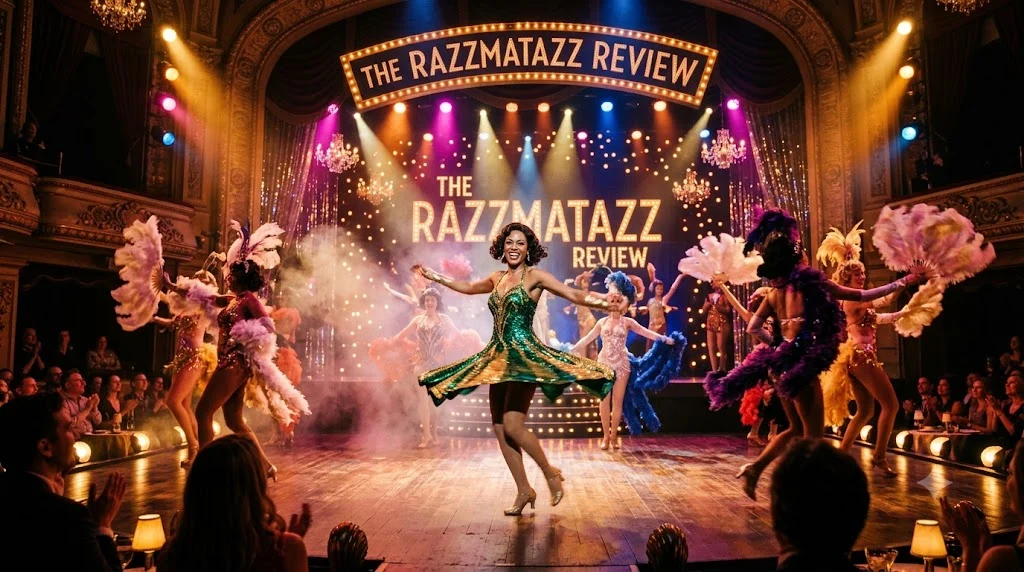
Picture this. The lights go down. A spotlight cracks open the dark. Brass horns blast. Confetti cannons fire. A dancer in sequins slides across a stage that seems to stretch forever. The crowd loses its mind.
What do you call that moment?
You call it razzmatazz.
It’s one of those words that just feels like what it means. Say it out loud. Razzmatazz. There’s energy in every syllable. It practically demands attention which, funnily enough, is exactly what the thing it describes always does.
This guide covers everything you need to know about the razzmatazz meaning. You’ll find the definition broken down clearly, a pronunciation walkthrough, the full etymology, real usage examples across different contexts, synonyms and antonyms with nuance explained, and a look at where this word shows up in culture, politics, sports, and everyday conversation. By the end, you won’t just know what razzmatazz means you’ll know exactly how and when to use it.
Let’s get into it.
What Does Razzmatazz Mean? The Core
At its most basic level, razzmatazz means noisy, flashy, extravagant activity designed to dazzle, excite, or impress an audience. Think spectacle. Think over-the-top presentation.
But here’s the interesting thing: the word actually carries two slightly different meanings depending on context. Understanding both is what separates someone who knows the word from someone who truly uses it well.
Meaning 1: Genuine, Exciting Spectacle
Sometimes razzmatazz is a compliment. It describes lively, energetic entertainment the kind that makes you lean forward in your seat. A circus opening. A jazz band in full swing. A sporting event with a choreographed halftime show. In this sense, the razzmatazz is the point. Nobody complains that a fireworks display is “too much.” That’s the whole idea.
Meaning 2: Empty Promotional Hype
Other times, razzmatazz carries a skeptical edge. It implies that the flashy surface is covering up a lack of real substance underneath. Politicians use razzmatazz. So do advertisers. So does the tech industry every single time it launches a product that’s basically last year’s model in a new color.
In this second sense, calling something razzmatazz is a gentle accusation. You’re saying: great show, but where’s the beef?
Both meanings live comfortably inside the same word. Context does the heavy lifting.
Quick Reference: Razzmatazz at a Glance
| Feature | Detail |
|---|---|
| Word | Razzmatazz |
| Part of Speech | Noun (uncountable) |
| Primary Meaning | Flashy, exciting showmanship or spectacle |
| Secondary Meaning | Empty promotional hype or theatrical distraction |
| Register | Informal and conversational |
| Common Contexts | Entertainment, politics, sports, marketing, everyday speech |
| Correct Spelling | R-A-Z-Z-M-A-T-A-Z-Z |
| Common Misspellings | Razzamatazz, razmatazz, razzamaTaz |
| First Recorded Use | Late 19th to early 20th century, American English |
Razzmatazz Definition in Simple Words
Strip away everything fancy and here’s what razzmatazz means in the plainest English possible: it’s the kind of big, loud, shiny display that makes people look, whether what’s underneath deserves the attention or not.
That’s it. That’s the whole word.
How Do You Pronounce Razzmatazz?
Pronunciation trips people up more than you’d expect with this word. So let’s fix that right now.
Phonetic spelling: raz-muh-TAZ
IPA notation: /ˌræz.məˈtæz/
The stress lands firmly on the last syllable: tazz. Say it like this raz (rhymes with jazz), muh (unstressed, quick), TAZZ (hit this one). Three beats total. The emphasis on that final syllable is what gives the word its punchy, performative feel.
A quick trick: Think of the word “jazz.” Razzmatazz ends with that same sound. And jazz, as you’ll see in a moment, isn’t a coincidence it’s where this word essentially grew up.
British and American speakers pronounce razzmatazz almost identically. The British version sometimes rounds the vowels slightly, but you’d barely notice in casual conversation. Either way, stress that final syllable and you’re good.
Where Did Razzmatazz Come From? Etymology and Origin
Words don’t appear out of nowhere. Every word has a story and razzmatazz has a particularly good one. It grew out of an era soaked in music, theatrics, and a culture that celebrated spectacle like a religion.
The Reduplicative Roots
Linguists classify razzmatazz as a reduplicative formation a word built by repeating sounds with small variations. English loves this pattern. Think of hocus-pocus, riff-raff, zigzag, flip-flop, hodgepodge. These words feel playful and energetic precisely because the repetition creates rhythm. Razzmatazz follows the same logic, and that built-in rhythm makes it sound theatrical even before you know what it means.
The Jazz Era Connection
The word first appeared in American English in the late 1800s and gained traction in the early 1900s right in the heart of the jazz and vaudeville era. This timing matters enormously.
Jazz culture had its own vivid vocabulary. Musicians used words that mirrored the energy of the music itself: hot, cool, swing, cats, cats in the alley. Razzmatazz fit right in. In early jazz slang, it described a raw, brassy, energetic style of playing the kind that filled a smoky room and made people forget their troubles for a couple of hours.
Vaudeville the wildly popular variety-show entertainment of the same era ran on exactly this energy. Acrobats, comedians, singers, magicians, and chorus lines all crammed into the same show. The whole business model depended on spectacle. Razzmatazz was practically the company motto.
The Close Cousin: Razzle-Dazzle
You’ve almost certainly heard razzle-dazzle. It’s older than razzmatazz and shares its DNA. Razzle-dazzle appeared in the 1880s as American slang for a confusing, dazzling situation something that disoriented you even as it impressed you. Think of a magician’s trick. The flash of light that makes you miss the sleight of hand.
Razzmatazz developed partly in the shadow of razzle-dazzle. Both words share that sense of exciting-but-possibly-deceptive spectacle. Over time razzmatazz broadened out while razzle-dazzle stayed slightly more associated with deliberate confusion and misdirection.
How the Word Evolved Over Time
| Era | How Razzmatazz Was Used |
|---|---|
| Late 1800s | Musical and performance slang in American English |
| Early 1900s | Jazz circles and vaudeville theaters |
| Mid-1900s | Advertising, political rhetoric, newspaper commentary |
| Late 1900s | Pop culture, sports coverage, entertainment journalism |
| Today | Broad informal use across media, politics, marketing, and everyday speech |
The word aged remarkably well. Most slang from the vaudeville era has long since disappeared. Razzmatazz stuck around because it fills a gap that no other single word fills quite as satisfyingly.
Razzmatazz in a Sentence: Real-World Examples
Knowing a definition is step one. Seeing a word used in real, varied context is what makes it actually stick. Here are original example sentences across different settings pay attention to how the tone shifts depending on context.
Entertainment and Performance
“The Oscars ceremony opened with wall-to-wall razzmatazz: a thirty-piece orchestra, a drone light show, and an emcee who clearly rehearsed every gesture twice.”
“She’d seen bigger stages but never so much razzmatazz packed into a single opening number.”
Politics and Public Life
“Behind all the razzmatazz of the convention the balloons, the speeches, the carefully timed applause the policy platform was three pages long and said almost nothing.”
“Voters were getting tired of the razzmatazz and wanted someone who’d just answer a question directly.”
Marketing and Advertising
“The product launch had every element of razzmatazz: fog machines, a celebrity cameo, a countdown clock. The app it was launching still crashed on first use.”
“Great marketing creates genuine razzmatazz. Bad marketing just borrows it.”
Sports and Major Events
“The World Cup opening ceremony delivered exactly the kind of razzmatazz billions of viewers had tuned in for.”
“There’s a reason the Super Bowl halftime show exists: pure, unapologetic razzmatazz.”
Everyday Conversation
“He showed up to a casual birthday dinner in a velvet blazer. Total razzmatazz.”
“The new restaurant is all razzmatazz and very little food worth talking about.”
Notice something? In the entertainment and sports examples, razzmatazz is mostly positive exciting, celebratory, earned. In the politics and marketing examples, it curls slightly skeptical. That tonal flexibility is one of the reasons the word has survived this long.
How to Use Razzmatazz in a Sentence: Usage Notes
Do use it when:
- Describing large-scale spectacle with a performative or theatrical quality
- Adding personality to commentary on events, launches, or personalities
- Conveying excitement or (gently) calling out hollow showmanship
- Writing in a conversational, informal register
Don’t use it when:
- Writing formal academic, legal, or technical documents
- Describing quiet, understated excellence the word fights that tone
- You want to seem neutral; it carries inherent personality and opinion
Grammatical notes worth knowing:
Razzmatazz is an uncountable noun. You wouldn’t say “three razzmatazzes happened at the event.” You’d say “the event was full of razzmatazz” or “the razzmatazz of the event was overwhelming.” It behaves like water or music you measure it in degree, not in units.
Razzmatazz Synonyms: Words That Capture the Same Energy
English is wonderfully crowded with words that live near razzmatazz in meaning. But they’re not interchangeable. Each one sits at a slightly different angle on the same idea.
| Synonym | Core Nuance | Best Used When… |
|---|---|---|
| Pizzazz | Exciting energy and flair, usually a compliment | Describing a person’s natural charisma or a brand’s appeal |
| Panache | Elegant, stylish confidence in performance or presentation | The spectacle has taste and skill behind it |
| Fanfare | Loud, celebratory public attention, often formal | Announcing something significant with ceremony |
| Showmanship | The skill and craft of entertaining an audience | The performer genuinely knows what they’re doing |
| Spectacle | A visually striking public display or scene | Large-scale visual impact, neutral to positive tone |
| Dazzle | To impress or overwhelm with brilliance | Emphasizing the effect on the viewer more than the display itself |
| Flash | Showy, eye-catching, sometimes superficial | Often implies a lack of depth behind the display |
| Extravaganza | An elaborate, large-scale production or event | The event itself is the thing — concerts, shows, galas |
| Glamour | Exciting, alluring visual appeal, often with old-Hollywood connotations | Fashion, celebrity, and aesthetic contexts |
| Hoopla | Excited fuss and commotion, slightly chaotic | Informal situations where people are making more of something than it deserves |
| Pizzazz | Lively energy and visual appeal | When the flair feels fresh and original |
| Fanfare | Ceremonial excitement, often music-adjacent | Official announcements or launches with pomp |
Fanfare is often attached to specific ceremonial moments: the opening of a summit, the arrival of someone important, a royal announcement. Razzmatazz is messier, more sprawling, more theatrical. You can have razzmatazz without a single clear announcement being made.
Razzmatazz Antonyms: The Opposite End of the Spectrum
Understanding what a word means also means understanding what it doesn’t mean. Here’s what lives on the opposite side of razzmatazz.
| Antonym | What It Represents |
|---|---|
| Simplicity | Clean, unadorned presentation with nothing extra |
| Restraint | Deliberate holding back; choosing less over more |
| Modesty | Avoiding excess, attention, or showiness |
| Understatement | Saying or showing less than the full truth or effect |
| Minimalism | Stripping everything to its most essential form |
| Sobriety | Serious, measured, no-nonsense in tone and presentation |
| Subtlety | Working quietly beneath the surface rather than on top of it |
| Plainness | Straightforward and unpretentious, with no decorative intent |
Razzmatazz Across Industries: Where You’ll Actually Encounter This Word
Razzmatazz didn’t stay in the jazz clubs where it grew up. It spread. Today it appears in contexts its early users probably never imagined.
Entertainment and Theater
Broadway was practically invented to produce razzmatazz. From the moment the curtain rises on a major production to the final bow, every technical element lighting, sound, choreography, costume is calibrated to create that feeling of overwhelm-in-the-best-possible-way.
Film premieres run on the same logic. The red carpet isn’t about clothes. It’s about generating a spectacle large enough to make audiences feel like what they’re about to see matters before they’ve seen a single frame.
Award shows like the Oscars, Grammys, and BAFTAs are essentially razzmatazz delivery systems with trophies attached.
Politics and Public Relations
Politicians have understood razzmatazz since at least the Roman Empire, when emperors staged gladiatorial games to keep citizens distracted and satisfied. Modern political rallies follow the same playbook: music, lighting, choreographed crowd energy, and a speaker who understands that performance is as important as content.
Campaign launches, party conventions, and state visits all deploy razzmatazz deliberately. The question analysts always ask is whether the spectacle matches the policy and it often doesn’t.
Journalists and political commentators reach for this word regularly:
“The prime minister’s conference appearance had all the razzmatazz of a rock concert and the policy depth of a bumper sticker.”
That sentence tells you everything about the skeptical second meaning of the word.
Sports and Major Events
The Super Bowl halftime show has an annual budget that rivals the production of a major film. The FIFA World Cup opening ceremony involves months of planning, thousands of performers, and a global television audience in the hundreds of millions. The Olympics opening ceremony is arguably the most watched single act of razzmatazz on the planet.
Here, crucially, the razzmatazz is the product. Nobody watches the Super Bowl halftime show hoping to be disappointed by how understated it is. The scale and spectacle are exactly what’s being delivered. In this context, razzmatazz is pure value.
Notable examples of sporting razzmatazz:
- The 2008 Beijing Olympics opening ceremony, widely described as the most elaborate in Olympic history, involving 15,000 performers and a budget estimated at $100 million
- Cirque du Soleil performing at the Super Bowl XXXV halftime show
- The 2022 FIFA World Cup opening ceremony in Qatar, featuring a multilingual performance watched by an estimated 1.5 billion people
Marketing and Advertising
No industry has commercialized razzmatazz more deliberately than marketing. The entire discipline of brand activation getting consumers to experience a brand rather than just see an advertisement is built on engineered spectacle.
Apple product launches became the gold standard. Steve Jobs understood that the announcement was as important as the product itself. The darkened stage, the single spotlight, the dramatic pause before the reveal that was razzmatazz, precisely calibrated and controlled.
The danger, as the word’s second meaning implies, comes when the razzmatazz exceeds the product’s actual merit. History is littered with spectacular launches of products that didn’t survive their first year.
Where razzmatazz works hardest in marketing:
- Product launch events and keynotes
- Brand activations at music festivals and sporting events
- Viral campaigns built on spectacle or surprise
- Influencer collaborations designed to manufacture organic-looking excitement
- Flagship store openings with theatrical design
Everyday Conversation
You don’t need a stage or a marketing budget to encounter razzmatazz. The word works perfectly at human scale too.
Someone shows up to a casual office party in a full tuxedo. That’s razzmatazz. A neighbor puts up more Christmas lights than a Vegas casino. Also razzmatazz. A first date at a rooftop restaurant with a twelve-course tasting menu when you’ve never even texted before. Absolutely razzmatazz.
Using the word in these everyday contexts is one of the more delightful things you can do with it. It’s precise enough to be meaningful and playful enough to land without sounding harsh.
Razzmatazz in Pop Culture and Media
The word has punched well above its weight in popular culture. It appears in some of the most recognized entertainment products of the 20th century.
Chicago: Razzle Dazzle
The 1975 musical Chicago and its 2002 film adaptation features a number called “Razzle Dazzle” that is essentially a thesis statement on razzmatazz as a concept. The song’s central argument is that a spectacular enough performance can make an audience believe anything, regardless of the truth underneath.
The number captures something important: razzmatazz isn’t just entertainment. In the wrong hands, it’s a tool for misdirection.
The song became iconic because it articulated something people felt but hadn’t quite named: the uncomfortable relationship between spectacle and truth.
Pulp’s “Different Class” and the Razzmatazz Album
British indie band Pulp released a live album titled Razzmatazz in 1993. The title captured the band’s theatrical, glam-inflected sensibility perfectly. Frontman Jarvis Cocker built his entire stage persona on a kind of ironic razzmatazz the glamour of working-class Sheffield dressed up in secondhand velvet.
Razzmatazz Barcelona
The Sala Razzmatazz nightclub in Barcelona, opened in 2000, became one of Europe’s most celebrated electronic music venues five rooms, five different musical identities under one roof. The name choice was intentional: the venue promised spectacle, energy, and a night you wouldn’t quite be able to explain to your friends.
Media Usage
The word appears regularly across quality journalism. The Guardian, The New York Times, the BBC, and British political commentary have all reached for razzmatazz when covering events where spectacle and substance seemed to be operating in different time zones.
A quick scan of headlines reveals patterns:
- Sports coverage uses it positively, almost always describing opening ceremonies or championship events
- Political coverage uses it skeptically, almost always implying the spectacle is compensating for something
- Entertainment coverage uses it warmly, often as a tribute to a performer or production
That three-way split in tone tells you a lot about how the word actually functions in the wild.
Common Mistakes People Make With Razzmatazz
Even confident writers stumble here. Worth knowing before you use it.
Spelling it wrong
The most common errors:
- Razzamatazz (wrong | extra “a” in the middle)
- Razmatazz (wrong | only one “z” in the first syllable)
- RazzamaTaz (wrong | and also strange)
- Razzmatass (wrong | and now it means something else)
The correct spelling has two z’s at the start, then matazz at the end. Write it out slowly once: R-A-Z-Z-M-A-T-A-Z-Z. That’s it.
Using it too casually and stripping the punch
Razzmatazz works because it’s vivid and specific. If you use it to describe everything from a birthday cake to a board meeting, it loses its edge. Save it for moments that genuinely deserve it when something is genuinely theatrical, over-the-top, or spectacularly hollow.
Missing the tone shift
As established earlier, razzmatazz can be complimentary or skeptical depending on context. Getting that wrong in writing can confuse readers or create the opposite impression of what you intended. If you’re praising something, make the warmth clear in the surrounding sentences. If you’re gently criticizing the spectacle-over-substance ratio, let the word do its skeptical work.
Treating it as plural
You wouldn’t write “the many razzmatazzes of the event.” Razzmatazz is uncountable. Use it like atmosphere, or excitement, or music. Describe its degree, not its quantity.
Why Razzmatazz Is One of the Best Words in English
It would be easy to write this off as a novelty word the kind you use once at a dinner party to seem interesting and never again. But razzmatazz deserves better than that.
The word captures something genuinely complex: the double-edged nature of spectacle itself. It holds both celebration and critique inside the same four syllables. You can use it to describe the most joyful moments of human performance an Olympic ceremony, a Broadway premiere, a jazz legend hitting their stride and you can use it to puncture political theatre, marketing excess, and the eternal human tendency to mistake a great show for a great thing.
That tension is useful. Language that captures tension is rare. Most words just mean one thing. Razzmatazz means one thing and its complicated shadow simultaneously.
It also sounds exactly like what it describes. Linguists call this iconicity when the sound of a word mirrors its meaning. Razzmatazz sounds flashy. It sounds excessive. It sounds like brass horns and sequins and a spotlight hitting a mirror ball in a room full of people who aren’t quite sure whether to be dazzled or skeptical. That they’re feeling both at once is, of course, the whole point.
Use it well. It earns the attention it demands.
FAQs
What does razzmatazz mean in simple words?
It means big, loud, flashy spectacle the kind designed to dazzle and impress, whether or not there’s real substance behind it.
Can razzmatazz be used as a compliment?
Absolutely. When used in the context of entertainment, sports, or performance, it often describes something genuinely thrilling. “The show was pure razzmatazz” at a Broadway opening night is high praise.
Is razzmatazz British or American English?
The word originated in American English but has been adopted enthusiastically by British writers and speakers. Both use it freely today, though British political journalism may reach for it slightly more often.
What’s the difference between razzmatazz and pizzazz?
Pizzazz is warmer and almost always positive a natural, irresistible quality. Razzmatazz is bigger and occasionally skeptical it implies someone planned the spectacle deliberately and the results may or may not live up to the hype.
Can you use razzmatazz as an adjective?
Not technically it’s a noun. But you’ll sometimes see it used informally as a modifier: “a razzmatazz campaign,” “razzmatazz marketing.” In formal writing, stick to noun form.
What’s the opposite of razzmatazz?
Restraint, simplicity, or understatement the deliberate choice of less over more, quiet over loud, substance over spectacle.
What industries use razzmatazz most?
Entertainment, politics, sports, marketing, and advertising. Anywhere audiences exist and need to be impressed.
How old is the word razzmatazz?
It dates to the late 1800s in American English making it over 125 years old.
Conclusion
Razzmatazz meaning is richer than most people expect from a word that sounds like it should be on a cereal box. It’s a word built in a specific cultural moment American jazz clubs and vaudeville stages in the early 20th century and it carries all that energy forward into every context where it appears today.
You now know the full razzmatazz definition in both its positive and skeptical registers. You know how to pronounce it, where it came from, how its close cousins razzle-dazzle and pizzazz differ from it, and how to use it confidently across different tones and contexts.
The next time you watch something spectacular a halftime show that goes three minutes too long, a product launch with fog machines and no working product, a political speech that’s more theatre than substance, or a Broadway opening that makes the hair on your arms stand up you’ll have the exact right word for it.
Discover More Related Articles:
- IG Mean | Internet Culture & Everyday Conversations In 2026
- Mogging Meaning | Dating, Memes & Internet Culture In 2026