
Definition
At its most basic, mogging means to visibly outshine or overshadow another person usually in terms of physical appearance, presence, or social dominance.
You’ve probably stumbled across it in a TikTok comment section, a Reddit thread, or a group chat and thought what on earth does “mogging” mean? You’re not alone. This word went from niche internet forum slang to mainstream Gen Z vocabulary faster than most people could keep up. And honestly, once you understand it, you start seeing it everywhere.
This guide covers everything. The mogging definition, its origins, every type of mogging, how it’s used across different platforms, and what it actually means in dating culture. By the end, you’ll not only get it you’ll be using it correctly.
Let’s get into it.
What Does Mogging Mean?
If you “mog” someone, you make them look lesser just by existing near them. It’s not something you have to consciously do. You just show up, and the contrast does the talking.
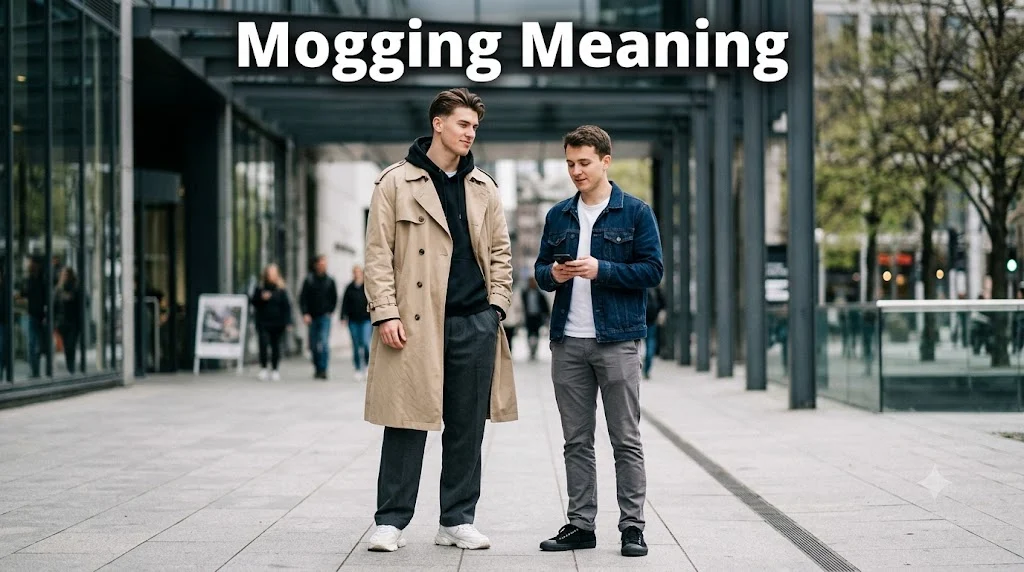
Think of it this way. Two guys walk into a party together. One is well-groomed, tall, broad-shouldered, and dressed sharply. The other is… not. Without saying a word, the first guy has mogged the second one simply by comparison.
That’s mogging in action.
The word works as a verb in multiple forms:
| Term | Meaning | Example |
|---|---|---|
| Mog | To outshine someone in looks or presence | “He mogged the entire lineup” |
| Mogging | The active act of overshadowing someone | “He’s mogging everyone at the event” |
| Mogged | Having been outshone by someone else | “I got mogged standing next to him” |
| Mogger | The person doing the outshining | “That guy is a natural mogger” |
| Mogged on | Dominated thoroughly in appearance | “He got mogged on hard in that photo” |
Simple enough, right? But the term goes deeper than this table suggests. The mogging meaning in slang has evolved significantly since it first appeared online, and today it covers a lot more ground than just looks.
Where Did Mogging Come From? The Real Origin Story
Here’s where it gets interesting. Mogging didn’t start on TikTok. It didn’t come from Instagram or Twitter either. Its roots go much deeper into the darker corners of the internet specifically, online communities built around male physical appearance and self-improvement.
The Lookism and Incel Forum Roots
The term “mog” first surfaced in communities like Lookism.net and several Reddit forums, including r/Lookism and early looksmaxxing subreddits. These were spaces where users discussed often obsessively how physical appearance, particularly facial structure, determined social outcomes for men.
In those communities, mogging described something specific: when one man’s physical attributes so clearly outclassed another’s that standing next to them created an unflattering contrast. It wasn’t casual conversation. It was part of a broader vocabulary around looks-ranking and social hierarchy.
Other terms from those same circles like looksmaxxing, looksmatch, frame, and canthal tilt were used alongside “mog” to build a detailed framework around physical appearance and attraction.
Did “Mog” Come From the British Word for Cat?
There’s a theory worth addressing here. In British English, a “mog” or “moggy” is an informal word for a domestic cat. Some people have suggested this is the etymological root of the internet slang term. The connection is loose at best. The internet use of “mog” developed independently within looksmaxxing culture and likely has no real link to the British cat term. It’s a coincidence that makes people curious but doesn’t hold up under scrutiny.
How Mogging Jumped from Forums to Mainstream
The spread followed a predictable but fascinating pattern:
Stage 1 (2015–2018): Used almost exclusively on Lookism.net and niche Reddit forums. Vocabulary was dense, hyperspecific, and not accessible to outsiders.
Stage 2 (2019–2020): Reddit’s broader self-improvement communities picked up the term. Subreddits like r/malegrooming, r/Fitness, and eventually r/dating_advice started seeing it appear.
Stage 3 (2021–2022): TikTok exploded it. Short-form video made side-by-side comparisons viral content. “Walk-in” videos, confidence content, and aesthetic culture gave mogging a new home. The term shed much of its darker context and became something more playful.
Stage 4 (2023–Present): Mogging is now mainstream Gen Z slang. It appears in comment sections, group chats, everyday conversation, and even brand marketing. Its meaning has broadened considerably.
Mogging Meaning in Slang | Every Type You Need to Know
This is where the vocabulary gets rich. Over time, “mogging” branched out into several distinct subtypes. Each one describes a slightly different form of overshadowing.
Face Mogging
Face mogging refers specifically to outshining someone in facial attractiveness. It’s probably the most common type used in its original context. Facial structure jawline, cheekbones, eye area, symmetry gets compared, and whoever comes out clearly ahead is face-mogging the other.
“His bone structure face-mogged everyone in that group photo without even trying.”
This is still heavily used in looksmaxxing communities, where facial features are analyzed in granular detail.
Height Mogging
Height mogging is exactly what it sounds like. When someone’s physical height creates a stark contrast with those around them, especially in photos or videos, that’s height mogging.
It’s one of the most discussed types on TikTok, where side-by-side videos often highlight dramatic height differences. A 6’4″ person standing next to someone 5’7″ in a friend group photo? Classic height mog scenario.
Quick facts about height mogging discourse online:
- Height mogging is frequently debated in online dating communities
- It’s one of the few types of mogging that’s almost impossible to change through self-improvement efforts
- Reddit threads on height mogging regularly hit tens of thousands of upvotes
Looks Mogging
Looks mogging is broader than face mogging. It takes into account the full physical package facial features, yes, but also body, grooming, skin quality, posture, and overall aesthetic presentation. Someone can be “looks-mogged” even if their face alone isn’t drastically different, if the overall impression is significantly inferior.
Style Mogging
Style mogging emerged as the term moved mainstream. It describes being so well-dressed that others around you look underdressed by comparison. You don’t need a better face. You just need a better outfit and the presence to wear it.
“He showed up in a fitted suit to a business casual event and style-mogged the whole room.”
Confidence Mogging
This one’s arguably the most evolved meaning. Confidence mogging happens when someone’s energy, charisma, and self-assurance so clearly overshadows everyone else’s that they command the room without any particular physical advantage.
It’s a significant departure from the original definition. Confidence mogging doesn’t require you to be tall, symmetrical, or conventionally attractive. It requires presence.
“She walked into that interview room and confidence-mogged every other candidate before she said a word.”
Skill Mogging
Skill mogging means performing at such a visibly higher level than those around you that the gap becomes almost embarrassing. This gets used in sports content, gaming clips, music videos, and workplace scenarios.
“That pass was absurd. He just skill-mogged the entire opposing team.”
Here’s a clean breakdown of all the types:
| Type of Mogging | What It Means | Common Context |
|---|---|---|
| Face Mogging | Outshining someone in facial attractiveness | Looksmaxxing, dating |
| Height Mogging | Being significantly taller in a comparison | TikTok, Reddit, dating |
| Looks Mogging | Outshining in overall physical appearance | Social media, dating |
| Style Mogging | Dressing so well others look underdressed | Fashion, social events |
| Confidence Mogging | Radiating so much presence others pale in comparison | Social settings, dating |
| Skill Mogging | Performing so far above others it’s stark | Sports, gaming, work |
Mogging Meaning on Social Media | Platform by Platform
The same word plays differently depending on where you encounter it. Here’s how mogging shows up across the platforms where Gen Z actually spends time.
What Does Mogging Mean on TikTok?
TikTok is where mogging truly went viral. The platform’s short-form format is almost tailor-made for side-by-side comparisons, and that’s exactly the kind of content where mogging language thrives.
How mogging appears on TikTok:
- Walk-in videos where someone enters a room confidently and commenters declare they’re “mogging” everyone
- Side-by-side duet videos comparing two people’s appearance or style
- Glow-up transformation videos where the creator “mogged their past self”
- Caption language like “POV: You’re getting mogged by your friend again”
- Comment sections on celebrity or athlete content where fans debate who’s mogging whom
TikTok also accelerated the shift toward confidence mogging and style mogging specifically. The looksmaxxing origins became less dominant as creators used the term more playfully and inclusively.
Mogging Meaning on Reddit
Reddit is where the term lived before anywhere else, and its usage there is still more precise and technically dense than on TikTok.
Key subreddits where mogging appears regularly:
- r/Looksmaxxing (focused on self-improvement for appearance)
- r/malegrooming
- r/dating_advice
- r/AmItheAsshole (appears occasionally in context)
- r/teenagers and r/GenZ for more casual usage
On Reddit, mogging discussions often go deep. You’ll find threads analyzing specific photos, rating facial features, or debating whether height mogging is more impactful than face mogging in dating scenarios. The discourse is more serious and systematic than TikTok’s playful usage.
Instagram and Twitter/X
On Instagram, mogging language mostly lives in comment sections under photos, especially celebrity content, influencer posts, and sports imagery.
Common comment formats include:
- “He’s mogging the whole team photo honestly”
- “The height mog in this picture is unreal”
- “She effortlessly mogged every other guest at this event”
On Twitter/X, mogging gets used in quote-tweet format during celebrity photo releases, awards shows, or sporting events. It also appears in dating discourse threads where users debate attraction dynamics.
Mogging Meaning in Texting and Everyday Conversation
What does mogging mean when your friend sends it in a group chat? In casual texting, mogging is almost always lighthearted. The heavy appearance-ranking context largely drops away.
How Gen Z uses it in texts:
- “Bro you’re about to mog everyone at this party”
- “I just got mogged by my own little brother in this photo lmao”
- “She showed up to the date and mogged all my expectations”
In everyday use, it’s often a compliment or a joke rarely loaded with the intensity it carries in looksmaxxing communities.
Mogging Meaning vs. Looksmaxxing | What’s the Difference?
These two terms come from the same cultural ecosystem, but they describe very different things. Confusing them is a common mistake.
Looksmaxxing is the process of maximizing your physical appearance through deliberate, often systematic effort. It includes things like skincare routines, hairstyling, grooming, fitness training, teeth whitening, posture improvement, and in extreme cases, cosmetic procedures. It’s an action something you do over time.
Mogging is the outcome or the act. You mog someone. You don’t looksmaxx someone. The relationship between the two is directional: people looksmaxx so that they can mog, or at least avoid being mogged.
| Concept | Definition | Is It Active or Passive? |
|---|---|---|
| Looksmaxxing | Systematically improving your physical appearance | Active process |
| Mogging | Outshining someone in looks or presence | Active act |
| Being mogged | Being outshone by someone else | Passive experience |
| Looksmatch | A partner who is equally attractive | Concept / Relationship dynamic |
The two terms often appear together in discussions. For example: “He’s been looksmaxxing for six months and now he’s mogging guys he used to be intimidated by.” That sentence makes perfect sense in the context of this vocabulary.
Mogging Meaning in Dating | Why It Matters in That Space
Dating culture is where mogging gets its most emotionally charged usage. The term pops up constantly in discussions about attraction, couple dynamics, and how physical appearance factors into romantic outcomes.
The “Looksmatch” Debate
One of the most discussed concepts alongside mogging in dating contexts is the looksmatch the idea that partners in a relationship are roughly equal in conventional attractiveness. When someone “mogs their partner,” it means there’s a visible attractiveness gap that others notice.
This has become a real talking point on platforms like Reddit and TikTok, where couple photos get analyzed in comment sections and users declare whether one person is “mogging” the other.
Face Mogging Meaning in Couple Photos
When a couple posts a photo and one person clearly outshines the other in conventional facial attractiveness, the comment sections fill up quickly. Users will say one person is “face-mogging” the other, sometimes framed as a compliment for the better-looking one, sometimes as commentary on the perceived mismatch.
This happens to celebrities regularly. Whenever a high-profile couple releases a photo together, the mogging discourse is almost inevitable.
Is Mogging in Dating Toxic?
Honestly, it depends entirely on how it’s being used. Here’s a fair take:
The case that it’s problematic:
- It reduces people to their physical appearance
- It reinforces rigid and often unrealistic beauty standards
- It can make people feel inadequate or embarrassed about their looks
- Its roots in incel-adjacent communities carry genuinely harmful ideologies
The case that it’s mostly harmless in mainstream use:
- Most Gen Z users treat it as lighthearted slang without the original ideological weight
- Using the word doesn’t automatically mean endorsing the communities it came from
- Observing physical attractiveness differences is something humans have always done the slang is new, the behavior isn’t
- The term has evolved significantly and now covers non-appearance-based contexts
The honest answer: the word itself isn’t inherently toxic. The context, intent, and frequency of use determine whether it becomes harmful. Like most internet slang, it’s a tool. What matters is how you use it.
Mogging Meaning in Meme Culture
Memes gave mogging a second life and a mainstream audience. Without meme culture, this word might have stayed buried in niche forums forever.
The Side-by-Side Comparison Meme Format
The most common mogging meme format is dead simple: two images placed side by side, one clearly more impressive than the other in whatever category is being compared. The caption declares one is “mogging” the other.
This format works for:
- Two celebrities at the same event
- Before and after self-improvement photos
- Two athletes competing in the same sport
- Two product designs
- Two historical figures compared on some metric
It’s endlessly adaptable because mogging, at its core, is just about comparison and contrast.
“You Just Got Mogged” Reaction Content
Another viral format: someone posts a photo or video doing something they’re proud of, and someone else posts a reaction with a clearly superior version of the same thing. The caption? “You just got mogged.”
This became a widespread comment section phenomenon on platforms like Reddit and Twitter, used as playful one-upmanship.
Celebrity Mog Debates
Few things generate more engagement online than a photo of two famous people standing next to each other. When one visibly stands out in height, appearance, or presence, the mogging discourse fires up immediately. These threads can rack up thousands of comments as people debate the specifics.
Meme culture is largely responsible for mogging leaving its dark niche origins behind. When a term gets memed enough, it loses its original edge and becomes part of the general internet lexicon.
Is Mogging Always About Looks? The Modern Expanded Meaning
Here’s the honest evolution of this word: it started as a very specific term about physical appearance comparison, and it’s now a general-purpose word for any kind of dominance through excellence.
That shift matters. It means the word is increasingly accessible and less tied to the toxic beauty-ranking culture it originated in.
How Mogging Now Gets Used Beyond Appearance
Academic or professional contexts:
“She submitted a 50-page thesis when everyone else did the minimum 20 pages and absolutely mogged the whole department.”
Music and entertainment:
“His feature verse mogged the lead artist on their own song.”
Sports:
“That goal was absurd. He mogged the goalkeeper mentally before he even touched the ball.”
Gaming:
“He’s been mogging everyone in ranked matches this season. Top 0.1%.”
Even creative work:
“Her short story submission mogged every other entry in the contest.”
The common thread in all of these? The core meaning stays intact one person or thing dramatically outshines another in a specific category. What’s changed is that the category no longer has to be physical appearance.
This expanded definition has made “mogging” genuinely useful slang for talking about excellence and contrast in almost any context.
The Cultural Debate Around Mogging | A Grounded Look
No vocabulary guide on this term is complete without acknowledging where it came from and what cultural baggage it carries.
The Looksmaxxing and Incel Pipeline
The communities that developed “mogging” weren’t benign. Lookism.net, certain looksmaxxing subreddits, and adjacent spaces have at various times promoted deeply problematic ideas including the belief that men’s worth is determined by their physical attributes, that certain men are biologically doomed to social failure, and other ideologies that feed into hopelessness and resentment.
Understanding this context doesn’t mean you can’t use the word. It means you should know where it came from.
How the Term Shed Its Baggage
Language absorbs and then diffuses context. When enough people use a word in an entirely different setting, its original meaning weakens. This is exactly what happened to “mogging” when TikTok adopted it. Millions of teenagers using a word playfully to describe a good hair day creates enormous distance from its origins in forums discussing male physical hierarchy.
Is that distance complete? No. The looksmaxxing community still exists and still uses the term in its original, more rigid sense. But the mainstream usage is genuinely different.
What the Broader Conversation Really Needs
The cultural conversation around mogging ultimately reflects something older and more fundamental: humans compare themselves to each other. That behavior isn’t new, and slang like this doesn’t create it. What matters is whether the frameworks people build around these comparisons promote self-improvement and healthy perspective or resentment and obsession.
Looksmaxxing as a concept improving yourself physically through deliberate effort isn’t inherently harmful. Mogging, used playfully to acknowledge when someone looks great, isn’t inherently harmful either. The harm comes from communities that use this vocabulary to rank human worth and cultivate pessimism about things outside anyone’s control.
Real Examples of Mogging Used in a Sentence
Seeing a word used correctly across contexts is often the fastest way to truly understand it. Here are realistic examples across different settings:
Social situations:
- “He walked into the reunion looking like he’d spent the last five years specifically preparing to mog everyone.”
- “I can’t believe I agreed to stand next to him in that photo complete height mog.”
Dating:
- “She’s clearly face-mogging him in every couple photo they post, but they seem genuinely happy.”
- “He spent a year looksmaxxing and honestly he’s mogging his old photos completely now.”
Sports and competition:
- “That performance mogged every other routine in the competition. It wasn’t even close.”
- “He skill-mogged the defending champion in under three sets.”
Everyday humor:
- “My little cousin just turned 16 and is already height-mogging me. I’m dealing with it.”
- “She showed up to a casual brunch in a full fit and style-mogged everyone without warning.”
Compliments:
- “You’re going to mog that job interview. Show up confident.”
- “The way you edited that video mogged every other creator in that niche.”
Mogging Meaning for Beginners | The Quick Cheat Sheet
If you want a fast reference to share with someone who’s never heard the term, here it is:
What mogging means:
- To visibly outshine or overshadow someone, usually in appearance or presence
Where it came from:
- Online looksmaxxing and male appearance forums, around 2015 to 2018
How to use it:
- As a verb: “He mogged everyone at the party”
- As a participle: “She’s mogging the whole lineup”
- As past tense: “I got mogged in that photo”
What it doesn’t mean:
- It’s not an insult toward the person being mogged (it’s more neutral observation than attack)
- It doesn’t require intent you can mog someone without trying
Related terms you should know:
| Term | Quick Definition |
|---|---|
| Mogged | Past tense; having been outshone |
| Mogger | The person doing the mogging |
| Looksmaxxing | The process of improving your appearance |
| Looksmatch | A romantic partner of similar attractiveness |
| Frame | Used in looksmaxxing to refer to body structure |
| Glow-up | A significant positive physical transformation |
FAQs
What does mogging mean?
Mogging means to visibly outshine or overshadow someone else, typically in physical appearance, confidence, height, or overall presence.
What does mogging mean on TikTok?
On TikTok, mogging is used in video captions, duets, and comment sections to describe when someone dramatically outshines others in appearance, confidence, or style.
What does mogging mean in dating slang?
In dating contexts, mogging refers to one person clearly outshining their partner or rivals in physical attractiveness.
What is face mogging?
Face mogging specifically means outshining someone in facial attractiveness. It focuses on facial structure jawline, cheekbones, eye area, and symmetry rather than overall appearance.
What is height mogging?
Height mogging happens when someone’s physical height creates a clear, visible contrast with those around them, making others appear shorter by comparison.
What does it mean to mog someone?
To mog someone means to outshine them to look, carry yourself, dress, or perform so far above their level that the contrast becomes obvious. You don’t necessarily intend to mog someone.
Where did mogging come from?
Mogging originated in online looksmaxxing and male appearance communities, specifically forums like Lookism.net and Reddit communities like r/Lookism and r/looksmaxxing, roughly between 2015 and 2018.
Is mogging the same as looksmaxxing?
No. Looksmaxxing is the process of deliberately improving your physical appearance over time. Mogging is the act or outcome of outshining someone else.
Conclusion
Mogging is a modern internet slang term that refers to someone significantly outshining or outperforming another person, usually in appearance, confidence, style, or social presence. The term has become popular across social media platforms, memes, and online communities, where users often use it humorously to describe obvious comparisons between people.
While mogging is most commonly associated with physical attractiveness, it can also apply to other areas where one person appears noticeably more impressive than another. Understanding the meaning of mogging helps you better follow online conversations and internet culture, especially among younger generations who frequently use trending slang.
As with many internet expressions, the context matters. Mogging can be used playfully among friends or as a serious comparison, depending on the situation. Knowing how and when it is used will help you recognize the term and its meaning whenever you encounter it online.
Discover More Related Articles:
- Redundant Meaning | Work, Writing & Communication In 2026
- Nonse Meaning | Slang, Technology & Everyday Language In 2026