
Definition
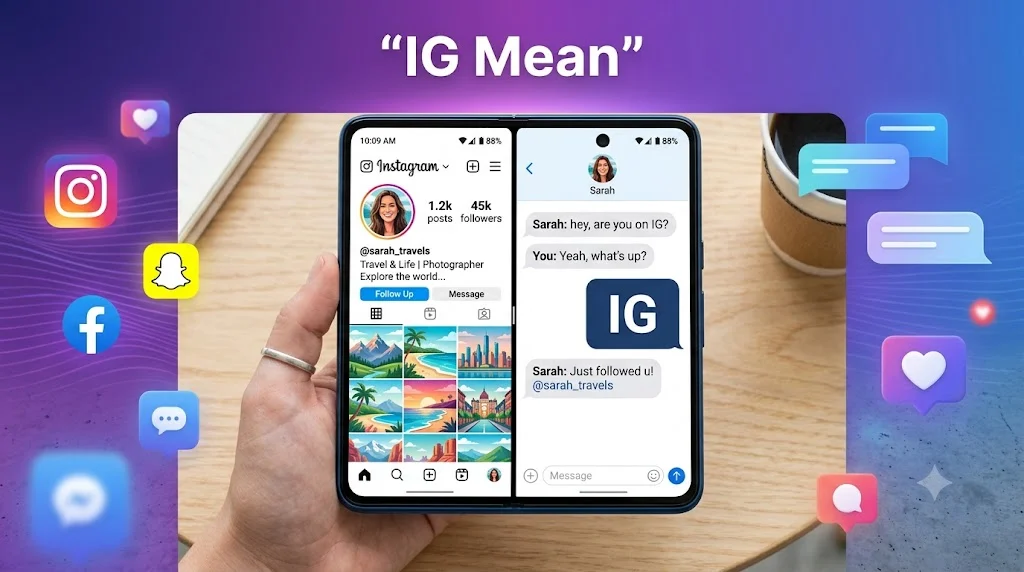
IG is a commonly used abbreviation that can mean “I Guess” in text messages and online chats, often used to express uncertainty or a casual opinion. It is also widely recognized as a short form of Instagram, one of the world’s most popular social media platforms.
You’re texting a friend about weekend plans. They reply with a simple “IG.” You pause. Are they talking about the photo-sharing app or giving you a lukewarm response to your suggestion? This tiny two-letter abbreviation creates genuine confusion every single day for millions of people.
Here’s the truth. “IG” lives two completely different lives in our digital world. One meaning ties directly to a billion-dollar social media platform. The other serves as a casual way to express mild agreement or uncertainty in everyday conversations.
By the time you finish reading this guide, you will never misinterpret “IG” again. You will understand exactly how to use it, how to spot the difference between its meanings, and why this little abbreviation has become so embedded in our online language.
Understanding the Two Sides of IG
Before we dive deep into each meaning, let’s establish a clear foundation. “IG” functions as a classic digital homograph. The same letters carry completely different meanings based entirely on where and how you encounter them.
Think of it like the word “bat.” In one context, it’s a piece of sports equipment. In another, it’s a flying mammal. The spelling stays identical, but the meaning shifts based on the situation. “IG” works exactly the same way in our online conversations.
| Context | Meaning | When You See It |
|---|---|---|
| Social Media | In bios, captions, and profile mentions | |
| Text Messaging | I guess | In replies to questions or suggestions |
The beauty of this abbreviation lies in its simplicity. Two letters convey either a massive social platform or a casual expression of mild agreement. But that simplicity also creates confusion. So let’s break down each meaning thoroughly.
IG Meaning: The Instagram Connection
When people talk about “IG” in social media contexts, they are almost always referring to Instagram. This abbreviation has become the preferred shorthand for the platform among users worldwide.
What Does IG Stand For on Social Media
Instagram launched in October 2010 as a photo-sharing app that quickly revolutionized how we share visual content. Within its first year, the platform attracted over 10 million users. Today, that number has grown to over 2 billion monthly active users worldwide.
The abbreviation “IG” emerged naturally from the platform’s name. Users needed a quick way to reference the app without typing the full eight-letter word. “Insta” and “Gram” also appear, but “IG” gained the most traction because it requires only two keystrokes.
You will encounter this meaning in several common scenarios:
- Someone asks for your “IG handle” to follow you
- A post caption directs followers to “check my IG stories”
- People mention “sending a DM on IG” for direct messages
- Users reference “IG Reels” when discussing short video content
How People Use IG When Referring to Instagram
The abbreviation appears across all digital spaces, not just within Instagram itself. People use it in text messages, on other social platforms, and even in spoken conversations.
Consider this real-world example. Two friends meet at a coffee shop. One asks, “Did you see my post on IG?” The other immediately understands they are discussing Instagram content. The abbreviation saves time and feels more natural in casual conversation.
Instagram itself has embraced this shorthand. The platform’s official materials sometimes use “IG” in marketing and communications. However, the abbreviation remains primarily user-generated slang rather than an official brand designation.
The Growth and Impact of Instagram
Since Facebook acquired Instagram for approximately $1 billion in 2012, the platform has transformed digital culture. Instagram introduced Stories in 2016, directly competing with Snapchat. Reels launched in 2020 as a response to TikTok’s explosive growth.
Today, Instagram generates billions in advertising revenue. The platform has become essential for influencers, brands, and everyday users alike. When people reference “IG,” they tap into this massive cultural phenomenon.
Consider these statistics that demonstrate the platform’s significance:
- Over 95 million photos upload to Instagram daily
- The average user spends 30 minutes per day on the app
- More than 90% of Instagram users follow at least one business account
- Instagram has over 2 billion monthly active users globally
These numbers explain why “IG” has become so ubiquitous. People need a quick way to reference this enormous platform that touches nearly every aspect of modern digital life.
IG Meaning: The I Guess Connection
The second primary meaning of “IG” functions as shorthand for “I guess.” This usage dominates text messaging, chat apps, and informal digital conversations.
What Does IG Mean in Text
When someone types “IG” in response to a question or statement, they are usually saying “I guess.” This casual expression conveys a specific tone that full words simply don’t capture as efficiently.
The phrase “I guess” itself carries several nuances. It can express mild agreement, uncertainty, reluctance, or a lack of strong opinion. The abbreviated version “IG” carries all these same shades of meaning.
Here is how “IG” functions in everyday text conversations:
Mild Agreement appears when someone accepts a suggestion without enthusiasm. For example, “Want to get pizza?” receives a reply of “IG.” This response means “I guess so” or “fine, that works.”
Uncertainty emerges when someone isn’t sure about something. “IG we should leave now?” suggests the person isn’t completely confident in that decision.
Reluctance shows up when someone agrees reluctantly. “IG I can help you move” indicates the person isn’t thrilled about helping but will do it anyway.
Indifference can also appear. “IG that’s fine” demonstrates that the person doesn’t have strong feelings either way.
How Tone Changes the Meaning
The same two letters can communicate vastly different emotions based on punctuation, capitalization, and accompanying elements. Pay attention to these subtle signals.
Lowercase “ig” typically indicates casual, quick responses. Someone in a hurry might type “ig” without capitalization because it takes less effort.
Capital “IG” sometimes carries more formality or emphasis. However, many people use all caps casually too. Context matters more than capitalization.
Question mark after IG shifts the meaning toward uncertainty. “IG?” essentially asks “is that what you think?” or “are you sure?”
Period after IG suggests more finality. “IG.” often means “I guess so, and that’s settled.”
Emojis with IG completely transform the tone. “IG 🤷” communicates a shoulder shrug of indifference.
Breaking Down Real Conversations
Let’s examine how “IG” appears in actual text exchanges. These examples demonstrate the abbreviation in action.
Scenario One: Making Plans
Person A: “Want to try that new Thai place tonight?”
Person B: “IG”
In this exchange, Person B agrees but lacks enthusiasm. They aren’t excited about Thai food, but they aren’t opposed either. “IG” communicates a neutral acceptance.
Scenario Two: Confirming Details
Person A: “The movie starts at 7, right?”
Person B: “IG so”
This response reveals uncertainty. Person B thinks the movie starts at 7 but doesn’t feel completely sure. Adding “so” after “IG” reinforces the “I guess” meaning.
Scenario Three: Making Decisions
Person A: “Should we take the highway or back roads?”
Person B: “IG highway is faster”
The “IG” here indicates the speaker isn’t making a definitive claim. They believe the highway is faster but acknowledge they might be wrong.
Scenario Four: Reluctant Agreement
Person A: “Can you cover my shift tomorrow?”
Person B: “IG I can”
Person B agrees to help but clearly doesn’t want to. The “IG” communicates their reluctance without outright refusal.
How to Tell the Difference: A Practical Guide
Distinguishing between Instagram and “I guess” requires careful attention to context. Here is your foolproof detection system.
The Context Rule
Ask yourself a simple question. Where did you encounter “IG”? The answer usually reveals the meaning immediately.
On Instagram itself – If you see “IG” within the Instagram app, it almost always refers to the platform. Users don’t typically type “I guess” when they are already on Instagram.
In a caption or bio – When “IG” appears in a profile description or post caption, it means Instagram. Someone writing “check my IG” in their bio clearly references the platform.
In response to a question – When “IG” appears as a reply in a text conversation, it usually means “I guess.” Someone asks “want to go?” and you reply “IG” – you are agreeing reluctantly.
Within a longer sentence – The surrounding words provide clues. “My IG handle” clearly means Instagram. “IG I’ll do it” clearly means “I guess.”
The Grammar Check
Examine how “IG” functions grammatically in the sentence. This approach almost always reveals the correct meaning.
When “IG” means Instagram, it typically acts as a noun. You can replace it with “Instagram” and the sentence still works perfectly.
- “Follow me on IG” becomes “Follow me on Instagram”
- “Check my IG stories” becomes “Check my Instagram stories”
- “I posted on IG” becomes “I posted on Instagram”
When “IG” means “I guess,” it functions as a verb phrase. You can replace it with “I guess” and the sentence retains its meaning.
- “IG we can try” becomes “I guess we can try”
- “IG that works” becomes “I guess that works”
- “IG so” becomes “I guess so”
The Platform Test
Consider which platform you are using at the moment. This simple check often resolves confusion instantly.
On Snapchat – Most “IG” references mean “I guess” because you are already on a different social platform. However, someone might say “add me on IG” to direct you to Instagram.
On WhatsApp – “IG” in WhatsApp messages typically means “I guess” because WhatsApp functions as a messaging app. However, someone might share their “IG profile” link.
On Facebook – Similar to WhatsApp, “IG” in Facebook messages usually means “I guess.” But Facebook posts might reference “my IG” when promoting Instagram content.
On TikTok – “IG” in comments often directs people to Instagram. Creators frequently say “follow my IG” to grow their following across platforms.
The Punctuation Clue
Pay attention to punctuation. While not foolproof, these patterns frequently indicate the correct meaning.
| Punctuation Pattern | Likely Meaning | Example |
|---|---|---|
| IG with period | “Check my IG.” | |
| IG with question mark | I guess | “IG we’re going?” |
| IG with emoji | I guess | “IG 😬” |
| IG in a hashtag | “#IG” | |
| Lowercase ig | I guess | “ig we can” |
| “my IG” or “your IG” | “Follow my IG” | |
| “IG + verb” | I guess | “IG I’ll go” |
Real Examples That Show the Difference
Let’s examine identical-looking phrases and see how context changes everything.
Example One: “IG is down”
- Context A: You are scrolling Twitter and see “IG is down” trending.
- Meaning: Instagram is experiencing technical difficulties.
- Context B: Your friend texts “IG is down” after you ask if they want to go out.
- Meaning: I guess the plan is canceled or not happening.
The Psychology Behind Using IG as I Guess
Why do people use “IG” instead of typing “I guess”? The answer reveals interesting insights about digital communication.
Efficiency in Texting
Typing “I guess” requires seven characters including the space. “IG” requires only two. That difference might seem small, but it adds up across hundreds of conversations.
When people text, they prioritize speed. Every keystroke takes time and effort. Abbreviations like “IG” reduce friction in digital communication.
Consider how many times you type similar phrases. “I guess” appears frequently in casual conversation. Abbreviating it saves genuine time and energy over months and years of messaging.
Emotional Distance
The abbreviated “IG” creates a specific emotional effect. Typing “I guess” feels more formal and deliberate. Typing “IG” feels casual and almost dismissive.
This emotional distance can be useful. When someone wants to express indifference without being rude, “IG” serves that purpose perfectly. It communicates “I don’t care strongly” without saying those words directly.
The abbreviation also softens disagreement. Saying “IG you’re right” sounds less confrontational than “I guess you’re right.” The shortened version feels more conversational and less weighted.
Generational Language Patterns
Younger generations have embraced abbreviations like “IG” as part of their linguistic identity. Using these terms signals membership in digital native communities.
Teenagers and young adults grew up with texting and social media. Abbreviations feel natural to them because they have always existed. “IG” and similar terms form the foundation of their digital vocabulary.
This generational divide sometimes creates confusion. Older users might not recognize “IG” as “I guess” and assume it always means Instagram. Understanding these linguistic patterns helps bridge communication gaps.
The Role of Speed in Digital Conversations
Text conversations move quickly. People type responses while doing other tasks. They respond to multiple conversations simultaneously. Speed matters.
Using “IG” allows you to acknowledge a message without breaking your flow. It keeps the conversation moving without requiring mental effort to formulate a complete response.
This speed-oriented communication style has become normal. People now expect quick replies. Abbreviations enable that speed without sacrificing meaning.
Related Slang and Texting Abbreviations
“I G” doesn’t exist in isolation. It belongs to a larger ecosystem of digital shorthand. Understanding these related terms provides valuable context.
Common Texting Abbreviations
| Abbreviation | Meaning | Usage Example |
|---|---|---|
| IDK | I don’t know | “IDK what to do tonight” |
| TBH | To be honest | “TBH, I don’t really care” |
| IMO | In my opinion | “IMO, that movie was overrated” |
| IMHO | In my humble opinion | “IMHO, you should go” |
| SMH | Shaking my head | “SMH at that decision” |
| LOL | Laugh out loud | “That’s hilarious LOL” |
| BRB | Be right back | “BRB, getting food” |
| TTYL | Talk to you later | “Gotta go, TTYL” |
| FR | For real | “FR, that actually happened” |
| NGL | Not gonna lie | “NGL, I was nervous” |
How IG Fits With Other Slang
“I G” often appears alongside these other abbreviations. The combination creates a specific conversational rhythm.
Consider this exchange: “IDK, IG we’ll see what happens.” The speaker combines uncertainty (IDK) with reluctant agreement (IG) to express complete indecision.
Another example: “IG you’re right, TBH.” Here, the speaker reluctantly agrees while being honest about their feelings. The combination of “IG” and “TBH” creates a nuanced message.
These abbreviations work together to create efficient communication. They allow people to express complex emotions quickly.
Digital Language Evolution
Internet slang constantly evolves. New terms emerge while others fade away. “IG” has proven remarkably durable because it serves two essential functions.
The abbreviation first appeared in early text messaging. As smartphones became ubiquitous, “IG” gained popularity. Now it exists across all digital platforms.
Compared to other slang terms, “IG” shows remarkable staying power. Terms like “ROFL” (rolling on the floor laughing) have largely been replaced by emojis. But “IG” remains strong.
This durability likely stems from its dual meanings. Serving both Instagram and “I guess” gives “IG” broader utility than most abbreviations.
Regional and Cultural Variations
Different communities use “IG” in slightly different ways. Understanding these variations prevents misinterpretation.
American English speakers frequently use “IG” as “I guess” in everyday texting. The abbreviation appears across age groups and regions.
British English speakers use “IG” similarly, though they might pair it with different slang terms. “IG, innit?” combines American abbreviation with British expression.
International Users often default to “IG” meaning Instagram because the platform has global reach. However, “I guess” usage appears worldwide among English speakers.
Gaming Communities sometimes use “IG” to mean “in-game.” This additional meaning appears primarily in gaming contexts. “What’s your IG rank?” means “what’s your in-game rank.”
Professional Settings rarely use “IG” as “I guess” because it sounds too casual. However, “IG” as Instagram might appear in marketing or business communications.
Common Scenarios and How to Interpret IG
Let’s examine specific situations where “IG” appears and break down how to interpret each one.
Scenario One: Social Media Promotions
You see a YouTube video with this caption: “Follow my IG for exclusive content.”
The meaning is clearly Instagram. The creator wants you to follow their Instagram account. This usage appears constantly across all content platforms.
Why this means Instagram: The phrase “follow my” directly precedes “IG.” You follow people on social media, not “I guess.” The grammar makes the meaning obvious.
Scenario Two: Texting with Friends
Your friend texts: “IG we should leave around 6.”
This means “I guess we should leave around 6.” Your friend expresses uncertainty about the timing. They aren’t sure but offer a suggestion.
Why this means I guess: The “IG” precedes a suggestion. Your friend wouldn’t say “Instagram we should leave around 6.” The verb “should” makes “I guess” the logical interpretation.
Scenario Three: Casual Chat
You ask a question: “Do you think this looks good?”
Your friend replies: “IG”
This brief response means “I guess so.” Your friend doesn’t have a strong opinion but offers mild agreement.
Why this means I guess: The “IG” stands alone as a response to a yes/no question. This pattern almost always indicates “I guess.”
Scenario Four: Group Planning
Someone in a group chat says: “IG we’re all meeting at the park.”
This means “I guess we’re all meeting at the park.” The speaker believes this is the plan but acknowledges uncertainty.
Why this means I guess: The phrase “we’re meeting” creates a situation where “I guess” makes grammatical sense. “Instagram we’re meeting” doesn’t work.
Scenario Five: Instagram Comments
Someone comments on your photo: “This is fire IG”
In this context, “IG” likely means Instagram but serves more as emphasis. The person might be tagging the platform or using “IG” as filler.
Why this could be either: Instagram comments sometimes use “IG” just because it’s the platform name. However, the commenter might also mean “I guess” as in “I guess this is fire.” Usually context determines the meaning.
Using IG Correctly in Your Own Communication
Now that you understand both meanings, let’s discuss how to use “IG” effectively in your own digital conversations.
When to Use IG as Instagram
Use “IG” when referencing the platform in casual contexts. It’s appropriate for social media bios, captions, and informal conversations.
Appropriate Situations:
- Writing your Instagram bio
- Directing people to your profile
- Mentioning Instagram features
- Discussing content on the platform
Examples:
- “My IG handle is @username”
- “Check my IG stories for behind-the-scenes content”
- “I posted a new Reel on IG today”
When to Avoid:
- Formal business communications
- Professional documents
- Academic writing
- Official marketing materials (unless targeting a casual audience)
When to Use IG as I Guess
Use “IG” when texting friends, family, or anyone in casual digital conversation. It works best for expressing mild agreement or uncertainty.
Appropriate Situations:
- Responding to suggestions
- Expressing reluctant agreement
- Showing uncertainty
- Quick casual replies
Examples:
- “IG that works for me”
- “IG we could try that”
- “IG so, if you want”
When to Avoid:
- Important conversations
- Formal communications
- When clarity matters most
- When the recipient might not understand
Tips for Clear Communication
If you want to avoid confusion, consider these strategies for using “IG” effectively.
Provide Context: When using “IG” as Instagram, make the platform clear. “My IG profile” or “IG stories” leaves no doubt. When using “IG” as “I guess,” pair it with a complete thought. “IG we can go” confirms the meaning.
Watch Your Audience: Consider who you are communicating with. A teenage friend will understand “IG” perfectly. A grandparent might not. Adjust based on your recipient.
Expand When Needed: If confusion seems likely, just type the full words. “I guess” and “Instagram” take slightly longer but prevent misunderstanding.
Use Emojis Wisely: Emojis clarify tone and meaning. “IG 🤷” clearly shows indifferent agreement. “IG 📸” clearly references Instagram photos.
The Evolution of IG in Digital Culture
Understanding how “IG” became popular reveals fascinating insights about language evolution in the digital age.
Early Text Messaging Culture
When SMS texting first became popular, character limits forced creativity. People developed abbreviations to fit more meaning into 160 characters.
“I G” emerged from this constraint. Typing “I guess” took valuable characters. “IG” saved space while preserving meaning.
As smartphones replaced feature phones, character limits largely disappeared. However, the abbreviation habits persisted. People continued using “IG” because it felt natural.
The Rise of Social Media
Instagram launched in 2010. Users quickly needed shorthand for the platform. “IG” naturally filled this gap.
Interestingly, “IG” already meant “I guess” in text messaging. The dual meaning emerged organically as social media grew.
This parallel evolution created the modern confusion. Two different linguistic threads converged on the same abbreviation.
Instagram’s Influence
As Instagram exploded in popularity, “IG” became increasingly associated with the platform. New users often learn “IG” as Instagram before learning the “I guess” meaning.
This shift reflects broader trends. Social media platforms now dominate digital culture. Their abbreviations often overshadow older meanings.
However, the “I guess” meaning persists. Texting remains ubiquitous, and people still need efficient ways to express reluctant agreement.
Modern Digital Communication
Today’s digital landscape features multiple platforms and communication styles. “IG” flows across all of them.
The abbreviation appears in:
- SMS text messages
- WhatsApp conversations
- Snapchat chats
- TikTok comments
- Twitter posts
- Facebook messages
- Instagram itself
This ubiquity makes “IG” one of the most versatile abbreviations in modern English. It serves different functions on different platforms while remaining instantly recognizable.
Misunderstandings and How to Avoid Them
Even with careful attention, misunderstandings happen. Here are common pitfalls and how to navigate them.
The Ambiguous IG
Sometimes context doesn’t clearly reveal the meaning. In these cases, consider additional clues.
Tip One: Look at the surrounding conversation. What were you discussing before “IG” appeared? This history often resolves ambiguity.
Tip Two: Consider the relationship. Close friends use “IG” as “I guess” frequently. Professional contacts probably mean Instagram.
Tip Three: Ask for clarification. There’s no shame in saying “Do you mean Instagram or I guess?” This prevents confusion.
Cultural Differences
Different generations and cultures might interpret “IG” differently. Be aware of these variations.
Older Users often assume “IG” means Instagram. They might not recognize the “I guess” meaning at all.
Younger Users understand both meanings intuitively. They switch between them based on context automatically.
Non-Native Speakers might struggle with either meaning. Abbreviations are especially challenging for language learners.
Gendered Interpretations
Search data shows people asking “what does IG mean from a girl” or “what does IG mean from a guy.” Let’s address this directly.
The Reality: “IG” means the same thing regardless of who sends it. The meaning depends entirely on context, not gender.
A girl texting “IG” probably means “I guess” or “Instagram” just like a guy would. Gender doesn’t change digital abbreviations.
What Might Vary: Communication style, personality, and relationship dynamics affect how people use “IG.” But these factors aren’t gendered.
The Emoji Factor
Emojis completely change the interpretation of “IG.” Consider these combinations:
- “IG 😊” = I guess (happy agreement)
- “IG 🙄” = I guess (annoyed agreement)
- “IG 🤔” = I guess (thoughtful uncertainty)
- “IG 📱” = Instagram (phone reference)
- “IG 📸” = Instagram (camera reference)
- “IG 🎥” = Instagram (video reference)
When emojis accompany “IG,” they almost always clarify the intended meaning. Pay attention to these visual cues.
The Future of IG and Digital Language
Language constantly evolves. What will happen to “IG” in the coming years?
Instagram’s Continued Dominance
As long as Instagram remains relevant, “IG” as Instagram will persist. The platform continues growing, adding features, and attracting users.
Even if Instagram eventually declines, the abbreviation might survive. “IG” could become the default shorthand for any photo-sharing platform, similar to how “Kleenex” became generic for tissues.
The Persistence of Texting Slang
Texting shows no signs of slowing down. “I guess” remains a common expression. The “IG” abbreviation will likely continue as long as people text.
However, new abbreviations constantly emerge. “IG” might eventually be replaced by something even shorter. But its dual meaning gives it staying power.
The Role of AI and Autocomplete
As AI-powered keyboards improve, abbreviation usage might change. Predictive text could suggest full words instead of abbreviations.
But human communication tends toward efficiency. People who want to type “IG” will likely continue doing so. Autocomplete might actually reinforce abbreviation use.
Generational Shifts
Younger generations might develop new meanings for “IG.” Digital language evolves quickly. What “IG” means today might change in a decade.
However, the two core meanings seem stable. Instagram and “I guess” are both established. New meanings would likely layer on rather than replace.
Practical Tips for Using IG Effectively
Let’s consolidate everything into actionable advice for your digital communication.
For Clarity
Be explicit when it matters. If confusion could cause problems, just type “Instagram” or “I guess.” The extra seconds are worth avoiding misunderstandings.
Provide context clues. “My IG handle” clearly means Instagram. “IG we should” clearly means “I guess.” Structure your sentences to reveal meaning.
Use punctuation intentionally. Question marks, periods, and emojis all communicate tone. Choose them deliberately.
For Natural Communication
Match the conversation style. If friends use abbreviations, feel free to use “IG.” If the conversation is formal, avoid it.
Don’t force it. “IG” should feel natural. If you’re thinking too hard about whether to use it, just type the full words.
Read the room. Consider the recipient’s age, relationship, and communication style. Adapt accordingly.
For Social Media
Use “IG” in your bio to save space. Bios have character limits. “My IG” takes less space than “Instagram.”
Direct followers clearly. “Follow me on IG” leaves no doubt about meaning.
Avoid ambiguity in captions. Your captions reach diverse audiences. Consider whether everyone will understand your shorthand.
FAQs
What does IG mean on Instagram?
On Instagram itself, “IG” means Instagram. It’s a shorthand reference to the platform. Users say “my IG,” “IG stories,” or “IG Reels” to refer to specific features.
What does IG mean on Snapchat?
On Snapchat, “IG” usually means “I guess” because you’re in a messaging context. However, someone might say “add me on IG” to direct you to Instagram. Context determines the meaning.
What does IG mean on TikTok?
On TikTok, “IG” often means Instagram. Creators commonly say “follow my IG” in videos and captions. However, in TikTok comments, it might mean “I guess.” Look at the surrounding text.
What does IG mean on WhatsApp?
On WhatsApp, “IG” typically means “I guess.” The platform is primarily for messaging, so the “I guess” interpretation dominates. However, sharing Instagram profiles also happens.
What does IG mean from a girl?
“IG” from a girl means either “I guess” or “Instagram,” exactly like it would from anyone else. The meaning comes from context, not gender. Tone, punctuation, and emojis provide clues.
What does IG mean from a guy?
Same answer. “IG” from a guy means “I guess” or “Instagram” based entirely on context. Don’t overthink the sender’s gender.
What does IG mean in gaming?
In gaming communities, “IG” can mean “in-game.” This usage appears in phrases like “IG currency” or “IG stats.” However, this is less common than the two main meanings.
What does IG mean in business?
In professional contexts, “IG” nearly always means Instagram. Marketers, social media managers, and business owners use it this way constantly. “I guess” is too casual for most business communications.
Conclusion:
Understanding IG meaning is important because the abbreviation is commonly used in texting, social media, and online conversations. While IG most often stands for Instagram, it can also mean “I guess” depending on the context of the conversation.
The meaning of IG is usually easy to identify by looking at how it is used in a sentence. On social media, people often use IG when referring to Instagram, while in casual chats and text messages, it frequently means “I guess.”
As online communication continues to evolve, abbreviations like IG help people communicate more quickly and efficiently. Knowing its different meanings can help you better understand messages, social media posts, and digital conversations.
Discover More Related Articles:
- Redundant Meaning | Work, Writing & Communication In 2026
- Nonse Meaning | Slang, Technology & Everyday Language In 2026