
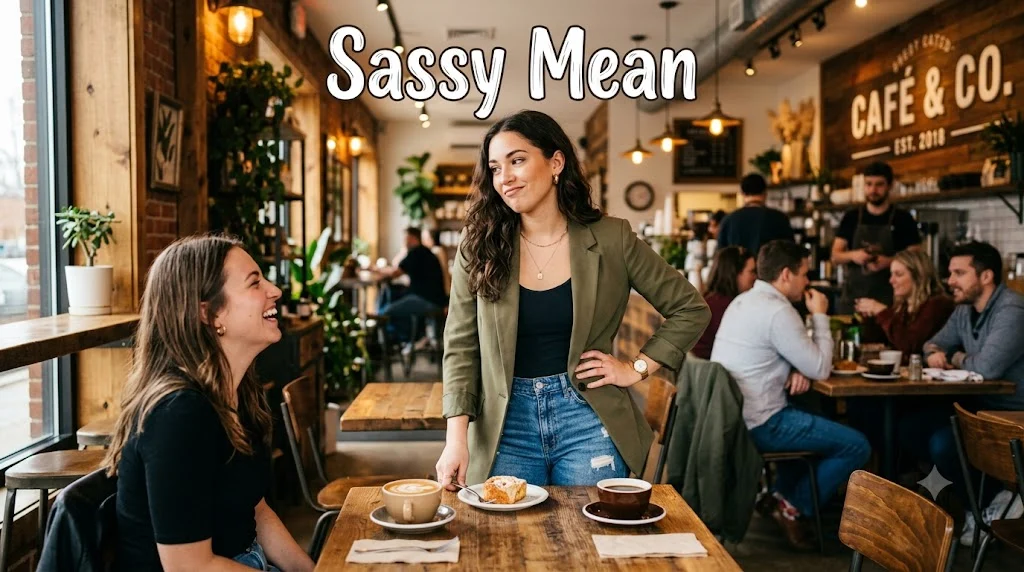

Definition
Sassy is an adjective used to describe someone who is bold, confident, lively, and not afraid to express their opinions, often in a clever or playful way. Depending on the situation, being sassy can be seen as charming and witty or slightly disrespectful if the person speaks too sharply.
Ever met someone who delivers a killer comeback with a smirk, leaving everyone around them either gasping or cracking up? That’s sass in its natural habitat.
You’ve probably heard the word thrown around. Maybe someone called you sassy. Maybe you’ve wondered whether that was a compliment or a subtle insult. The truth is, most people can’t quite put their finger on what sassy really means. Is it confidence with an edge? Is it just another word for rude? Or is it something else entirely?
Let’s clear this up once and for all.
This comprehensive guide unpacks every layer of this feisty little word. We’ll explore its linguistic roots, its modern-day usage across text messages and social media, and exactly how to channel sass effectively in your own life. By the end, you won’t just understand the sassy meaning. You’ll know precisely when to deploy it and when to dial it back.
The Core Sassy Definition
At its heart, sassy describes someone who’s boldly confident, playfully cheeky, and unafraid to speak their mind.
The straightforward sassy definition is this: displaying a lively, bold, and somewhat saucy attitude. Think of it as confidence with a wink. It’s the verbal equivalent of a raised eyebrow and a knowing smile.
Here are the key components that make up sass:
- Confidence – You believe in yourself and your perspective
- Wit – You’re quick on your feet with clever responses
- Playfulness – There’s no real malice behind the words
- Boldness – You’re not afraid to say what others are thinking
Let’s anchor this definition with an example. Imagine your friend shows up wearing an outfit that’s ambitious. A sassy response isn’t “That looks terrible.” That’s just mean. A sassy response is “Well, you’re certainly making a statement today. I respect the commitment.” See the difference? One attacks. The other acknowledges with humor.
The word “sassy” has roots in 16th-century English, originally derived from “saucy.” Back then, it meant impudent or disrespectful, especially toward authority figures. A saucy servant talked back to their master. A saucy child didn’t defer to their parents.
But language evolves. Today’s sassy meaning carries a much more positive, empowering connotation. What was once a criticism of boldness has become a celebration of it.
This transformation reflects broader cultural shifts. We find wit and charm more appealing than quiet compliance.
The Sassy Personality: Traits and Characteristics
People with sassy personalities possess a distinct set of traits that set them apart from the crowd. A sassy person isn’t just someone who makes jokes. They embody a specific blend of characteristics that make their interactions memorable and engaging.
Core traits of sassy individuals:
| Trait | What It Looks Like | Real Example |
|---|---|---|
| Quick-witted | Responds instantly with clever observations | Someone makes a bland comment about the weather. You fire back with “Wow, you really went out on a limb with that observation.” |
| Self-confident | Comfortable in their own skin | Doesn’t seek constant validation. Trusts their own judgment without needing approval. |
| Playfully teasing | Uses humor to connect, not harm | Pokes fun at a friend’s questionable life choices but with obvious affection and warmth. |
| Outspoken | Says what others are thinking | Calls out obvious nonsense in a meeting when everyone else stays silent out of politeness. |
| Energetic | Brings life to conversations | Their presence elevates the room’s energy level. People feel more engaged when they’re around. |
| Assertive but not aggressive | Stands their ground respectfully | Disagrees without attacking the other person. Maintains respect while holding their position. |
Let’s dive deeper into each of these traits.
Quick-wittedness is perhaps the most visible sassy personality trait. It’s not just about being smart. It’s about processing information rapidly and generating a clever response in real time. This requires mental agility and a certain fearlessness. You can’t be quick-witted if you’re constantly second-guessing yourself.
Self-confidence forms the foundation of the sassy meaning. Without genuine self-assurance, sass comes across as defensive or mean-spirited. Confident people don’t need to tear others down to feel good about themselves. They can make jokes because they’re secure enough to laugh at themselves too.
Playful teasing requires emotional intelligence. You need to know where the line is and not cross it. A sassy person reads the room. They understand their audience. They know when someone can handle a joke and when they can’t. This sensitivity is what separates charming sass from hurtful sarcasm.
Being outspoken means you’re not afraid to voice your opinions. Sassy people don’t hide their perspectives to avoid conflict. They express themselves openly but with enough humor that people remain receptive. It’s a delicate balance that takes practice to master.
Energy is contagious. Sassy people often have a vibrant presence that draws others in. They make conversations more interesting. They turn mundane interactions into something memorable. This energy comes from genuine engagement with the world around them.
Assertiveness without aggression is the hallmark of mature sass. You can stand your ground without raising your voice. You can disagree without being disagreeable. This skill makes sassy people effective communicators in both social and professional settings.
What sassy is NOT:
- It’s not being mean for the sake of being mean
- It’s not constant negativity or complaining
- It’s not an excuse to be disrespectful
- It’s not the same as being argumentative
- It’s not aggression disguised as humor
The psychology behind sass
Psychologists might frame sassy behavior as a form of social intelligence. You’re reading the room, understanding social dynamics, and using humor to navigate tricky situations. This requires emotional awareness to know when sarcasm lands and when it falls flat.
Research in personality psychology suggests that sassy individuals often score high on measures of verbal fluency, social cognition, and emotional intelligence. They process social information quickly and respond in ways that maintain positive relationships while still expressing their authentic selves.
Sassy Meaning in Different Contexts
The sassy meaning shifts depending on where and how you use it. That nuance matters more than you think.
Sassy meaning in slang
In casual conversation and pop culture, “sassy” has become shorthand for anyone with a bold, unapologetic attitude. It’s often used affectionately to describe friends who keep things interesting. Think of it as slang for “spicy personality.”
A sassy friend is the one who keeps group chats lively. They never let a boring moment slide. They turn mundane exchanges into entertaining interactions. This positive sassy meaning in slang has largely replaced the older, more negative connotations.
Sassy meaning in text messages
When someone calls you sassy over text, you’re getting a digital wink. It usually means your message had an edge to it, playful, teasing, maybe a little bold. The sassy meaning in text often involves:
- Emojis that amplify the cheekiness (😏, 🙄, 💅)
- Dry humor that’s hard to miss
- Responses that turn a mundane conversation into something entertaining
- Quick comebacks that keep the exchange lively
Digital communication has actually amplified sassy behavior. Without vocal tone and facial expressions, we rely more heavily on word choice and emojis to convey our intent. A sassy text requires careful calibration. Too sharp and you seem mean. Too soft and you lose the effect.
Sassy meaning for a girl or woman
This context carries extra weight because of gender dynamics. A woman called sassy might be seen as confident and assertive. But here’s the catch. The same behavior in men often gets labeled as “charismatic” or “confident.”
So when people ask what sassy means for a girl, the answer often depends on who’s doing the labeling. Some women embrace the term as a badge of honor. Others find it dismissive. The key is understanding the speaker’s intent.
Research shows that assertive women are often penalized in professional settings for behaviors that are rewarded in men. Being called sassy at work might be a coded way of saying “you’re too much.” Being called sassy in social settings is often a genuine compliment.
Sassy meaning in social media
On platforms like TikTok, Instagram, and Twitter, sass has become performance art. Think of those viral videos where someone delivers a deadpan response to an absurd question. Or the Twitter roasts that rack up thousands of likes.
Social media amplifies sassy behavior because the medium rewards quick, memorable interactions. A sassy comment on a post can elevate your social standing or get you ratioed if you miss the mark. The stakes are higher but so are the rewards.
Influencers have built entire careers on their sassy personas. Viewers tune in for the entertainment value. They want to see someone say what they’re thinking. This public sass is often more exaggerated than private sass, but the underlying principles remain the same.
Sassy meaning in relationships
This is where things get personal. In romantic relationships, a sassy partner brings energy and excitement. They keep conversations interesting. The sassy meaning in a relationship can cut both ways though.
Used playfully, sass strengthens bonds. It creates inside jokes and shared humor. It keeps the relationship dynamic and engaging. Couples who tease each other affectionately often report higher relationship satisfaction.
Used passive-aggressively, sass erodes trust. It masks genuine frustration with sarcasm. It creates resentment that builds over time. The difference lies in whether you’re teasing with affection or masking genuine frustration with humor.
The same applies to friendships and family relationships. Sass works when everyone understands it’s coming from a place of love. It fails when it’s used to avoid vulnerability or express unspoken criticism.
Sassy vs Other Personality Traits
Sass gets confused with other bold behaviors all the time. The distinctions actually matter quite a bit.
Sassy vs rude
This is the big one. It’s where most people get tripped up. Rudeness lacks wit, warmth, and social awareness. It’s just aggression without the clever packaging. Sass, by contrast, lands differently because it’s funny.
You can get away with saying something bold if you make people laugh while you say it. The difference is that sassy people read the room first. Rude people plow through without caring.
Consider this comparison:
| Behavior | Example | Why It Works or Fails |
|---|---|---|
| Sassy | “I love your confidence in that opinion.” | The humor softens the criticism. It makes people think without feeling attacked. |
| Rude | “That’s a opinion.” | There’s no humor. No warmth. Just aggression. People feel attacked and defensive. |
Sassy vs sarcastic
Sarcasm is a tool. Sassy is a whole personality. Sarcasm involves saying the opposite of what you mean for ironic effect. Sass can include sarcasm, but it’s broader.
A sassy remark might be a sincere observation delivered with a wink. It doesn’t have to drip with irony. Think of it this way: all sarcasm can be sassy, but not all sass is sarcastic.
| Aspect | Sassy | Sarcastic |
|---|---|---|
| Scope | Broad personality trait | Specific communication style |
| Intent | Usually positive or neutral | Often critical or ironic |
| Tone | Playful and warm | Dry and cutting |
| Frequency | Ongoing behavior | Situational |
Sassy vs confident
Confidence stands alone. Sass is confidence with performance value. A confident person might simply state their opinion. A sassy person will state their opinion and make you smile while they do it.
Sass adds an extra layer of entertainment to the confidence. It’s the difference between saying “I disagree” and saying “I disagree, but I love the enthusiasm behind your wrongness.”
Sassy vs feisty
Feisty suggests a scrappy, fight-ready energy. It’s more aggressive than sassy. Sass implies playful engagement. Feisty implies you’re ready for a scrap. Both are spirited, but sassy has more humor baked in.
A feisty person might respond to an insult with immediate confrontation. A sassy person might respond with a clever one-liner that disarms the other person without escalating the conflict.
Sassy vs assertive
Assertiveness is about stating your needs and boundaries clearly and respectfully. Sass achieves similar outcomes but adds flair. Assertiveness is direct. Sass is stylish. You can be both, and many sassy people are. But they aren’t the same thing.
When sassy crosses the line
A sassy remark becomes problematic when:
- You’re punching down (targeting someone vulnerable)
- The other person clearly isn’t in on the joke
- You’re using it to avoid genuine emotional expression
- It shifts from playful to mean-spirited
- You’re the only one laughing
Is Sassy a Compliment or an Insult?
Whether being called sassy feels good or bad depends entirely on who’s saying it and how they mean it.
When sassy is a compliment
Most people these days use “sassy” positively. It signals that you’re:
- Interesting enough to hold a conversation
- Quick enough to keep up with verbal sparring
- Confident enough to have an opinion
- Fun enough to make others laugh
If someone says “you’re so sassy” and they’re smiling, congratulations. You’ve got a desirable personality trait. It means you’re memorable. People enjoy your company. You bring energy to interactions. The sassy meaning in this context is basically “you’ve got charisma.”
Cultural data supports this shift. Surveys of language usage show that positive references to sassy behavior have increased significantly over the past two decades. What was once a criticism has become an aspiration.
When sassy is an insult
The sassy definition carries negative baggage in specific contexts. Some people use it to dismiss women who speak up. Others use it to label anyone who challenges them as “difficult.” In professional settings, being called sassy might mean you’re seen as unprofessional or disruptive. It’s a coded way of saying “you’re too much.”
Case study: The workplace double standard
Here’s where things get really interesting. A male manager who speaks bluntly is often called “direct” or “decisive.” A female manager who does the same thing might be called “sassy” or “bossy.” That’s not about the behavior. That’s about perception and gender bias.
Research from Harvard Business Review confirms this pattern. Women who display assertive behavior are often rated lower on likeability than men who display the same behavior. The language used to describe them reflects this bias. “Sassy” is one of those loaded terms.
So when someone calls you sassy at work, ask yourself: would they say the same thing to a man who acts the same way? If the answer is no, you’re experiencing a double standard.
How to respond when someone calls you sassy
Your response depends on the situation and your relationship with the person.
| Scenario | Best Response |
|---|---|
| A friend says it playfully | “You know it. I keep things interesting around here.” |
| A colleague says it dismissively | “I prefer to think of it as being direct. Is that a problem?” |
| A stranger says it online | Ignore them. They’re not worth your energy. |
| Someone says it with confusion | “What do you mean by that? I want to understand.” |
| A boss says it in a review | “I’m hearing you say I come across as too casual. Can we talk about how to adjust that professionally?” |
Real-World Examples of Sassy Behavior
Nothing clarifies the sassy meaning like seeing it in action.
Everyday sassy responses
Example 1: The backhanded compliment
Person A: “I just finished a 10K run this morning.”
Sassy response: “Oh wow, that’s impressive. Meanwhile, I’m celebrating that I remembered to put on matching socks today. We’re both winning.”
This works because it acknowledges the other person’s achievement while adding self-deprecating humor. The sassy remark doesn’t diminish their accomplishment. It just adds a playful contrast.
Example 2: The mild roast
Person A: “I think my new haircut makes me look like a celebrity.”
Sassy response: “Yeah, maybe a celebrity who just woke up from a 12-hour flight. But it’s a vibe. I’m not mad at it.”
The key here is the quick recovery. The sassy response starts with a playful dig but immediately softens with “it’s a vibe” and “I’m not mad at it.” The criticism is there but it’s wrapped in warmth.
What makes these examples work
Notice the pattern. In every example, the sassy response:
- Acknowledges the other person’s statement
- Adds humor without cruelty
- Keeps the interaction light
- Shows personality without demanding attention
- Maintains the relationship rather than damaging it
The sassy meaning in these interactions comes through loud and clear: confidence, wit, and playfulness all working together.
How to Use Sassy in a Sentence
Mastering the sassy meaning means knowing how to deploy it in real conversations.
Simple sassy phrases to keep in your back pocket
- “I appreciate your confidence in that opinion.”
- “Well, that’s certainly a choice.”
- “I’d argue with you, but I don’t have the energy to be this wrong today.”
- “I’m not saying you’re wrong. I’m just saying I’m right. There’s a difference.”
- “That’s one way to look at it. The wrong way. But one way.”
- “I love that you think I have the answer to that.”
- “Let me think about that… No, I’m still good. But I appreciate the effort.”
Situational sassy sentences
| Situation | Sassy Sentence |
|---|---|
| Someone asks an obvious question | “I love that you think I have the answer to that. I barely have the answer to what I’m having for dinner.” |
| You’re being pressured to agree | “Let me think about that… No, I’m still good. But I appreciate the effort.” |
| Someone makes a ridiculous claim | “If you say so. I’ll just be over here in reality, but you do you.” |
| You’re asked to do something unreasonable | “Oh, absolutely. I’ll get right on that. Right after I finish these other seventeen things on my list.” |
| Someone tries to embarrass you | “I’d blush, but I’m too busy being right about everything.” |
| Someone asks for your opinion repeatedly | “My opinion hasn’t changed since the first three times you asked. But I admire your persistence.” |
| A friend makes a questionable decision | “I support you. I also reserve the right to say ‘I told you so’ later. But right now, I support you.” |
Sassy remark vs sassy response
A sassy remark is any comment with that bold, witty energy. A sassy response specifically answers someone else’s statement. The sassy remark might be unsolicited. The sassy response is reactive.
Both fit the broader sassy definition. The distinction matters because a response shows you’re quick on your feet, while a remark shows you’re naturally bold. Responses are reactive. Remarks are proactive.
When to avoid sassy sentences entirely
There are situations where even the most skillful sass won’t land well:
- In a job interview unless the interviewer sets a very casual tone first
- During an argument about something serious when emotions are already high
- When you’re speaking to someone who’s clearly upset and needs compassion, not humor
- In cultures where directness is considered disrespectful and indirect communication is valued
- When you’re not confident the other person will understand your intent and might take offense
The sassy meaning works best in lighthearted, informal settings. Use it strategically and you’ll come across as charismatic. Use it carelessly and you’ll come across as defensive or mean.
How to gauge if a sassy sentence is appropriate
Ask yourself these questions before deploying sass:
- Does this person know me well enough to understand my humor?
- Is the setting casual enough for this kind of interaction?
- Am I making a point or just being sharp?
- Is there any risk of hurting this person’s feelings?
- Would I be comfortable if someone said this to me?
If you answer “no” to any of these questions, reconsider.
The Sassy Woman Meaning
The sassy woman meaning carries cultural baggage that’s worth unpacking.
The double standard
Let’s be honest with each other. A sassy man is charming. A sassy woman is “too much.” That’s not fair, but it’s the reality we’re working with. When people ask what sassy means for a girl, the answer often includes unspoken judgments.
A woman who speaks her mind is a “sassy woman.” A man who does the same is a “leader.” A woman who’s direct is “difficult.” A man who’s direct is “decisive.” A woman who’s funny is “trying too hard.” A man who’s funny is “naturally charismatic.”
You see the problem. The same behavior gets different labels based on gender. This isn’t just perception. It’s systematic bias that affects careers, relationships, and self-perception.
Pop culture sassy women
Think about these iconic sassy characters:
Miranda Priestly from The Devil Wears Prada delivers biting one-liners with ice-cold precision. Her sass is intimidating but also admirable. She commands respect through sheer force of personality.
The sassy woman meaning in modern culture
Today, being a sassy woman often signals that you’re someone who:
- Doesn’t take nonsense from anyone
- Can hold your own in any conversation
- Brings energy and humor to every room you enter
- Is unapologetically yourself in a world that frequently asks women to be smaller
This sassy meaning is a superpower. Use it with awareness of the double standard, but don’t let it stop you from expressing yourself.
Research on gender and assertiveness
Studies consistently show that women face a double bind with assertiveness. If you’re assertive, you’re seen as competent but unlikeable. If you’re warm, you’re seen as likeable but incompetent. This is the “likability penalty” that affects women in the workplace.
Sass offers one way around this. Humor disarms people. If you make someone laugh while asserting yourself, they’re less likely to view you negatively. The sassy woman meaning in professional contexts is often about finding that balance.
Sassy Behavior: What It Looks Like and Why People Do It
Sassy behavior is deliberate communication, not accidental rudeness.
The mechanics of sass
When someone engages in sassy behavior, they’re usually doing several things at once:
- Assessing the situation – Is this a safe space for playful humor?
- Finding the angle – What’s the funniest way to make this point?
- Delivering with timing – Too early or too late and the joke falls flat
- Reading the reaction – Adjusting if the audience isn’t responsive
- Maintaining warmth – Making sure the humor doesn’t cross into meanness
This isn’t random. It’s a skill. People with sassy personalities have often spent years honing their delivery. They know how to walk the line between clever and offensive.
Is Being Sassy Good or Bad?
Like any personality trait, sass has strengths and weaknesses.
The positives of being sassy
- You’re memorable. Sassy people stand out. People remember interactions with you. This can be valuable in both social and professional contexts.
- You make others feel at ease. Humor reduces tension and makes people comfortable. Sassy people often make others feel less awkward in unfamiliar situations.
- You command attention. Sassy people have presence. When they speak, people listen. This can be an advantage in meetings, negotiations, and social gatherings.
- You’re better at navigating conflict. A well-placed joke can defuse a tense situation. Sassy people often de-escalate conflicts before they become serious.
- You develop strong relationships. People who appreciate wit tend to gravitate toward you. Your friendships are often based on mutual enjoyment of humor.
- You’re seen as intelligent. Wit is correlated with verbal intelligence. People who make clever jokes are often perceived as smarter.
- You maintain perspective. Humor helps you avoid taking yourself too seriously. This can protect against stress and burnout.
The negatives of being sassy
- You can be misunderstood. Not everyone gets the joke. Some people will take your sass as hostility, especially if they don’t know you well.
- You might be seen as unprofessional. In conservative settings, sass doesn’t always land well. It can be perceived as disrespectful or immature.
- You can accidentally hurt feelings. Even when you don’t mean to, your words can sting. People who are more sensitive may be genuinely upset by what you thought was harmless.
- You might avoid vulnerability. Sass can become a shield that prevents genuine connection. If you’re always joking, people may never see the real you.
- You may be dismissed. Some people, especially women, get labeled as “difficult” for the same behavior that gets men called “charismatic.”
- You can come across as arrogant. Confidence is attractive. Overconfidence is not. The line between the two can be hard to see.
- You might wear people out. Sass takes energy. Not everyone can match your pace. Some people might find you exhausting to be around.
When sass works best
The sassy meaning shines in:
- Casual social settings with friends and acquaintances
- Relationships where both parties know each other well
- Creative or informal work environments
- Situations where everyone understands you’re joking
- Group settings where energy is needed
- Interactions where tension needs to be broken
Sassy Meaning in English: Etymology and Evolution
The sassy meaning in English has transformed dramatically over centuries.
The journey from saucy to sassy
“Sassy” has its roots in the word “saucy,” which came from the Old French “sauce” meaning the same thing it does today. Originally, “saucy” described food that was flavorful or piquant.
Over time, the meaning shifted. “Saucy” started being used to describe people who were boldly flavorful in their language. It meant they were cheeky, impertinent, or spirited.
The 20th-century shift
During the 1900s, attitudes toward authority changed. Assertiveness became more valued. “Sassy” (a contraction of “saucy” that became its own word) started to take on more positive associations.
A sassy person was no longer just someone who failed to show proper respect. A sassy person was someone who had spirit, personality, and backbone. This shift accelerated during the civil rights and women’s liberation movements as marginalized groups claimed the right to speak up.
The modern sassy meaning in English
Today, “sassy” has almost completely shed its negative baggage. It’s primarily used as a compliment. The sassy meaning in English has evolved to emphasize:
- Cleverness over disrespect
- Boldness over rudeness
- Charisma over impertinence
- Confidence over aggression
- Playfulness over defiance
| Period | Meaning | Connotation |
|---|---|---|
| 16th-17th Century | Saucy, impudent | Negative |
| 18th-19th Century | Disrespectful toward authority | Mostly negative |
| Early 20th Century | Spirited, bold | Mixed |
| Late 20th Century | Confident, witty | Mostly positive |
| 21st Century | Charismatic, playful | Positive |
Pop culture’s role in the transformation
Films, television, and social media accelerated this shift. Characters like Samantha from Sex and the City, Jessica Pearson from Suits, and countless sassy sidekicks in sitcoms made sass aspirational.
People wanted to be the one delivering the witty one-liner. Sass became a cultural shorthand for someone who was interesting, not someone who was difficult.
Related words that followed a similar path
- Cheeky in British English: Once negative, now often affectionate. A “cheeky” comment is playful rather than disrespectful.
- Feisty: Shifted from “aggressive dog” to “spirited person.” The modern usage emphasizes energy and determination over combativeness.
- Bold: Evolved from “daring in a bad way” to “daring in a good way.” Boldness is now generally seen as a positive trait.
- Spunky: Originally meant “full of spirit” in a positive way. It’s been consistently positive, unlike its cousins.
How to Embrace Being Sassy
You can channel your sassy personality effectively and use it as an asset.
Step 1: Know your audience
Not everyone appreciates sass. Some people find it exhausting. That doesn’t mean you should change who you are, but it does mean you should be strategic.
Save your sharpest wit for people who can handle it. Dial it back when you’re around strangers or in formal situations. The sassy meaning doesn’t require you to be on all the time.
Step 2: Master the delivery
Sass is 90% about tone. A friendly smirk takes the edge off. A warm smile turns a potentially offensive comment into a joke.
Sarcasm doesn’t always translate well in text. If you’re sending a sassy text message, consider adding an emoji or a “just kidding” to clarify your intent. It might feel obvious to you, but it won’t always feel obvious to the person on the other end.
The Sassy Meaning is Ultimately About You
Understanding sass isn’t just about vocabulary. It’s about knowing yourself.
Recap of the sassy meaning
We’ve covered a lot of ground. The sassy definition involves boldness, confidence, and playful wit. A sassy person says what they think, makes others laugh, and navigates social situations with energy and charm.
The sassy personality is memorable, engaging, and often highly effective in informal settings. It’s a combination of verbal skill, emotional intelligence, and social awareness.
Final encouraging note
If you’ve got a sassy streak, lean into it. Not everyone will appreciate it, and that’s okay. The people who do will be your people. The ones who don’t are probably too busy worrying about what other people think to enjoy the conversation anyway.
And if you’re not naturally sassy? That’s fine too. The sassy meaning isn’t about being someone you’re not. It’s about understanding an aspect of human behavior and communication that can be incredibly effective when used well.
Reflect on your own relationship with sass
Think about the last time someone called you sassy. How did it make you feel? Does that feeling align with the sassy definition we’ve explored? What contexts bring out your sassy side? What contexts make you hold back?
These questions help you understand your relationship with this personality trait. They help you decide when and how to use sass in your own life.
The power of owning your personality
Ultimately, the sassy meaning is about authenticity. It’s about connecting with people through shared laughter.
Sass is not about being mean or dismissive. It’s about being bold and clever while maintaining warmth. When you master this balance, you become someone people genuinely enjoy being around.
FAQs
What does sassy mean in simple words?
Sassy means being confidently bold and playfully witty, usually with a touch of humor. It’s the opposite of being timid or overly serious. A sassy person speaks their mind but does it in a way that makes people smile.
What does sassy mean for a girl?
The sassy meaning for a girl is often about confidence and expressiveness. A sassy girl speaks her mind, uses humor to navigate situations, and refuses to shrink herself to please others.
What does sassy mean in slang?
In slang, sassy is shorthand for anyone with a lively, bold, and unapologetic attitude. It’s often used as a compliment and usually appears in casual, fun contexts.
Is sassy a compliment?
Most of the time, yes. The sassy meaning has shifted from “disrespectful” to “charismatic.” But context matters. In professional settings, being labeled sassy can be a downside. In social settings, it’s almost always positive.
Is being sassy positive or negative?
That depends entirely on the context. A sassy personality can be either a strength or a liability. The sassy meaning is neutral, but how you deploy your sass makes all the difference.
What is the difference between sassy and rude?
Rudeness is mean without humor or social awareness. Sass is witty, warm, and read-the-room. A sassy person makes you laugh. A rude person just makes you uncomfortable. The difference is intent and delivery.
What are sassy personality traits?
Sassy people tend to be: quick-witted, confident, energetic, playful, outspoken, and socially perceptive. They know how to read a room and respond with humor that fits the moment.
Can someone learn to be sassy?
Yes and no. You can learn to be more expressive and confident. You can practice delivering witty remarks. But the sassy meaning often involves a natural quickness that’s hard to teach.
Conclusion
The word sassy describes someone who is bold, confident, and not afraid to express their opinions. It is often used to describe people with a lively personality, quick wit, and a playful attitude. Depending on the situation, being sassy can be seen as charming and entertaining.
However, the meaning of sassy can also have a negative side if someone’s remarks come across as disrespectful or overly rude. The context, tone, and relationship between people usually determine whether sassiness is viewed positively or negatively.
In modern English, sassy is commonly used as a compliment for individuals who show confidence, independence, and a strong sense of self. Understanding the context helps you recognize when the word is meant as praise and when it may suggest inappropriate behavior.
Overall, sassy refers to a spirited and confident attitude that can make a person stand out, especially when balanced with respect and good manners.
Discover More Related Articles:
- Redundant Meaning | Work, Writing & Communication In 2026
- Nonse Meaning | Slang, Technology & Everyday Language In 2026