

Definition
“The Cronut isn’t just a pastry. It’s proof that the right idea, at the right moment, can travel faster than any marketing campaign.” The name “Cronut” comes from blending the words croissant and doughnut.
That pastry is the cronut. And once you understand the cronut meaning, you’ll completely understand why people set their alarms for 4 a.m. just to get one.
This isn’t just a food story. It’s a story about creativity, perfect timing, and how one chef with one idea turned the entire pastry world upside down. By the time you finish reading, you’ll know exactly what a cronut is, where it came from, how it’s made, and why its legacy still holds up more than a decade later.
Let’s get into it.
What Is the Cronut Meaning?
So what does cronut mean, exactly?
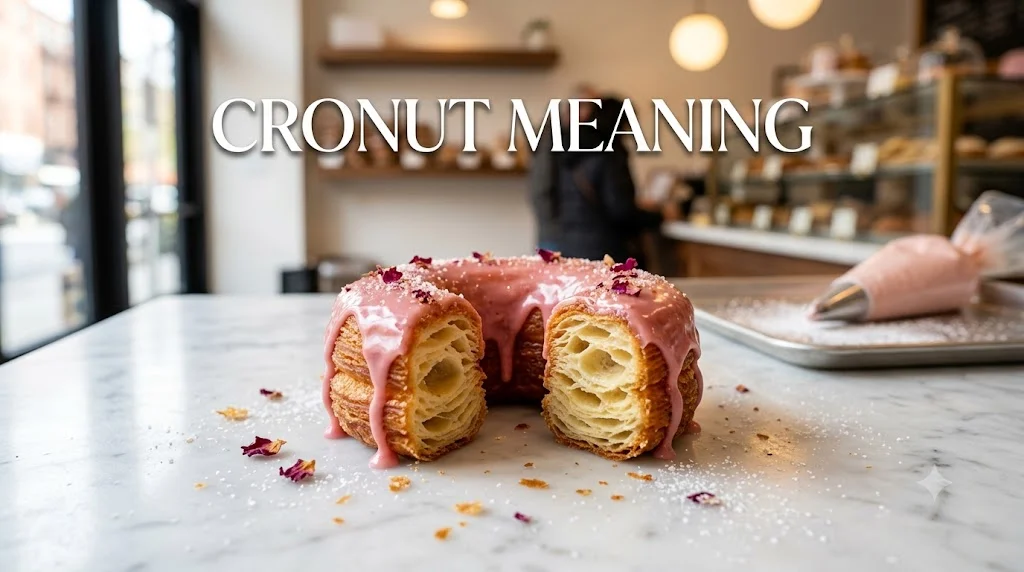
At its simplest, a cronut is a trademarked pastry hybrid that takes the buttery, laminated dough of a croissant and combines it with the shape and frying method of a doughnut. The result is something that belongs to neither category fully. It’s crispier than a doughnut, richer than a croissant, flakier than both, and filled with flavored cream that changes every single month.
The word itself is a portmanteau. Take “croi” from croissant, combine it with “nut” from doughnut, and you get cronut. Short, catchy, instantly understandable. It’s one of those names that explains itself the moment you hear it.
But here’s something most people don’t know: Cronut with a capital C is a registered trademark. Chef Dominique Ansel owns the name in the United States. That means no other bakery can legally sell something called a “Cronut.” Imitators have to call their versions things like “doughssant,” “croughnut,” or simply “croissant doughnut.” None of those names have stuck the way Cronut has, which tells you everything about how perfectly that name was crafted.
In the most practical terms, here’s what the cronut meaning breaks down to:
| Term | Meaning |
|---|---|
| Cronut | A fried, laminated pastry shaped like a doughnut with croissant-style layers |
| Laminated dough | Dough folded repeatedly with butter to create distinct, flaky layers |
| Trademark | The name “Cronut” is legally owned by Dominique Ansel |
| Origin | Dominique Ansel Bakery, New York City, May 2013 |
| Texture | Crispy outside, soft and layered inside, cream-filled center |
Think of it this way. If a croissant and a doughnut had a child and that child went to culinary school in Paris, it would be a cronut.
The Cronut Origin Story: Who Invented It and When
Every great invention has an origin story. The cronut’s is surprisingly human.
Dominique Ansel is a French-born pastry chef who grew up in a working-class family in Beauvais, France. He trained in France, worked his way up through some of the most demanding professional kitchens in Europe, and eventually landed in New York City where he worked as the executive pastry chef at Daniel, one of the most celebrated French restaurants in America.
May 10, 2013. That’s the date the cronut launched publicly.
The first batch sold out in minutes. The next day, longer lines. Within a week, the story had been picked up by food blogs, then by major newspapers, then by television. It spread like nothing in pastry history had spread before.
Here are some facts from those early days that still feel almost unbelievable:
- The first batch each morning was limited to 250 cronuts
- People began lining up as early as 5 a.m. to secure one
- Black market resellers were flipping cronuts for $40 to $100 each
- Concierge services at five-star hotels were offering cronut acquisition as a premium service
- Time Magazine named the cronut one of the 25 Best Inventions of 2013
- Within weeks, copycat versions appeared in bakeries across Japan, Australia, the UK, France, and Brazil
Cronut Ingredients: What Is a Cronut Actually Made Of?
Here’s where it gets fascinating from a baking perspective.
The cronut meaning goes much deeper than “fried croissant dough.” That description is technically in the right neighborhood but completely misses the complexity of what’s actually involved. Let’s break it down ingredient by ingredient and process by process.
The Foundation: Laminated Dough
Everything starts with laminated dough. This is the same type of dough used in croissants, pains au chocolat, and Danish pastries. The process involves layering butter into dough through a series of precise folds and chills. Each fold creates new layers. The end result, after dozens of folds, is dough with hundreds of thin alternating layers of butter and pastry.
When this dough is exposed to high heat, two things happen simultaneously. The water in the butter converts to steam, pushing the layers apart and creating that signature flakiness. And the butter itself fries the dough from within, creating a rich, golden texture you simply cannot achieve any other way.
The Frying Medium: Grapeseed Oil
Most doughnuts are fried in generic vegetable oil or palm oil. Ansel uses grapeseed oil specifically. Why does that matter? Grapeseed oil has a high smoke point and a very neutral flavor. It doesn’t compete with the butteriness of the laminated dough. It fries clean and lets the dough’s natural richness come through without any greasy aftertaste.
This is one of those small details that separates a thoughtfully engineered food product from a quick imitation.
The Filling: Flavored Cream
After frying, the cronut gets filled. This isn’t done by splitting it open like a doughnut. A piping bag with a long, thin nozzle gets inserted directly into the layers, and cream is injected from multiple angles so every bite has filling. The flavor of that cream changes every single month at Dominique Ansel Bakery.
The Glaze and Finish
While the cronut is still warm from the fryer, it gets glazed. The glaze is also flavor-coordinated with the filling. On top of that, the cronut often gets rolled in a flavored sugar. So you’ve got three distinct flavor components: the glaze, the sugar coating, and the injected cream. All three are thoughtfully matched.
Here’s a clean breakdown of the full component structure:
| Component | Description | Why It Matters |
|---|---|---|
| Laminated butter dough | Multi-layered croissant-style dough | Creates the signature flaky texture |
| Grapeseed oil (for frying) | High smoke point, neutral flavor | Clean fry, no greasiness |
| Cream filling | Injected after frying, flavor changes monthly | Rich interior, layered with each bite |
| Glaze | Applied warm, flavor-matched | Glossy exterior, adds sweetness |
| Sugar coating | Rolled on immediately after frying | Caramelizes on the surface |
| Seasonal garnish | Varies by month | Visual appeal, flavor accent |
How Long Does It Actually Take to Make?
This is the detail that stops most people cold. Making a true cronut takes approximately three days.
The laminated dough can’t be rushed. The butter needs to stay cold between folds or it melts into the dough instead of layering through it. Multiple resting and chilling periods are non-negotiable. Then the shaped cronuts need to proof (rise) before frying. The cream filling, glaze, and sugar coating are prepared separately and applied in a specific order at specific temperatures.
You’re not making a doughnut. You’re running a small manufacturing operation.
Cronut vs Donut: How Are They Actually Different?
People often assume a cronut is just a fancy doughnut. It isn’t. The differences go all the way down to the structure of the dough itself.
A standard yeast doughnut uses simple leavened dough. It’s soft, uniform, pillowy. It takes a few hours from start to finish. A cake doughnut uses even simpler batter. Neither involves lamination, extended chilling, or multi-day preparation.
Here’s how the two compare directly:
| Feature | Cronut | Regular Doughnut |
|---|---|---|
| Dough type | Laminated (layered butter dough) | Yeasted or cake batter |
| Texture | Flaky, layered, crispy exterior | Soft, uniform, chewy throughout |
| Frying oil | Grapeseed oil | Vegetable or palm oil |
| Prep time | Approximately 3 days | 2 to 4 hours |
| Filling method | Injected through layers via piping | Split open or hole-based |
| Flavor complexity | Multi-layered, buttery, rich | Straightforward, sweet |
| Price range | $7 to $8 or more per piece | $1 to $3 per piece |
| Shelf life after frying | Best within hours | Good for a full day |
The most important distinction is probably the texture. Bite into a doughnut and you get consistent softness all the way through. Bite into a cronut and you feel the crisp shatter of the outer layers first, then a flaky middle zone, then a cream-filled core. It’s genuinely three different textures in a single bite, which is unlike anything else in pastry.
Another key difference: a doughnut forgives inconsistency. A cronut does not. If the butter melts at the wrong stage, the layers collapse. If the oil isn’t at the right temperature, the dough absorbs grease instead of frying cleanly. Every variable matters, which is precisely why you can’t just bang these out at scale.
Cronut vs Croissant: Same Dough, Completely Different Outcome
If the cronut uses croissant dough, why doesn’t it taste like a croissant? Great question. The answer is the frying.
Baking a croissant creates a golden, flaky exterior through convective oven heat. The inside stays relatively airy and hollow. Frying a cronut creates something structurally different. The direct oil contact creates a much crispier, more defined exterior crust. The inside layers stay distinct and moist in a different way than a baked croissant would be. And of course, the cream filling changes the eating experience entirely.
| Feature | Cronut | Croissant |
|---|---|---|
| Base dough | Laminated butter dough | Laminated butter dough |
| Cooking method | Fried in grapeseed oil | Baked in oven |
| Shape | Round, ring (doughnut-shaped) | Curved crescent |
| Exterior | Crispy, golden-fried crust | Flaky, slightly dry baked crust |
| Interior | Cream-filled, distinct layers | Airy, hollow or lightly structured |
| Eating occasion | Special treat, dessert | Everyday breakfast staple |
| Preparation result | Rich, indulgent, one-of-a-kind | Classic, familiar, comforting |
They share a starting point and diverge completely after that. It’s a bit like how bourbon and French cognac are both distilled spirits, but nobody would confuse one for the other. Same category, entirely different expression.
Why Is It Called a Cronut? The Name Explained
The naming of the cronut is actually a small masterclass in branding, even if Ansel didn’t consciously think of it that way.
Croissant + doughnut = cronut. Strip the front of one word, strip the back of another, smash them together. The result is short (two syllables), instantly communicates exactly what the thing is, and sounds vaguely European in a way that adds a tiny bit of prestige. It’s not trying too hard. It’s not overly cute. It just works.
Compare it to what imitators came up with:
- Doughssant
- Croughnut
- Croissonut
- Croissant doughnut (boring, descriptive, forgettable)
None of those land. “Cronut” is the only one you remember after hearing it once.
The trademark filing happened fast. Ansel moved quickly to protect the name after the initial wave of attention. As a result, every bakery in the world that makes this type of pastry has to use a different name. The cronut trademark is one of the more unusual trademark victories in food history, because the product and the name are so tightly fused that the trademark essentially monopolizes the concept’s identity.
The Cronut’s Rise to Fame: Understanding Why It Went Viral
The cronut launched in May 2013. Let’s think about what that moment looked like in terms of media and culture.
Instagram had launched in 2010 and was growing at an extraordinary rate. Food photography had become a serious cultural activity. People weren’t just eating interesting food; they were documenting it. A product like the cronut, with its photogenic layers and glossy glaze, was tailor-made for that environment.
But virality isn’t automatic. Plenty of beautiful food exists and never trends. The cronut hit because of a combination of factors that almost never align this perfectly.
The viral formula that made cronuts famous:
| Factor | How the Cronut Used It |
|---|---|
| Genuine novelty | Nothing like it existed before. Not even close. |
| Visual appeal | Flaky layers, glaze, cream — it photographs beautifully from every angle |
| Scarcity | 250 per day maximum. Lines ran out. People left disappointed. |
| Story | A French chef in New York invents something new. Classic narrative. |
| Social proof | Celebrity chefs, food writers, and celebrities all weighed in publicly |
| Media timing | Perfect overlap with food blog explosion and Instagram growth |
| Sustained mystery | Monthly flavor changes meant there was always a new reason to return |
Celebrity chefs took notice. Food critics who usually covered Michelin-starred restaurants wrote about this $5 pastry. The feedback loop was self-sustaining.
Time Magazine’s Invention of the Year recognition in 2013 gave the cronut a legitimacy that separated it from other food trends. It wasn’t just trendy. It was recognized as a genuine innovation. That distinction matters.
Cronut Flavor Varieties: The Genius of Monthly Rotation
Here’s something Dominique Ansel does that most food businesses never attempt. He changes the cronut flavor every single month. The flavor change isn’t cosmetic, either. The cream filling changes. The glaze changes. The sugar coating changes. All three components shift together to create a completely new flavor profile.
This is brilliant for several reasons.
First, it means there’s always something new to report on. Food journalists and bloggers don’t need a new angle on the cronut because Ansel provides one every thirty days. The cronut has been in continuous news rotation since 2013 largely because of this mechanism.
Second, it creates urgency. Miss this month’s flavor and it’s gone forever. You can’t come back next year and get the same one. That FOMO (fear of missing out) keeps demand consistently high.
Third, it keeps the product from going stale in the cultural imagination. Most food trends peak and fade. The cronut has stayed relevant because it reinvents itself monthly.
Some of the flavors that have appeared over the years include:
- Rose vanilla with lychee cream
- Blackberry cheesecake
- Salted caramel with apple
- Champagne and raspberry
- Chocolate with hazelnut praline
- Passion fruit and mango
- Crème brûlée
- Pistachio with cherry blossom
- Caramel apple with cinnamon glaze
- Hibiscus with coconut cream
Each of these represents a separate product development project. Ansel’s team has to develop and test the new filling, adjust the glaze, calibrate the sugar coating, and ensure the whole thing works structurally when injected into the cronut’s layers. That’s not a small operation. It reflects a serious, ongoing commitment to the product more than a decade after launch.
Where Can You Get an Authentic Cronut?
Let’s be precise here, because this matters.
The only place in the world where you can purchase a trademarked, authentic Cronut is at a Dominique Ansel Bakery location.
As of 2024, Dominique Ansel Bakery operates at the following locations:
| Location | Address |
|---|---|
| New York City (Original) | 189 Spring St, New York, NY 10012 |
| Las Vegas | Inside The Venetian Resort |
| London | 17-21 Elizabeth St, Belgravia, London |
The New York location is where it all started and remains the most iconic. The daily production limit is still enforced. Lines still form early. Pre-ordering online is sometimes available, but availability is limited and sells out fast.
A few practical tips if you’re planning a visit:
- Arrive before 8 a.m. if you want to guarantee a cronut. The bakery opens at 8 a.m. on weekdays and 9 a.m. on weekends, but the line fills up fast.
- Each person can buy a maximum of two cronuts. This limit has been in place since the beginning and is firmly enforced.
- Check the website for the current month’s flavor before you go. Dominique Ansel Bakery announces each month’s flavor on their official website and social media channels.
- Expect to pay around $7 to $8 per cronut at the New York location. Prices may vary slightly by location.
Outside of these official locations, hundreds of bakeries worldwide sell their own versions under alternative names. Many of them are excellent. But they aren’t Cronuts in the trademarked sense, and the recipe, technique, and quality will vary significantly.
Can You Make a Cronut at Home? A Realistic Assessment
Yes. You can make a cronut at home. Should you expect it to taste like Dominique Ansel’s original on your first attempt? No. But can you make something genuinely delicious that captures the spirit of the cronut? Absolutely.
Here’s what you’re working with:
Option A: Full Scratch Laminated Dough
This is the authentic approach. It involves making laminated dough from scratch, which requires:
- Day 1: Mix the base dough, refrigerate overnight
- Day 2: Begin the lamination process (folding butter into dough in stages with chilling between each fold), shape the cronuts, refrigerate overnight
- Day 3: Final proof, fry, fill, glaze, and serve
The frying temperature matters enormously. 375°F (190°C) is the standard target. Too low and the dough absorbs oil. Too high and the exterior burns before the interior cooks through.
Recommended home process (simplified):
- Prepare or purchase laminated croissant dough
- Roll to approximately ¾ inch thickness
- Cut rings using a 3-inch cutter and a 1-inch cutter for the hole
- Allow shaped cronuts to proof at room temperature for 60 to 90 minutes
- Fry in grapeseed or canola oil at 375°F for approximately 90 seconds per side
- Drain on a wire rack (not paper towels, which trap steam)
- While still warm, roll in flavored sugar
- Inject cream filling using a piping bag with a long, thin tip
- Glaze the top immediately before serving
Option B: Puff Pastry Shortcut
Store-bought puff pastry is laminated dough that’s already been prepared. It’s not identical to Ansel’s custom dough, but it’s a workable shortcut that produces genuinely tasty results. Most home bakers use this approach.
The result won’t be identical to the original, but it’ll be recognizably a cronut-style pastry. The layers will be thinner, the butteriness slightly less pronounced, and the texture a little less dramatic. But fill it with vanilla cream and glaze it properly and it’s a treat worth making.
Key Tips for Home Bakers:
- Use European-style butter with higher fat content for the lamination. Standard American butter works but produces less dramatic layers.
- Don’t skip the chilling steps. Warm butter = no layers. The lamination only works if the butter stays solid between folds.
- Grapeseed oil is worth buying even for home use. The neutral flavor makes a real difference.
- Eat cronuts the same day you make them. They don’t keep. The crispy exterior becomes soggy within hours, especially after filling.
The Cronut’s Lasting Impact on Food Culture
The cronut’s meaning in the broader food world goes well beyond its ingredients or even its flavor.
When it launched in 2013, the food industry watched something unprecedented happen. A single pastry item, from a single small bakery, generated global media coverage, sustained lines of hundreds of people daily, created a secondary resale market, and inspired imitations on six continents, all without a single dollar spent on advertising.
That had never happened before. Not like that. Not that fast.
The cronut changed how the food industry thinks about product launches. It proved that:
- Scarcity is a marketing tool. Limiting quantity doesn’t just manage costs. It generates desire.
- Novelty has value beyond taste. People weren’t just buying a pastry. They were buying a story, an experience, a social media moment.
- A single chef can compete with global brands. Dominique Ansel Bakery is a small operation. It went toe-to-toe for media attention with companies worth billions, and won.
- Food photography changes everything. The cronut was visually designed, whether intentionally or not, for the camera. Its cross-section, its glaze, its layers were all things that looked extraordinary in a photograph.
None of that would have happened on the same timeline without the cronut. It was the catalyst for everything that followed in his career.
Cronut Meaning in Simple Words: A Summary for Beginners
If you’ve made it this far and you want the simplest possible summary, here it is.
A cronut is:
- A pastry shaped like a doughnut
- Made from croissant-style laminated (layered butter) dough
- Fried in oil instead of baked
- Filled with flavored cream, glazed, and coated in flavored sugar
- Invented by Dominique Ansel in New York City in May 2013
- A trademarked product — only Dominique Ansel Bakery can sell an official Cronut
- One of the most culturally significant food products of the 21st century
It takes three days to make. It costs about $7 to $8. And people have been waking up before dawn for over a decade to get one.
That’s the cronut meaning in full.
FAQs
What does cronut mean in baking?
In baking, cronut refers to a pastry that uses croissant-style laminated dough but is shaped and cooked like a doughnut.
What is a cronut made of?
A cronut is made from laminated butter dough (the same foundational dough as a croissant), fried in grapeseed oil. After frying, it’s filled with a flavored cream injected through the layers, rolled in flavored sugar while still warm, and finished with a glaze that matches the flavor profile of the filling.
Who invented the cronut?
Dominique Ansel invented the cronut. He’s a French-born pastry chef who trained in France and worked in New York before opening Dominique Ansel Bakery in 2011.
Why are cronuts so popular?
Cronuts became popular because they were genuinely new, photographed beautifully, were available only in very limited quantities, and launched at exactly the moment when food photography and social media were reaching mainstream adoption.
Is a cronut a croissant or a donut?
It’s neither one completely and both at the same time. It uses croissant-style dough but is made using doughnut techniques.
Can I get a cronut outside New York?
Official Cronuts (with a capital C) are only available at Dominique Ansel Bakery locations in New York City, Las Vegas, and London.
How long does it take to make a cronut?
Making an authentic cronut takes approximately three days. The laminated dough requires extended chilling between folds, and the shaped pastries need a proofing period before frying.
What does a cronut taste like?
Biting into a cronut gives you multiple textures and flavors in sequence. The exterior is crispy from frying. The middle layers are flaky, rich, and buttery from the laminated dough.
Conclusion:
More than a decade after it first appeared in a small SoHo bakery, the cronut still draws lines. It still generates monthly food press. It still sits on wishlists of food-obsessed travelers planning New York trips.
Most food trends burn bright and disappear. The cronut hasn’t. And the reason comes back to what the cronut meaning actually represents at its core. It isn’t just a clever combination of two existing pastries. It’s evidence that genuine innovation, made with real care and technical mastery, tends to outlast everything built purely for attention.
Dominique Ansel wasn’t trying to go viral. He was trying to make something extraordinary. That distinction, between making something for the crowd and making something for the craft, is what separates a lasting creation from a passing trend.
Next time you see a cronut, or its inspired descendants, you’ll know exactly what you’re looking at. Not just a pastry. A moment in food history that changed how the world thinks about what a bakery can do.
Discover More Related Articles:
- Redundant Meaning | Work, Writing & Communication In 2026
- Nonse Meaning | Slang, Technology & Everyday Language In 2026