

Definition
Ciao is an informal Italian greeting used to say “hello” or “goodbye.” It is commonly used among friends, family members, and people who know each other well. The word originated in Italy and has become popular worldwide as a friendly and casual way to greet or part from someone.
Most languages need two separate words to cover a hello and a goodbye. Italian looked at that arrangement and decided one would do just fine. That word is ciao four letters that have somehow conquered the globe, slipped into dozens of languages, and become one of the most recognized words on the planet.
But here’s what most people don’t realize: ciao isn’t just a casual swap for “hi” or “bye.” It carries rules, cultural weight, and a surprisingly deep history. Use it correctly and you come across as warm and worldly. Use it in the wrong setting and you might accidentally insult an Italian professor.
This guide covers everything. The meaning, the pronunciation, the origin, the cultural nuance, when to use it, when to absolutely avoid it, and how it compares to every other Italian greeting worth knowing. Whether you’re preparing for a trip to Italy, picking up the language from scratch, or just genuinely curious, you’ll leave here knowing ciao better than most native English speakers ever will.
What Does Ciao Mean? The Direct Answer
Let’s get straight to it. Ciao means both “hello” and “goodbye.” One word. Two opposite functions. Context handles the rest.
When someone walks into a room and says ciao, they’re saying hello. When they turn to leave and say ciao, they’re saying goodbye. It’s the same word doing completely different jobs depending on the moment, and Italians navigate this without a second thought.
Here’s a simple way to think about it:
| Situation | Ciao Translates As |
|---|---|
| Friend walks through the door | Hello / Hey |
| Friend walks out | Bye / See ya |
| Opening a text message | Hey / Hi |
| Ending a text message | Bye / Later |
| Said twice (“ciao ciao”) | Warm, affectionate farewell |
| Group setting, entering | Hey everyone |
The rule underneath all of this is the most important thing to memorize before anything else:
Ciao is strictly informal. Always.
It belongs with friends, family, peers, and people you already know well. It does not belong in a business meeting, at a doctor’s reception desk, or the first time you speak to someone significantly older than you. That informality is baked into the word’s DNA and Italians feel it immediately when it’s misused.
English speakers often find the hello/goodbye duality confusing at first. Interestingly enough, Italians find that confusion equally puzzling. To them, the context makes it completely obvious. It’s a bit like how “see you” in English sort of implies a farewell without anyone being confused by the verb “see.”
Ciao Definition: What the Dictionaries Say
Ciao isn’t just Italian anymore. It’s officially an English word too.
Merriam-Webster lists ciao as an English interjection used to express greeting or farewell. The Oxford English Dictionary includes it as well, tracing its usage in English-language writing back to the early 20th century. That’s not a short tenure. Ciao has been part of the English lexicon for over a hundred years, which is longer than most people assume.
Linguistically, ciao belongs to a category called a bidirectional salutation a single expression that functions as both a greeting and a parting phrase. It’s a fairly rare category. Most languages keep those functions separated. A few others exist around the world, but none have traveled quite as far or as fast as ciao.
The technical term for what ciao is in English is a loanword a word borrowed from another language and adopted with minimal or no modification. What makes ciao special among loanwords is that it wasn’t just borrowed by English. It was borrowed by German, French, Portuguese, Spanish, Albanian, Romanian, Turkish, and several others. That kind of cross-linguistic adoption is unusual and speaks to the word’s remarkable cultural reach.
There’s a difference worth noting between a loanword and a borrowed phrase. A borrowed phrase is still felt as “foreign” by speakers s they’re quoting from another language. A loanword has been absorbed. People use it without thinking of it as foreign at all. Ciao has crossed that line in English and in many other languages. It doesn’t feel like you’re speaking Italian when you say it. It just feels like language.
The Origin of Ciao: A Surprisingly Humble History
Here’s the part that shocks most people. Ciao originally meant “I am your slave.”
Not metaphorically. Literally. The word traces back to the Venetian dialect phrase “s-ciào vostro” which translates directly as “I am your slave” or “your servant.” It was a phrase used by servants and people of lower social standing as an extremely humble form of greeting, essentially saying to the person they addressed: you have power over me, I submit to your authority.
Here’s how it unfolded across time:
| Period | Development |
|---|---|
| Medieval Venice | “S-ciào vostro” used as a servant’s formal submission phrase |
| 17th to 18th century | Shortened to “sciào” in everyday Venetian speech |
| Early 19th century | Began spreading beyond Venice into northern Italy |
| Late 19th century | Adopted across Italy as a casual everyday greeting |
| Early 20th century | Italian immigrants carried it to the Americas and Australia |
| Mid to late 20th century | Global spread through cinema, fashion, and pop culture |
This kind of etymological transformation isn’t unique to ciao. Think about what happened to other everyday words:
“Goodbye” came from the phrase “God be with you,” which contracted and lost its religious meaning over centuries of casual use. “Hello” may derive from an Old High German hailing call used to get a ferryman’s attention. Humble, functional, or even servile origins are surprisingly common in the words humans use most often.
Ciao Pronunciation: Get It Right the First Time
Let’s address the elephant in the room. A lot of English speakers look at the word “ciao” and try to sound it out phonetically. The result is usually something like “see-ow” or “chee-ow.” Both are wrong.
Ciao is pronounced CHOW. That’s it. One syllable. It rhymes perfectly with “now,” “wow,” “bow,” and “chow” as in food.
For those who prefer technical notation:
IPA transcription: /tʃaʊ/
Breaking that down simply: the “ci” combination in Italian produces a “ch” sound (like “cheese” or “child”), and “ao” together produces the “ow” sound as in “now.” Put them together and you get CHOW.
The easiest memory trick: think of the phrase “chow time” or “chow down.” The opening sound is identical. Say “chow” and you’ve nailed the pronunciation of ciao.
Common mispronunciations and what causes them:
| Mispronunciation | Why It Happens | Correction |
|---|---|---|
| “See-ow” | Reading “ci” as English “see” | In Italian, “ci” = “ch” sound |
| “Chee-ow” | Splitting the vowels incorrectly | “ao” is one sound: “ow” |
| “Chay-oh” | Guessing at the vowels | Just say CHOW |
| “Kay-oh” | Total phonetic guesswork | Rhymes with “wow” |
Does the pronunciation vary across Italy? Marginally. There are regional accents across the country and some tonal differences between northern and southern Italian speech. But the core pronunciation of ciao stays consistent everywhere. A Milanese person and a Sicilian person say it recognizably the same way.
If you want to hear it from a native speaker’s mouth before your trip, the website Forvo is excellent. It features recordings of actual native speakers pronouncing words in their natural accent. Google Translate’s audio function also works reliably for ciao specifically.
How Italians Actually Use Ciao: Real Situations, Real Rules
Knowing what ciao means and knowing how to use it correctly are two different things. Italians don’t think consciously about the rules they absorbed them growing up. As a learner or traveler, you need to understand them explicitly.
Ciao is a social signal first, a word second. When you say ciao to someone in Italy, you’re not just greeting them. You’re telling them: we’re on the same level, I know you, we have a familiar relationship. That’s why using it with the wrong person feels off to Italians. It’s not about vocabulary. It’s about social positioning.
Who you say ciao to:
- Close friends, always
- Family members, always
- Colleagues you’ve worked with long enough to build genuine rapport
- Classmates and peers of similar age
- Children (the age difference doesn’t matter here adults always use ciao with kids)
- Shopkeepers, waitstaff, or service workers you visit regularly and know by name
Who you do not say ciao to:
- Strangers in a shop, restaurant, or on the street
- Doctors, lawyers, professors, or any professional in a first meeting
- Anyone in an interview, formal meeting, or official context
- Your partner’s parents when you first meet them (use buongiorno and let them signal the shift)
Real conversation examples show the word in natural action:
As hello:
“Ciao Marco! Quanto tempo che non ci vediamo!” “Hey Marco! It’s been so long since we’ve seen each other!”
As goodbye:
“Ok, ciao! Ci sentiamo domani.” “Ok, bye! We’ll talk tomorrow.”
The doubled version:
“Ciao ciao! A presto!” “Bye bye! See you soon!”
Group greeting:
“Ciao a tutti! Come va?” “Hey everyone! How’s it going?”
The doubled “ciao ciao” deserves its own mention because it’s not just repetition for emphasis. It signals genuine warmth and affection. When an Italian says “ciao ciao” rather than a single “ciao,” they’re expressing fondness. It’s roughly equivalent to “bye bye” in English slightly softer, slightly more endearing than a single goodbye.
Reading the room is everything. Italians develop an instinct for when ciao fits, and that instinct comes from understanding the social relationship involved, not the time of day or setting alone. A formal restaurant doesn’t automatically make ciao wrong if you’re meeting a close friend there. A casual coffee bar doesn’t automatically make ciao right if you’re greeting the owner for the very first time.
Ciao in Text Messages and Digital Communication
Does ciao behave differently in texts and online messages than it does in speech? Not really. The informal register transfers perfectly to digital communication, which makes sense because texting is itself an informal medium.
Italians use ciao in messaging the same way they use it in person:
Opening a conversation:
“Ciao! Sei libera stasera?” “Hey! Are you free tonight?”
Closing a conversation:
“Ok dai, ciao!” “Alright then, bye!”
As a quick standalone response:
Sending “Ciao!” alone at the end of a thread functions as a friendly sign-off, equivalent to “later” or “talk soon” in English.
Outside Italy, ciao has caught on in digital communication among non-Italian speakers for a few interesting reasons. First, it feels warmer than a plain “bye.” Second, it carries a certain effortless cosmopolitan quality. Third, it’s short perfectly suited to the economy of text messages. You’ll see it regularly in English-language social media captions, newsletter sign-offs, and even corporate emails trying to project a friendly tone.
One small caution: in written professional communication, ciao can land as flippant or overly casual even when the sender means it affectionately. If you’re emailing someone you don’t know well, stick to conventional English closings. Save ciao for the people and contexts where the informality is the whole point.
Ciao vs. Every Other Italian Greeting: The Full Breakdown
This is the section travelers and Italian learners need most. Knowing ciao is step one. Knowing when NOT to use ciao and what to say instead is what actually gets you through daily life in Italy without accidentally offending anyone.
Here’s every major Italian greeting compared side by side:
| Word | Meaning | Formality | Best Used When |
|---|---|---|---|
| Ciao | Hello / Goodbye | Informal | Friends, family, peers you know well |
| Buongiorno | Good morning / Good day | Formal | Strangers, shops, offices (daytime) |
| Buonasera | Good evening | Formal | Strangers, restaurants, events (evening) |
| Salve | Hello | Semi-formal | Safe default with unfamiliar people |
| Arrivederci | Goodbye | Formal | Professional farewells, strangers |
| A presto | See you soon | Informal | Friends you expect to see shortly |
| A dopo | See you later | Informal | Same-day farewell |
| Addio | Farewell (final) | Emotional / Formal | Permanent or long-term departures |
| Buonanotte | Good night | Neutral | End of evening, before bed |
Ciao vs. Buongiorno
The difference isn’t about time of day. A lot of English speakers assume buongiorno is just “good morning” and ciao is just “hello” so they use ciao all day and buongiorno only before noon. That’s not how it works.
Buongiorno is the formal daytime greeting and you use it with anyone you don’t know well regardless of the hour. Walk into a pharmacy in the afternoon and say “Buongiorno” even though it’s 4pm. It’s not technically “good morning” in that sense it’s closer to “good day” in British English. The formality level is what matters, not the clock.
Ciao vs. Arrivederci
Both mean goodbye. The difference is entirely about relationship and formality. Ciao as a goodbye is for people you know. Arrivederci is for everyone else. Use arrivederci when leaving a shop, ending a conversation with a stranger, or parting ways after a professional meeting.
There’s also a more emphatic formal version: “ArrivederLa” (capital L) which is extremely polite and used in very formal situations or with elder individuals you want to show deep respect to. Most travelers don’t need this one, but it’s worth knowing it exists.
Ciao vs. Salve
Salve is the unsung hero of Italian greetings for learners and travelers. It occupies the semi-formal middle ground between ciao and buongiorno. You can say salve to someone you’ve just been introduced to, to a stranger you’re about to ask for directions, or to a service worker you haven’t built a relationship with yet.
The practical rule: when you genuinely don’t know whether ciao or buongiorno is appropriate, say salve. You will never be wrong with salve.
When Addio Is Appropriate
Addio is not your everyday farewell. It carries weight. Italians use it for significant, potentially permanent goodbyes when someone emigrates, when you end a relationship, when someone is seriously ill. Using addio to say bye to a friend leaving a dinner party would be genuinely bizarre and slightly alarming. Don’t use addio casually.
Why Ciao Went Global: The Word That Escaped Italy
Ciao didn’t stay in Italy. It traveled. And it traveled further than almost any other word from any Romance language. Today you’ll encounter it in casual speech across Europe, Latin America, and beyond. Understanding why it spread so far says something interesting about language, culture, and human connection.
Italian Immigration
The late 19th and early 20th centuries saw massive Italian emigration, particularly to the United States, Brazil, Argentina, and Australia. Italian communities formed in cities across these countries and brought their language, food, customs, and greetings with them. The communities were large enough and visible enough that the surrounding cultures absorbed elements of Italian life including vocabulary.
Cinema and Pop Culture
Italian cinema had a profound global influence from the 1940s through the 1980s. Neorealist films, Fellini’s masterpieces, and the spaghetti western genre reached enormous international audiences. Italian actors, directors, and the sounds of the Italian language became familiar to people who’d never set foot in Europe. Ciao appeared in subtitles, was spoken on screen, and started sticking in people’s heads.
Fashion and design played a role too. Italian brands became globally aspirational through the second half of the 20th century. The language carried an association with elegance, warmth, and style that made borrowing its words feel desirable rather than foreign.
Where Ciao Lives Today
Here’s where the word landed and what happened to it in different languages:
| Language or Region | Local Form | What It Means There |
|---|---|---|
| German | Tschau or Ciao | Informal goodbye (hello function largely dropped) |
| French | Ciao | Casual goodbye, used widely |
| Brazilian Portuguese | Tchau | Standard informal goodbye nationwide |
| Argentine Spanish | Chau | Everyday casual goodbye |
| Romanian | Ciao | Informal greeting and farewell |
| Albanian | Çao | Used informally, adopted through Italian contact |
| Turkish | Çav or Ciao | Informal goodbye in some urban contexts |
| Greek | Used alongside native greetings | Informal borrowed farewell |
Notice something interesting in that table. In several of these languages, ciao only means goodbye. The hello function was lost in translation. Brazilians say “oi” or “olá” to greet someone but “tchau” to leave. Argentines say “hola” and “chau.” The word was adopted but cut in half.
This makes Italy somewhat unique it’s one of the few places where ciao still carries both directions simultaneously. Elsewhere it became a one-way street.
Ciao and Italian Culture: The Social Layer Beneath the Word
Language and culture are inseparable and ciao is a perfect illustration of that. To understand why ciao matters to Italians, you need to understand something about how Italians relate to each other.
Greetings in Italy are not small talk. In many cultures, saying hello to someone is a reflex, a formality, something you do almost mechanically. In Italy, the way you greet someone communicates information about your relationship, your respect for them, and your social awareness. Choosing the wrong greeting isn’t a minor slip. It registers.
Bella Figura
Italian culture has a concept called “bella figura” which translates roughly as “making a good impression” or “cutting a fine figure.” It applies to appearance, behavior, manners, and speech. Italians take it seriously. Using ciao with someone’s grandmother when you’ve just been introduced violates bella figura not because ciao is rude per se, but because it signals a failure to read the social situation correctly.
Bella figura isn’t about being stiff or formal. It’s about being appropriate. Among friends, bella figura might actually require ciao showing warmth, ease, and genuine familiarity. The concept is about calibrating correctly, not defaulting to formality.
What Ciao Communicates Emotionally
When you say ciao to an Italian and it’s the right word for the moment, it communicates several things at once:
- Recognition: I see you and I know you
- Equality: We’re on the same level, there’s no hierarchy here
- Warmth: I’m glad you’re here or glad we crossed paths
- Familiarity: Our relationship is close enough for this word
That’s a lot of emotional content packed into four letters. It’s why Italians can hear ciao from across a piazza and immediately sense the nature of the relationship between the people involved.
Physical Greetings and Ciao
In Italy, ciao rarely arrives alone. It typically comes paired with physical contact a handshake, a hug, or the famous cheek kiss (or two). The physical greeting matches the verbal one. Close friends get ciao plus a genuine embrace. Acquaintances you’re warming up to might get ciao plus a single cheek kiss. The spoken word and the physical gesture signal the same degree of intimacy.
For travelers, it’s worth knowing that the physical greeting customs vary somewhat by region. Northern Italians tend to be slightly more reserved in physical greetings compared to southern Italians, who are generally more openly demonstrative. The verbal ciao, however, works consistently across the whole country.
Common Mistakes Non-Italians Make With Ciao
Even people who know what ciao means make errors in how they use it. Here are the most common ones and how to avoid them.
Using ciao with strangers in shops and restaurants
This is the most frequent traveler mistake. Walking into a Roman trattoria and greeting the host with “Ciao!” reads as overly familiar at best and mildly rude at worst. Say “Buongiorno” or “Buonasera” depending on the time of day. Save ciao for places where you already have a relationship.
Mispronouncing it and not correcting yourself
“See-ow” happens. Italians will understand you. But making a small effort to say CHOW correctly signals genuine respect for the language and always lands well with locals.
Using “ciao ciao” in written formal contexts
Ending a professional email with “ciao ciao!” reads as flippant and slightly unprofessional in Italian workplace culture. Among close colleagues it might be fine. In any other context, close with “cordiali saluti” (kind regards) or “a presto” at minimum.
Assuming it works across all Romance languages
Spanish speakers don’t use ciao. Neither do French speakers as a hello. If you’re in Madrid, Barcelona, or Paris, defaulting to ciao as a greeting will get you puzzled looks. The word traveled to some Romance-language regions and not others, and its function changed where it did arrive.
Over-relying on ciao as a non-Italian to seem worldly
Using ciao once or twice in a natural way is charming. Peppering every conversation with it when you’re clearly not Italian starts to feel performative. Use it when it fits, not as a fashion statement.
Beginner’s Practical Guide: Using Ciao Correctly From Day One
If you’re just starting to learn Italian or heading to Italy for the first time, here’s the most practical framework possible.
The one rule that covers 90% of situations: If you wouldn’t say “hey” or “bye” in that situation in English, don’t say ciao in Italian. Formality maps reasonably well across both languages in this respect.
When to use ciao and when to use something else:
| Scenario | Use Ciao? | Better Option |
|---|---|---|
| Entering a hotel and greeting the receptionist | No | Buongiorno |
| Saying hi to a fellow traveler your age at a hostel | Yes | Ciao is perfect |
| Leaving a restaurant after your meal | Maybe | Grazie, arrivederci is safer |
| Greeting a local friend | Yes | Ciao, always |
| Meeting your friend’s parents for the first time | No | Buongiorno, let them set the tone |
| Waving to kids playing in the piazza | Yes | Ciao works fine |
| Entering a pharmacy or small shop | No | Buongiorno or Buonasera |
| Parting with a tour guide after a private tour | No | Arrivederci, grazie mille |
Starter sentences worth practicing before your trip:
| English | Italian with Ciao |
|---|---|
| Hey, how are you? | Ciao, come stai? |
| Hi everyone! | Ciao a tutti! |
| Bye, see you later today! | Ciao, a dopo! |
| Hey, are you free tonight? | Ciao, sei libero/a stasera? |
| Bye bye, take care of yourself! | Ciao ciao, stammi bene! |
| Hey, long time no see! | Ciao, quanto tempo! |
| Bye, see you soon! | Ciao, a presto! |
One more thing worth emphasizing for beginners: Salve is your safety net. When you walk into any situation and you genuinely can’t tell whether ciao or buongiorno is appropriate, say salve. It’s warm enough not to feel cold and formal enough not to overstep. Nobody will ever look at you strangely for saying salve. It’s the socially intelligent middle ground.
Ciao Meaning in Text Messages and Modern Slang
Beyond standard usage, ciao has developed a secondary life in digital slang that’s worth understanding separately.
In Italian online culture, ciao functions exactly as it does in speech. But among non-Italian English speakers, ciao in text messages often carries a slightly different tone:
As a sign-off: “Alright I gotta run, ciao!” used affectionately, slightly tongue-in-cheek
As a dismissal: “Ciao!” with an exclamation point at the end of a conversation can sometimes be read as a sharp, final goodbye “we’re done here.” Context and relationship determine which reading applies.
As a style choice: Many people working in creative fields, fashion, food, travel, and media use “ciao” in newsletters, Instagram captions, and email sign-offs as a personality marker. It’s warm without being sentimental and international without being pretentious when used sparingly.
“Ciao for now” is a common English-language hybrid phrase that’s appeared in casual writing for decades. It’s self-aware, slightly playful, and communicates friendliness without any Italian language skill required.
The key with ciao in slang or digital contexts is the same as with all language: read the tone of the exchange and match it. Ciao in a warm, casual conversation lands as charming. Ciao dropped into a tense exchange reads as dismissive.
Quick Reference Summary Card
For anyone who wants the essentials at a glance:
| Feature | Detail |
|---|---|
| Meaning | Hello AND Goodbye |
| Pronunciation | CHOW (rhymes with “now”) |
| IPA | /tʃaʊ/ |
| Origin | Venetian “s-ciào vostro” = “I am your slave” |
| Register | Informal only |
| Use with | Friends, family, peers you know well |
| Don’t use with | Strangers, authority figures, formal settings |
| Formal hello alternatives | Buongiorno, Buonasera, Salve |
| Formal goodbye alternatives | Arrivederci |
| Used outside Italy | Germany, France, Brazil, Argentina, and many more |
| In English dictionaries | Yes, fully recognized loanword |
| Doubled form | “Ciao ciao” = warm, affectionate farewell |
Ciao: Four Letters That Carry a Whole Culture
It’s worth pausing to appreciate what an unusual word ciao really is. It began in medieval Venice as an expression of submission and servitude. Centuries of daily use stripped away its original meaning, softened it, warmed it, and turned it into one of the friendliest words in any language. Then it spread carried by immigrants, film directors, fashion houses, and pop culture until it landed in dozens of languages and became genuinely global.
Today ciao is what linguists call a “false friend” in one sense: it looks simple but it carries hidden complexity. The hello/goodbye duality is the obvious part. The formality rules, the cultural context, the regional nuances, and the emotional signal it sends those are the layers underneath that most people never explore.
Knowing all of that doesn’t make ciao harder to use. It makes it easier because you understand what you’re actually communicating when you say it. You’re not just producing a sound. You’re signaling: I know you. We’re equals. I’m glad you’re here or glad we crossed paths.
That’s a remarkable amount of warmth for four letters to carry.
Start with ciao. Use it correctly and use it with confidence. Let it open the door to a language that rewards every learner with richness, expressiveness, and a culture that puts genuine human connection at the center of daily life.
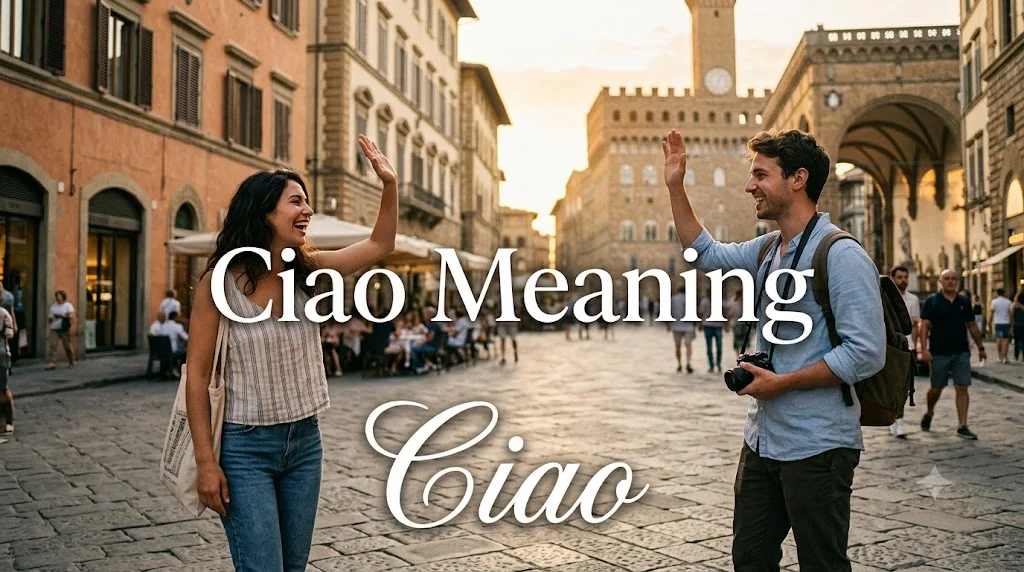
And when you finally find yourself in a sunlit Italian piazza, waving to a friend across the square — you’ll know exactly what to say.
FAQs
Is ciao hello or goodbye?
Both. Ciao functions as hello when someone arrives and goodbye when someone leaves. The same word handles both directions and context makes the meaning clear every time.
Can non-Italians use ciao?
Absolutely. Ciao is used informally across Europe, Latin America, and in casual English-language contexts worldwide. Nobody owns it at this point. Use it naturally and you’ll fit right in.
Why do Italians say “ciao ciao” instead of just “ciao”?
Doubling the word adds warmth and affection. “Ciao ciao” is slightly more tender than a single “ciao” similar to how “bye bye” in English sounds softer and more affectionate than “bye.”
Is saying ciao rude?
Not in itself. But using it in a formal setting or with someone you don’t know well can come across as presumptuous or overly familiar.
Is ciao in the English dictionary?
Yes. Both Merriam-Webster and the Oxford English Dictionary include ciao as an official English interjection. It’s a fully naturalized loanword, not a foreign term.
What’s the difference between ciao and arrivederci?
The difference is entirely about formality and relationship. Ciao as a goodbye is for people you know well. Arrivederci is the formal farewell used with strangers, professionals, and anyone you want to address respectfully.
What’s the difference between ciao and buongiorno?
Ciao is informal and can be used any time of day with people you know. Buongiorno is formal and used as a daytime greeting with strangers and in professional contexts.
When did ciao enter the English language?
English-language texts began using ciao in the early 20th century, corresponding with the wave of Italian immigration to English-speaking countries and the growing international influence of Italian culture.
Conclusion
The word “ciao“ is a popular Italian greeting used to say both hello and goodbye in informal situations. It is widely recognized around the world and is often associated with friendliness, warmth, and casual conversation.
Understanding the meaning of ciao helps you communicate more naturally when speaking with Italian speakers or encountering Italian culture. While it is suitable for friends, family, and familiar acquaintances, more formal greetings may be preferred in professional settings.
Whether you hear it in travel, movies, music, or everyday conversations, ciao remains one of the most iconic and versatile words in the Italian language. Its simple yet welcoming nature has made it a global expression that continues to be used and appreciated by millions of people.
Discover More Related Articles: