

Definition
The wife of a reigning king who holds the title of queen by virtue of marriage, not by royal inheritance or sovereign right.
When most people picture a queen, they picture power. A crown. A throne. Someone who rules.
But monarchy doesn’t work that simply. There’s more than one type of queen and the differences between them are enormous. One type rules a country. Another type simply married someone who does.
That second type? She’s called a queen consort.
It’s one of the most misunderstood titles in the entire royal lexicon. People mix it up with queen regnant, queen mother, and queen dowager constantly. Even news anchors stumbled over it when Camilla was officially named Queen Consort in September 2022.
So let’s fix that. This guide breaks down the queen consort meaning in plain English, explores what the role actually involves, walks through the history of famous queen consorts, and explains every key distinction you need to know.
By the time you finish reading, you’ll understand it better than most people ever will.
What Does Queen Consort Mean? The Clear, Simple
Let’s start with the word “consort” itself because that’s where the confusion begins.
“Consort” comes from the Latin consortem, meaning partner or sharer. In a royal context, a consort is simply the spouse of a reigning monarch. They share the monarch’s life. They don’t share the monarch’s throne.
So a queen consort is a woman who holds the title of queen because she is married to a reigning king. She didn’t inherit the crown. . She married into it.
That last part matters enormously. “By right” is the legal and constitutional distinction that separates a queen consort from a queen regnant. A queen regnant rules in her own right. A queen consort holds her title entirely through her husband.
The moment the king dies or abdicates, her title changes. She doesn’t step into his role. She steps aside.
Quick pronunciation guide: Queen Consort is pronounced kwēn KON-sort. The stress falls on the first syllable of “consort.”
Why Do We Even Need a Special Title?
Good question. If she’s called a queen, why not just call her “the queen”?
Because monarchy runs on precision. Titles communicate rank, authority, and legal standing. Calling someone “queen” without qualification implies sovereign power. Adding “consort” makes it instantly clear that she holds an honorific position, not a constitutional one.
It protects the clarity of succession. It prevents any ambiguity about who actually holds power. And historically, that ambiguity could start wars.
Queen Consort vs Queen: What’s Actually the Difference?
This is the heart of the matter. Let’s lay it out clearly.
There are four distinct female royal titles that get confused with each other constantly. Here’s how each one works:
| Title | How She Got It | Does She Rule? | Source of Power | Example |
|---|---|---|---|---|
| Queen Regnant | Inherited or was elected to the throne | Yes | Hereditary succession | Elizabeth II, Mary I |
| Queen Consort | Married the reigning king | No | Royal marriage | Camilla, Queen Alexandra |
| Queen Dowager | Was queen consort; her husband the king has died | No | Widowhood | Catherine Parr (briefly) |
| Queen Mother | Is the queen dowager whose child is now the monarch | No | Widowhood and lineage | Queen Elizabeth The Queen Mother |
The single most important distinction: a queen consort has no sovereign authority. She cannot sign legislation. She cannot open Parliament. In constitutional terms, she is not part of the governing apparatus at all.
A queen regnant, on the other hand, does all of these things. She is the head of state. She is the sovereign. The country is hers to govern (within constitutional limits).
Elizabeth II was a queen regnant. Camilla is a queen consort. These are not comparable roles.
The Difference Between Queen Consort and Queen Regnant
When people ask “what is the difference between queen consort and queen regnant,” the simplest answer is this:
A queen regnant sits on the throne because it’s hers. A queen consort sits beside the throne because she married the man it belongs to.
Queen regnants in British history include:
Mary I (reigned 1553 to 1558), the first queen regnant of England. Elizabeth I (reigned 1558 to 1603), who never married and ruled alone. Mary II (reigned 1689 to 1694), who ruled jointly with her husband William III. Anne (reigned 1702 to 1714), the last monarch of the House of Stuart. And of course Elizabeth II (reigned 1952 to 2022), the longest-reigning British monarch in history.
Each of these women held power in her own right. Their husbands (if they had any) were consorts, not sovereigns.
The Difference Between Queen Consort and Queen Dowager
When a king dies, his queen consort doesn’t become queen regnant. She becomes a queen dowager: a former queen consort who has been widowed.
The word “dowager” comes from the Old French douagiere, referring to a widow who holds a title from her late husband. It signals that the title is inherited from the marriage, not from the current reign.
So Catherine of Aragon became a queen dowager after Henry VIII (who divorced rather than widowed her, which made the situation legally complicated). Adelaide of Saxe-Meiningen became queen dowager when William IV died in 1837.
The Difference Between Queen Consort and Queen Mother
Here’s where it gets even more specific.
A queen mother is a queen dowager whose son or daughter is the current reigning monarch.
Not every queen dowager becomes a queen mother. If her child doesn’t inherit the throne (perhaps a sibling or cousin does), she remains a queen dowager.
The most famous queen mother in British history is Queen Elizabeth The Queen Mother, wife of King George VI and mother of Queen Elizabeth II. When her daughter ascended the throne in 1952, she became “Queen Elizabeth The Queen Mother” to distinguish her from the new Queen Elizabeth II.
She held that beloved title until her death in 2002 at the age of 101.
What Does a Queen Consort Actually Do?
Here’s where it gets interesting. Because while a queen consort holds no constitutional power, the role is far from ceremonial fluff.
Modern queen consorts are extraordinarily busy. The expectations placed on them are enormous and the scrutiny they face is relentless.
Ceremonial and State Duties
A queen consort attends virtually every major state occasion alongside the monarch. This includes:
State Opening of Parliament. The queen consort sits in the House of Lords while the king reads the King’s Speech. She doesn’t participate constitutionally but her presence is a powerful symbol of royal continuity.
State banquets. When foreign heads of state visit, the queen consort co-hosts alongside the king. These aren’t just dinner parties. They’re diplomatic instruments.
Royal tours. She accompanies the king on official overseas visits, representing Britain abroad. These tours strengthen diplomatic ties and promote trade, culture, and bilateral relationships.
Remembrance Day ceremonies. She stands alongside the royal family at the Cenotaph in Whitehall every November.
Military parades and investitures. She attends royal garden parties, the Order of the Garter ceremony at Windsor, Trooping the Colour, and hundreds of other official engagements every year.
In 2023, Queen Camilla carried out over 200 official engagements. That’s not a ceremonial role. That’s a full-time job.
Charitable Patronages
This is arguably where queen consorts have the most tangible real-world impact.
Modern queen consorts champion causes under their patronage. Camilla’s focus areas include:
Literacy and reading programs. Domestic abuse and sexual violence survivor support. Osteoporosis awareness (she is patron of the Royal Osteoporosis Society). Animal welfare. The arts and heritage.
Through patronages, a queen consort can genuinely shift public attention and government policy toward causes that matter. Queen Alexandra used her position to modernize nursing in Britain. Queen Elizabeth The Queen Mother’s work for the arts helped establish institutions that still operate today.
Does a Queen Consort Have Any Real Power?
Constitutionally: no. She holds zero executive, legislative, or judicial authority.
But influence? That’s a different matter.
Throughout history, some of the most politically influential figures in European courts were queen consorts. Eleanor of Aquitaine effectively governed England as regent while Richard I was on the Crusades. Catherine de’ Medici ruled France as regent for her young sons for decades. Even in the 19th century, Queen Adelaide had significant private influence over William IV’s political decisions.
The distinction is critical though: influence is informal. It depends entirely on the personal relationship with the king and the political culture of the era. It carries no legal weight. A queen consort cannot issue decrees, sign treaties, or override Parliament.
Can a queen consort act as regent? In very rare legal circumstances, yes. Under the Regency Act 1953, if the monarch is incapacitated and specific legal conditions are met, a regency council can be appointed. Historically, queen consorts have occasionally served as regent while their husbands were abroad. But this is the exception, not the rule, and even then they govern in the king’s name, not their own.
Royal Household Management
Historically, the queen consort managed the royal household: overseeing staff, managing schedules, running the domestic operations of the palaces. This was a substantial administrative role, especially before modern palace management structures existed.
Today, the monarch’s household is managed by professional staff. But the queen consort still plays a role in setting the tone of court life, representing the monarchy’s values through her personal conduct and public image.
A Brief History of Queen Consorts: How the Role Evolved
The queen consort title has existed for as long as European monarchies have. But what the role looked like in 1200 AD is radically different from what it looks like in 2025.
Medieval Origins: The Consort as Political Instrument
In the medieval period, royal marriages were almost never about love. They were strategic alliances. A king married a foreign princess to seal a treaty, end a war, or consolidate territory.
The queen consort’s primary purpose was biological: she was expected to produce a male heir. Failure to do so could be catastrophic. Henry VIII divorced Catherine of Aragon, partially, because she failed to produce a surviving male heir. Anne Boleyn was executed, partially, for the same reason.
But beyond producing heirs, medieval queen consorts often wielded real power. When kings were away at war (which was often), the queen stayed home and governed. She issued royal commands in the king’s name. She dealt with rebellious barons.
This gave some queen consorts genuine governing experience and real political authority, even if it was technically borrowed from their husbands.
Famous Queen Consorts in History
Eleanor of Aquitaine (c. 1122 to 1204)
Perhaps the most remarkable consort in all of European history. Eleanor was first queen consort of France (married to Louis VII) and then queen consort of England (married to Henry II).
She led her own forces during the Second Crusade. he outlived two monarchs she married, four of her ten children, and most of her contemporaries. Her political instincts were sharper than almost any king of her era.
Queen Alexandra (1844 to 1925)
Wife of Edward VII and the woman who arguably modernized what it meant to be a queen consort in the public age. Alexandra was enormously popular, partly because of her warmth and partly because she endured her husband’s well-known infidelities with extraordinary grace. She championed nursing reform and supported charitable causes at a time when public expectations of royal women were just beginning to shift.
Queen Elizabeth The Queen Mother (1900 to 2002)
The most beloved British queen consort of the 20th century. Wife of King George VI, she stood beside him through the abdication crisis when his brother Edward VIII gave up the throne, through the Blitz during World War II (refusing to leave London), and through years of postwar austerity. When her daughter became Elizabeth II in 1952, she became “The Queen Mother” and remained a beloved public figure until her death at 101.
Her refusal to leave Buckingham Palace during the Blitz is perhaps her most famous moment. She reportedly said that the princesses could not leave without her, she could not leave without the King, and the King would not leave under any circumstances.
The Modern Evolution of the Role
Constitutional monarchy changed everything.
As kings lost real governing power to elected parliaments, queen consorts lost whatever political influence they’d had through proximity to that power. By the 20th century, the role had shifted almost entirely toward public service, charity, and symbolism.
This isn’t a lesser role. It’s a different one.
Today, a queen consort is the monarchy’s most visible public face after the monarch himself. She humanizes the institution. She champions causes that governments overlook.
Queen Consort in the British Monarchy: The Legal and Ceremonial Framework
Britain’s constitutional monarchy is one of the most carefully structured in the world. So how does the queen consort fit into that structure?
The Legal Status of a Queen Consort in the UK
Here’s the surprising part: there is no single statute that defines the queen consort’s role.
Her position is largely governed by convention and precedent rather than codified law. The title is granted automatically upon marriage to the king. There are no acts of Parliament she must sign, no constitutional oath of her own that mirrors the monarch’s coronation oath.
What the law does specify is what she cannot do. She cannot act as a counsellor of state unless specifically appointed.
Her power, in legal terms, is essentially zero. Her influence, culturally and diplomatically, can be significant.
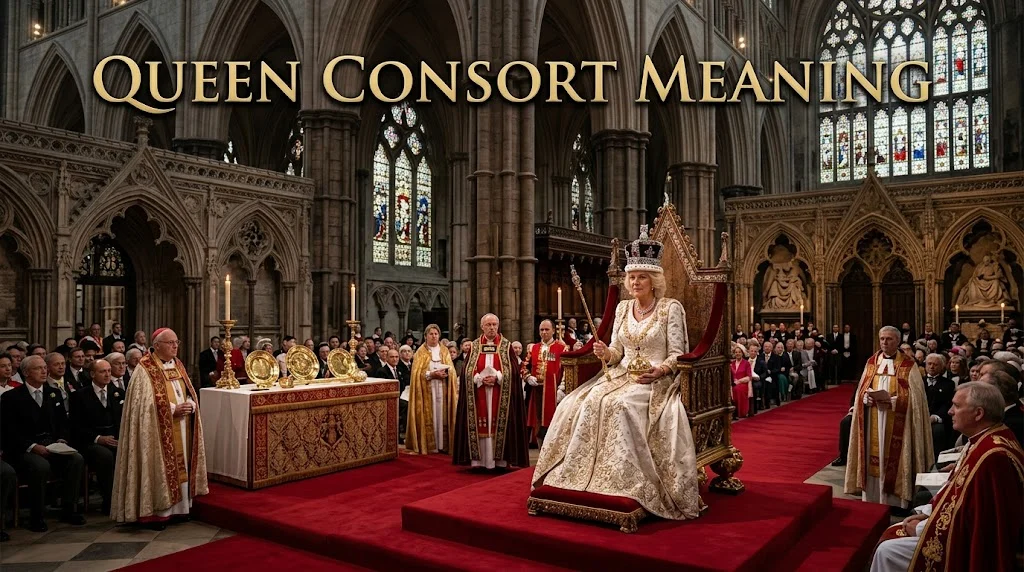
The Coronation of a Queen Consort
The coronation of a queen consort is a separate and distinct ceremony from the monarch’s coronation, though they usually happen on the same day.
Historically, the queen consort was crowned at Westminster Abbey in a parallel ceremony. Her crown was different from the king’s. Her oath was different. The regalia used were her own, not the Crown Jewels used for the sovereign.
The queen consort’s coronation includes:
The anointing. She is anointed with holy oil on the crown of her head, symbolizing divine blessing and consecration to her role.
The crowning. A crown is placed on her head. For British queen consorts, this has historically been a specific crown made for the occasion.
The ring. A ring is placed on her finger, symbolizing her union with the kingdom as well as with the king.
The scepter and rod. She receives her own scepter and ivory rod, symbols of her authority within her role.
Camilla’s coronation in May 2023 was notably modernized. She wore a reworked version of Queen Mary’s Crown, restyled without the Koh-i-Noor diamond (which had been removed from royal display due to historical sensitivity around its origins in colonial India). The ceremony retained its ancient structure while acknowledging contemporary values.
Can a Queen Consort Become Queen Regnant?
No. Her title as queen consort does not grant any succession rights.
The succession to the British throne operates under specific laws, most recently updated by the Succession to the Crown Act 2013. Succession passes through bloodline, not through marriage.
If a king dies, his queen consort becomes queen dowager. The throne passes to the next person in the line of succession, usually the king’s eldest child.
If that heir is a woman, she becomes queen regnant in her own right. Her mother, the previous queen consort, is then typically styled queen dowager.
The only way a queen consort could theoretically become queen regnant is if she independently inherited the throne through her own royal bloodline, completely separate from her marriage. This would be extraordinarily rare.
Camilla: The Modern Queen Consort
No discussion of the queen consort role is complete without looking at Camilla, Queen Consort of the United Kingdom.
When King Charles III ascended to the throne on September 8, 2022, following the death of Queen Elizabeth II, Camilla automatically became Queen Consort. The transition happened instantly, without ceremony. That’s how the title works.
The Road to Queen Consort
Camilla’s path to the role was anything but conventional.
She had known Charles since the early 1970s and their relationship continued even through his marriage to Diana, Princess of Wales. After Diana’s death in 1997 and years of gradual public rehabilitation, Camilla and Charles married in a civil ceremony at Windsor Guildhall on April 9, 2005.
At the time of the marriage, it was announced that Camilla would use the title “Princess Consort” rather than queen consort when Charles eventually became king, to spare public feeling. But that plan quietly changed.
In February 2022, Queen Elizabeth II publicly expressed her wish that Camilla be known as Queen Consort when the time came. This was a significant and deliberate act of royal endorsement from the longest-reigning British monarch in history.
When Charles became king seven months later, Camilla became Queen Consort as Elizabeth II had wished.
Camilla’s Coronation
Camilla was crowned Queen Consort at Westminster Abbey on May 6, 2023, alongside King Charles III’s coronation ceremony.
Key facts about the ceremony:
She wore a cream silk robe embroidered with motifs representing the four nations of the United Kingdom. She was crowned with a reworked version of Queen Mary’s Crown, the first time a consort crown has been reused rather than newly made in modern history. The ceremony was attended by heads of state, foreign royals, and approximately 2,200 guests. An estimated 20 million people in the UK watched on television. Internationally, the audience was estimated at over 300 million.
Camilla’s Work as Queen Consort
Since becoming Queen Consort, Camilla has been one of the most active members of the royal family.
Her primary patronages and causes include:
Literacy. She founded The Reading Room, a book club and literacy initiative, in 2012. As Queen Consort she’s expanded this significantly, using her platform to promote reading across age groups and backgrounds.
Domestic abuse and sexual violence. Camilla has been one of the most prominent royal voices on this issue for years. She has met with survivors, visited shelters, and helped amplify advocacy organizations’ work.
Osteoporosis. As patron of the Royal Osteoporosis Society, she has raised significant awareness and funds for research into the condition, which affects approximately 3.5 million people in the UK.
Animal welfare. A passionate dog lover, she supports animal welfare charities and often appears at public engagements with her Jack Russell terriers.
In her first full year as Queen Consort, Camilla carried out 228 official engagements across the United Kingdom and abroad.
The King Consort: The Flip Side of the Title
Here’s a question that doesn’t come up enough: when a queen regnant rules, what’s her husband called?
He’s typically called Prince Consort, not King Consort. And there’s a fascinating reason for this that tells you everything about how gendered royal hierarchy actually is.
Why Isn’t He Called King Consort?
Historically, a king outranked a queen in the rigid hierarchy of European monarchy. The idea of a man being subordinate to his wife went against the entire social and legal framework of pre-modern Europe.
So when a queen regnant ruled, her husband occupied an awkward position. He was her subject, legally. But culturally and socially, a husband was supposed to be head of household. The tension between these two realities produced a compromise: he got a title that acknowledged his royal status without implying sovereign authority.
The solution was “prince consort.” Not king. Prince.
Prince Albert, husband of Queen Victoria, is the most famous example. Victoria became queen at 18 and ruled for 63 years. Albert was her husband, her closest advisor, and her intellectual partner. Yet he was never King Albert. He was formally styled Prince Consort from 1857 onward, a title specifically created by Letters Patent.
Prince Philip, husband of Elizabeth II, faced exactly the same situation. When Elizabeth became queen in 1952, Philip was not made King Philip. He was styled His Royal Highness The Prince Philip, Duke of Edinburgh. He was only formally titled “Prince of the United Kingdom” in 1957. Like Albert before him, he was never king.
This is slowly changing as modern monarchies update their frameworks, but the traditional system still largely holds.
Queen Consort Across Other Monarchies
The queen consort isn’t just a British phenomenon. Most constitutional monarchies with a king at their head have a comparable title and role.
| Country | Current/Recent Example | Official Title | Notes |
|---|---|---|---|
| Spain | Queen Letizia | Queen Consort of Spain | Married King Felipe VI in 2004; highly active in public diplomacy |
| Netherlands | Queen Máxima | Queen Consort | Argentinian-born; married King Willem-Alexander in 2002; WHO special advocate for financial inclusion |
| Sweden | Queen Silvia | Queen of Sweden | German-born; married King Carl XVI Gustaf in 1976; known for work with children’s rights |
| Belgium | Queen Mathilde | Queen of the Belgians | First native-born Belgian queen consort; married King Philippe in 1999 |
| Japan | Empress Masako | Empress Consort | Married Emperor Naruhito in 1993; previously a career diplomat; her title in Japanese is kōgō |
| Denmark | Queen Mary | Queen of Denmark | Australian-born; married King Frederik X in 2004; became consort when he ascended in January 2024 |
| Jordan | Queen Rania | Queen of Jordan | Married King Abdullah II in 1993; one of the world’s most prominent advocates for education |
Each of these women holds a position analogous to a British queen consort: titled through marriage, with no constitutional sovereignty, but with significant public, diplomatic, and charitable responsibilities.
Queen Rania of Jordan is worth particular attention. She’s leveraged her position as consort to become one of the world’s most influential advocates for girls’ education and refugee rights, with over 10 million social media followers and regular appearances at global forums like the World Economic Forum in Davos.
Queen Máxima of the Netherlands holds a formal UN appointment as the Secretary-General’s Special Advocate for Inclusive Finance for Development, giving her a recognized international role beyond her national ceremonial one.
These examples show how the queen consort role, while constitutionally limited, can be shaped by the individual into something genuinely impactful.
Why the Title “Queen Consort” Exists: The Bigger Picture
Step back for a moment and think about what the title is actually designed to do.
Monarchy is a system built on clarity of authority. Every title in the royal hierarchy exists to communicate, instantly and precisely, who holds what kind of power. “King” means sovereign. “Queen regnant” means sovereign. “Prince” means royal family member without the throne. “Duke” means high-ranking noble.
“Queen consort” occupies a carefully defined space in that hierarchy: honored but not sovereign, visible but not ruling, royal but not regnant.
This serves several practical purposes:
It prevents succession confusion. By making clear that a queen consort has no inheritance rights, the title removes any ambiguity about who the throne passes to when the king dies.
It defines constitutional responsibility. Since she holds no constitutional authority, she bears no constitutional accountability. She doesn’t govern, so she can’t be blamed for governance.
It honors the monarch’s spouse. The king’s wife is an important figure in national life. She needs a title that reflects that importance without overstating her legal authority.
It allows the role to be meaningful without being powerful. A queen consort can champion causes, represent the country abroad, and embody royal values without needing to hold office.
The title is both an honor and a limitation. By design.
Key Facts About Queen Consorts at a Glance
Here are some quick, useful facts worth knowing:
The title is automatic. There’s no vote, no parliamentary approval, no ceremony required. The moment a man becomes king and is married, his wife is queen consort.
Britain has had over 30 queen consorts. From Matilda of Flanders (wife of William the Conqueror) to Camilla, the list stretches back nearly a thousand years.
Not all monarchs have had queen consorts. Elizabeth I never married. So there was no king consort and no queen consort during her reign. Same for many other monarchs throughout history.
Some queen consorts never had a coronation. While coronation is traditional, it isn’t legally required. A queen consort holds her title regardless.
The most jewels ever assembled for a consort crown: Queen Mary’s Crown, made in 1911, originally contained the Koh-i-Noor diamond, the Cullinan III and IV diamonds, and hundreds of other gems. It was reworked for Camilla’s coronation in 2023 without the Koh-i-Noor.
Camilla is the first queen consort in British history to have been previously divorced and the first to have stepchildren who are the heirs to the throne.
Eleanor of Aquitaine is the only woman in history to have been queen consort of both France and England.
The Queen Consort Role Today: Where It’s Heading
Monarchy is changing. Not disappearing (despite what republicans argue), but evolving. And the queen consort role is evolving with it.
The old model of a silent, decorative spouse is gone. Today’s queen consorts are expected to have voices, causes, and public identities of their own. They speak on policy issues. They use social media strategically. They’re public figures in a way their predecessors simply weren’t.
At the same time, the constitutional limits haven’t changed. A queen consort still holds no governmental authority. The tension between visibility and powerlessness defines the modern role.
What’s shifted is how queen consorts handle that tension. The most effective ones don’t fight it. They work within it, channeling their visibility toward causes where personal advocacy matters more than legal authority. Rania of Jordan on education. Máxima of the Netherlands on financial inclusion. Camilla on domestic abuse and literacy.
The queen consort title, in its modern form, is what you make of it. The framework is ancient. The possibilities are very much alive.
FAQs
What does queen consort mean?
A queen consort is the wife of a reigning king who holds the title of queen through marriage rather than through inheritance or sovereign right. She does not rule the country.
Is a queen consort the same as a queen?
No. A queen (regnant) rules in her own right, having inherited or been elected to the throne. A queen consort holds her title solely because she married the king.
Can a queen consort rule the country?
No. A queen consort holds no executive, legislative, or judicial authority. She cannot sign legislation, open Parliament, or make sovereign decisions.
Who becomes a queen consort?
The woman who marries a reigning king automatically becomes queen consort. The title doesn’t require parliamentary approval or a coronation (though coronation is traditional).
What happens to a queen consort when the king dies?
She becomes a queen dowager: a former queen consort who has been widowed. If her child subsequently becomes the reigning monarch, she may additionally be styled queen mother.
What’s the difference between queen consort and queen mother?
A queen consort is the wife of the currently reigning king. A queen mother is a queen dowager whose son or daughter is the current reigning monarch. Elizabeth The Queen Mother was queen consort to George VI and queen mother to Elizabeth II.
Can a queen consort become queen regnant?
Not through her marriage. The only way she could become queen regnant is if she independently inherited the throne through her own royal bloodline, completely separate from her marriage.
What is the difference between queen consort and queen dowager?
A queen consort is currently married to a reigning king. A queen dowager was previously a queen consort whose husband, the king, has died.
Conclusion:
She’s the king’s wife. She’s a public figure with enormous visibility and zero constitutional power. She wears a crown she didn’t inherit. She carries a title she earned through marriage. And within those limits, the best of them have shaped history as profoundly as any sovereign.
Understanding the queen consort meaning isn’t just a matter of getting royal terminology right. It’s about understanding how power works in a monarchy: who holds it, who doesn’t, and how influence can operate even in the absence of authority.
The title has existed for nearly a thousand years. It’s been worn by diplomatic pawns and by women of extraordinary political genius. By women who endured terrible marriages and women who changed the course of nations. By women who shaped empires and women who simply showed up, year after year, with grace and dignity, to do a job that asks everything and grants very little in return.
That, in the end, is the queen consort meaning. And it’s more complicated, more interesting, and more human than most people ever realize.
Discover More Related Articles: