
Definition
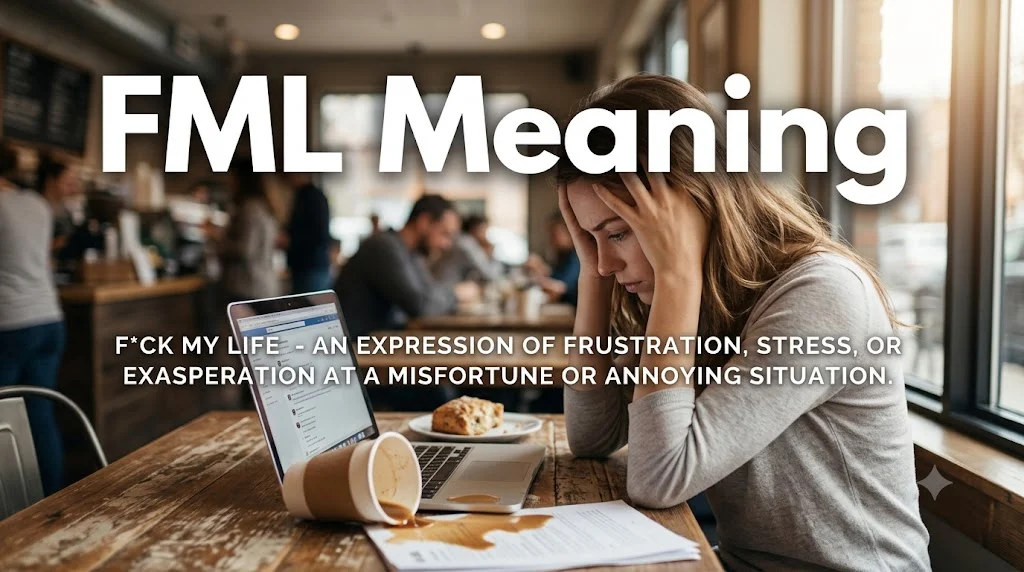
FML stands for “F*ck My Life.” It is a popular internet slang acronym people use to express frustration, disappointment, embarrassment, or bad luck after something goes wrong. FML stands for “F*ck My Life.” It is a popular internet slang acronym people use to express frustration, disappointment, embarrassment, or bad luck after something goes wrong.
You wake up late. You stub your toe getting out of bed. Your car won’t start. And your first thought? FML.
Three letters. One massive emotional download. If you’ve seen this acronym floating around text messages, Instagram captions, TikTok comments, or Reddit threads and wondered what it actually means you’re in the right place. This guide covers everything. The definition, the history, how people use it across every major platform, when it’s appropriate, when it isn’t, and how it compares to similar slang terms.
Let’s get into it.
What Does FML Mean?
FML stands for “F* My Life.”**
It’s an expression of frustration, exasperation, or bad luck usually delivered with a heavy dose of self-deprecating humor. When someone types FML, they’re not announcing a life crisis. They’re reacting to one of those annoyingly unlucky moments that feels equal parts awful and absurd.
Think of it as the digital equivalent of throwing your hands in the air and groaning. It’s dramatic. It’s a little funny. And it’s deeply relatable.
“Missed my alarm, got stuck in traffic, and walked into work with my shirt on inside out. FML.”
That’s the sweet spot. A minor catastrophe, told with just enough humor to make it bearable.
Key facts about the FML acronym:
- Full form: F*** My Life
- Type: Internet slang / texting acronym
- Tone: Frustrated, self-deprecating, darkly comic
- Used in: Texts, chats, social media captions, memes, comment sections
- Avoid in: Professional settings, formal writing, serious emotional contexts
The FML Full Form and What It Actually Communicates
The literal meaning is “F*** My Life” but what it communicates is a different thing entirely. FML is rarely used as a serious statement of despair. It’s almost always ironic or comedic a way of acknowledging that something genuinely bad just happened, but surviving it with a laugh.
The phrase carries three emotional layers at once:
- Frustration | Something went wrong. That’s annoying.
- Disbelief | Of course this happened. Of course.
- Humor | But hey, at least it makes a good story.
That combination is exactly why FML took off. It lets people vent without being too heavy about it. Nobody wants to text their friend a three-paragraph breakdown over spilling their lunch. FML says it all in three letters.
The Origin and History of FML
FML didn’t appear out of nowhere. Its roots go back to the mid-2000s when internet forums and early SMS culture were at their peak.
Here’s how the timeline unfolded:
2005 to 2007 | The phrase starts appearing in online forums and chat rooms. Short-form expressions like OMG, LOL, and WTF were already embedded in digital vocabulary so FML fit right into that ecosystem.
2008 | This is the pivotal year. The website FMyLife.com launched and changed everything. The site invited users to submit short, anonymous stories about their worst moments, each one ending with the classic sign-off: FML. The format was irresistible. Stories were funny, cringey, and universal. The site exploded in popularity almost immediately.
2009 | FMyLife.com crossed into mainstream media. News outlets covered it. Celebrities referenced it. The phrase jumped from niche internet culture into everyday conversation.
2010 to 2015 | FML becomes standard texting shorthand. It’s no longer something only internet-savvy teens know. It’s everywhere.
2016 onward | Social media platforms, especially Snapchat, Instagram, and later TikTok, give FML a second life as a caption tool. Fail videos, relatable memes, and “morning routine gone wrong” content carries the phrase into a whole new generation.
Today | Gen Z uses it fluently alongside newer slang like “no cap,” “lowkey,” and “slay.” It’s evolved from a niche web phrase into a permanent fixture of casual English.
FML Meaning Across Every Major Platform
The core meaning stays the same everywhere but the style of usage shifts depending on where you are. Here’s a breakdown:
| Platform | How FML Gets Used |
|---|---|
| Text / SMS | Quick one-word reaction to bad news from a friend |
| Venting in group chats, often with a voice note or emoji | |
| Snapchat | Photo caption showing something gone wrong (“this is my life”) |
| Story text overlay on a fail clip or unfortunate selfie | |
| TikTok | On-screen text in relatable videos, comment reactions |
| Status updates, shared memes about bad days | |
| Twitter / X | Rant tweets, end-of-day exhaustion posts |
| Thread titles introducing a personal fail story | |
| Discord | Casual reaction in gaming or friend group servers |
A few platform-specific notes worth knowing:
On TikTok, FML appears most often as on-screen text overlaid on a video. Someone shows themselves dropping their phone in a toilet. The caption? FML. The comment section usually responds with a mix of laughing emojis and solidarity.
On Reddit, FML often anchors an entire post title. “Scheduled the wrong date for my job interview. FML.” It signals to readers: this is a personal fail story, come sympathize with me (and probably laugh a little).
On Snapchat, it pairs naturally with the ephemeral nature of the app. Snap a picture of your flat tire. Add “FML” in big block letters. Send to your best friends. Done.
FML Meaning in Text and Chat Conversations
In one-on-one texting, FML functions as shorthand for a mini-vent session. It can stand alone as its own message or appear as a reaction within a longer sentence.
Standalone use:
“Just got to work and realized I left my laptop at home. FML.”
Mid-sentence use:
“FML, I have to redo the entire presentation from scratch.”
As a response:
Friend: “You have to work this weekend too?” You: “FML yes. Third week in a row.”
Notice how capitalization adds intensity. Compare these three:
- fml | low energy, tired, resigned
- FML | standard usage, genuine frustration
- FML!!! | peak exasperation, everything is on fire
Small detail but it matters in digital communication where tone is already hard to read.
How and When to Use FML the Right Way
Using FML correctly comes down to reading the room. It’s casual slang that lives in informal spaces. Here’s a simple guide:
Use FML when:
- Something mildly terrible just happened to you
- The situation is frustrating but not actually serious
- You’re talking to friends, family, or close colleagues
- You want to vent and keep the energy light
- The context is digital and informal (texts, DMs, comment sections)
Don’t use FML when:
- You’re in a professional setting emails, work Slack channels, client calls
- Someone is sharing genuine emotional pain with you
- The situation is actually serious (a health crisis, a real loss)
- You’re talking to someone unfamiliar with internet slang
- You’re posting on a brand or business account
The golden rule: FML lives in the space between “this is genuinely upsetting” and “this is kind of funny in hindsight.” The moment it tips into real distress, a different kind of expression is needed.
Is FML Offensive?
Honest answer? It depends on the audience.
The term contains a profanity the F-word is embedded right there in the acronym. But in practice, most people process FML as a unit rather than spelling out each word mentally. It’s similar to how WTF reads as an exclamation of shock rather than a specific profanity to most internet users.
That said, context matters:
- Among close friends online: Completely accepted and normal
- In casual social media: Generally fine platforms like TikTok and Instagram don’t flag the abbreviation
- At work or school: Worth avoiding. Even in casual workplace chats, it can read as unprofessional
- Around older generations or non-English speakers: May confuse or offend if the full form is known
- In formal writing: Never appropriate
The term isn’t considered hate speech or targeted harassment. It’s self-directed frustration. But because of the embedded profanity, it’s in a different category than totally clean slang like FOMO or BRB.
If you’re unsure whether FML is appropriate in a given situation, the answer is probably: don’t use it.
FML vs. Other Slang | What’s the Difference?
FML belongs to a family of emotional reaction acronyms but each one occupies a slightly different emotional lane. Here’s how they stack up:
| Acronym | Full Form | Emotional Tone | Best Used When |
|---|---|---|---|
| FML | F*** My Life | Frustrated + darkly comic | Something goes wrong for you |
| SMH | Shaking My Head | Disapproval + disbelief | Someone else does something |
| WTF | What The F*** | Shock + confusion | Something unexpected or bizarre happens |
| OMG | Oh My God | Broad surprise (+ or –) | Any strong emotional reaction |
| OOF | (no full form) | Sympathetic cringe | Reacting to someone else’s bad news |
| LMAO | Laughing My A** Off | Pure amusement | Something is genuinely hilarious |
| NGL | Not Gonna Lie | Candid admission | Sharing an honest, slightly vulnerable take |
| IKR | I Know Right | Enthusiastic validation | Agreeing strongly with something |
| RIP (ironic) | Rest In Peace | Humorous resignation | When something is over or doomed |
| YOLO | You Only Live Once | Reckless optimism | Justifying a bold or impulsive choice |
The key distinction with FML specifically: it’s self-directed. The frustration turns inward. SMH judges someone else. WTF reacts to something external. FML says: this is happening to me and my life is, at least in this moment, a disaster.
That self-deprecating quality is a big part of why it resonates so widely. There’s something universally human about laughing at your own misfortune.
FML in Meme Culture
Meme culture and FML have a long, happy relationship.
It started with FMyLife.com, which was essentially a meme format before “meme” became the universal term for relatable internet content. The site’s formula short story, cringey outcome, “FML” signoff is structurally identical to what we now call “relatable content.”
On TikTok, FML lives in the comment sections of fail videos and “tell me you’re having a bad day without telling me you’re having a bad day” style content. It also appears as on-screen text in creator videos where someone walks through their genuinely chaotic day.
On Instagram and Twitter/X, FML anchors “this is fine” meme energy that genre of content where everything is visibly falling apart but the person narrating it maintains a strange calm.
On Reddit, entire subreddits like r/tifu (Today I F***ed Up) operate on the same emotional wavelength as FML culture. The formula is the same: personal disaster, self-aware humor, shared catharsis.
What makes FML meme-proof is that it doesn’t rely on a specific format. It’s a feeling. And feelings are infinitely remixable.
Real-World FML Scenarios and Conversation Examples
Nothing explains slang better than seeing it in action. Here are realistic scenarios showing FML used naturally:
The Commute Disaster
“Train cancelled, had to get an Uber that took 45 minutes, walked in 20 minutes late to a meeting I was supposed to be running. FML.”
The Tech Tragedy
“Worked on my report for three hours. Laptop died. Hadn’t saved once. FML.”
See how FML flows naturally? It’s not dramatic. It doesn’t demand a lengthy response. It’s just an honest, efficient way of saying: today has been a lot.
How People Respond to FML
When someone sends you an FML message, what do you say back?
The sympathetic response:
“Oh no 😭 that’s awful, I’m sorry” “Ugh that’s the worst” “Sending you good vibes rn”
The humor-matching response:
“LMAOOO no way” “Classic [name] behavior honestly” “FML for you”
What you don’t want to do is respond to a clearly lighthearted FML message with excessive concern. If someone texts you “locked my keys in my car FML” and you respond with “are you okay? do you need to talk?” that’s a tonal mismatch. Read the energy. FML is usually an invitation for commiseration and maybe a laugh, not a crisis intervention.
FML and Emotional Expression in the Digital Age
Here’s something worth pausing on: why does a three-letter acronym carry so much weight?
The answer is that digital communication stripped out almost everything we normally use to convey emotion tone of voice, facial expressions, body language, pacing. What’s left is text on a screen. Slang like FML evolved to fill that gap. It’s emotional shorthand. It compresses a complex feeling (frustration, exhaustion, disbelief, rueful humor) into three characters.
In a weird way, FML is actually more precise than a longer expression would be. If someone texts “I’m having a really tough day and things keep going wrong,” that’s vague. But “FML” everyone knows exactly what that means. The tone is clear. The intensity is calibrated. The slight humor is built in.
This is why internet slang isn’t lazy communication. It’s efficient communication. Each term carries specific emotional metadata that users have collectively agreed on over years of usage.
FML occupies a very specific emotional register: frustrated but not broken, complaining but not spiraling, relatable and a little bit funny. No longer phrase captures that combination as cleanly.
FML Across Generations
One of the more interesting things about FML is its generational reach.
Millennials were the first generation to grow up with FMyLife.com and SMS culture. FML is deeply embedded in their digital vocabulary. Many millennials remember the FMyLife.com era specifically.
Gen Z inherited it and kept it alive on TikTok, Discord, and Instagram. For Gen Z users, FML sits comfortably alongside newer slang like “no cap,” “understood the assignment,” and “it’s giving.” It’s established enough to feel classic but still used often enough to feel current.
Older generations may recognize FML if they’re active on social media but it’s less likely to be a natural part of their texting habits. The profanity element can also make some people from older demographics uncomfortable once they know the full form.
Non-English speakers in international online communities often use FML too, borrowed directly from English internet culture. In multilingual WhatsApp groups or international Discord servers, it appears as a lingua franca of frustration.
Related Slang Terms Worth Knowing
FML doesn’t exist in isolation. It’s part of a broader vocabulary of casual digital expression. Here are terms that frequently appear alongside it:
| Acronym | Meaning | Typical Use |
|---|---|---|
| OMG | Oh My God | General surprise or shock |
| LOL | Laugh Out Loud | Finding something funny |
| LMAO | Laughing My A** Off | Something is very funny |
| ROFL | Rolling On the Floor Laughing | Extreme amusement |
| SMH | Shaking My Head | Disapproval or disbelief |
| WTF | What The F*** | Shock at something bizarre |
| TBH | To Be Honest | Candid admission |
| NGL | Not Gonna Lie | Similar to TBH |
| IDK | I Don’t Know | Expressing uncertainty |
| IKR | I Know Right | Strong agreement |
| BRB | Be Right Back | Brief absence from chat |
| TTYL | Talk To You Later | Signing off |
| FOMO | Fear Of Missing Out | Anxiety about missing something |
| YOLO | You Only Live Once | Embracing risk or impulsiveness |
| OOF | (interjection) | Sympathetic wince |
| AF | As F*** | Intensifier (“tired AF”) |
| FR | For Real | Emphasizing sincerity |
| ICYMI | In Case You Missed It | Sharing something the other person may not have seen |
| RIP | Rest In Peace (ironic) | Something is over or doomed |
Understanding this full ecosystem helps FML land properly in context. Someone who knows what OOF means will automatically understand how FML differs from it. Someone who uses YOLO will instinctively grasp the tonal family that FML belongs to.
Texting Etiquette and When FML Crosses a Line
Most of the time, FML is harmless. But there are edge cases where it can land badly.
Using FML around someone who’s actually struggling is probably the most common misstep. If your friend is going through a genuine hardship and you respond to something minor in your own life with “FML,” the tonal gap can feel dismissive. Timing and awareness matter.
Using FML in professional digital communication is another common mistake. Even in casual company Slack channels, FML can read as unprofessional to some colleagues or managers. Safer to keep it to personal channels.
Overusing FML dilutes the impact. If every small inconvenience gets labeled FML, the expression loses its punch. Good slang usage is calibrated reserved for moments that actually earn it.
Using it ironically in front of someone who doesn’t know the full form can create awkward situations. If a relative or older colleague reads FML and looks it up or asks what it means, that conversation might be uncomfortable.
The bottom line: FML is a fantastic term in the right context. Like any slang, it’s about reading your audience and matching the energy of the conversation.
The Psychology Behind Self-Deprecating Slang Like FML
There’s a reason FML resonates so deeply. It taps into something genuinely human: the ability to laugh at your own misfortune.
Psychologists call this self-enhancing humor the capacity to reframe frustrating situations as funny rather than catastrophic. It’s actually a healthy coping mechanism. People who can find humor in their own bad luck tend to handle stress better and maintain stronger social connections.
FML is that instinct, compressed into three letters. By saying FML, you’re:
- Acknowledging something went wrong (honesty)
- Not catastrophizing it (perspective)
- Framing it as a shared human experience (connection)
- Inviting others to laugh with you, not at you (social bonding)
That’s a lot of emotional work for an acronym. No wonder it stuck.
Internet slang as a whole often serves this function. LOL diffuses tension. SMH lets you express mild judgment without a confrontation. OOF lets you empathize without overcomplicating. And FML lets you vent while staying likeable.
Quick-Reference Summary: Everything You Need to Know About FML
Here’s everything wrapped up into a clean, scannable box:
| Detail | Information |
|---|---|
| FML full form | F*** My Life |
| Type | Internet slang / acronym / abbreviation |
| Tone | Frustrated, self-deprecating, darkly humorous |
| Born | Mid-2000s; popularized by FMyLife.com around 2008 |
| Platforms | Text, WhatsApp, Snapchat, Instagram, TikTok, Twitter/X, Reddit, Discord |
| Appropriate for | Casual digital conversation with friends and peers |
| Avoid in | Professional settings, formal writing, serious emotional contexts |
| Related terms | SMH, WTF, OOF, OMG, LMAO, NGL, IKR, YOLO, FOMO |
| Generational reach | Millennials and Gen Z primarily |
| Profanity level | Mild (embedded, not explicit) |
Three things to always remember about FML:
- It’s self-directed frustration, not aggression toward others
- Humor is the key ingredient without it, it becomes something heavier
- Context is everything the same three letters can be perfect or completely wrong depending on where and how you use them
FAQs
1. What does FML mean?
FML stands for “F*** My Life,” an expression used to show frustration or disappointment.
2. Is FML a bad word?
Yes, it contains profanity, so it’s best used only in casual conversations.
3. Where is FML commonly used?
FML is popular in text messages, social media, memes, and online chats.
4. Can FML be used jokingly?
Yes, people often use FML humorously for small everyday mishaps.
5. What are some alternatives to FML?
Common alternatives include “My luck,” “Seriously?”, “What a day,” and “SMH.”
6. Is FML appropriate for work?
No, it’s generally considered too informal and inappropriate for professional settings.
7. What does someone mean when they say FML?
They usually mean something frustrating, embarrassing, or unlucky has happened.
8. Is FML still popular?
Yes, FML remains a widely recognized internet slang term across social media and messaging apps.
Conclusion
Three letters. Endless relatability.
FML has earned its place in the digital lexicon not because it’s clever or complicated but because it perfectly captures a very specific human feeling. That moment when life trips you up in an almost poetic way and all you can do is sigh, shake your head, and type three letters into your phone.
From FMyLife.com in 2008 to TikTok comment sections today, FML has proven it isn’t going anywhere. It’s woven into the fabric of how people communicate frustration online with just enough humor to keep it from tipping into despair.
So the next time your coffee spills, your alarm doesn’t go off, or the universe decides to make Tuesday difficult you know exactly what to say.
FML.
And somehow, once you say it, things feel just a little bit better.
Discover More Related Articles: