
Definition
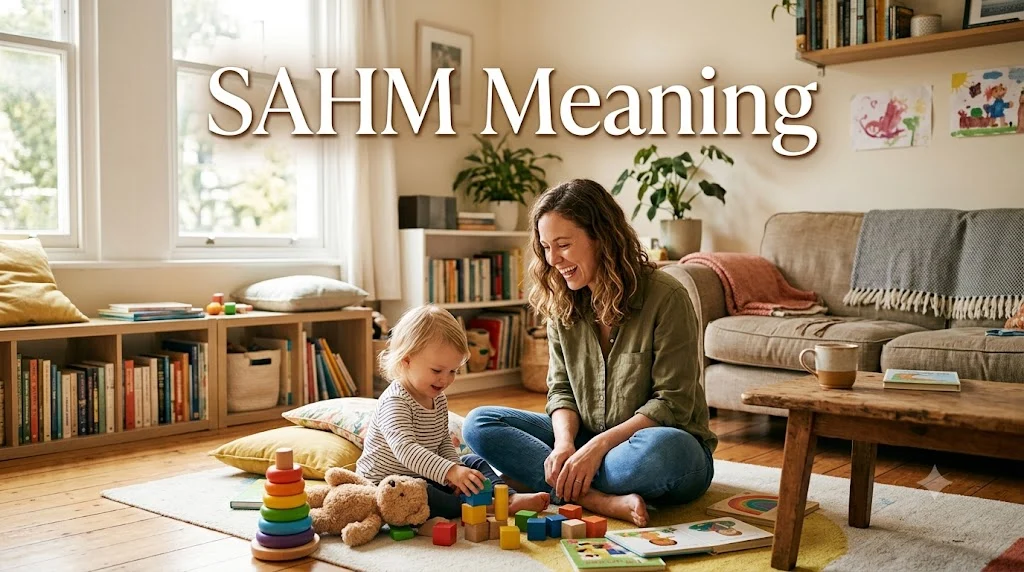
SAHM stands for “Stay-at-Home Mom.” It refers to a mother who primarily stays at home to care for her children and manage household responsibilities instead of working in a paid job outside the home.
Picture this. You’ve just joined a Facebook mom group or stumbled onto a parenting subreddit. Within minutes, you’re reading posts packed with “SAHM this” and “SAHM that” and everyone seems to get it except you. Sound familiar? You’re not alone. Thousands of people search for the SAHM meaning every single day.
So let’s just say it clearly upfront: SAHM stands for Stay-At-Home Mom.
But here’s the thing. It’s not just an acronym. It’s an identity, a community, a lifestyle, and for millions of women around the world, it’s the most demanding job they’ve ever had. Understanding what SAHM truly means goes far deeper than three letters and a period.
This guide covers everything: the SAHM definition, where it’s used, how it differs from similar terms, what the lifestyle actually looks like, and why this little acronym has become one of the most recognized pieces of parenting slang on the internet.
What Does SAHM Mean? The Simple, Direct Answer
SAHM = Stay-At-Home Mom.
That’s the SAHM full form. It refers to a mother who has stepped away from paid employment outside the home to focus on raising her children and managing the household full-time. She’s the primary caregiver. Her office is the kitchen, the nursery, the minivan, and every pediatrician’s waiting room in town.
The SAHM acronym is made up of four letters:
- S = Stay
- A = At
- H = Home
- M = Mom
You pronounce it as individual letters: S-A-H-M. It’s not spoken as a word (it doesn’t rhyme with “ham,” despite what some newcomers assume).
Technically speaking, SAHM is an initialism, not a true acronym, because the letters are spoken individually rather than blended into a single spoken word like NASA or SCUBA. However, in everyday parenting conversation, people call it an acronym and nobody corrects them.
“Being a SAHM isn’t a lifestyle choice you make once. It’s a choice you remake every single day.”
That quote captures something essential. The SAHM definition on paper is simple. The reality is anything but.
Where Did the SAHM Acronym Come From?
The term didn’t appear in a dictionary one day. It grew organically from the internet.
In the late 1990s and early 2000s, online parenting forums started exploding in popularity. Sites like BabyCenter, iVillage, and The Bump brought mothers together in a way that had never existed before. These women were typing fast, posting often, and creating their own shorthand to keep up with the pace of conversation.
SAHM emerged from that culture. Parenting forums needed quick, scannable terms. Nobody wanted to type “stay-at-home mom” fifty times a day in forum posts. So SAHM stuck. By the time Facebook groups and Twitter took over in the 2010s, SAHM was already so embedded in parenting culture that it crossed over into everyday texting and casual conversation.
Today, you’ll find it absolutely everywhere:
- In Instagram bios
- In TikTok captions and comments
- Across Reddit parenting communities
- In WhatsApp mom groups
- In professional parenting articles
- Even in academic discussions about labor economics
The SAHM abbreviation went from niche forum slang to mainstream parenting vocabulary in less than two decades. That’s a fast rise for three letters and an initial.
SAHM Meaning in Different Places: Text, Chat, and Social Media
The meaning of SAHM doesn’t change depending on where you see it. But how it’s used shifts a lot based on platform. Let’s walk through each one.
SAHM Meaning in Texting and Chat
In personal texts and chat apps, SAHM comes up casually and conversationally. It’s shorthand that saves time when messaging friends or family.
Examples you might actually see:
- “She left her job last year. Full SAHM mode now.”
- “I’ve been a SAHM for four years and I honestly miss adult conversation.”
- “Any SAHM tips for keeping toddlers busy on a rainy day?”
It flows naturally in text because the people sending it already know what it means. The SAHM meaning in chat is identical to its broader definition. It’s just faster to type.
SAHM Meaning on Social Media
This is where SAHM really lives and breathes. Different platforms use it in slightly different ways.
| Platform | How SAHM Shows Up | Examples |
|---|---|---|
| TikTok | Video captions, hashtags, community identity | #SAHMlife, #SAHMtok, day-in-the-life content |
| Bio descriptions, reel captions, hashtags | “SAHM of 3 boys” in bio, #SAHMmom | |
| Group names, post descriptions, advice threads | “SAHM Support Group,” posts asking for advice | |
| Subreddit discussions, post titles, flair | r/SAHP, r/Mommit, “Fellow SAHMs, how do you cope?” | |
| X (Twitter) | Quick commentary, parenting debates | “SAHM culture is misunderstood and undervalued” |
| Board titles, blog pin descriptions | “SAHM schedule ideas,” “SAHM budget tips” |
TikTok deserves special mention. The #SAHMlife hashtag has accumulated billions of views. A whole generation of content creators has built audiences specifically around authentic SAHM content: the chaos, the humor, the burnout, the beautiful moments. It’s one of the most honest corners of parenting content online right now.
SAHM Meaning in Parenting Communities
In dedicated parenting spaces, SAHM carries more weight than just a descriptor. It signals membership. When someone identifies as a SAHM in a parenting forum, other SAHMs immediately understand the context of their questions and struggles.
Reddit communities like r/SAHP (Stay-At-Home Parents), r/Mommit, and r/beyondthebump are full of SAHM discussions. These aren’t casual spaces. People share deeply personal experiences about financial stress, identity loss, relationship dynamics, and the quiet joy of watching their kids grow up close.
The SAHM meaning in parenting isn’t just a job title. It’s a whole framework for how someone structures their life, their finances, their relationships, and their sense of self.
What Does a SAHM Actually Do? The Real Picture
Here’s where things get interesting. Ask someone unfamiliar with the term what a SAHM does and they might say “she stays home.” Technically true. Wildly incomplete.
The work of a stay-at-home mom is relentless, varied, and largely invisible to those outside the household. Consider what a typical SAHM manages on any given day:
Child-Centered Responsibilities:
- Feeding infants and managing feeding schedules
- Diaper changes, potty training, bathing routines
- Developmental play and early learning activities
- Monitoring milestones and coordinating pediatric appointments
- Managing school drop-offs, pickups, and homework
- Handling sick days, which can stretch into weeks
- Navigating emotional meltdowns, sibling conflicts, and behavioral challenges
Household Management:
- Meal planning and cooking three meals a day (plus snacks)
- Grocery shopping and budget management
- Cleaning, laundry, and organization
- Home maintenance coordination
- Managing family schedules and appointments
- Managing pet care where applicable
Administrative and Logistical Work:
- Insurance coordination
- Managing finances and household budgets
- Communication with schools, healthcare providers, and family
- Researching childcare options, activities, camps, and programs
- Organizing birthday parties, holidays, and family events
Emotional Labor:
- Being the emotional anchor for children throughout the day
- Maintaining the mental load of the entire household
- Supporting a partner’s work life by handling everything at home
- Managing her own mental health with limited time or support
A 2019 study by Salary.com estimated that the work a stay-at-home mother does would cost approximately $178,201 per year if each task were paid at market rate. That figure includes things like childcare, housekeeping, cooking, tutoring, nursing, and transportation. When people say SAHMs “don’t work,” they’re ignoring an enormous amount of skilled, exhausting, unpaid labor.
SAHM vs. WAHM: What’s the Difference?
This comparison comes up constantly. And it matters.
WAHM stands for Work-At-Home Mom. She’s a mother who earns income while also caring for her children at home. The key distinction from a SAHM is that income piece.
| Characteristic | SAHM | WAHM |
|---|---|---|
| Full Form | Stay-At-Home Mom | Work-At-Home Mom |
| Paid Employment | No | Yes, from home |
| Primary Role | Childcare and household | Childcare, household, AND income |
| Financial Independence | Dependent on partner’s income | Partial or full income of her own |
| Common Examples | Full-time caregiver | Freelancer, blogger, remote worker, online seller |
| Typical Challenges | Financial dependence, isolation | Balancing work and childcare, time management |
| Community Term | SAHM | WAHM |
Here’s where it gets blurry. A SAHM who starts a blog, sells crafts on Etsy, or picks up freelance work technically crosses into WAHM territory. Many women drift between these labels as their circumstances evolve. And plenty of WAHMs point out that working from home while also being the primary caregiver is intensely difficult in some ways harder than either role alone.
Neither is better. They’re just different arrangements shaped by finances, career goals, childcare costs, and personal values.
SAHM vs. Working Mom: The Debate Nobody Needs
The internet loves to pit SAHMs against working moms. Let’s be clear: this framing is exhausting and unhelpful.
Both paths come with trade-offs.
What SAHMs sometimes miss by not working outside the home:
- Professional development and career progression
- Financial independence and retirement savings
- Adult social interaction and intellectual stimulation
- Personal identity outside of motherhood
What working moms sometimes miss by not being home full-time:
- Being present for every developmental milestone
- Flexibility during sick days or school events
- The slower rhythm of a home-based day with children
Most mothers don’t make these choices in a vacuum. The decision is usually shaped by:
- Childcare costs: In major U.S. cities, full-time childcare for one child costs between $20,000 and $35,000 per year. For families with multiple young children, the math often doesn’t work in favor of both parents working.
- Family values and cultural expectations
- Career flexibility and remote work availability
- Partner income and job stability
- Personal fulfillment and mental health needs
The SAHM vs. working mom debate tends to assume both options are freely available to every family. They’re not. Financial reality makes the choice for many families long before personal preference enters the picture.
SAHM vs. Homemaker: They’re Not the Same Thing
People use these interchangeably but they’re genuinely different.
Homemaker is an older, more formal term. It shows up in legal documents, tax filings, and government surveys. A homemaker manages a household but doesn’t necessarily have children. The term focuses on the domestic role itself.
SAHM is modern, digital-native, and specifically centers the parenting aspect. A SAHM might have a spotless house or a chaotic one. That’s not the point. The point is that she’s raising her children full-time.
Here’s a quick comparison:
| SAHM | Homemaker | |
|---|---|---|
| Origin | Internet parenting communities, late 1990s | Traditional, formal English |
| Requires Children | Yes, by definition | Not necessarily |
| Tone | Casual, community-based | Formal, institutional |
| Used in Legal Forms | Rarely | Often |
| Identity Framing | Parent-centered | Domestic-role-centered |
Many SAHMs find “homemaker” either too formal or too focused on housework rather than parenting. SAHM feels more specific to who they actually are.
SAHM vs. Housewife: Why the Distinction Matters
The word housewife carries historical baggage that makes many modern women uncomfortable. Historically, the housewife role was defined largely by her relationship to her husband: she managed his home, supported his career, and was often treated as an extension of his identity rather than a person with her own.
SAHM shifts the frame entirely. It centers the children, not the spouse. A SAHM’s primary role is as a parent, not as a partner to her husband. This isn’t just semantic. It represents a genuine cultural shift in how women in this role understand and describe themselves.
Many women who identify as SAHMs actively reject the word “housewife” because:
- It feels tied to outdated gender norms
- It implies subservience rather than choice
- It erases the parenting work, which is the whole point
- It doesn’t apply to single mothers, same-sex couples, or non-married parents in the SAHM role
That said, some women embrace the term “housewife” proudly, and that’s equally valid. Language is personal.
SAHD: The Stay-At-Home Dad
You can’t talk about SAHMs without mentioning SAHDs.
SAHD = Stay-At-Home Dad. The male equivalent of the SAHM. And while the numbers are still smaller, they’re growing fast.
According to Pew Research Center data, approximately 2.2 million fathers in the United States were stay-at-home dads as of the early 2020s. That number has more than doubled since the 1980s. Some key reasons:
- Partner’s career earns more (a growing reality as women’s earnings rise)
- Childcare costs make it economically smarter for one parent to stay home regardless of gender
- Changing cultural attitudes around fatherhood and caregiving
- Remote work disrupting traditional employment patterns
SAHDs face their own unique challenges. Social stigma, a lack of community spaces built for them, and the expectation that primary caregiving is a female role all create pressure that SAHMs don’t face in the same way.
The gender-neutral term SAHP (Stay-At-Home Parent) is increasingly used to include both SAHMs and SAHDs without gendering the role. You’ll see it especially in progressive parenting communities on Reddit.
The Full Parenting Acronym Glossary You Actually Need
If you’re new to parenting forums and social media, the acronyms can feel like learning a second language. Here’s a comprehensive reference table:
| Acronym | Full Form | Quick Explanation |
|---|---|---|
| SAHM | Stay-At-Home Mom | Primary caregiver, no outside employment |
| SAHD | Stay-At-Home Dad | Male primary caregiver at home |
| SAHP | Stay-At-Home Parent | Gender-neutral version of SAHM/SAHD |
| WAHM | Work-At-Home Mom | Earns income from home while parenting |
| WAHD | Work-At-Home Dad | Male equivalent of WAHM |
| WOHM | Work-Outside-Home Mom | Traditional working mother |
| First-Time Mom | A mother experiencing her first child | |
| STM | Second-Time Mom | On her second child |
| LO | Little One | Refers to a baby or young child |
| DH | Dear Husband | Common in parenting forums |
| DD | Dear Daughter | Refers to the poster’s daughter |
| DS | Dear Son | Refers to the poster’s son |
| MIL | Mother-In-Law | Frequently discussed in parenting forums |
| SIL | Sister-In-Law | Sister of a spouse |
| EBF | Exclusively Breastfed | Infant feeding method |
| EBM | Expressed Breast Milk | Pumped breast milk |
| BF | Breastfed/Breastfeeding | Nursing a baby |
| FF | Formula Fed | Baby fed by formula |
| CIO | Cry It Out | Sleep training method |
| AP | Attachment Parenting | Parenting philosophy emphasizing closeness |
| WFH | Work From Home | Remote work arrangement |
Bookmark this. You’ll need it.
How to Use SAHM Correctly in a Sentence
Some readers want to start using SAHM naturally in conversation but aren’t sure how. Here are real-world examples across different contexts.
In a text message:
“She quit her job after the baby arrived. She’s been a SAHM ever since and honestly seems so much happier.”
In a parenting forum post:
“Any other SAHMs dealing with mom burnout? I love my kids but I haven’t had a single hour to myself in three weeks.”
When NOT to use the acronym:
- In formal cover letters or resumes (write “stay-at-home parent” in full)
- In medical intake forms
- In legal documents
- In academic writing without defining it first
The SAHM abbreviation is conversational shorthand. It belongs in casual digital spaces, not formal paperwork.
Where SAHMs Actually Gather Online
The SAHM community online is enormous and remarkably supportive. If you’re a new SAHM or considering the transition, these are the real spaces where people talk.
Reddit Communities
Reddit has some of the most honest, unfiltered SAHM content on the internet.
- r/SAHP | Stay-at-home parents of any gender sharing experiences and advice
- r/Mommit | General mom community with lots of SAHM participation
- r/beyondthebump | Postpartum and early parenting, heavily SAHM-populated
- r/Parenting | Broader but frequently touches SAHM topics
- r/breakingmom | A space for venting without judgment
Facebook Groups
Private Facebook groups are where a lot of the real talk happens. Many are local and hyper-specific.
- “Stay-at-Home Moms Support Network”
- Local neighborhood mom groups
- Hobby-specific groups (SAHM bookclubs, SAHM fitness, etc.)
- Faith-based SAHM communities
TikTok
The #SAHMlife hashtag has made SAHM content one of the platform’s most consistently popular niches. Creators share:
- Realistic day-in-the-life vlogs
- Budget meals and grocery hauls
- Cleaning and organization routines
- Honest conversations about loneliness and burnout
- Funny, relatable moments that working parents also connect with
SAHM Instagram ranges from aspirational lifestyle content to raw, unfiltered realness. Hashtags like #SAHMmom, #SAHMlife, and #stayathomemom collectively have tens of millions of posts.
Parenting Blogs and Websites
Sites like Scary Mommy, Cup of Jo, and BabyCenter have deep archives of SAHM content. These were foundational to the community before social media took over.
The Real Benefits of Being a SAHM
Let’s get specific. Not the vague “quality time” cliché. The actual, documented benefits.
Direct involvement in early childhood development. The first three years of a child’s life represent the most critical period of brain development. Children with consistent, attentive caregiving during this window show measurable benefits in language acquisition, emotional regulation, and social skills. A SAHM who is present and engaged throughout this period provides something that even excellent childcare facilities can’t fully replicate: one-to-one, deeply attuned attention from the same person, every day.
Significant financial savings. The numbers are stark. Full-time childcare for an infant in New York City costs an average of $2,500 to $3,500 per month. For two children under five, that’s potentially $50,000 to $70,000 per year in childcare costs alone, before taxes, commuting costs, or work wardrobe expenses. For families where one parent earns a modest income, the SAHM arrangement can be the financially smarter choice even though it involves giving up a salary.
Flexibility in family life. SAHMs can adapt to sick children, school events, last-minute changes, and the unpredictable rhythms of family life without the stress of requesting time off work or losing income. This flexibility reduces family stress considerably.
Stronger attachment bonds. Decades of research into attachment theory, pioneered by John Bowlby and expanded by Mary Ainsworth, consistently shows that children with secure attachment bonds with their primary caregivers develop better emotional resilience, healthier relationships as adults, and stronger self-esteem. Full-time maternal presence is one pathway toward secure attachment, though it’s not the only one.
Homeschooling option. SAHMs are the backbone of the homeschooling movement in the United States. Approximately 3.3 million children were homeschooled in the U.S. as of 2021. The vast majority of homeschooling families have a SAHM as the primary educator.
The Real Challenges of Being a SAHM
Honesty matters here. The SAHM lifestyle comes with genuine difficulties that get glossed over in social media content.
Financial vulnerability. A SAHM who depends entirely on her partner’s income has limited financial autonomy. If the relationship ends, if the partner loses their job, or if a medical crisis strikes, the SAHM may have no independent financial resources. She also typically accumulates no retirement savings of her own during her SAHM years, which creates long-term financial risk.
Career gap challenges. Returning to the workforce after years as a SAHM is notoriously difficult. Many women find their skills feel outdated, their networks have thinned, and employers hold the gap against them. Studies show that women who take career breaks for caregiving earn significantly less than their peers for years after returning, a phenomenon economists call the motherhood penalty.
Social isolation. This one is underreported and deeply serious. Many SAHMs, especially in their early years, report profound loneliness. Adult conversation, intellectual stimulation, and a sense of professional identity can disappear almost overnight. Without intentional effort to build social connections, the isolation can contribute to depression and anxiety.
SAHM in the Era of Social Media and Modern Parenting
Something interesting happened when TikTok gave SAHMs a camera and an audience.
For decades, the dominant cultural image of the stay-at-home mom was either the cheerful 1950s housewife or the frazzled, self-deprecating “mommy blogger.” Social media, particularly TikTok, cracked that narrow image wide open.
Real SAHMs started filming their actual days. Not the Pinterest-worthy moments. The genuine ones: the 5 a.m. baby wake-ups, the toddler tantrums at the grocery store, the moment of quiet desperation in the car after dropping off the older kids. The response was enormous.
This content resonated because it was honest. Parents everywhere recognized themselves in it. The SAHM meaning online shifted from a descriptor to a community marker. When someone posts #SAHMlife, they’re not just identifying their employment status. They’re saying: I live this. Come find your people here.
Meanwhile, the rise of the SAHM influencer has created an interesting new category. Women who monetize their SAHM content through brand partnerships, affiliate marketing, and digital products are technically WAHMs by income, even if they identify as SAHMs by lifestyle. This blurring of lines reflects how modern work and caregiving have become increasingly intertwined.
The pandemic accelerated everything. Between 2020 and 2022, millions of mothers left the workforce, many permanently. School closures, childcare collapse, and the demands of remote work while also managing children at home pushed families to restructure. A significant percentage of pandemic-era SAHM transitions turned out to be permanent, reshaping the SAHM landscape in ways still being measured.
SAHM and the Broader Conversation About Women’s Labor
It’s impossible to fully understand the SAHM meaning without placing it in its economic and political context.
Unpaid domestic and caregiving labor is one of the largest categories of unrecognized economic activity in the world. The International Labour Organization estimates that unpaid care work represents approximately 9% of global GDP larger than the entire manufacturing sector. The overwhelming majority of that work is performed by women.
SAHMs are the most visible subset of this invisible workforce. Their work sustains the economy indirectly by raising children, supporting working partners, and maintaining homes without receiving a wage, benefits, or retirement contributions.
Several policy conversations center directly on this reality:
- Social Security credits for caregiving years: A longstanding proposal in the United States would allow SAHMs (and SAHDs) to earn Social Security credits for years spent as primary caregivers, reducing long-term financial risk.
- Universal childcare: If high-quality, affordable childcare were widely available, the SAHM vs. working mom calculation would shift significantly for many families.
- Paid family leave: The United States remains one of the only developed nations without federal paid parental leave, a policy gap that directly shapes who ends up as a SAHM and why.
These aren’t partisan points. They’re structural realities that shape the SAHM lifestyle in concrete ways.
FAQs
What does SAHM mean in texting?
SAHM in texting means Stay-At-Home Mom. It’s used casually in text messages the same way it’s used everywhere else: to describe a mother who cares for her children full-time rather than working outside the home.
Is SAHM a slang term?
It started as informal internet slang in parenting forums during the late 1990s and early 2000s. Today it’s so widely used that it’s recognized in mainstream parenting culture, media, and even some professional contexts.
What’s the difference between SAHM and WAHM?
A SAHM doesn’t earn income. A WAHM earns income from home while also being the primary caregiver. The distinction matters financially and practically, though the lines blur for many women who do occasional freelance or side income work.
What does SAHD mean?
SAHD stands for Stay-At-Home Dad. The male equivalent of a SAHM. SAHDs are a growing group in the United States and globally as gender roles around caregiving continue to evolve.
What does SAHP mean?
SAHP stands for Stay-At-Home Parent. It’s a gender-neutral alternative that includes SAHMs, SAHDs, and non-binary parents in primary caregiving roles.
Can a SAHM also be considered a WAHM?
If a SAHM earns any consistent income, even from blogging, selling online, or freelancing, many people would reclassify her as a WAHM. There’s no strict income threshold.
How do you pronounce SAHM?
Each letter separately: S-A-H-M. It does not rhyme with any English word. Never say it like “sam” or “sham.”
What’s the opposite of a SAHM?
The term WOHM (Work-Outside-Home Mom) is sometimes used, though it’s less common than SAHM. Most people just say “working mom.”
Conclusion
Understanding the SAHM meaning helps you better interpret conversations about parenting, family life, and social media. The acronym simply stands for Stay-at-Home Mom, referring to a mother who primarily manages childcare and household responsibilities instead of working outside the home full-time.
Today, the term is widely used in text messages, online communities, parenting blogs, and everyday conversations. While every family’s situation is different, being a SAHM involves a wide range of responsibilities that contribute significantly to the home and family.
Now that you know what SAHM means, you’ll be able to recognize and use the acronym confidently whenever you see it in chats, social media posts, or discussions about parenting and family life.
Discover More Related Articles:
- Circa Meaning | The Historical Term Everyone Sees but Few Understand In 2026
- Dichotomy Meaning | That Make It Easy to Understand In 2026