
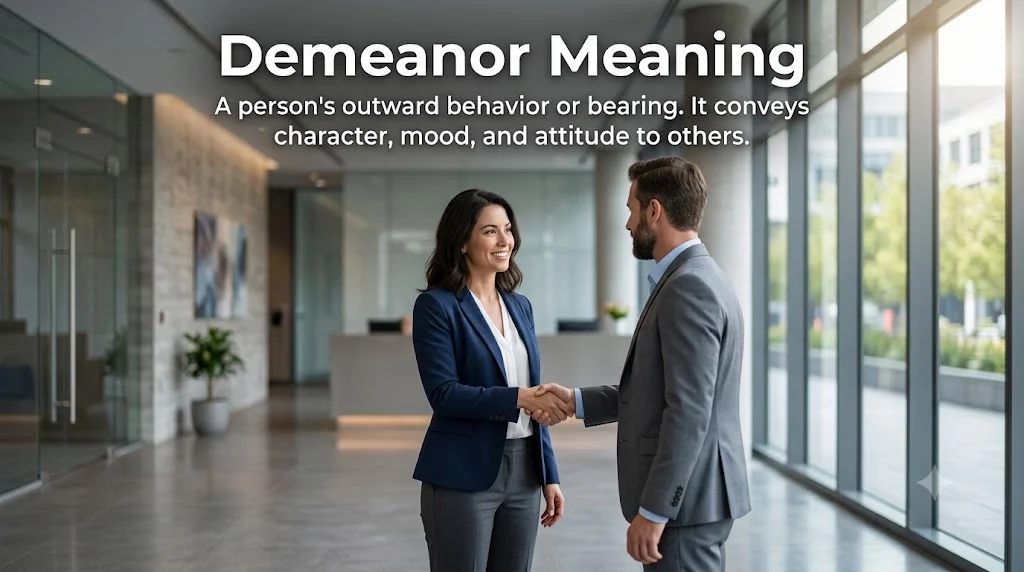

Definition
Demeanor is a person’s outward behavior, facial expressions, body language, and overall manner of interacting with others.
You walk into a room and people start forming opinions before you utter a single word. That invisible energy you project? That is your demeanor at work. It speaks volumes about who you are, what you feel, and how others should treat you. Understanding demeanor meaning goes far beyond memorizing a dictionary definition. It is about grasping the subtle art of human perception and learning how to wield it intentionally.
This guide unpacks every layer of demeanor meaning. You will learn the precise definition, the subtle differences between demeanor and similar concepts like attitude and behavior, and how to read other people’s silent signals with surgical precision. More importantly, you will discover actionable strategies to adjust your own demeanor for interviews, leadership roles, difficult conversations, and everyday social situations. Let us dive in.
What Exactly Is Demeanor?
At its simplest level, demeanor meaning refers to the outward behavioral expression of your internal emotional state. It is how you conduct yourself, your bearing, and the overall impression you leave on others through observable cues. The term comes from the Old French word “demener,” which means to conduct or guide. That etymology is telling because demeanor is literally about how you guide yourself through social spaces.
Pronunciation is straightforward but frequently mangled. Say it as “dih-MEE-ner.” The emphasis lands firmly on the second syllable. Practice it a few times because using the word correctly signals sophistication and emotional intelligence in professional settings.
A professional demeanor combines elements of composure, respect, and situational awareness. It means dressing appropriately for the context, arriving on time, maintaining eye contact without staring, speaking clearly and concisely, and showing respect for others through active listening. Professional demeanor also requires emotional regulation, which means keeping frustration, excitement, or disappointment within socially acceptable bounds.
Understanding demeanor meaning also requires recognizing that context dramatically changes interpretation. A serious demeanor that seems appropriate and even admirable in a courtroom or boardroom might read as cold and unwelcoming at a family gathering or social event. Similarly, a cheerful demeanor that works beautifully in customer service might undermine your authority during a disciplinary conversation.
Demeanor Versus Its Synonyms: Drawing Sharp Distinctions
Many people use demeanor, behavior, attitude, personality, and disposition interchangeably. That is a mistake that muddies communication and limits your ability to perceive social dynamics accurately. Each term describes a distinct aspect of human expression, and understanding the differences unlocks deeper social intelligence.
Behavior refers to specific actions and conduct. It answers the question of what someone does. For example, holding a door for a stranger is a behavior. Demeanor answers the question of how someone does it. You can hold the door with a warm smile and gracious nod, projecting a friendly demeanor. Alternatively, you can hold the door with a blank expression and avoid eye contact, projecting a cold or indifferent demeanor. Same behavior, wildly different demeanor.
Let us cement these distinctions with a concrete table.
| Concept | Definition | Can You Control It? | Example |
|---|---|---|---|
| Behavior | Specific actions and conduct | Yes, with effort | Holding a door for someone |
| Demeanor | How you express your actions | Yes, with awareness | Holding the door with a warm smile |
| Attitude | Internal mental stance | Often, with reflection | Believing the task is tedious |
| Personality | Enduring traits and patterns | Very difficult | Being an extrovert |
| Disposition | Natural habitual tendency | Slowly, over time | Generally being optimistic |
Consider a real world scenario that illustrates these distinctions perfectly. A customer service representative deals with an angry client. The client’s behavior involves shouting and aggressive gestures. The representative maintains a calm and respectful demeanor despite feeling anxious internally. Their attitude toward the client might be negative, but they consciously display a professional demeanor. Their personality might be naturally introverted, and their disposition might lean toward avoiding conflict. Yet in that moment, their demeanor bridges the gap between what they feel and what they must project.
The Anatomy of Demeanor: Reading the Silent Signals
Demeanor does not exist in abstract theory. It lives in specific, observable physical and vocal cues that you can learn to read with remarkable accuracy. The human brain processes these signals unconsciously, but you can bring that processing into conscious awareness. This section breaks down every component of demeanor meaning so you can read others and manage your own output.
Nonverbal Communication: The Heavy Lifter
Nonverbal signals carry between 65 to 93 percent of all communication meaning, depending on which study you consult. Demeanor lives primarily in this nonverbal space. The words you speak matter, but how you speak them often matters more.
Gestures reveal the emotional subtext of your spoken words. Open palms facing upward suggest honesty, openness, and receptivity. Crossed arms signal defensiveness or discomfort. Pointing gestures often read as aggressive or accusatory. Fidgeting, such as tapping fingers or bouncing legs, reveals anxiety or impatience. The best demeanor includes purposeful, deliberate gestures that reinforce verbal content without becoming distracting.
Proxemics, or physical distance, shapes demeanor perception in ways most people overlook. Standing too close invades personal space and can suggest aggression or inappropriate familiarity. Standing too far suggests coldness or disinterest. The appropriate distance depends entirely on relationship and context. Intimate relationships allow closer proximity. Professional relationships require more space. Cultural background also affects comfort with proximity.
Paroverbal Communication: The Voice You Cannot See
Your voice carries immense demeanor information independent of your actual words. Tone of voice encompasses pitch, volume, and inflection. A warm tone features moderate pitch and gentle variation. A cold tone features flat, monotone delivery. A confident tone projects steady volume without shouting. An anxious tone rises in pitch and becomes breathy or shaky.
Pacing affects how people perceive your demeanor. Speaking too quickly suggests nervousness, excitement, or a desire to get the interaction over with. Speaking too slowly suggests boredom, lack of intelligence, or condescension. The sweet spot falls somewhere in the middle, with slight slowing for emphasis on important points. Pausing before responding signals thoughtfulness and composure, whereas jumping in immediately can suggest impulsiveness or lack of respect.
Volume management reveals emotional state and social awareness. Speaking too loudly suggests aggression, excitement, or lack of social calibration. Speaking too quietly suggests fear, submission, or insecurity. The appropriate volume matches the environment and situation. People with excellent demeanor adjust their volume to suit the room size, background noise, and audience composition.
Laughter and vocal fillers like “um” and “uh” also impact demeanor perception. Frequent laughter suggests a cheerful, approachable demeanor when appropriate to context. Excessive filler words suggest nervousness or lack of preparation. Reducing filler words through practice and pausing dramatically improves your perceived confidence and professionalism.
Energy and Physical Presence
Demeanor includes your overall energy level and how you occupy physical space. High energy people project enthusiasm and engagement. Low energy people project fatigue or disinterest. Neither is inherently bad, but matching your energy to the context matters enormously. A high energy demeanor works beautifully for sales and presentations. A low energy demeanor might be more appropriate for serious discussions or sensitive conversations.
Physical presence involves how much space you take up and how you move through it. People who project confidence take up more physical space, spreading their arms, using broad gestures, and standing with feet shoulder width apart. People who project insecurity make themselves smaller, crossing limbs and keeping movements minimal. This aspect of demeanor meaning stems from evolutionary biology. Expanding your physical space signals dominance and confidence. Compressing your space signals submission and anxiety.
Walking style also contributes to demeanor perception. A confident walk features upright posture, steady pace, and purposeful movement. An anxious walk features hurried steps, looking down, and erratic movement. A relaxed walk features slower pace, casual arm swing, and scanning the environment. Your gait reveals your internal state to anyone watching.
The Demeanor Spectrum: Positive and Negative Expressions
Demeanor falls along a spectrum from highly positive and approachable to highly negative and repellant. Understanding where specific demeanor types fall helps you recognize them in others and cultivate the expressions most beneficial to your goals. This section maps out the most common demeanor categories with specific behavioral markers.
Positive Demeanor Types
A friendly demeanor makes people feel welcome and comfortable. It manifests through frequent smiling, open body language, warm eye contact, and inviting gestures. People with friendly demeanor lean slightly toward conversation partners and nod to show engagement. They mirror the other person’s emotional expressions, building rapport through unconscious mimicry. This demeanor works beautifully in customer service, sales, networking, and social situations where building trust matters.
A respectful demeanor communicates that you value others as human beings. It includes waiting for others to finish speaking before responding, acknowledging others’ perspectives even when you disagree, using appropriate titles and forms of address, and avoiding dismissive language or gestures. Respectful people do not interrupt, roll their eyes, or check their phones while others speak. Their demeanor signals that others matter, which builds trust and loyalty over time.
Negative Demeanor Types
A cold demeanor pushes people away and creates distance. It features minimal facial expression, flat tone of voice, limited eye contact, and closed body language. Cold people may cross their arms, avoid physical proximity, and offer short, dismissive responses. Their demeanor signals disinterest, superiority, or emotional unavailability. While occasionally useful for maintaining professional boundaries, chronic cold demeanor isolates you from meaningful connections.
An aggressive demeanor intimidates and threatens others. It includes invading personal space, pointing fingers, raising voice volume, and making aggressive gestures. Aggressive people interrupt frequently and dismiss opposing views with contempt. Their demeanor triggers defensive responses in others, making productive communication nearly impossible. This demeanor destroys relationships and undermines authority in the long run.
An arrogant demeanor communicates superiority and dismissiveness. It includes excessive eye contact that feels like staring, condescending tone, frequent interrupting, and dismissive gestures like rolling eyes or sighing. Arrogant people talk more than they listen and rarely acknowledge others’ contributions. Their demeanor repels collaboration and stifles innovation by making others feel small.
A nervous or anxious demeanor undermines credibility and trust. It manifests through fidgeting, avoiding eye contact, speaking too quickly, hesitating frequently, and using excessive filler words. Anxious people often sweat, blush, or tremble slightly. Their demeanor signals uncertainty and fear, which others interpret as incompetence or dishonesty. This is particularly damaging in interviews and presentations where confidence matters most.
A sullen or hostile demeanor creates negative energy in any room. It features slumped posture, minimal facial expression, monosyllabic responses, and active avoidance of engagement. Sullen people may sigh dramatically, roll their eyes, or offer sarcastic responses. Their demeanor announces their displeasure and makes others uncomfortable. This demeanor poisons team morale and creates toxic work environments.
Context Shapes Everything: Demeanor Across Settings
The exact same demeanor expression can be appropriate or inappropriate depending entirely on context. Understanding this nuance is what separates socially intelligent people from those who consistently misread rooms. This section explores how demeanor meaning shifts across different environments and situations.
Demeanor in the Workplace
Professional environments demand specific demeanor adaptations based on role, seniority, and organizational culture. A serious demeanor might be exactly right during a financial crisis meeting where the stakes are high and difficult decisions loom. That same serious demeanor would be counterproductive during a team building exercise or holiday celebration. Context awareness matters enormously.
Senior leaders often benefit from a composed demeanor that projects stability and confidence. Employees need to feel that their leaders can handle pressure without breaking. A leader who panics or becomes visibly frustrated destabilizes the entire organization. Conversely, leaders who maintain composure during challenges reassure their teams and maintain productivity.
Entry level employees should project a demeanor that balances confidence with humility. Being too confident can read as arrogance and alienate more experienced colleagues. Being too humble can read as insecurity and undermine your credibility. The sweet spot involves asking thoughtful questions, acknowledging what you do not know, and speaking up with appropriate assertiveness when you have value to add.
Different departments often value different demeanor expressions. Sales and marketing departments typically reward high energy, friendly, and confident demeanor. Finance and legal departments often value serious, composed, and precise demeanor. Human resources departments tend to prefer warm, empathetic, and respectful demeanor. Adapting your demeanor to your departmental culture helps you fit in and advance.
Demeanor During Job Interviews
Interviews represent one of the most high stakes demeanor contexts. Research shows that interviewers form strong impressions within the first thirty seconds, long before candidates have said anything meaningful. Your demeanor during those initial moments sets the trajectory for the entire conversation.
First impressions matter enormously. Enter the room with upright posture, a genuine smile, and steady eye contact. Offer a firm but not crushing handshake. Wait to be offered a seat rather than sitting immediately. These small demeanor signals demonstrate confidence and respect simultaneously.
Throughout the interview, maintain an engaged demeanor that shows active listening. Nod occasionally to show understanding. Lean slightly forward to indicate interest. Mirror the interviewer’s energy level and body language subtly. These rapport building techniques make you more likeable and memorable.
When asked challenging questions, a composed demeanor becomes essential. Take a breath before answering rather than rushing. Maintain eye contact and steady voice. If you do not know something, acknowledge it with grace rather than bluffing. An honest but confident demeanor in these moments often impresses more than a perfect but nervous answer.
Demeanor in Customer Service
Customer service roles demand exceptional demeanor management because you interact with people who may be frustrated, angry, or confused. Your demeanor can escalate or de escalate emotional situations rapidly.
A calm demeanor is your most powerful tool for de escalation. When customers become agitated, matching their energy only worsens the situation. Instead, maintain a steady voice, open body language, and a composed facial expression. Your calmness will gradually influence theirs through emotional contagion. This psychological principle describes how emotions spread between people unconsciously.
Empathy must be visible in your demeanor, not just stated in words. Make eye contact, nod to show understanding, and use phrases like “I can see why that would be frustrating” with genuine tone. People need to feel heard and understood before they can accept solutions. Your demeanor communicates whether you truly understand or just going through the motions.
Professionalism in customer service means maintaining composure even when customers become personal or abusive. You cannot control their behavior, but you can control your response. A respectful demeanor in the face of disrespect demonstrates character and often defuses hostility through sheer contrast.
Demeanor in Leadership and Management
Leadership demeanor directly affects team performance, retention, and morale. Research shows that employees who perceive their leaders as approachable and warm report higher job satisfaction and lower turnover intentions. Yet leaders must also project competence and authority, creating a complex balancing act.
The ideal leadership demeanor combines warmth with authority. Warmth makes you approachable and trustworthy. Authority makes you credible and worthy of following. Leaders who lean too far toward warmth risk being perceived as weak or pushovers. Leaders who lean too far toward authority risk being perceived as cold or tyrannical. The integration of both creates what psychologists call “assertive warmth.”
Transparency and authenticity matter enormously in leadership demeanor. Employees can detect falseness and manipulation. A leader who pretends everything is fine when problems clearly exist loses credibility. A leader who acknowledges challenges while maintaining confidence projects honesty and strength simultaneously. This nuanced demeanor requires emotional intelligence and self awareness.
Listening demeanor deserves special attention for leaders. Active listening goes beyond hearing words. It involves making eye contact, putting away devices, nodding to show understanding, and asking follow up questions. Employees who feel genuinely heard contribute more ideas, report higher satisfaction, and develop stronger loyalty.
How to Improve Your Demeanor: Practical Psychology
Your demeanor is not fixed. Unlike personality or disposition, demeanor can shift with awareness and practice. This section provides evidence based strategies for developing the demeanor you want to project. These techniques draw from psychology, neuroscience, and behavioral research.
Develop Self Awareness First
You cannot improve what you cannot see. Most people have significant blind spots about their own demeanor. They believe they project warmth when others experience coldness. They think they seem confident when others perceive nervousness. Breaking through these blind spots requires external feedback.
Record yourself in conversation. Video captures your body language, facial expressions, and tone of voice more accurately than your own memory. Watch without sound first to study your nonverbal signals. Then watch with sound to evaluate vocal delivery. Most people find this uncomfortable but ultimately transformative.
Ask trusted colleagues or friends for honest feedback. Frame the request carefully. Ask “What does my demeanor typically communicate in meetings?” rather than “Do I seem confident?” The first question invites observation. The second invites opinion. Specific questions yield more useful answers.
Pay attention to how others react to you. If people frequently seem defensive or guarded around you, your demeanor may read as aggressive or cold. If people frequently talk over you or ignore your input, your demeanor may read as timid or uncertain. Social feedback provides valuable data about your impact.
Practice Emotional Regulation
Your internal emotional state directly affects your external demeanor. When you feel anxious, your body produces stress hormones that manifest in visible ways. You may fidget, speak quickly, avoid eye contact, or show tense facial expressions. Regulating those internal states helps you project the demeanor you intend regardless of how you feel.
Breathing techniques offer immediate regulation. Deep diaphragmatic breathing activates the parasympathetic nervous system, reducing stress responses. Inhale for four counts, hold for four counts, exhale for six counts. This pattern quickly lowers heart rate and relaxes facial muscles. Practice this before high stakes interactions.
Cognitive reframing changes how you interpret situations, which changes your emotional response, which changes your demeanor. Instead of thinking “I am terrified of this presentation,” reframe to “I am excited to share this information with interested people.” Reframing transforms anxiety into energy, shifting your demeanor from nervous to enthusiastic.
Progressive muscle relaxation reduces physical tension that leaks into demeanor. Starting from your feet and moving upward, tense and release each muscle group. This practice increases body awareness and reduces unconscious tension patterns. Less physical tension means more relaxed and confident demeanor expression.
Master the Power of Pacing
Speaking pace dramatically affects demeanor perception. Fast speaking projects nervousness, excitement, or lack of confidence. Slow speaking projects thoughtfulness, authority, and composure. Consciously slowing your speech rate improves your perceived confidence almost instantly.
Practice pausing before answering questions. Many people rush to respond because silence feels uncomfortable. But taking two to three seconds before answering signals thoughtfulness and confidence. It also gives you time to formulate a better response. The pause communicates that you take the question seriously.
Vary your pacing for emphasis. Speak slightly faster when covering familiar or less important material. Slow down significantly for key points, making direct eye contact during those moments. This pacing variation keeps listeners engaged and highlights your most important messages. Monotone delivery, regardless of speed, suggests boredom or lack of conviction.
Optimize Your Body Language
Small adjustments to physical posture and gestures produce immediate demeanor improvements. Stand with your feet shoulder width apart and distribute your weight evenly. This stable stance projects confidence and groundedness. Avoid shifting weight from foot to foot, which signals anxiety.
Keep your hands visible rather than hiding them in pockets or behind your back. Visible hands signal honesty and openness. Use gestures that match your verbal content, but keep them within your personal space bubble. Gestures that extend too far invade others’ space and can read as aggressive.
Maintain an open chest position by rolling your shoulders back slightly. This opens your lungs for better breathing and projects confidence. Avoid crossing your arms or hunching forward, which closes off your body language. Open body language signals receptivity and approachability.
Make eye contact deliberately but not aggressively. Maintain eye contact for about three to five seconds at a time before briefly looking away. This pattern creates connection without intimidation. Practice this balance until it feels natural.
Mirror Others Thoughtfully
Mirroring involves subtly matching another person’s body language, pacing, and energy level. This unconscious behavior builds rapport and makes others feel comfortable. When done naturally, mirroring makes you seem more likeable and trustworthy.
Notice the other person’s posture and energy. If they lean forward, lean forward slightly after a moment. If they speak slowly, slow your pace to match. These subtle alignments signal connection and understanding without conscious awareness.
Avoid obvious or exaggerated mirroring, which feels creepy and manipulative. The goal is subtle synchronization, not mimicry. Wait a few seconds after the other person makes a move before adjusting. This creates natural feeling alignment rather than parrot like imitation.
FAQs
What does demeanor mean in simple words?
Demeanor is the outward expression of your inner state through body language, facial expressions, tone of voice, and overall bearing. It is how you come across to others without saying a word.
Is demeanor the same as behavior?
No. Behavior is what you do. Demeanor is how you do it. You can perform the same behavior with vastly different demeanors. Holding a door open is behavior.
Can someone change their demeanor?
Absolutely. Unlike personality or disposition, demeanor is highly malleable. With self awareness and practice, you can adjust your body language, vocal delivery, and emotional expression.
What does a professional demeanor look like?
Professional demeanor includes appropriate dress, punctuality, respectful language, active listening, emotional regulation, and composed body language.
How do you pronounce demeanor?
Pronounce it “dih-MEE-ner.” The emphasis falls on the second syllable. The “e” sounds like the “ee” in “see.” Many people mistakenly emphasize the first syllable, but the correct pronunciation places stress firmly in the middle.
What are examples of positive demeanor?
A friendly demeanor involves smiling, open body language, and warm eye contact. A confident demeanor includes upright posture, steady voice, and purposeful gestures.
What are examples of negative demeanor?
A cold demeanor includes minimal facial expression, flat tone, and limited eye contact. An aggressive demeanor features invading personal space, pointing, and raised volume.
How does demeanor affect first impressions?
Demeanor heavily influences first impressions, often more than what you say. People form initial judgments within seconds based on body language, facial expression, and vocal tone.
Conclusion:
Understanding the meaning of demeanor can help you communicate more effectively and better understand the impressions people make in everyday life. Whether someone has a calm, friendly, confident, or serious demeanor, their behavior and attitude often influence how others perceive and respond to them.
The word demeanor is commonly used in conversations, workplaces, schools, interviews, and even legal settings to describe a person’s outward behavior. Learning its meaning, synonyms, and correct usage can improve both your English vocabulary and your ability to describe people’s actions accurately.
By using demeanor in the right context, you can express yourself more clearly and sound more natural in both speaking and writing. As you continue expanding your vocabulary, this useful word will become an easy and valuable part of your everyday English.
Discover More Related Articles:
- SAHM Meaning | What It Stands for & How People Use It In 2026
- Nuanced Meaning | Text, Writing & Conversation In 2026