
Definition
Hemorrhoids are swollen veins in the lower rectum or around the anus that can cause discomfort, itching, pain, or bleeding.
You noticed something while wiping. Or maybe you felt a small lump in the shower and your stomach dropped a little. Now you’re here, searching for answers, probably hoping someone will just tell you what’s normal and what’s not.
Good news first: hemorrhoids are incredibly common. By age 50, about half of all adults have dealt with one in some form. They’re rarely dangerous, and most clear up with simple home care. But the appearance of a hemorrhoid can vary quite a bit depending on its type, size, and how long it’s been there, and that variation is exactly why so many people feel confused or even a little panicked when they spot one.
This guide walks through what hemorrhoids actually look like, broken down by type, color, size, and stage of healing. You’ll also learn how to tell a hemorrhoid apart from a skin tag or an anal fissure, since those get mistaken for each other constantly. By the end, you’ll have a clear mental picture of what you’re dealing with and a solid sense of when it’s time to call a doctor instead of Dr. Google.
Let’s get into it.
External vs Internal Hemorrhoids and Why Their Appearance Differs So Much
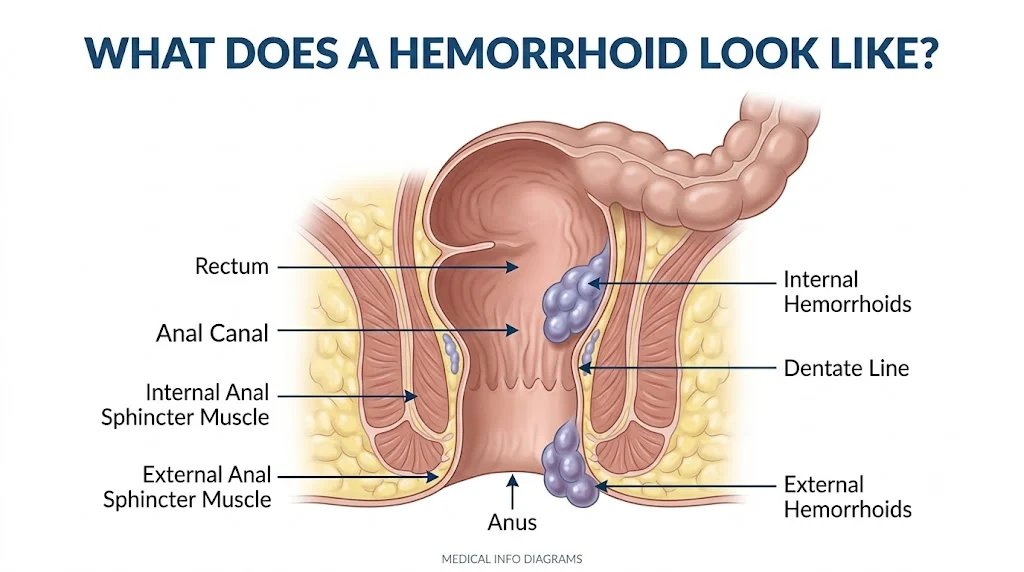
Here’s the first thing to understand. Not all hemorrhoids look the same because not all hemorrhoids form in the same place. The anal canal has a dividing line called the dentate line, and where a hemorrhoid develops relative to that line changes almost everything about how it looks and feels.
What External Hemorrhoids Look Like
External hemorrhoids form right at the anal opening, under the skin that surrounds it. Because they’re covered in regular skin (the kind packed with sensitive nerve endings) you can usually see and feel them directly.
A typical external hemorrhoid looks like a small, soft bump near the anus. Picture something close to a pea or a small grape sitting just outside the opening. The color often blends with your normal skin tone at first, sometimes appearing slightly pink or reddish if there’s irritation.
Common visual traits of external hemorrhoids:
- Round or oval shaped lump
- Located at or just outside the anal opening
- Skin colored to light pink under normal circumstances
- Soft and squishy to the touch when not thrombosed
- Can appear singly or in small clusters
- Size ranges from a small pea to roughly the size of a grape
Because the skin over external hemorrhoids has so many nerve endings, these tend to be the ones that cause noticeable pain, itching, or burning, especially after a bowel movement or long periods of sitting.
What Internal Hemorrhoids Look Like
Internal hemorrhoids are a different story entirely. These form higher up, inside the rectum, above the dentate line. That area has far fewer pain receptors, which is exactly why internal hemorrhoids are often painless even when they’re bleeding.
Under normal circumstances, you won’t actually see an internal hemorrhoid. They stay tucked inside the rectal canal. The most common giveaway is bright red blood, either on toilet paper, in the bowl, or streaked on stool.
If an internal hemorrhoid grows large enough, it can push through the anal opening during a bowel movement. This is called prolapse, and it’s the point where internal hemorrhoids finally become visible.
What a prolapsed internal hemorrhoid looks like:
- Smooth, moist, pinkish red tissue
- Rounded, somewhat shiny surface
- May retract back inside on its own or with gentle pressure
- In advanced cases, stays outside permanently
| Feature | External Hemorrhoid | Internal Hemorrhoid |
|---|---|---|
| Location | At the anal opening | Inside the rectum, above dentate line |
| Visibility | Usually visible and palpable | Often invisible unless prolapsed |
| Pain level | Can be quite painful | Usually painless unless complicated |
| Typical color | Skin toned to reddish | Pink to red, moist appearance |
| Common symptom | Itching, lump, discomfort | Painless bleeding |
Understanding this split is honestly the most useful first step in figuring out what you’re looking at, because the rest of the picture (color, texture, pain) tends to follow from whether you’re dealing with an external or internal hemorrhoid.
There’s a third category worth mentioning too. Some hemorrhoids straddle both zones, forming partly above and partly below the dentate line. Doctors sometimes call these mixed or combined hemorrhoids. Visually, they can show traits of both types at once: a portion that’s covered in regular sensitive skin and another portion with that smoother, moister internal tissue. These tend to be a bit more complicated to treat since they don’t respond to internal only or external only remedies in a consistent way.
What a Thrombosed External Hemorrhoid Looks Like
This is the one that scares people the most, and understandably so. A thrombosed external hemorrhoid happens when blood pools inside the swollen vein and forms a clot. The result is a sudden, hard lump that looks noticeably different from a regular hemorrhoid.
Where a typical external hemorrhoid is soft and skin colored, a thrombosed one turns firm and develops a dark purplish blue color. The clot underneath the skin is what causes that distinct shading, almost like a small bruise sitting right under the surface.
Key signs of a thrombosed hemorrhoid:
- Sudden appearance, often within hours
- Hard, firm texture rather than soft and squishy
- Dark purple or bluish color
- Significant pain, especially in the first one to three days
- Tenderness when sitting or touching the area
- Size can range from a small marble to something closer to a golf ball in severe cases
The pain from a thrombosed hemorrhoid tends to peak around 48 to 72 hours after it forms, then gradually eases as the body starts reabsorbing the clot. The color often shifts too, moving from deep purple toward a lighter brownish or yellowish tone as it heals.
Sometimes a thrombosed hemorrhoid ruptures on its own, releasing the clot. This usually brings quick pain relief, though it can also mean a small amount of bleeding. If this happens, keeping the area clean is important to avoid infection.
“Thrombosed hemorrhoids look alarming, but they’re rarely a medical emergency. The pain is real, though, and it’s one of the few hemorrhoid types where seeing a doctor within the first 48 hours can make a real difference in comfort.”
If a thrombosed hemorrhoid is caught early enough (within 72 hours) a doctor can sometimes remove the clot in a quick in-office procedure, which provides nearly immediate relief. After that window, most providers will recommend letting it heal on its own with supportive care.
It helps to understand why the color shows up so dramatically with thrombosed hemorrhoids compared to regular ones. Skin is somewhat translucent, especially the thin skin around the anus. When a clot forms just beneath it, that dark, dense mass of coagulated blood shows through, almost like looking at a bruise through a thin curtain. This is different from a standard hemorrhoid, where the blood is still flowing and the tissue simply looks swollen and pink or red rather than dark and fixed in place.
Doctors often describe the texture difference using a simple comparison. A regular hemorrhoid feels a bit like a small water balloon, soft and yielding under light pressure. A thrombosed hemorrhoid feels closer to a small grape that’s been left in the freezer, firm, dense, and unable to compress easily. This texture test alone, gently pressing the area, can often tell you which type you’re dealing with even before considering color.
One detail that surprises a lot of people is how quickly a thrombosed hemorrhoid can form. Unlike regular hemorrhoids that build up gradually from repeated straining over days or weeks, a thrombosed one can appear within a matter of hours, sometimes after a single intense bowel movement, a long car ride, or even heavy lifting. That suddenness is part of why it tends to alarm people so much. One moment there’s nothing unusual, and the next there’s a hard, painful lump that wasn’t there before.
Internal Hemorrhoid Appearance When Prolapsed
Internal hemorrhoids are graded on a scale of one to four based on how far they protrude. This grading system is one of the clearest ways to understand how appearance changes as severity increases.
Grade I Internal Hemorrhoids
At this stage, there’s no visible bulge at all. The hemorrhoid stays entirely inside the rectum. The only sign is usually bright red blood during or after a bowel movement. If you were searching for “what does a hemorrhoid look like” and you have a Grade I, the honest answer is that you probably won’t see anything visually different.
Grade II Internal Hemorrhoids
Here, the hemorrhoid protrudes during straining or a bowel movement but slides back in on its own once you’re done. If you happen to catch it at the right moment, it looks like a small, soft, pink bulge that briefly appears at the anal opening before retracting.
Grade III Internal Hemorrhoids
This is where things become more visible and persistent. The hemorrhoid protrudes during bowel movements or even physical activity, but it doesn’t go back in on its own. You’d need to gently push it back with a finger. Visually, it appears as a soft, rounded, pinkish red mass, often somewhat shiny or moist looking due to the mucus that naturally coats internal rectal tissue.
Grade IV Internal Hemorrhoids
At this final stage, the hemorrhoid stays prolapsed permanently and can’t be pushed back inside. This is the most visible and often the most uncomfortable stage. The tissue may appear darker, more swollen, and is more prone to irritation since it’s now constantly exposed rather than protected inside the rectal canal.
Quick summary table of internal hemorrhoid grades:
| Grade | Visible? | Appearance | Retracts on Own? |
|---|---|---|---|
| Grade I | No | Not visible externally | N/A |
| Grade II | Sometimes | Small pink bulge during straining | Yes |
| Grade III | Yes | Rounded, moist, pink to red mass | No, needs manual push |
| Grade IV | Yes, always | Larger, possibly darker, persistent | No, stays out permanently |
Knowing your grade matters because it directly affects treatment options. Grade I and II often respond well to dietary changes and topical treatments, while Grade III and IV sometimes require more involved procedures like rubber band ligation or surgical removal.
It’s worth noting that hemorrhoid grades aren’t necessarily a one way street. Someone with a Grade II hemorrhoid today doesn’t automatically progress to Grade III next month. With proper management, things like increasing fiber intake, staying hydrated, and avoiding straining, a hemorrhoid can actually improve and move backward on the grading scale over time.
Doctors typically determine the grade through a combination of patient description and a physical exam, sometimes using a small lighted scope called an anoscope to get a clear look at internal tissue that wouldn’t otherwise be visible. This exam is quick, generally not painful, and gives a much more precise answer than guessing based on symptoms alone.
Hemorrhoid Color Changes and What They Actually Mean
Color tells you a lot about what’s going on inside a hemorrhoid, and it’s one of the fastest ways to gauge severity without needing a medical exam.
Pink or red hemorrhoids usually indicate fresh, mild irritation. This is the color you’d expect from a recently formed hemorrhoid or one that’s mildly inflamed from straining or friction.
Dark purple or blue hemorrhoids almost always point to thrombosis, meaning a blood clot has formed inside the vein. As covered earlier, this color comes from pooled, clotted blood sitting just under the skin’s surface.
Bright red blood seen on toilet paper or in the toilet bowl typically comes from internal hemorrhoids and reflects fresh bleeding from the lower rectal area, close to the anus.
Dark red or maroon blood mixed into stool suggests bleeding from higher up in the digestive tract and is less typical of standard hemorrhoids. This kind of bleeding deserves medical attention since it can point to other gastrointestinal issues.
Pale, gray, or whitish discoloration is rare but important to know about. This can signal necrotic tissue, meaning the area isn’t getting enough blood flow. This is uncommon but does require prompt medical evaluation since it suggests something more serious than a typical hemorrhoid.
Here’s a simple breakdown:
- Pink to red: mild, fresh irritation
- Purple to blue: likely thrombosed
- Bright red blood: fresh, lower rectal bleeding
- Dark or maroon blood: possible higher source, worth checking
- Gray or pale: rare, needs medical attention promptly
Color alone shouldn’t be your only diagnostic tool, but combined with texture and pain level, it gives a pretty reliable picture of severity.
Friction and irritation from wiping, tight clothing, or excessive cleaning can also temporarily redden the area, sometimes making a mild hemorrhoid look more inflamed than it actually is. If color seems to fluctuate throughout the day, getting worse after activity and calming down with rest, that’s a fairly normal pattern and doesn’t necessarily indicate the hemorrhoid is worsening overall.
Hemorrhoid Size and Texture: What Counts as Normal
People often assume hemorrhoids are tiny, barely noticeable things. Sometimes that’s true. Other times, especially with thrombosed or advanced prolapsed hemorrhoids, they can grow surprisingly large.
Typical size range:
- Small hemorrhoids: about the size of a pea, roughly 5 to 8 millimeters
- Medium hemorrhoids: closer to a grape, around 1 to 2 centimeters
- Large or thrombosed hemorrhoids: can reach the size of a small marble or, in severe cases, closer to a golf ball
Texture varies just as much as size. A regular external hemorrhoid feels soft, almost like a small fluid filled cushion. Press gently and it gives a bit. A thrombosed hemorrhoid feels completely different: hard, firm, almost like a small stone sitting under the skin.
Internal hemorrhoids, when prolapsed, tend to feel soft and somewhat spongy, often with a slightly moist or mucousy surface since that tissue isn’t designed to be exposed to air regularly.
It’s also worth noting that hemorrhoids rarely show up alone. Many people develop multiple hemorrhoids at once, sometimes in a small cluster around the anal opening. This is more common with external hemorrhoids than internal ones.
Another texture clue worth mentioning involves the surface itself. A regular hemorrhoid usually has a smooth, rounded surface. If you notice anything with an irregular, lumpy, or cauliflower like texture, that’s outside the typical hemorrhoid presentation and warrants a medical opinion, since that kind of texture can sometimes indicate other skin conditions in the anal area that need a different approach entirely.
Hemorrhoid vs Skin Tag vs Anal Fissure: Telling Them Apart
This comparison comes up constantly because these three conditions genuinely do look and feel similar at a glance, but they’re treated very differently.
Anal Skin Tags
A skin tag is essentially leftover stretched skin from a previous hemorrhoid that has since healed. Once the swelling goes down, sometimes the skin doesn’t fully retract, leaving a small flap behind.
Skin tag characteristics:
- Soft, flexible flap of skin
- No pain, no bleeding under normal circumstances
- Doesn’t change in size with bowel movements
- Skin colored, matching surrounding tissue
- Stays the same day to day
Anal Fissures
A fissure is a small tear in the lining of the anus, usually caused by passing a hard or large stool. Unlike a hemorrhoid, there’s no actual lump involved.
Fissure characteristics:
- Thin, linear tear rather than a rounded lump
- Sharp, intense pain during and after bowel movements
- Bright red blood, often in small streaks
- No visible swelling or bump
- Pain can persist for several minutes after a bowel movement
Quick Comparison Table
| Condition | Lump Present? | Pain Pattern | Bleeding | Changes with BM |
|---|---|---|---|---|
| Hemorrhoid | Yes | Variable, can be painless or painful | Common | Often yes |
| Skin Tag | Yes, but soft | None | No | No |
| Anal Fissure | No | Sharp pain during and after BM | Yes, streaky | No physical change |
If you’re staring at something and trying to figure out which category it falls into, ask yourself three quick questions. Does it hurt sharply during bowel movements, or is the discomfort more of a dull ache or itch? Is there an actual round lump, or just a flap of skin? And does it bleed in streaks (more typical of fissures) or does blood coat the stool or drip separately (more typical of hemorrhoids)?
These distinctions matter because fissures often need different treatment, like stool softeners and topical numbing agents, while skin tags usually don’t need treatment at all unless they’re causing hygiene issues or discomfort.
Common Causes Behind Hemorrhoid Appearance
Understanding what causes hemorrhoids helps explain why they look the way they do and why certain people are more prone to developing them.
Straining during bowel movements is probably the single biggest contributor. Each time you push too hard, pressure builds in the rectal veins, and over time that repeated pressure causes them to swell and stretch.
Chronic constipation forces repeated straining, while chronic diarrhea causes constant irritation to the anal area, both of which contribute to hemorrhoid formation in different ways.
Pregnancy adds significant pressure to pelvic blood vessels due to the growing uterus, plus hormonal changes that relax vein walls. This is why hemorrhoids are extremely common during pregnancy and especially in the third trimester.
Prolonged sitting, particularly on hard surfaces or for extended periods (think long flights or desk jobs) restricts blood flow and adds pressure to the rectal area.
Low fiber diets lead to harder stools, which means more straining, which means more pressure on those delicate veins.
Aging plays a role too, since the tissue and muscles supporting the rectal veins naturally weaken over time, making hemorrhoids more common as people get older.
Quick list of common risk factors:
- Frequent straining during bowel movements
- Chronic constipation or diarrhea
- Pregnancy and childbirth
- Obesity
- Sitting for long periods
- Low fiber, low fluid diets
- Heavy lifting
- Family history of hemorrhoids
- Aging
None of these guarantee you’ll develop a hemorrhoid, but they do stack the odds, and most people who get hemorrhoids can point to at least one or two of these factors in their daily life.
Genetics also plays a bigger role than most people realize. If your parents dealt with hemorrhoids, there’s a reasonable chance you might be more prone to them too, partly because vein wall strength and connective tissue elasticity can run in families. This doesn’t mean hemorrhoids are inevitable if a parent had them, but it does mean it’s worth paying a bit more attention to prevention habits like fiber intake and avoiding prolonged straining if you know there’s a family history.
Heavy lifting deserves a special mention since it’s an often overlooked cause. Anyone who lifts weights regularly, works a physically demanding job, or even just lifts something heavy incorrectly can put a surprising amount of pressure on the same blood vessels affected by straining during a bowel movement.
The Valsalva maneuver, which is the technical term for holding your breath and bearing down while lifting, raises abdominal pressure in almost the exact same way that straining on the toilet does. People who lift heavy regularly without proper breathing technique sometimes develop hemorrhoids purely from this pattern, separate from any digestive issues.
Healing Stages: How Hemorrhoid Appearance Changes Over Time
Watching a hemorrhoid heal is honestly one of the more reassuring parts of dealing with one, because the visual changes follow a fairly predictable pattern.
Stage one, the acute phase, happens in the first one to three days. Swelling peaks here, and color is usually at its most intense, whether that’s deep red for irritated tissue or dark purple for a thrombosed clot.
Stage two, gradual reduction, typically spans days three through seven. Swelling starts to go down, and pain begins easing noticeably. Color often softens, moving from a deep red or purple toward lighter pink or brownish tones.
Stage three, continued shrinking, usually covers the second week. The lump becomes noticeably smaller and softer, and any tenderness mostly fades unless there’s ongoing irritation from bowel movements.
Stage four, resolution, can take anywhere from two to six weeks depending on severity. The hemorrhoid either flattens out completely or, in some cases, leaves behind a small skin tag as a remnant.
Realistic healing timeline overview:
| Days | What’s Happening | Visual Changes |
|---|---|---|
| 1 to 3 | Acute swelling, peak discomfort | Bright red or dark purple, firm if thrombosed |
| 3 to 7 | Swelling begins reducing | Color softens, less tender |
| 7 to 14 | Continued shrinking | Smaller, softer, less noticeable |
| 14 to 42 | Full resolution | Flattens out or leaves minor skin tag |
It’s worth mentioning that this timeline assumes basic home care like sitz baths, fiber intake, and avoiding further straining. Without any care at all, healing can take significantly longer, and recurring strain can actually prevent a hemorrhoid from fully resolving.
Signs that healing is going well include gradually decreasing size, softening texture, and steadily reducing pain. On the flip side, signs that something isn’t improving as expected include increasing size, new or worsening pain after the first week, spreading redness, or fever, all of which point toward needing medical evaluation rather than continued home treatment.
Home care genuinely makes a measurable difference in how that healing timeline plays out. Sitz baths, which just means sitting in a few inches of warm water for ten to fifteen minutes a few times a day, help relax the muscles around the anus and improve blood flow to the area, both of which speed up the natural healing process. Adding fiber gradually, whether through food sources like fruits, vegetables, and whole grains, or through a fiber supplement, softens stool and reduces the straining that originally caused the problem.
Staying hydrated matters just as much as fiber, since fiber without enough water can actually make stool harder rather than softer. A simple rule of thumb many doctors mention is aiming for at least eight glasses of water a day while increasing fiber, since the two work together rather than independently.
Topical treatments, including over the counter creams and suppositories containing ingredients like witch hazel or hydrocortisone, can reduce itching and inflammation, though they don’t necessarily speed up the underlying healing process by much. They’re more about comfort during the healing window than about shortening it.
When to See a Doctor: Signs You Shouldn’t Self Diagnose
Most hemorrhoids genuinely are manageable at home, but there are specific warning signs that mean it’s time to stop relying on self diagnosis and get an actual medical opinion.
See a doctor promptly if you notice:
- Heavy or persistent rectal bleeding, especially if it’s more than light spotting
- Severe pain that doesn’t start improving within a few days
- Fever or chills alongside anal pain or swelling, which can indicate infection
- A lump that appears gray, black, or is rapidly increasing in size
- Bleeding that doesn’t fit typical hemorrhoid patterns, such as dark, tarry stool
- A change in bowel habits lasting more than a few weeks
- Unexplained weight loss alongside rectal symptoms
These signs don’t automatically mean something serious is happening, but they’re exactly the kind of details that deserve a professional exam rather than guesswork. Rectal bleeding in particular, while overwhelmingly caused by hemorrhoids in most cases, should always be evaluated at least once to rule out other conditions, especially in anyone over 45 or with a family history of colorectal issues.
A doctor can perform a quick visual exam and sometimes an internal exam to confirm exactly what’s going on. This isn’t something to feel embarrassed about either. Colorectal specialists and primary care doctors see this exact issue constantly, and getting checked takes just a few minutes.
Quick Self Check Guide
Here’s a simple checklist you can run through if you’re trying to figure out what you’re dealing with.
Ask yourself the following:
- Is there a visible or palpable lump near the anal opening?
- Is the lump soft and skin colored, or hard and purplish?
- Does it hurt constantly, only during bowel movements, or not at all?
- Is there bleeding, and if so, is it bright red or darker in color?
- Did the lump appear suddenly within hours, or has it grown gradually over days?
- Does anything protrude during straining and then retract afterward?
- Has the lump remained the same size for more than two weeks without improvement?
See a doctor if any of these apply:
- Bleeding is heavy or doesn’t stop with light pressure
- Pain is severe and unmanageable with basic care
- You notice fever, chills, or spreading redness
- The lump is gray, black, or rapidly growing
- Symptoms last beyond two to three weeks despite home treatment
- You’re over 45 and experiencing rectal bleeding for the first time
This checklist won’t replace an actual medical exam, but it’s a solid starting point for understanding the severity of what you’re dealing with and whether it’s reasonable to try home treatment first.
FAQs
What color is a hemorrhoid supposed to be?
Most hemorrhoids start out pink to red. If a clot forms inside, the color shifts to dark purple or blue. As healing progresses, color generally lightens back toward a normal skin tone or fades into a brownish shade before disappearing completely.
Can a hemorrhoid look like a skin tag?
Yes, and this confusion happens often. A healed hemorrhoid can leave behind loose skin that looks just like a skin tag. The key difference is that skin tags don’t swell, hurt, or bleed, while active hemorrhoids typically do at least one of those things.
Do hemorrhoids always look the same?
No. Appearance depends heavily on type (internal versus external), whether a clot has formed, and what stage of healing it’s in. A fresh external hemorrhoid looks completely different from a thrombosed one, which in turn looks different from a healing one two weeks later.
How big can a hemorrhoid get?
Most stay small, around the size of a pea to a grape. Thrombosed or severely prolapsed hemorrhoids can grow larger, sometimes reaching the size of a marble or, in more extreme cases, even larger. Size alone doesn’t always correlate with how much discomfort it causes.
What does a healing hemorrhoid look like?
A healing hemorrhoid gradually shrinks in size, softens in texture, and lightens in color. Pain and tenderness reduce steadily. By the two to four week mark, most hemorrhoids either flatten completely or leave behind a small, painless skin tag.
Conclusion
Hemorrhoids look different depending on where they form, how severe they are, and what stage of healing they’re at, which is exactly why so many people feel uncertain about what they’re seeing. The good news is that once you understand the basic visual markers (color, size, texture, and location) it becomes much easier to figure out whether you’re dealing with something minor or something that needs medical attention.
Most hemorrhoids resolve within a few weeks with simple home care: more fiber, more water, less straining, and a bit of patience. But don’t ignore the warning signs covered above. If bleeding is heavy, pain is severe, or anything looks unusual compared to what’s described here, get it checked out. A quick visit to a doctor is far better than weeks of uncertainty.
Discover More Related Articles:
- Razzmatazz Meaning | From Showbiz to Everyday Speech In 2026
- Luxor Meaning | Everything About Egypt’s Famous City In 2026
- Mogging Meaning | Dating, Memes & Internet Culture In 2026