
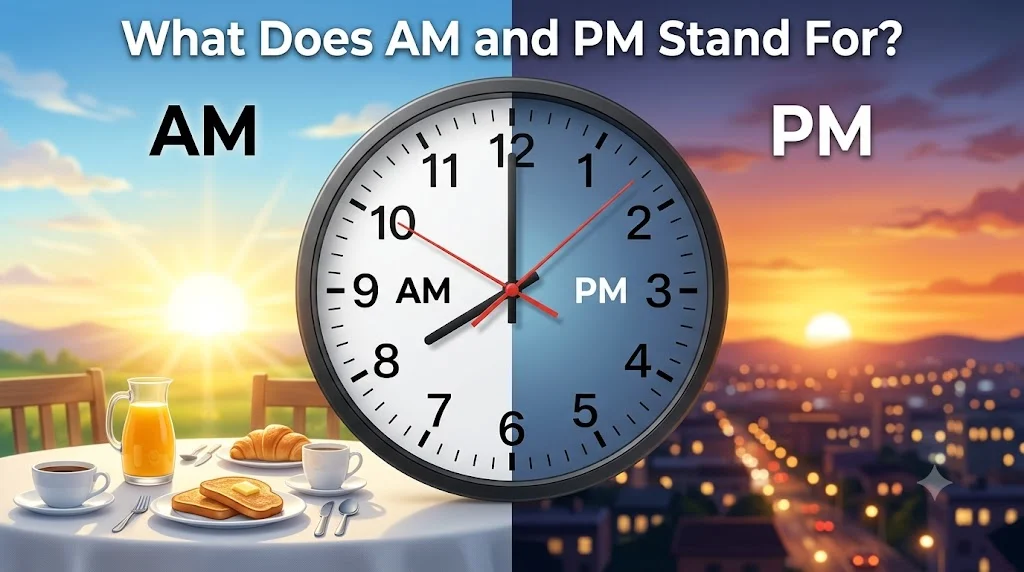

Definition
AM and PM are abbreviations used in the 12-hour clock system to distinguish between the two halves of the day.
PM stands for Post Meridiem, a Latin phrase meaning “after midday” or “after noon.”
AM stands for Ante Meridiem, a Latin phrase meaning “before midday” or “before noon.”
Pop quiz: what time is 12 AM? If you paused even for a second, you’re not alone. Millions of people glance at a clock every single day and still trip over this exact question. It’s one of those oddities of daily life that nobody really teaches you in school, yet everyone is expected to just know.
Here’s the short answer before we get into the good stuff. AM stands for Ante Meridiem, a Latin phrase meaning “before midday.” PM stands for Post Meridiem, meaning “after midday.” That’s it. That’s the whole secret. The dividing line between the two isn’t midnight, like a lot of people assume. It’s noon.
Now let’s actually unpack why this system exists, where it came from, and why it trips up so many smart people. By the end of this guide, you’ll never second guess a noon or midnight appointment again, and you’ll actually understand the logic behind a labeling system most of us use dozens of times a day without ever questioning it.
Where AM and PM Actually Come From
The terms AM and PM didn’t get invented by some clock company trying to sell watches. They come straight from Latin, a language that shaped a huge chunk of how we measure and describe time today.
The word “meridies” in Latin means midday or noon. Break it down further and you’ll find “medius,” meaning middle, fused with “dies,” meaning day. Literally, meridies translates to “middle of the day.” Add the prefix “ante,” meaning before, and you get ante meridiem, or before midday. Swap that prefix for “post,” meaning after, and you get post meridiem, or after midday.
The Romans tracked time using the sun’s position in the sky. Noon marked the moment the sun hit its highest point, directly overhead. Everything before that moment fell under ante meridiem. Everything after fell under post meridiem. Simple, sun-based logic that’s held up for roughly two thousand years.
What’s interesting is that English never bothered translating these terms the way it did with other time words. We say “midnight” and “noon” in plain English, but we kept AM and PM in their original Latin form. Maybe it’s because the abbreviations were just too convenient to replace, or maybe nobody got around to inventing an English version that stuck. Either way, you’re using a tiny piece of ancient Rome every time you check your phone.
“Ante meridiem and post meridiem aren’t just abbreviations. They’re a 2,000-year-old solution to a problem every civilization with a clock eventually had to solve: how do you talk about time without constant confusion?”
This Latin-based system eventually spread through Europe and into English-speaking countries, where it became the standard for civil timekeeping. By the time mechanical clocks showed up in medieval Europe, the 12-hour format with AM and PM labels was already baked into how people thought about their day.
It’s worth pointing out that the 12-hour split itself goes back even further than the Romans. Ancient Egyptians are credited with dividing daylight into 12 segments and nighttime into another 12 segments, giving us the 24-hour day structure we still use today. Sundials measured the daytime hours, while early water clocks, called clepsydras, tracked the nighttime hours when the sun wasn’t around to cast a shadow. The Egyptians weren’t thinking in terms of AM and PM the way we do now, but they laid the numerical groundwork that the Romans later built on with their Latin labeling system.
By the 1500s and 1600s, as mechanical clocks became more common in European towns and households, the 12-hour AM/PM format had already cemented itself as the default way ordinary people talked about time.
The 12-Hour Clock, Explained Simply
Here’s the thing about a 24-hour day: humans don’t naturally think in 24-hour blocks. We think in cycles. Morning, afternoon, evening, night. So instead of counting straight through from 1 to 24, the 12-hour clock splits the day into two neat halves.
The first half runs from midnight to noon. That’s your AM block. The second half runs from noon to midnight. That’s PM. Each half contains exactly 12 hours, and the numbers reset and repeat: 1, 2, 3, all the way to 12, twice a day.
Think about why this matters. Without AM or PM attached, the number “7:00” is basically useless information. Is that breakfast time or dinner time? Are you waking up or winding down? The AM/PM tag removes that ambiguity in two letters.
Here’s how the structure breaks down:
| Time Block | Hours Covered | Label |
|---|---|---|
| Late night into early morning | 12:00 to 11:59 | AM |
| Midday into night | 12:00 to 11:59 | PM |
Compare that to the 24-hour clock, sometimes called military time or international time, which counts straight through without ever resetting. Instead of “8:00 PM,” you’d write “20:00.” Instead of “1:00 AM,” you’d write “01:00.” No labels needed because every hour gets its own unique number.
Both systems tell you the exact same time. They just communicate it differently. The 12-hour clock leans on cultural shorthand (AM means morning-ish, PM means evening-ish), while the 24-hour clock leans on pure numerical sequence.
This is actually one of the more practical reasons the AM/PM system has survived for so long despite its quirks. Analog clocks, the kind with physical hands sweeping around a dial, are fundamentally built around a 12-hour cycle. Designing an analog clock face with 24 numbers crammed onto it would be cluttered and hard to read at a glance. The 12-hour format keeps the clock face clean and the numbers large enough to read quickly, even from across a room.
Why the US Still Uses 12-Hour Time
You might wonder why the United States, along with a handful of other countries, stuck with the 12-hour AM/PM system while most of the world moved toward 24-hour time for everyday use. Honestly, it comes down to habit more than logic. Once a country builds its clocks, watches, schedules, and culture around a system, switching becomes more trouble than it’s worth. The 12-hour format isn’t more accurate or more efficient. It’s just familiar, and familiarity is a powerful thing when it comes to something as ingrained as telling time.
The Midnight and Noon Problem
Alright, here’s where things get genuinely tricky, and where almost everyone stumbles at least once.
Quick gut check: is 12:00 AM in the morning or at night? If you said morning, that’s actually correct, but here’s the twist. 12:00 AM is midnight, the very start of a new day.
Now flip it. Is 12:00 PM morning or afternoon? 12:00 PM is noon, smack in the middle of the day.
Why does this feel so backward? Let’s walk through the logic.
Remember that AM means “before midday” and PM means “after midday.” Midnight technically sits exactly 12 hours before noon, which mathematically should make it AM, since it falls before the midday marker. And noon itself is the midday marker, the exact moment the meridiem flips from ante to post. So technically, noon doesn’t perfectly fit into either ante or post meridiem since it IS the meridiem. By convention, though, we label it 12:00 PM.
Here’s a cleaner way to remember it:
- 12:00 AM = the stroke of midnight, the very beginning of the day
- 12:01 AM = one minute into the new day, still early morning
- 11:59 AM = one minute before noon, still morning
- 12:00 PM = noon, the exact middle of the day
- 12:01 PM = one minute into the afternoon
- 11:59 PM = one minute before the next midnight
So why does this confuse so many people? Because our brains expect “12” to behave like a starting point for AM hours and an ending point for PM hours, almost like an odometer rolling over. But midnight is actually the start of the AM block, not its end, and noon is the start of the PM block, not its end. That mental mismatch is exactly where the confusion creeps in.
Why Some Style Guides Avoid 12 AM and 12 PM Entirely
Because this confusion is so widespread, a lot of professional style guides recommend sidestepping the issue altogether. Instead of writing “12:00 AM” or “12:00 PM,” they suggest writing “12:00 midnight” and “12:00 noon” directly. Airlines, hospitals, and legal documents often use this approach since a misread midnight or noon can cause real problems, like a flight booked for the wrong day or a contract deadline interpreted incorrectly.
If you’re ever writing something where precision really matters, like a meeting invite, a flight itinerary, or a legal document, consider skipping the AM/PM label entirely for these two specific hours and just spelling out “noon” or “midnight” instead. It removes all doubt.
AM/PM Chart: 24-Hour Time vs. 12-Hour Time
Sometimes the clearest way to understand something is to see it laid out side by side. Here’s a full breakdown comparing every hour of the day in both formats.
| 24-Hour Time | 12-Hour Time (AM/PM) |
|---|---|
| 00:00 | 12:00 AM (midnight) |
| 01:00 | 1:00 AM |
| 02:00 | 2:00 AM |
| 03:00 | 3:00 AM |
| 04:00 | 4:00 AM |
| 05:00 | 5:00 AM |
| 06:00 | 6:00 AM |
| 07:00 | 7:00 AM |
| 08:00 | 8:00 AM |
| 09:00 | 9:00 AM |
| 10:00 | 10:00 AM |
| 11:00 | 11:00 AM |
| 12:00 | 12:00 PM (noon) |
| 13:00 | 1:00 PM |
| 14:00 | 2:00 PM |
| 15:00 | 3:00 PM |
| 16:00 | 4:00 PM |
| 17:00 | 5:00 PM |
| 18:00 | 6:00 PM |
| 19:00 | 7:00 PM |
| 20:00 | 8:00 PM |
| 21:00 | 9:00 PM |
| 22:00 | 10:00 PM |
| 23:00 | 11:00 PM |
Bookmark this table. Screenshot it. Stick it on your fridge if you need to. It’s the single most useful reference for converting between the two formats without doing mental math every time.
Common Mistakes People Make With AM and PM
Even people who’ve used AM and PM their entire lives slip up sometimes. Here are the mistakes that show up most often, plus how to avoid each one.
Writing 12:00 AM when they mean noon. This is the single most common error. Someone wants to say “the deadline is at noon” but types “12:00 AM” instead, accidentally setting the deadline for the start of the day instead of the middle. Always double check noon and midnight specifically since these two are the easiest to flip.
Calling 12:30 AM “morning.” Technically, anything between midnight and noon falls under AM, which loosely maps to “morning” in casual conversation. But say “I’ll see you at 12:30 in the morning” out loud and it sounds strange, doesn’t it? Most people reserve the word “morning” for hours closer to sunrise, even though 12:30 AM technically qualifies. This is more of a language quirk than a hard rule, but it’s worth knowing so your wording doesn’t confuse the listener.
Mixing 12-hour and 24-hour notation in the same document. If you’re writing a schedule, pick one format and stick with it. Switching between “3:00 PM” and “15:00” in the same paragraph forces the reader to constantly convert between systems, which slows everyone down and increases the odds of a mistake.
Forgetting the AM/PM label entirely. Writing just “7:00” in a text message to a friend might be fine since context usually fills in the gap. But in a formal email, a flight confirmation, or a meeting invite, dropping the AM/PM label can cause real scheduling chaos.
Using lowercase and uppercase inconsistently. You’ll see “AM,” “am,” “a.m.,” and “A.M.” all used interchangeably. None of these are technically wrong, but consistency matters for professional writing. Most modern style guides, including the Associated Press style guide, recommend lowercase with periods: a.m. and p.m. Tech and casual writing tends to favor the cleaner uppercase version without periods: AM and PM. Pick a style and stay consistent throughout whatever you’re writing.
How AM and PM Show Up in Everyday Life
Once you start paying attention, AM and PM are everywhere, woven into far more than just the clock on your wall. Understanding the small variations in how different industries and tools handle this labeling can save you from real confusion down the road.
On your phone and computer. Most smartphones default to 12-hour AM/PM display in the US, though nearly every device lets you switch to 24-hour time in the settings menu. International travelers and people working in technical fields often flip this setting specifically to avoid the noon and midnight ambiguity discussed earlier.
On medication labels and prescriptions. Pharmacies and hospitals frequently use 24-hour time on official paperwork specifically to eliminate the AM/PM confusion risk. Giving a patient medication at the wrong hour because of a midnight or noon mix-up isn’t a small error, it’s potentially dangerous, so healthcare settings lean toward the format with zero ambiguity built in.
This patchwork of usage isn’t random. Each field gravitates toward whichever format reduces the risk of costly mistakes while still matching what its audience expects to see. For everyday casual use, AM and PM remain comfortable and familiar. For situations where a misread could cause real harm or confusion, the 24-hour format steps in instead.
Both formats measure the exact same 24 hours in a day. The difference is purely how that information gets communicated.
| Feature | 12-Hour Clock (AM/PM) | 24-Hour Clock |
|---|---|---|
| Common usage | United States, Canada, Australia, parts of the UK | Most of Europe, Asia, Latin America, and globally in military, aviation, and medical fields |
| Format style | Resets at 12, uses AM/PM labels | Counts straight through from 00 to 23 |
| Ambiguity risk | Higher, especially around noon and midnight | Lower, since every hour has a unique number |
| Common in | Everyday casual conversation, clocks, watches | Transportation schedules, scientific data, military operations, hospitals |
Here’s a real comparison of the same times written both ways:
- 3:00 PM = 15:00
- 9:00 AM = 09:00
- 11:45 PM = 23:45
- 6:30 AM = 06:30
- 12:00 PM (noon) = 12:00
- 12:00 AM (midnight) = 00:00
Notice how the 24-hour format never needs a label. Once you hit 13:00, you automatically know it’s the afternoon, since AM hours never go past 12. That built-in clarity is exactly why fields where mistakes are costly, like aviation, medicine, and the military, almost universally use the 24-hour system. A pilot scheduling a flight at “3:00” with no other context could mean disaster. A pilot scheduling a flight at “15:00” leaves zero room for misinterpretation.
That said, the 12-hour clock isn’t going anywhere in everyday life, especially in the US. It’s woven into how people talk, how analog clocks are built, and how casual scheduling works. Both systems serve their purpose well. It’s really just about matching the right format to the right situation.
How the AM/PM System Survived the Digital Age
You’d think digital clocks, with their precise glowing numbers, might have killed off the AM/PM format in favor of something cleaner. Instead, the opposite happened. Digital clocks actually made the AM/PM system more visible than ever, since now the label sits right there in tiny letters next to the time instead of being implied by an analog clock’s position.
Early digital clocks and watches in the 1970s and 1980s had to make a choice: display time in 12-hour format with a small AM or PM indicator, or display it in full 24-hour format. Manufacturers selling primarily to American consumers overwhelmingly chose the 12-hour option, since that’s what their customers already understood intuitively from a lifetime of reading analog clocks. That early manufacturing decision rippled forward into how computers, microwaves, car dashboards, and eventually smartphones default their time displays even today.
Smartphones changed the game slightly by giving users a toggle. Open the settings on nearly any modern phone and you’ll find an option to switch between 12-hour and 24-hour time display. This flexibility means the AM/PM debate isn’t really a debate at all anymore. It’s a preference, and most operating systems let you pick whichever format feels more natural to you, often based on your region’s default setting when you first set up the device.
Smartwatches followed a similar pattern, often defaulting to whatever format matches your phone’s settings. Even voice assistants like the ones built into smart speakers will say “your alarm is set for seven AM” rather than “your alarm is set for oh seven hundred,” at least for users in regions where the 12-hour format remains the cultural norm.
AM and PM Around the World
Even though AM and PM trace back to Latin, the way different cultures handle the morning and afternoon split varies more than you might expect. Looking at how other languages tackle this same problem reveals just how practical the AM/PM solution actually is.
In Spanish, people often use “de la mañana” (of the morning), “de la tarde” (of the afternoon), and “de la noche” (of the night) instead of a direct AM/PM equivalent. This gives Spanish speakers three categories instead of two, splitting the day a bit more naturally around how people actually experience daylight and darkness rather than rigidly dividing everything at noon.
French follows a similar pattern with “du matin” (of the morning) and “du soir” (of the evening), though French speakers commonly default to the 24-hour clock for anything formal, reserving the morning and evening phrases mostly for casual conversation.
Mandarin Chinese uses time markers like “shàngwǔ” (morning, literally “above noon”) and “xiàwǔ” (afternoon, literally “below noon”), which actually echoes the same ante meridiem and post meridiem logic the Romans used, just expressed through completely different vocabulary and writing.
Japanese similarly uses “gozen” (before noon) and “gogo” (after noon), a near perfect linguistic parallel to AM and PM despite developing independently through a totally different language family.
Wrapping Up
So there you have it. AM stands for ante meridiem, meaning before midday, and PM stands for post meridiem, meaning after midday, with noon as the dividing line that splits the two. Midnight kicks off the AM block as 12:00 AM, and noon kicks off the PM block as 12:00 PM, a small but important distinction that trips up even the most clock-savvy among us.
This whole system, born out of Roman sundials and Latin vocabulary, has quietly survived mechanical clocks, digital displays, smartphones, and smartwatches without ever needing a major overhaul. That kind of staying power says something about how genuinely useful a simple “before midday, after midday” split really is, even with its quirky midnight and noon edge cases.
Next time someone hesitates over whether a meeting at “12:00” means lunch or the literal stroke of midnight, you’ll know exactly how to clear things up. And if you’re ever in doubt, just write out “noon” or “midnight” instead of relying on the AM/PM label for those two specific hours. Simple fix, zero confusion, and now you’ve got two thousand years of Roman timekeeping logic to back you up.
FAQs
1. What do AM and PM stand for?
AM stands for Ante Meridiem (before midday), and PM stands for Post Meridiem (after midday). These Latin terms are used in the 12-hour clock system.
2. What time does AM start and end?
AM begins at 12:00 midnight and ends at 11:59 in the morning, just before noon.
3. What time does PM start and end?
PM starts at 12:00 noon and continues until 11:59 at night, just before midnight.
4. Is 12:00 noon AM or PM?
12:00 noon is PM because it marks the start of the afternoon period.
5. Is 12:00 midnight AM or PM?
12:00 midnight is generally considered AM because it marks the beginning of a new day.
6. Why do we use AM and PM?
AM and PM help distinguish between morning and afternoon/evening times in the 12-hour clock format, avoiding confusion between identical hour numbers.
7. Which countries commonly use AM and PM?
Countries such as the United States, Canada, and Australia frequently use the 12-hour clock with AM and PM.
8. What is the difference between AM and PM?
AM refers to the time from midnight to noon, while PM refers to the time from noon to midnight. This distinction helps identify whether a time occurs in the morning or later in the day.
Conclusion
AM and PM are abbreviations derived from Latin that help distinguish between the two halves of a 24-hour day. AM refers to the time from midnight to just before noon, while PM covers the period from noon to just before midnight. This system makes it easier to tell morning and afternoon/evening times apart when using the 12-hour clock format.
Understanding the difference between AM and PM is important for scheduling appointments, setting alarms, planning meetings, and avoiding time-related confusion. While many countries use the 24-hour clock, the AM/PM format remains widely used in everyday life around the world.
Now that you know what AM and PM stand for, reading and communicating time becomes much simpler. Whether you’re checking a clock, booking an event, or coordinating with others, knowing the meaning of these abbreviations helps ensure you’re always on time.
Discover More Related Articles:
- Razzmatazz Meaning | From Showbiz to Everyday Speech In 2026
- Luxor Meaning | Everything About Egypt’s Famous City In 2026
- Mogging Meaning | Dating, Memes & Internet Culture In 2026