
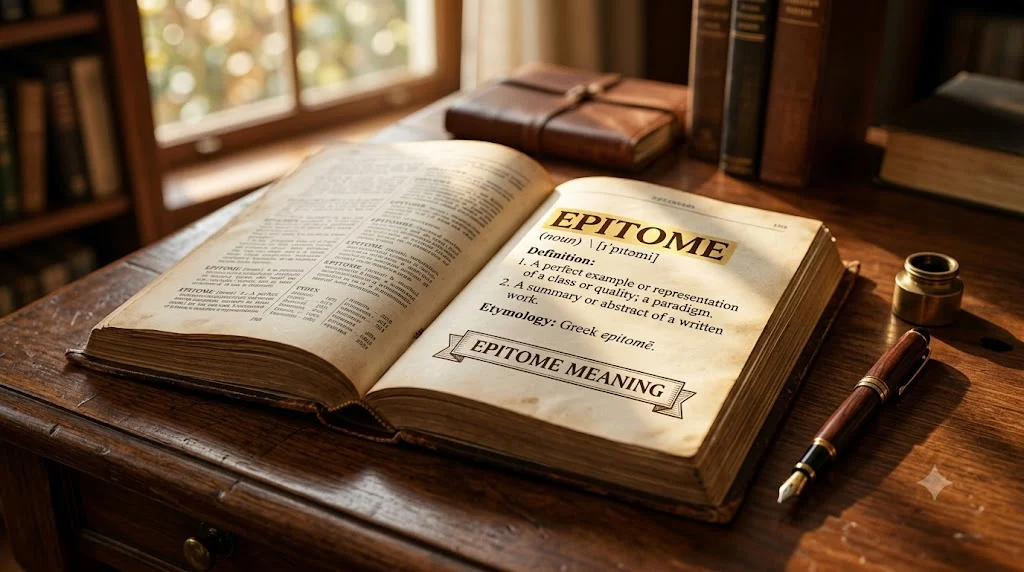

Definition
An epitome is a person or thing that is considered the perfect example or ideal representation of a particular quality, type, or characteristic.
You’ve heard it before. Someone walks into a room and a friend leans over and whispers, “She’s the epitome of confidence.” You nodded. You probably understood. But do you know exactly what that word is doing in that sentence and why “epitome” hit harder than just saying “a great example”?Why Everyone Mispronounces This Word
That’s what this guide is for.
Whether you’re a student building your vocabulary, a writer sharpening your craft, or simply someone who wants to use words correctly, you’re in the right place. By the end, you won’t just know the epitome definition you’ll understand when to use it, how to pronounce it, where it came from, and what makes it different from every word that looks similar.
Let’s get into it.
What Does Epitome Mean?
Here’s the short version, in plain English.
Epitome means the most perfect or most representative example of something. It’s the one thing or person that captures the very essence of a quality so completely that you couldn’t find a better example if you tried.
Think of it this way. If someone says a person is “a great example of kindness,” that’s a compliment. But if they say that person is “the epitome of kindness,” they’re saying something stronger. They’re saying: this person doesn’t just show kindness they are kindness, distilled into human form.
That’s the power of this word. It doesn’t just point to an example. It points to the example.
| Feature | Detail |
|---|---|
| Word | Epitome |
| Part of Speech | Noun |
| Pronunciation | ih-PIT-uh-mee |
| Origin | Greek and Latin |
| Core Meaning | The most perfect or representative example of something |
| Always Used With | “the epitome of ___” |
| Register | Formal, literary, professional |
The Full Epitome Definition, Unpacked
The dictionary gives you the bones. This section gives you the muscle.
Merriam-Webster defines epitome as “a typical or ideal example” and “a condensed account.” Oxford’s take is similar: “a person or thing that is a perfect example of a particular quality or type.”
But here’s what those definitions don’t fully explain.
Epitome implies distillation. It doesn’t just mean “a good example.” It means the example that captures the soul of something. The thing that, if you had to explain a quality to someone who’d never encountered it, you’d point to and say, “That. Right there.”
Consider the difference:
“This painting is an example of modern art.”
vs.
“This painting is the epitome of modern art.”
The first sentence places the painting in a category. The second sentence crowns it. It says: of all the modern art in the world, this one is what modern art is about.
That distinction matters especially in writing.
Epitome also carries a slightly formal, even literary weight. You won’t hear it in casual small talk as often as you’d see it in journalism, academic writing, professional communication, or fiction. But it does appear in everyday speech and when it does, it lands with precision.
One more thing worth knowing: epitome works for both positive and negative qualities. People often assume it’s only a compliment. It isn’t. You can say something is “the epitome of poor judgment” just as correctly as you’d call someone “the epitome of grace.”
How to Pronounce Epitome
This is one of the most misread words in the English language. Don’t feel bad if you’ve been saying it wrong you’re in good company.
Correct pronunciation: ih-PIT-uh-mee
Say it in four syllables:
ih · PIT · uh · mee
The stress falls on the second syllable: PIT.
Here’s the mistake most people make. They see “epitome” and read it like “epitome rhymes with home.” So they say EP-ih-tome. That’s wrong but it’s completely understandable. English spelling doesn’t always match pronunciation, and this word is a perfect example of that.
A memory trick that actually works:
Try saying: “I pit a me.” Weird sentence. Useful trick. It gives you the four syllables and the stress in exactly the right place: ih-PIT-uh-mee.
Another way to think about it: say the word “epitomize” the verb form out loud. Most people get that one right. Now drop the “-ize” and you’re most of the way there.
For confirmation, Merriam-Webster’s online dictionary has an audio button right on the word’s page. It’s worth a quick listen the first time.
Common pronunciation mistakes:
| Incorrect | Correct |
|---|---|
| EP-ih-tome (3 syllables, rhymes with “home”) | ih-PIT-uh-mee (4 syllables) |
| ep-ih-TOH-mee (stress on third syllable) | ih-PIT-uh-mee (stress on second) |
| EE-pih-tome | ih-PIT-uh-mee |
Once you hear it correctly, it sticks. And once it sticks, you’ll never mishear it again.
Epitome Origin and Etymology: Where Did This Word Come From?
Words carry history. Knowing a word’s origin often makes its meaning click in a way no definition can.
Epitome comes from Greek. The original Greek word was epitomē (ἐπιτομή), which meant “abridgment” literally, “a cutting short.” It came from the prefix epi- (meaning “upon” or “into”) combined with temnein (meaning “to cut”).
So in its earliest form, an epitome was a condensed version of something. A summary. A digest. If you took a long text and cut it down to its essential parts, you had an epitome of that text.
Latin borrowed the word with the same meaning. Roman writers used it to describe shortened versions of longer works. In fact, many historical texts survive today only because someone wrote an epitome of them a condensed summary that outlasted the original.
Then English adopted it, and something interesting happened. The meaning gradually shifted.
Over time, instead of meaning “a condensed version,” epitome began to mean “the thing that best represents the essence of something.” The idea of compression stayed but it became less about shortening a document and more about distilling a quality to its purest form.
By the 17th and 18th centuries, English writers were using it in the modern sense we recognize today.
Etymology at a glance:
| Stage | Form | Meaning |
|---|---|---|
| Ancient Greek | epitomē | Abridgment, a cutting short |
| Latin | epitome | Condensed version, summary |
| Early Modern English | epitome | Summary; representative example |
| Modern English | epitome | The most perfect or representative example |
This evolution is actually quite beautiful. The word that once meant “cutting something down to its essence” now describes something that is the essence. The concept stayed intact only the application changed.
Epitome in a Sentence: Real Examples Across Different Contexts
The best way to truly understand any word is to see it in action. Here are real, varied sentences that show exactly how epitome works across different topics and tones.
Everyday life:
- “That Sunday morning, with coffee in hand and no notifications, was the epitome of peace.”
- “His cramped studio apartment was somehow the epitome of organized chaos.”
- “That road trip was the epitome of adventure on a budget.”
Character and personality:
- “Her patience with her students made her the epitome of a dedicated teacher.”
- “He never raised his voice, never blamed others the very epitome of emotional maturity.”
- “Their grandmother was the epitome of quiet strength.”
Professional and formal settings:
- “The company’s response to the crisis was the epitome of poor crisis management.”
- “Her presentation was the epitome of preparation meeting opportunity.”
- “That contract clause was the epitome of legal ambiguity.”
Art, culture, and history:
- “Miles Davis was, to many jazz lovers, the epitome of cool.”
- “The Taj Mahal stands as the epitome of Mughal architectural beauty.”
- “Her debut novel became the epitome of the coming-of-age genre.”
Notice something? Epitome appears equally at home describing a person, a place, an object, or even an abstract moment. It’s a versatile word as long as you’re pointing to the most defining example of something.
Common Phrases Using Epitome
Some phrases with “epitome” have become fixtures in the English language. Here’s a breakdown of the most commonly used ones and what each really conveys.
Epitome of beauty When someone or something is called the epitome of beauty, it means they don’t just look attractive they represent beauty in its most ideal form. It’s the face, the landscape, or the artwork that makes people pause.
Epitome of success This goes beyond achievement. The epitome of success means someone whose life, career, or results capture everything people mean when they talk about succeeding. It’s not just reaching the top it’s defining what the top looks like.
Epitome of elegance Elegance that’s not just present but concentrated. The person or thing that, when you try to explain elegance to someone, you’d use as your reference point.
Epitome of excellence The gold standard. The benchmark. The thing others are measured against.
Epitome of kindness Not someone who does kind things someone who makes you understand what kindness actually is just by watching them.
Epitome of perfection Rarely used literally. More often, it’s an expression of extreme admiration “That meal was the epitome of perfection” means it couldn’t have been better.
Epitome of leadership Someone who doesn’t just lead but defines what leadership should look like. Think less about titles and more about impact.
Epitome of grace Grace here can mean physical elegance or dignified composure under pressure. Either way, it’s the ultimate version of it.
Epitome of professionalism The person who shows up prepared, composed, respectful, and effective every single time. No drama. Just results.
Epitome of intelligence Not just smart the kind of mind that makes you rethink what intelligence even means.
Epitome Synonyms: Close Words With Important Differences
Knowing synonyms is useful. Knowing how they differ from each other is genuinely powerful. Here’s the full breakdown.
| Synonym | Core Meaning | Key Difference from Epitome |
|---|---|---|
| Embodiment | A living or physical representation of a quality | Emphasizes physical or concrete expression; epitome is more abstract |
| Paragon | A model of excellence, especially moral | Implies virtue and admirable qualities specifically |
| Quintessence | The purest, most concentrated form of something | Focuses on purity and concentration; epitome focuses on representativeness |
| Archetype | The original model that othersare patterned after | Suggests a template or prototype; epitome suggests the best current example |
| Exemplar | A model worthy of imitation | Slightly more academic; implies others should follow the example |
| Personification | A person who so completely represents a quality they seem to be it | Stronger claim; often used for abstract qualities made human |
| Paradigm | A standard model or pattern | Common in academic and scientific writing; more technical |
| Paragon | A person of outstanding qualities | Carries a slightly old-fashioned or formal tone |
When should you choose “epitome” over its synonyms?
Use epitome when you want to say something is the single most defining or representative example of a quality whether positive or negative. It’s your word when nothing else quite captures the “this is what that looks like in its fullest form” feeling.
Use embodiment when the representative quality is physical or concrete when someone lives and breathes a characteristic.
Use quintessence when you want to emphasize purity the undiluted, unadulterated version of something.
Epitome Antonyms: The Other Side of the Coin
Epitome doesn’t have one clean antonym it depends on context. But here are the words that function as opposites in different situations.
| Antonym | How It Contrasts with Epitome |
|---|---|
| Antithesis | The direct opposite of something; where epitome is the purest example, antithesis is the exact reverse |
| Anomaly | Something that doesn’t fit the pattern at all |
| Exception | The thing that breaks the rule, rather than defining it |
| Deviation | A departure from the standard epitome represents |
| Inferior example | Simply a poor representation of the quality in question |
| Contrast | Used when setting up an opposing idea |
Here’s a useful example to feel the difference:
“If Gandhi was the epitome of peaceful resistance, violence in pursuit of political goals is its antithesis.”
The contrast is stark and that sharpness is exactly what antithesis delivers. When you want to set up a powerful opposite, pair epitome with antithesis. It’s one of the most effective rhetorical moves in formal writing.
Epitome vs. Similar Words: Side-by-Side Comparisons
People often confuse epitome with similar words. Here’s where they diverge and how to choose.
Epitome vs. Example
This is the most fundamental distinction.
An example is any instance of something. It’s neutral. Broad. Low stakes.
“The Eiffel Tower is an example of French architecture.”
Epitome is not just any instance it’s the defining one. The crowning one.
“The Eiffel Tower is the epitome of French architectural ambition.”
The second sentence says much more. It says: among all French architectural achievements, this one best captures what the French were reaching for.
Use “example” when you’re illustrating. Use “epitome” when you’re crowning.
Epitome vs. Embodiment
These two are often used interchangeably but they’re not identical.
Embodiment tends to describe someone or something that physically or personally represents a quality. It carries a slightly more literal feeling.
“She’s the embodiment of resilience.” She lives it. You can see it in her actions.
Epitome is slightly more abstract and evaluative.
“She’s the epitome of resilience.” She’s the perfect, defining model of what resilience looks like.
Both are compliments. Embodiment feels more personal. Epitome feels more like a declaration.
Epitome vs. Quintessence
Quintessence comes from ancient philosophy it was the fifth element, thought to be the purest substance of which stars were made. In modern usage, it means the most concentrated, purest form of something.
“This dish is the quintessence of Italian cooking.” It captures the pure, undiluted soul of Italian cuisine.
“This dish is the epitome of Italian cooking.” It’s the most perfect representative example of Italian cuisine.
The difference is subtle but real. Quintessence leans toward purity. Epitome leans toward representativeness. Often you can use either but quintessence sounds more philosophical, while epitome sounds more evaluative.
Epitome in Literature and Formal Writing
The word has a rich literary history and it shows up in formal writing with a specific, important purpose.
In classical literature, epitome originally meant a summary or abridgment. Many ancient historians wrote epitomes of longer historical works. For example, Epitome de Caesaribus was a late Roman work summarizing the lives of emperors. Justin wrote an Epitome of the historian Pompeius Trogus. These were serious academic documents compressed versions of larger works.
In modern literature, the meaning has evolved. Writers use epitome to make powerful evaluative statements. When a novelist writes that a character is “the epitome of Victorian restraint,” they’re packing enormous characterization into four words. The reader instantly understands not just what the character is like but how completely they embody an entire cultural moment.
In journalism, epitome appears when writers want to make definitive judgments. “This policy represents the epitome of shortsighted governance” says far more than “this policy is a bad example.”
In academic writing, epitome is used to establish a benchmark the standard against which other things are measured.
Tips for using epitome in formal writing:
- Always pair it with “of” “the epitome of [noun phrase]”
- Use it sparingly. It’s a strong word. Overusing it dilutes the impact.
- Make sure the quality you’re describing is genuinely the defining one not just a good example
- It works for both praise and criticism
Epitome Meaning in Simple Words: A Guide for Beginners and Kids
If all that felt complex, here’s the version stripped to its essentials.
Epitome means: the best, clearest, most perfect example of something.
That’s it. If something is so perfectly “that thing” that it could be used to define that thing it’s the epitome of it.
A simple analogy for kids:
Imagine someone asks you, “What does ‘cozy’ feel like?” And you say, “You know that feeling on a rainy afternoon, wrapped in a blanket with hot chocolate and a good book?” That feeling is the epitome of cozy.
It’s not just cozy. It’s so cozy that it explains what cozy means.
Try this fill-in-the-blank exercise:
“_______ is the epitome of _______.”
- “My grandmother’s kitchen is the epitome of warmth.”
- “A blank notebook is the epitome of possibility.”
- “That pop quiz on a Monday was the epitome of bad timing.”
Once you fill it in a few times, the word becomes yours. You’ll use it naturally because you understand what it’s doing.
Epitome Meaning in Urdu and Hindi
For readers whose first language is Urdu or Hindi, here’s how the concept translates.
Epitome Meaning in Urdu
In Urdu, epitome most closely translates to مثالی نمونہ (Misali Namuna) which literally means “an ideal example” or “a model example.”
You might also see it rendered as عین مثال (Ain Misaal) “the very example” or “the perfect example.”
“وہ خوبصورتی کا مثالی نمونہ ہے۔” Translation: “She is the epitome of beauty.”
The key thing to understand is that Urdu doesn’t have a single one-word equivalent. The concept is expressed through phrases but the meaning transfers fully.
Epitome Meaning in Hindi
In Hindi, the closest translation is आदर्श उदाहरण (Adarsh Udaharan) meaning “ideal example” or “perfect example.”
You’ll also encounter मूर्त रूप (Moorta Roop) “embodied form” which captures the sense of something being the living definition of a quality.
“वह सफलता का आदर्श उदाहरण है।” Translation: “He is the epitome of success.”
Both languages rely on phrases rather than single words which actually reinforces how rich and specific the English word “epitome” is. It compresses a whole concept into four syllables.
Grammar Notes: Using Epitome Correctly
Knowing what a word means is only half the job. Knowing how to use it correctly is the other half.
Here are the grammar rules you need to know.
Rule 1: Always use “the,” not “an”
In modern usage, epitome is almost always preceded by “the.”
✅ “She is the epitome of elegance.” ❌ “She is an epitome of elegance.”
There are rare exceptions in academic writing, but in standard usage personal, professional, or journalistic always go with “the.”
Rule 2: Always follow with “of”
Epitome needs a reference point. You can’t just say “she is the epitome” and leave it there. Epitome of what?
✅ “He is the epitome of dedication.” ❌ “He is the epitome.” (Incomplete)
Quick grammar checklist before you use it:
- Did I include “the” before it?
- Did I follow it with “of”?
- Is what comes after “of” a noun or noun phrase?
- Am I using it as a noun, not an adjective?
If the answer to all four is yes you’re good to go.
Epitome in Digital and Informal English
The internet loves strong words. And “epitome” has found a home in casual digital communication sometimes correctly, sometimes stretched a little thin.
On social media, you’ll regularly see captions like:
- “Sunday brunch done right. The epitome of self-care. 🥂”
- “This fit. The epitome of clean aesthetic.”
- “Traffic on a Monday morning. The epitome of suffering.”
Is this correct? Mostly yes. The word is being used to mean “the perfect example of” which is exactly right. The only thing that’s changed is the register. Social media has taken a formal word and made it casual, and the language can hold that.
What to watch out for: people sometimes use “epitome” when they just mean “really good” or “very typical.” The word has more weight than that. Reserve it for when you genuinely mean the defining example of something even in informal contexts. It lands harder when it’s precise.
The verb form, “epitomize,” is also common in digital writing:
“This moment epitomizes everything I love about autumn.”
That usage is clean, correct, and effective. Epitomize means “to be the epitome of” and it gives you more grammatical flexibility.
Epitome: A Word That Carries Real Weight
Here’s something worth sitting with. Most English words are tools. Useful, functional, interchangeable with several alternatives. Epitome is a little different.
It does something specific that no other single word does quite as cleanly: it crowns. It takes a quality beauty, failure, resilience, chaos, grace and points to the one thing that doesn’t just represent that quality but defines it.
That’s a remarkable thing for four syllables to do.
Writers who use it well understand this. They don’t reach for it because it sounds impressive. They reach for it because nothing else says exactly what they need to say. When you see it used well, it stops you. It makes you look at whatever is being described through fresh eyes.
And that’s worth knowing not just the definition, but the weight of the word.
Quick Reference Summary
Here’s everything, compressed for easy reference.
Epitome at a Glance:
| Feature | Detail |
|---|---|
| Meaning | The most perfect or representative example of a quality |
| Pronunciation | ih-PIT-uh-mee (4 syllables, stress on second) |
| Part of Speech | Noun |
| Origin | Greek epitomē → Latin → Modern English |
| Original Meaning | A condensed summary or abridgment |
| Modern Meaning | The defining example of a quality |
| Grammar Rule | Always “the epitome of ___” |
| Best Synonyms | Embodiment, paragon, quintessence, exemplar |
| Best Antonyms | Antithesis, anomaly, exception |
| Works For | Both positive and negative qualities |
| Register | Formal, literary, also used in casual modern speech |
FAQs
What is the meaning of epitome in simple words?
Epitome means the most perfect, most defining example of something. If something captures a quality so completely that it could be used to explain that quality, it’s the epitome of it.
How do you pronounce epitome correctly?
The correct pronunciation is ih-PIT-uh-mee four syllables, with the stress on the second syllable. The common mistake is saying “EP-ih-tome” (rhyming with “home”), which is incorrect.
Can epitome be used for negative things?
Yes, absolutely. “That meeting was the epitome of wasted time” is perfectly correct. Epitome is neutral it describes the most defining example of any quality, good or bad.
How do you use epitome in a sentence?
Always use “the epitome of” followed by a noun or noun phrase. For example: “She is the epitome of patience.” or “That decision was the epitome of poor judgment.”
What part of speech is epitome?
Epitome is a noun. Its verb form is “epitomize,” as in “His work ethic epitomizes what this company stands for.”
Is it “an epitome” or “the epitome”?
In modern standard English, it’s almost always “the epitome.” Saying “an epitome” is technically possible but sounds unusual and is rarely used correctly in everyday writing.
What’s a good synonym for epitome?
The closest synonyms are embodiment, paragon, quintessence, and exemplar. Each has a slightly different nuance embodiment is more personal, quintessence more philosophical, paragon more virtue-focused.
What is the verb form of epitome?
The verb form is epitomize (or epitomise in British English). It means “to be the epitome of” something. Example: “Her career epitomizes what hard work and persistence can achieve.”
Conclusion
The word epitome refers to the perfect example or highest representation of a particular quality, characteristic, or type. Although many people mispronounce it at first, its meaning is simple and widely used in everyday English, literature, and professional writing. By understanding its definition, pronunciation, and common examples, you can use epitome confidently to describe someone or something that truly represents the very best of a particular trait.
Discover More Related Articles: