

Definition
Eczema is a skin condition that causes dry, itchy, inflamed, and irritated skin. Symptoms can vary from mild to severe and often occur in recurring flare-ups.
You notice a patch of irritated skin. It itches. It’s flaky. Maybe it’s red, maybe it looks more grayish or dull. You pull out your phone and type: what does eczema look like? Then you’re flooded with a hundred images that don’t quite match what you’re seeing, and ten articles that all say the same vague things.
Here’s the problem. Eczema doesn’t follow a single script. It looks completely different depending on your skin tone, your age, where it appears on your body, and which type you actually have. What looks like a bright red rash on one person shows up as a dark, ashy patch on another. What affects a baby’s cheeks attacks an adult’s hands.
This guide covers all of it. Every type. Every stage. And the comparisons to other conditions that are frequently mixed up with eczema. By the end, you’ll know exactly what to look for.
What Is Eczema, Really?
Before getting into appearances, let’s lay a quick foundation. Eczema is a chronic inflammatory skin condition where the skin’s protective barrier breaks down. When that barrier weakens, moisture escapes and irritants get in. The immune system overreacts. Inflammation follows. Itching, dryness, redness, and rashes are the result.
Key facts about eczema:
- It affects over 31 million Americans across all age groups
- It’s not contagious you can’t catch it from someone else
- It tends to run in families alongside asthma and hay fever (a trio called the “atopic march”)
- It’s a chronic condition, meaning it doesn’t go away permanently for most people but can be managed
- “Eczema” isn’t one single disease it’s an umbrella term covering at least seven distinct types
That last point matters enormously. Because each type of eczema has its own appearance, its own preferred location on the body, and its own triggers. Grouping them all under one description is exactly why so many people struggle to recognize what they’re looking at.
The 7 Types of Eczema and What Each One Looks Like
Atopic Dermatitis | The Classic Form of Eczema
Atopic dermatitis is what most people mean when they say “eczema.” It’s the most common type, affecting roughly 9.6 million children and 16.5 million adults in the United States alone.
Where it appears:
- Inside of the elbows and behind the knees
- Neck and wrists
- Face especially the cheeks in infants
- Ankles and feet
What the eczema rash looks like:
- Patches that are red, brown, or grayish depending on skin tone
- Small raised bumps that may weep a clear or yellowish fluid when scratched
- Dry, sensitive skin with a rough, sandpaper-like texture
- Over time, skin thickens and becomes leathery from repeated scratching
- Crusted, flaky patches during and after flares
The single most defining feature of atopic dermatitis isn’t what you see it’s what you feel. The itch is severe and relentless. It typically gets worse at night, disrupting sleep and making the affected skin raw by morning.
Contact Dermatitis | When Your Skin Reacts to Something It Touched
Contact dermatitis comes in two flavors, and they look slightly different.
Allergic contact dermatitis happens when your immune system overreacts to a specific substance. Common culprits include nickel (in jewelry), latex, fragrances, preservatives in cosmetics, and poison ivy. The rash appears hours to days after contact, not immediately.
It looks like:
- Red, itchy, swollen skin
- Blisters that may ooze and crust
- A clear boundary that mirrors exactly where the skin touched the allergen (think: a watch-shaped rash on the wrist from a nickel buckle)
Irritant contact dermatitis is more immediate. It happens when a substance directly damages the skin no immune reaction needed. Frequent hand-washing, chemical exposure at work, and cleaning products are the usual triggers.
It looks like:
- Raw, chapped, cracked skin
- Blistering in severe cases
- Dry, scaly patches that worsen with continued exposure
That sharp boundary where the irritated skin stops and normal skin starts? That’s the giveaway that contact dermatitis is likely the culprit.
Dyshidrotic Eczema | The One With the Tiny Blisters
Dyshidrotic eczema is highly specific in where it appears: the palms of the hands, the fingers, and the soles of the feet. It almost never shows up anywhere else.
What dyshidrotic eczema looks like:
- Tiny, deep-set blisters (medically called vesicles) that sit beneath the skin surface
- The blisters cluster together, often on the sides of the fingers
- They’re filled with clear fluid and intensely itchy
- After the blisters dry out over 2 to 4 weeks, the skin cracks, peels, and becomes painful
When it appears on the feet, people frequently mistake it for athlete’s foot. The key difference: athlete’s foot is fungal and responds to antifungal treatment. Dyshidrotic eczema doesn’t.
Triggers most commonly include sweating, stress, exposure to metals like nickel or cobalt, and seasonal allergies.
Nummular Eczema | The Coin-Shaped Patches
The name says it all. Nummular comes from the Latin word for coin. This type produces round, coin-shaped patches of irritated skin that are usually very well-defined.
What nummular eczema looks like:
- Circular patches ranging from the size of a small coin to several centimeters across
- The patches may be red, pink, or brown
- They can ooze and crust over during active flares
- Or they stay dry, scaly, and intensely itchy
Nummular eczema most often appears on the legs, arms, torso, and hands. It’s frequently mistaken for ringworm because of its circular shape. The difference: ringworm tends to have a raised, distinct ring with clearer skin in the center. Nummular eczema patches are uniformly irritated throughout.
Seborrheic Dermatitis | Eczema’s Oily Cousin
Seborrheic dermatitis targets skin that’s rich in oil-producing glands the scalp, sides of the nose, eyebrows, eyelids, ears, and sometimes the chest.
What seborrheic dermatitis looks like:
- Flaky white or yellowish scales
- Greasy-looking patches of skin
- Mild redness underneath the scales
- On the scalp, it presents as dandruff persistent flaking that doesn’t respond to regular shampoo
In newborns, it appears as cradle cap thick, crusty, yellowish patches on the scalp that look alarming but are rarely itchy or uncomfortable for the baby.
Cold weather, stress, hormonal fluctuations, and a yeast called Malassezia that lives naturally on skin all contribute to flares.
Stasis Dermatitis | When Poor Circulation Damages the Skin
Stasis dermatitis is nearly always found on the lower legs and is directly tied to poor blood circulation. When veins can’t efficiently pump blood back up from the legs, fluid leaks into the surrounding tissues.
What stasis dermatitis looks like:
- Swollen, heavy-feeling lower legs and ankles
- Reddish-brown or purplish discoloration of the skin
- Itching, scaling, and sometimes open sores (ulcers) in severe cases
- Skin that weeps or crusts, particularly around the inner ankle
- Thickened, hardened skin over time
It commonly appears alongside varicose veins. If someone has visibly enlarged, rope-like veins on their legs along with discolored, scaly skin, stasis dermatitis is high on the list.
This type is far more common in older adults and people who spend long hours standing or have heart conditions that affect circulation.
Neurodermatitis | The Itch-Scratch Cycle
Neurodermatitis (also called lichen simplex chronicus) starts with a single itchy spot. Scratching it feels temporarily relieving. But every scratch signals the skin to become more sensitive, which leads to more itching, more scratching, and so on.
What neurodermatitis looks like:
- One or two very localized patches of skin
- The skin becomes thick, leathery, and deeply lined a process called lichenification
- The patches look raised and have an exaggerated skin texture
- Color may be darker than surrounding skin
Common spots: the back of the neck, the scalp, wrists, ankles, and the genital area. Unlike most other eczema types, flares aren’t usually triggered by external allergens or irritants. The trigger is neurological stress, anxiety, and habit all play major roles.
What Does Eczema Look Like on Different Skin Tones?
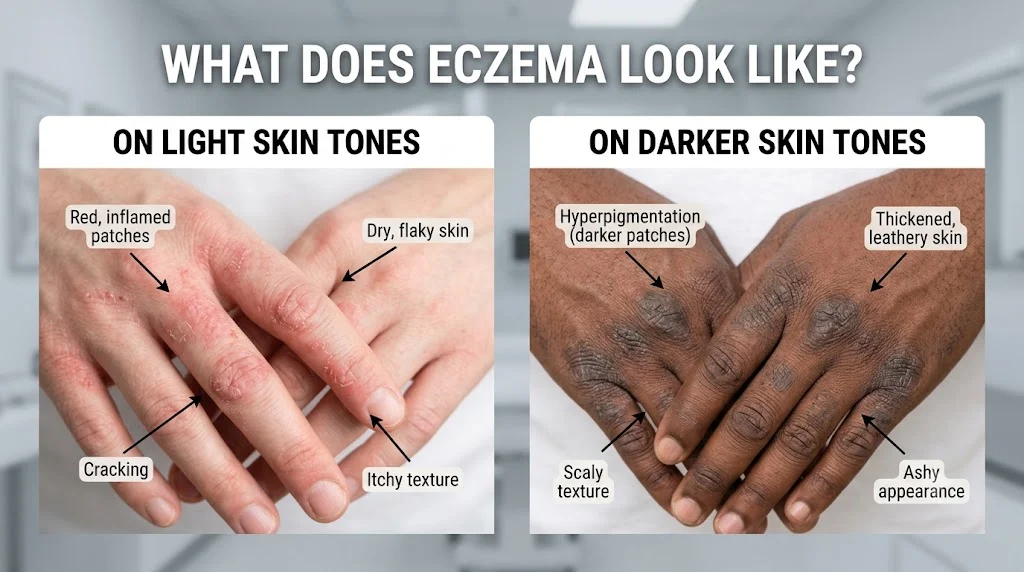
This is one of the most important and most overlooked aspects of eczema recognition. The vast majority of eczema images in medical literature and online feature light skin tones. That’s a real problem, because eczema looks significantly different depending on your complexion and misdiagnosis rates are substantially higher in people with darker skin.
Eczema on Fair and Light Skin
On fair skin, eczema is highly visible. The signs are:
- Bright red or pink patches that are easy to spot
- Redness is the dominant visual cue
- Swelling, scaling, and crusting are clearly visible
- After a flare, the skin may appear slightly darker (post-inflammatory hyperpigmentation) or return to its normal tone
This is the presentation most commonly photographed and referenced, which creates a skewed picture of what eczema looks like overall.
What Does Eczema Look Like on Dark Skin?
On medium to dark skin tones, eczema rarely looks red. Instead, the eczema appearance shifts dramatically:
- Patches appear gray, purple, ashen, dark brown, or black
- Redness may be present but is hard to detect visually
- Follicular eczema is more prominent rather than widespread patches, the inflammation concentrates around individual hair follicles, producing a bumpy texture
- Post-inflammatory hyperpigmentation (darkening) after flares can last for months
- Post-inflammatory hypopigmentation (lighter patches) can also develop after healing, leaving the skin looking uneven
“In skin of color, eczema can look completely different from what’s depicted in most textbooks. The classic red rash description causes significant diagnostic delays for Black and brown patients.” American Academy of Dermatology
Because the redness is invisible or muted, clinicians who aren’t familiar with eczema’s presentation in darker skin tones can miss it entirely. Itching remains the most reliable symptom regardless of skin tone.
Eczema on Medium and Olive Skin Tones
On olive and medium complexions, the presentation falls between the two extremes:
- Some redness may be visible but it’s less vivid than on fair skin
- Brownish or pinkish discoloration is common
- Post-flare discoloration tends to persist longer than on lighter skin
What Does Eczema Look Like on Different Body Parts?
What Does Eczema Look Like on the Face?
Facial eczema is particularly common in infants and young children.
In babies and toddlers:
- Cheeks are the most common site
- The rash looks red, dry, and sometimes oozes or crusts
- It can spread to the chin, forehead, and scalp
In adults:
- Eyelids: Swollen, red or darkened, scaly skin that can be mistaken for allergies
- Around the mouth: Dry, cracked, flaky patches
- Forehead and cheeks: Rough, discolored patches that flare with stress, weather changes, or skincare products
Facial skin is thin and reactive, so eczema symptoms here can appear more intense. The skin around the eyes is especially vulnerable constant blinking and touching irritates it further.
What Does Eczema Look Like on Hands?
Hand eczema is one of the most common forms in adults. It affects roughly 10% of the population and is especially prevalent among healthcare workers, hairdressers, cleaners, and chefs anyone whose hands are frequently exposed to water or chemicals.
Visible signs of eczema on hands:
- Dry, cracked, scaling skin on the back of the hands and between fingers
- Knuckle area is often heavily affected with thickened, rough skin
- Blisters on the palms and sides of fingers (dyshidrotic overlap)
- Skin that bleeds when cracked deeply
- Raw, peeled-looking fingertip skin
In severe cases, the cracking is deep enough that ordinary tasks like opening a jar or washing dishes become painful.
What Does Eczema Look Like on Legs?
The legs have two distinct eczema zones with different appearances.
Back of the knees (popliteal fossa):
- Classic atopic dermatitis location
- Thickened, dry, sometimes weeping skin
- Deeply lined and darker than surrounding skin in chronic cases
Lower legs:
- Stasis dermatitis territory
- Reddish-brown discoloration, swelling, scaly or weeping patches
- Often accompanied by visible varicose veins
Outer legs and shins:
- Nummular eczema frequently targets this area
- Coin-shaped, well-defined patches that may be confused with ringworm
What Does Eczema Look Like on Arms?
The inner elbows (antecubital fossa) are a signature atopic dermatitis location. What you’ll see:
- Skin that’s thickened, deeply creased, and rough
- Darker or lighter coloration compared to the surrounding skin
- Flaking, dryness, and sometimes weeping during active flares
- In chronic cases, the skin looks permanently leathery even between flares
The outer arms and forearms can develop nummular eczema or contact dermatitis patches, particularly if the person wears watches, bracelets, or clothing with synthetic fibers that touch the skin repeatedly.
What Does Eczema Look Like on the Scalp?
Scalp eczema is almost always seborrheic dermatitis. It presents as:
- Persistent flaking that regular shampoo won’t resolve
- Yellowish or white scales attached to the hair or fallen on the shoulders
- Greasy-looking patches at the hairline
- Redness and itching at the scalp, behind the ears, and on the back of the neck
It can extend to the eyebrows, eyelids, and the creases alongside the nose. The greasy quality of the scaling is what distinguishes seborrheic dermatitis from other scalp conditions.
What Does Eczema Look Like at Different Ages?
What Does Eczema Look Like in Babies?
Infant eczema typically appears between 3 and 6 months of age. It’s one of the earliest signs of the atopic march.
In babies under 6 months:
- Cheeks are ground zero red, weeping, crusty patches
- The chin, forehead, and scalp often follow
- The rash can look alarming raw, oozing, and crusty
- Babies scratch by rubbing their face against sheets or surfaces; watch for irritability, especially at night
Between 6 and 12 months:
- The rash migrates to joints elbows, knees, wrists, ankles
- Skin becomes drier and less weepy
Important distinction: Cradle cap (seborrheic dermatitis on the scalp) looks different from atopic dermatitis it’s thick, crusty, and yellowish, usually on the scalp only, and isn’t typically itchy. Many parents confuse the two.
What Does Eczema Look Like in Children?
As children grow, eczema’s appearance evolves:
- The face often clears as eczema shifts to skin folds
- Classic locations: behind the knees, inside the elbows, wrists, ankles, and neck
- Skin gets progressively thicker and more discolored with each flare
- Scratching overnight leads to bleeding and crusting by morning parents often notice blood on sheets
About 60% of children with atopic dermatitis see significant improvement by their teenage years. But for others, it persists or changes form.
What Does Eczema Look Like in Adults?
Adult eczema can be either a continuation of childhood eczema or a first-time diagnosis. Adult-onset eczema is more common than most people realize.
Where it tends to concentrate in adults:
- Hands (very common)
- Eyelids
- Neck and chest
- Genital area
- Face
What makes adult eczema different visually:
- Skin has usually accumulated years of repeated flares, so it may look permanently thickened or discolored even between episodes
- Lichenification (thick, leathery texture) is far more pronounced
- Chronic hand eczema is a major occupational issue the skin may look aged, cracked, and callused
Stress, hormonal shifts (especially in women during pregnancy or menopause), and occupational exposure are the biggest triggers in adults.
What Does Eczema Look Like Through Its Different Stages?
Understanding the stages of an eczema flare is one of the most useful things you can learn. The eczema skin condition looks completely different depending on which stage you’re observing.
What Does Eczema Look Like When It First Starts?
Early-stage eczema is easy to miss because the visible changes are subtle.
First signs:
- Skin feels tight, dry, or sensitive before any visible rash appears
- A slight dullness or roughness to the skin texture
- Mild itching that feels like a vague irritation rather than a clear rash
- Small bumps may appear that are easy to dismiss as a bug bite or dry skin
Acute Flare | What Eczema Looks Like at Its Worst
This is the stage most people picture when they think of eczema.
What an eczema flare up looks like:
- Intensely red (or darkened on darker skin), inflamed, swollen patches
- Small blisters or bumps that weep clear or yellowish fluid when broken
- Fluid dries into a honey-colored crust
- Skin is extremely itchy often unbearably so at night
- The affected area feels warm to the touch
- Scratching causes further damage, sometimes breaking the skin and creating a risk of infection
If the crust turns yellowish-green and the skin feels hot and increasingly painful, bacterial infection (usually Staphylococcus aureus) may have set in. This needs medical attention.
Subacute Stage | The Awkward In-Between Phase
After the acute peak, the skin transitions through a subacute stage:
- Weeping slows down and begins to dry out
- Scaling and flaking increase
- The redness or discoloration fades but hasn’t fully resolved
- The itching can actually intensify during this stage as the skin dries
Chronic Stage | What Long-Term Eczema Looks Like
Repeated flares over months or years change the skin permanently:
- Lichenification: the skin becomes thick, leathery, and deeply lined like the skin of an elephant, dermatologists sometimes describe it
- Color changes: persistent hyperpigmentation (darkening) or hypopigmentation (lighter patches)
- The skin feels rough and stiff even during remission
- Hair loss in heavily affected areas is possible in severe long-term cases
What Does Eczema Look Like When It’s Healing?
The healing stage brings gradual visual improvement:
- Scaling and flaking reduce
- Color slowly normalizes
- Skin texture begins to smooth
- Dark spots or lighter patches may persist for weeks to months even after the active eczema has resolved
Post-inflammatory hyperpigmentation those stubborn dark marks left behind after a flare is especially common in people with medium to dark skin. They’re not scars, but they can take a long time to fade.
Mild Eczema vs. Severe Eczema | Seeing the Difference
| Feature | Mild Eczema | Severe Eczema |
|---|---|---|
| Area affected | Small, localized patches | Large, widespread areas of the body |
| Skin appearance | Slightly dry, faintly pink or discolored | Deeply inflamed, raw, cracked, possibly bleeding |
| Itching intensity | Occasional, manageable | Constant, disrupts sleep every night |
| Weeping or crusting | Rare | Frequent, may signal infection |
| Skin texture | Mildly rough or scaly | Thick, leathery, deeply fissured |
| Daily impact | Minimal | Significant affects sleep, work, mental health |
| Response to OTC treatment | Usually responds well | Often requires prescription medication |
Dermatologists use validated scoring tools like SCORAD (Scoring Atopic Dermatitis) and the IGA (Investigator Global Assessment) scale to measure severity objectively. A SCORAD score below 25 indicates mild disease; above 50 is classified as severe.
One important note: severity isn’t only about how much skin is affected. A small patch of eczema on the eyelid or hand can be severely disruptive to daily functioning. Never dismiss eczema as “mild” just because it’s localized.
What Does Eczema Look Like Compared to Other Skin Conditions?
Eczema vs. Psoriasis The Most Common Mix-Up
These two conditions are frequently confused, especially in photos. Here’s how to tell them apart:
| Feature | Eczema | Psoriasis |
|---|---|---|
| Scale appearance | Fine, white-gray or yellowish flakes | Thick, silvery-white, powdery plaques |
| Patch borders | Blurry, irregular, fading edges | Sharp, well-defined edges |
| Common locations | Skin folds, face, hands | Elbows, knees, scalp, lower back |
| Itch intensity | Severe, often unbearable | Moderate — burning or stinging more common |
| Skin thickness | Varies; thickens with chronicity | Usually thick and raised from the start |
| Blisters | Possible | Rare |
| Nail changes | Less common | Very common (pitting, thickening) |
The texture is the biggest visual giveaway. Psoriasis plaques tend to be thick and raised with a distinct silvery sheen. Eczema patches are usually flatter, less defined, and scalier in a finer, more delicate way.
Eczema vs. Ringworm
Nummular eczema is the type most commonly mistaken for ringworm.
- Ringworm: perfectly circular with a raised, active border and clearer skin in the center caused by a fungal infection
- Nummular eczema: coin-shaped but uniformly irritated throughout no clearing in the center, not fungal
Ringworm responds to antifungal creams. Nummular eczema does not.
Eczema vs. Rosacea
- Rosacea: persistent facial redness, visible blood vessels (telangiectasia), flushing episodes rarely itchy, doesn’t scale significantly
- Facial eczema: dry, scaly, intensely itchy patches itching is central to the diagnosis
Eczema vs. Dry Skin
Many people confuse eczema with simple dry skin. Here’s the distinction:
- Dry skin: uniform, generalized, responds well to moisturizer, rarely intensely itchy
- Eczema: localized patches, inflamed, itching is disproportionate to dryness, doesn’t fully resolve with moisturizer alone
What Triggers an Eczema Flare and What Happens to the Skin?
Understanding triggers helps explain why eczema looks the way it does. Each trigger sets off a specific chain reaction in the skin.
Common eczema triggers and their visible effects:
| Trigger | What Happens to the Skin |
|---|---|
| Soaps, detergents, fragrances | Strips natural oils, skin reddens and dries within hours |
| Synthetic or wool fabrics | Physical friction irritates the barrier; itching and bumps follow |
| Sweat and heat | Blocks sweat glands, causes red itchy bumps (especially in body folds) |
| Stress and anxiety | Triggers immune response without external contact; flares appear within days |
| Cold, dry air | Moisture evaporates from already-weakened skin; cracking and bleeding follow |
| Allergens (pollen, dust mites, pet dander) | Immune overreaction causes widespread inflammation |
| Food triggers | Primarily in children; dairy, eggs, soy, wheat, and nuts are most common |
| Staphylococcus aureus | Colonizes eczema skin; makes patches more inflamed, weepy, and crusty |
One factor that’s often underestimated: Staph aureus (a common bacterium) colonizes eczema-affected skin at much higher rates than normal skin. It produces toxins that ramp up inflammation and make flares significantly worse. This is why infected eczema looks considerably more intense than a regular flare.
When Should You See a Doctor?
Don’t wait too long. These signs mean it’s time to get a professional evaluation:
- The rash looks yellow, crusty, or pussy — signs of bacterial infection
- You have a fever alongside a skin flare
- The eczema affects your eyes, eyelids, or genitals
- You’re losing sleep consistently because of itching
- Standard over-the-counter treatments haven’t improved things after 2 weeks
- The rash spreads rapidly or covers large areas of your body
- You’re not sure whether it’s eczema, psoriasis, or another condition
A dermatologist can diagnose eczema through a visual examination in most cases. For contact dermatitis, patch testing identifies the specific allergen. In unusual or unclear presentations, a skin biopsy may be performed. Getting an accurate diagnosis matters because eczema and psoriasis, for example, require completely different treatment approaches.
FAQ
What does eczema look like when it first starts?
In the very early stage, eczema looks like a subtle dullness or dryness of the skin with mild itching. Small bumps may appear. The intense visible rash typically follows within hours to days as inflammation builds.
Is eczema always red?
No. On light skin, eczema commonly appears red or pink. On darker skin tones, it often looks gray, purple, dark brown, or ashen. Redness is not a reliable indicator across all skin tones.
What does eczema look like on dark skin?
On dark skin, eczema typically appears as gray, purple, or dark brown patches. Redness is usually absent or invisible. Bumps concentrated around hair follicles are more common, and dark spots left after healing can last for months.
What does eczema look like on a baby?
In babies, eczema typically appears as red, weepy, crusty patches on the cheeks and forehead. After 6 months it often shifts to the skin folds at the elbows and knees.
Does eczema leave scars or dark marks?
Eczema itself doesn’t cause true scarring. However, post-inflammatory hyperpigmentation dark spots left after a flare is very common, especially on darker skin.
What does severe eczema look like?
Severe eczema covers large areas of the body with deeply inflamed, raw, cracking skin that may bleed. Itching is constant and often prevents sleep.
Conclusion
Eczema is a common skin condition that can cause dryness, itching, redness, and irritation. While its appearance may vary depending on the person’s age, skin tone, and the severity of the condition, recognizing the signs early can help you manage symptoms more effectively and seek appropriate treatment when needed.
Understanding what eczema looks like is the first step toward proper skin care and relief. If you notice persistent rashes, itching, or inflamed patches of skin, consulting a healthcare professional can help confirm the diagnosis and create a treatment plan tailored to your needs.
Discover More Related Articles:
- What Does AM and PM Stand For | Meaning, Full Form & Examples In 2026
- What Does a Hemorrhoid Look Like | Pictures, Symptoms & Identification Guide In 2026
- What Does Shingles Look Like | Pictures, Symptoms & Treatment Tips In 2026