
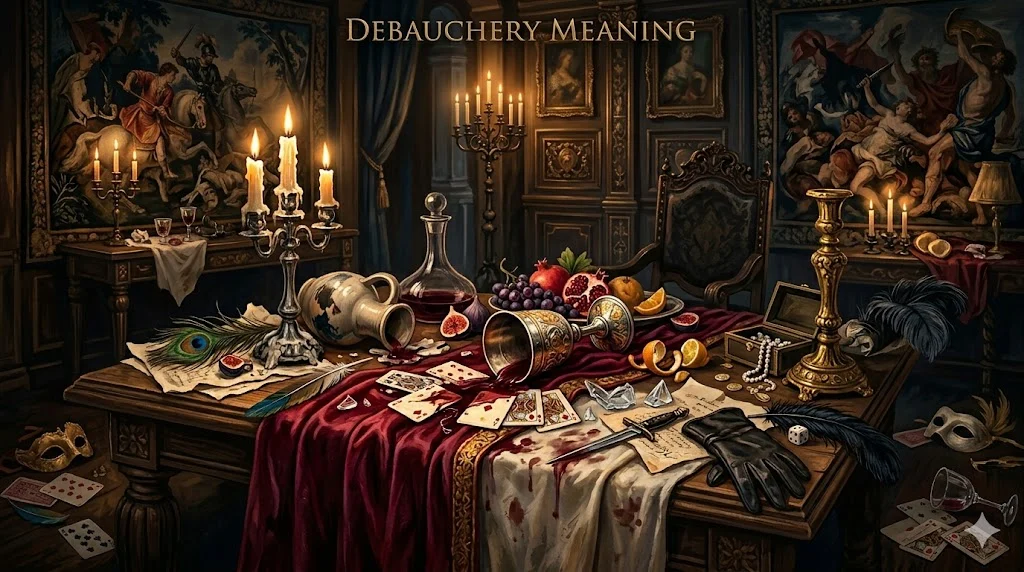

Definition
Put simply: debauchery is what happens when someone or a group of people abandons all self-control in the pursuit of pleasure.
At its core, debauchery means excessive indulgence in sensual pleasures particularly those involving alcohol, sexual activity, and other morally questionable behaviors to a degree that’s considered corrupt, reckless, or harmful.
Merriam-Webster defines debauchery as “extreme indulgence in sensuality.” The Oxford English Dictionary describes it as “excessive indulgence in sensual pleasures; intemperance.”
Both definitions point to the same idea: debauchery isn’t just having fun. It’s going so far overboard that moral boundaries dissolve. It implies a loss of restraint, a corruption of values, and behavior that most societies across history have judged as degrading.
The Simple, Plain-English Meaning
Think wild parties that spiral into chaos. Think excessive drinking that destroys relationships. Think reckless, morally unchained behavior that ignores consequences. That’s the essence of it.
If hedonism is the philosophy of pursuing pleasure, debauchery is what that pursuit looks like when it goes completely off the rails.
Debauchery as a Part of Speech
Grammatically, debauchery is a noun. It refers to a state, a practice, or a pattern of behavior not an action in itself. You don’t “debauchery” someone. Instead, you engage in debauchery, witness debauchery, or fall into debauchery.
Its related word forms are worth knowing too:
- Debauch (verb) | to corrupt or seduce someone away from virtuous behavior; “He was debauched by bad company.”
- Debauched (adjective) | describing a person or lifestyle marked by debauchery; “a debauched lifestyle”
- Debauchee (noun) | a person who habitually practices debauchery; “a notorious debauchee of the 18th century”
- Debaucher (noun) | one who leads others into debauchery
Quick Reference: Debauchery at a Glance
| Feature | Detail |
|---|---|
| Word Type | Noun |
| Pronunciation | dih-BAW-chuh-ree |
| Phonetic Spelling | /dɪˈbɔːtʃəri/ |
| Syllables | de·bauch·er·y (4 syllables) |
| Core Meaning | Extreme indulgence in sensual pleasures, often involving moral corruption |
| Register | Formal / Literary / Journalistic |
| Language Origin | Old French via Middle English |
| First Known Use | Early 17th century (circa 1600s) |
| Related Forms | Debauch (verb), debauched (adjective), debauchee (noun — a person who practices debauchery) |
You’re reading a novel set in ancient Rome. A historian calls an emperor’s lifestyle “a spiral of debauchery.” You watch a documentary about 18th-century secret societies, and the narrator darkly mentions “nights of debauchery.” A friend texts you the morning after a wild birthday party: “Last night was pure debauchery.
Same word. Wildly different tones.
That’s the thing about debauchery it’s a word that carries real weight. It’s been used by philosophers, novelists, historians, journalists, and your group chat. Yet a surprising number of people aren’t fully sure what it means or where it came from.
This guide fixes that. You’ll walk away knowing the full debauchery meaning, how to pronounce it, its fascinating origins, the many ways it shows up in real sentences, what words mean the same thing, and what stands as its opposite. Whether you’re a student, a writer, a curious reader, or someone who just stumbled across this word you’re in the right place.
Let’s start from the very beginning
How to Pronounce Debauchery
This word trips people up. It looks intimidating on the page but sounds much smoother once you know the breakdown.
Correct pronunciation: dih-BAW-chuh-ree
Phonetic spelling: /dɪˈbɔːtʃəri/
Syllable breakdown: de · bauch · er · y
The stress falls on the second syllable: dih-BAUCH-uh-ree. The “au” in “bauch” sounds like the “aw” in “law.” The ending “-ery” is soft and unstressed almost like “-ree.”
Common mispronunciations to avoid:
| Incorrect | Correct |
|---|---|
| dee-BOH-shuh-ree | dih-BAW-chuh-ree |
| deh-BAU-ker-ee | dih-BAW-chuh-ree |
| deh-BOW-chuh-ree | dih-BAW-chuh-ree |
Practice it out loud a few times and it’ll click. The word actually has a musical quality to it once you get it right.
The Origin and Etymology of Debauchery
Here’s where it gets genuinely interesting. The etymology of debauchery tells a story that most people don’t expect.
Tracing the Word to Its Roots
The word debauchery traces back to the Old French verb débaucher, which originally meant “to lead astray” or “to entice away from one’s work or duty.”
The prefix dé- suggests a turning away or undoing similar to the English “de-.” The root bauche is believed to relate to a workroom or workshop. So débaucher literally meant something like “to lure workers away from the workshop” to seduce them from their responsibilities.
By the time the word traveled into English in the early 1600s, it had already expanded far beyond the workplace. It came to describe any form of moral seduction or corruption leading people away not just from work but from virtue, duty, and self-discipline.
The Evolution of Meaning Over the Centuries
17th century: The word entered English with a strong moral connotation. To be debauched meant to be corrupted, particularly through drink or sexual excess.
18th century: The word found a comfortable home in literature and social commentary, used by writers and moralists to condemn the excesses of the aristocracy. The Hellfire Club a notorious series of secret societies in Britain gave the word real historical weight during this era.
19th century: Victorian morality sharpened the word’s edge. Debauchery became a term of serious condemnation, often applied to anything that contradicted the era’s rigid social codes.
20th and 21st centuries: The word has softened slightly in casual usage. Today you’ll hear it applied ironically someone calling a long brunch “absolute debauchery” but the serious, formal meaning hasn’t disappeared. In journalism, history, and literature, it still carries its full moral gravity.
Why Etymology Matters Here
Understanding that débaucher originally meant “to lure away from duty” adds a fascinating layer to the word. Debauchery isn’t just excess it’s abandonment. A departure from responsibility, virtue, and self-governance. That’s a much richer concept than simply “bad behavior.”
What Does Debauchery Mean in Different Contexts?
The word doesn’t live in a vacuum. Where it appears shapes exactly what it means. Here’s how debauchery functions across different settings.
Debauchery in Literature and Classical Usage
Debauchery has been a favorite word of writers for centuries. Authors used it as both a warning and, sometimes, a tantalizing subject.
- In John Milton’s moral writings, debauchery represented the spiritual ruin of those who surrendered to earthly temptation.
- Lord Byron | himself living a spectacularly debauched life used the concept in his poetry to explore the tension between pleasure and destruction.
- Charles Dickens painted scenes of moral corruption and excess, often using the concept of debauchery as a social critique against poverty, desperation, and the failings of the wealthy.
- In Fyodor Dostoevsky’s novels, characters who fall into debauchery often face profound psychological and spiritual consequences suggesting that the word carries weight far beyond simple excess.
In classical literary usage, debauchery almost always signals a turning point. A character who descends into it is heading somewhere dark.
Debauchery in Modern Everyday Usage
Today the word appears in news articles, cultural commentary, online discussions, and social media often in a more flexible way than its formal definition might suggest.
In journalism and serious writing, it retains its full weight. A headline about a political scandal might use “debauchery” to describe misconduct involving excess, moral corruption, or abuse of power.
In casual conversation, it’s often used with a wink. Calling your Saturday plans “a night of complete debauchery” probably means you’re planning to eat too much pizza and stay up late not that you’re descending into moral ruin.
This dual life serious and ironic at once is part of what makes the word so interesting.
The Debauchery Slang Meaning
In modern slang, debauchery has been somewhat reclaimed as a term of humor and exaggeration. You’ll see it used to describe:
- A wild office party that got out of hand
- A vacation where every meal involved dessert
- A group of friends who stayed out until 4 AM at a perfectly legal bar
The slang usage strips away the moral condemnation while keeping the flavor of excess. It’s still about going too far but in a way that’s funny rather than scandalous.
Context is everything. When your grandmother uses the word, she’s probably horrified. When your college roommate uses it to describe last weekend, they’re probably bragging.
Debauchery in a Sentence: Real-World Examples
Seeing a word used in genuine context is the fastest way to internalize its meaning. Here are ten varied examples formal, casual, literary, journalistic, and ironic showing the full range of how debauchery operates in real sentences.
Formal / Historical:
“The fall of the Roman Empire has been attributed, in part, to the debauchery of its ruling class emperors who prioritized pleasure over governance.”
Literary:
“He had spent a decade in debauchery, chasing every vice until nothing gave him pleasure anymore.”
Journalistic:
“Investigators described the gathering as a scene of open debauchery, with no shortage of alcohol and no presence of professional conduct.”
Moral / Philosophical:
“Ancient Stoic philosophers argued that debauchery weakens the soul just as inactivity weakens the body.”
Casual / Ironic:
“We ordered two desserts each and stayed at the restaurant for three hours pure debauchery, honestly.”
Social Commentary:
“Critics of the entertainment industry often point to its culture of debauchery as evidence of broader moral decline.”
Descriptive:
“The painting depicted a scene of Roman debauchery: overfilled goblets, reclining figures, and a general atmosphere of unchecked indulgence.”
Personal Narrative:
“After years of debauchery in his youth, he rebuilt his life slowly sobriety, routine, and small dignities replacing the chaos he’d once called freedom.”
Political:
“The senator’s resignation came after reports of personal debauchery that contradicted his public image as a moral conservative.”
Humorous:
“Three slices of birthday cake and staying up until midnight watching reality TV what can I say, it was an evening of pure debauchery.”
Debauchery Synonyms: Words That Mean the Same Thing
English is rich with words that orbit the same territory as debauchery. But none of them mean exactly the same thing each carries its own nuance, intensity, and context. Knowing the difference makes you a sharper writer and more precise thinker.
Formal Synonyms
Dissipation | Perhaps the closest synonym. Dissipation suggests a gradual wasting away of health, morals, or character through excess. Where debauchery feels dramatic and active, dissipation feels slow and corrosive. “Years of dissipation had aged him beyond his years.”
Licentiousness | Specifically refers to sexual immorality and disregard for accepted moral codes. More focused than debauchery, which can encompass many types of excess. “The court’s licentiousness shocked the clergy.”
Depravity | Deeper and darker than debauchery. Depravity implies a thoroughgoing moral corruption not just excess but a fundamental degradation of character. “The trial exposed the full depravity of his conduct.”
Profligacy | Reckless extravagance, particularly financial. A profligate person wastes resources without restraint. It overlaps with debauchery when the excess involves money spent on indulgence. “His profligacy left the estate in ruin.”
Intemperance | Specifically refers to lack of moderation, especially with alcohol. More clinical and narrow than debauchery. “His intemperance at public events embarrassed his colleagues.”
Libertinism | A philosophical commitment to rejecting moral and social conventions, particularly around sexuality. A libertine doesn’t just act without restraint they believe that’s the right way to live.
Casual / Modern Equivalents
- Excess | broad, non-judgmental, often used humorously
- Overindulgence | the friendliest of the bunch; implies going too far without the moral weight
- Wildness | casual, energetic, not necessarily negative
- Recklessness | implies danger and lack of care more than pleasure-seeking
Synonym Comparison Table
| Synonym | Core Focus | Moral Weight | Formality |
|---|---|---|---|
| Dissipation | Gradual decline through excess | High | High |
| Licentiousness | Sexual immorality | High | High |
| Depravity | Deep moral corruption | Very High | High |
| Profligacy | Reckless financial excess | Medium | Medium–High |
| Intemperance | Lack of moderation (esp. alcohol) | Medium | Medium |
| Decadence | Luxurious moral/cultural decline | Medium | Medium |
| Excess | General overindulgence | Low | Low–Medium |
| Overindulgence | Going too far without deep wrongdoing | Low | Low |
Debauchery Antonyms: The Complete Opposite
Understanding what a word isn’t is just as valuable as knowing what it is. Here are the true antonyms of debauchery the qualities and states that stand at the opposite end of the spectrum.
Temperance | The classic opposite of debauchery. Temperance means moderation and self-restraint, particularly around alcohol and physical pleasures. The 19th-century Temperance Movement was literally named after this concept.
Virtue | A broad term for moral excellence. Where debauchery represents moral failure, virtue represents moral strength.
Sobriety | In the narrow sense, freedom from intoxication. In the broader sense, seriousness, clarity, and self-control.
Moderation | The practice of doing nothing to excess. If debauchery is the dial turned all the way up, moderation is keeping it in the middle.
Abstinence | Active avoidance of a pleasurable activity, particularly alcohol or sex. More extreme than moderation it’s full restraint rather than balanced restraint.
Rectitude | Moral uprightness and correctness. A formal word for living by sound ethical principles.
Self-discipline | The ability to control one’s impulses and desires. The internal capacity that debauchery destroys.
Chastity | Specifically the opposite of sexual debauchery; restraint in sexual conduct.
Continence | Self-restraint from indulgence, particularly in physical appetites.
Related Concepts Worth Understanding
Hedonism vs. Debauchery: What’s the Actual Difference?
People conflate these two all the time and it’s worth setting the record straight.
Hedonism is a philosophical position. At its core, it holds that pleasure is the highest good in life that the pursuit of positive experiences is what gives existence meaning. In its most thoughtful form, hedonism doesn’t necessarily endorse excess. Epicurus, one of the most famous hedonist philosophers, actually advocated for simple, modest pleasures a good meal, good friends, and peaceful contemplation.
Debauchery is what happens when pleasure-seeking abandons all restraint. It’s hedonism without any philosophy behind it just raw, reckless consumption. The key distinction: a hedonist might savor a beautiful glass of wine; the debauchee drinks until they can’t stand up.
Put another way: not all hedonism is debauchery, but all debauchery is hedonistic. One is a philosophy; the other is its extreme, corrupted form.
Decadence vs. Debauchery
These two are frequent companions in historical writing but they’re not identical.
Decadence often describes a broader cultural or civilizational state a society sliding into luxury, softness, and moral looseness. It carries an aesthetic quality that debauchery doesn’t. The term “decadent” was even embraced by a literary movement in the late 19th century as a badge of honor.
Debauchery is more personal and active. It describes what individuals do the specific behaviors of excess and indulgence. Decadence is the atmosphere; debauchery is the act.
When historians write about Rome’s decline, they often use both: the decadence of the culture created the conditions for debauchery in its ruling class.
Vice, Excess, and Moral Corruption: The Full Picture
Debauchery sits within a broader family of related moral concepts:
- Vice | a habitual, ingrained immoral behavior or weakness. Vice is structural; it’s a flaw built into a person’s character over time. Debauchery can be a vice, but not every instance of debauchery rises to that level.
- Excess | simply going too far, without the moral charge. Excess is descriptive; debauchery is judgmental.
- Moral corruption | the broader process by which values, character, and ethical commitments erode. Debauchery is one of its most vivid symptoms.
Think of it as a set of concentric circles. Moral corruption is the widest ring everything that represents ethical deterioration. Vice is a subset of that. Debauchery is one specific, visceral expression of vice in action.
Cultural and Historical Examples of Debauchery
History is full of real, documented examples not abstract concepts but specific people, places, and eras. Here are some of the most compelling.
Ancient Rome: The Benchmark for Excess
Rome is, for many people, the definitive historical example of debauchery at a civilizational scale. While it’s easy to exaggerate (and historians do caution against taking ancient sources at face value), some emperors’ conduct was genuinely extraordinary.
Emperor Caligula (reigned 37–41 AD) became infamous for behavior that Roman historians described as violently erratic, sexually unrestrained, and deeply corrupt. Whether every account is accurate is debated but his name became synonymous with unchecked imperial power and all the excess that comes with it.
Emperor Nero (reigned 54–68 AD) was documented throwing lavish banquets that lasted days, constructing an enormous personal palace called the Domus Aurea, and indulging in performances, parties, and behavior that scandalized even the Roman senate.
Elagabalus (reigned 218–222 AD) reigned for only four years but left a reputation for excess that historians still discuss. Ancient sources describe parties, feasts, and conduct that defied virtually every Roman social convention.
Importantly, Roman moralists like Seneca and Juvenal wrote extensively about debauchery not to glorify it but to condemn what they saw as Rome’s moral decline. Their work gave us some of the most vivid depictions of what debauchery looks like at scale.
The Hellfire Club: 18th-Century Britain’s Most Infamous Secret Society
In the mid-18th century, Britain had a series of loosely connected groups known collectively as the Hellfire Clubs. The most famous was founded by Sir Francis Dashwood around 1749 and included members drawn from the aristocracy, politicians, and intellectuals.
Meetings reportedly took place at Medmenham Abbey and later in caves beneath West Wycombe. Accounts describe mock religious rituals, excessive drinking, and sexual impropriety the whole atmosphere designed to mock conventional morality and revel in transgression.
Members allegedly included Benjamin Franklin though historians debate the depth of his involvement. What’s documented is that these clubs represented a deliberate, organized rejection of social and moral norms by people who had the wealth and status to do so without consequence.
The Hellfire Club gave the word “debauchery” one of its most concrete historical anchors.
The Roaring Twenties: Prohibition and the Glamour of Excess
The 1920s in America created a peculiar situation: the government made alcohol illegal, and the result was arguably more debauchery, not less.
Prohibition (1920–1933) gave rise to speakeasies illegal bars hidden behind fake storefronts, accessed through secret doors and passwords. Jazz played late into the night. Bootleg liquor flowed freely. The cultural atmosphere of the decade captured in F. Scott Fitzgerald’s The Great Gatsby was one of glittering excess layered over moral emptiness.
The flappers, the jazz clubs, the all-night parties, the casual dismantling of Victorian-era moral codes the 1920s represented a cultural embrace of indulgence that remains one of history’s most recognizable chapters of debauchery, real and romanticized alike.
The Decadent Movement in Literature
The late 19th century saw a literary and artistic movement that deliberately embraced decadence and, in many cases, debauchery as aesthetic stances rather than simple moral failings.
Oscar Wilde’s The Picture of Dorian Gray (1890) explored the relationship between beauty, pleasure, and moral corruption with devastating clarity. Dorian’s descent into debauchery is the novel’s central engine.
Charles Baudelaire, the French poet, made excess and transgression the very subject of his most famous work, Les Fleurs du Mal (The Flowers of Evil), published in 1857. The French government prosecuted him for it.
These writers weren’t celebrating debauchery uncritically they were interrogating it. What does it cost to live without restraint? What happens to the soul? Their answers were rarely comforting.
Modern Pop Culture
Debauchery has never gone out of fashion as a subject for film, television, and music.
Films like Caligula (1979), Eyes Wide Shut (1999), The Wolf of Wall Street (2013), and Babylon (2022) all center on excess, moral corruption, and the seductive destruction of unchecked indulgence.
Television series exploring wealth and power think Succession, The White Lotus, and Euphoria often use debauchery as both a plot device and a commentary on contemporary values.
In music, artists from the Rolling Stones to Lil Wayne have made their own forms of debauchery a personal brand sometimes with genuine artistic purpose, sometimes simply as spectacle.
Is Debauchery Always Negative?
This is worth sitting with for a moment. Across centuries of moral philosophy, religious teaching, and social commentary, debauchery has been consistently and unambiguously condemned. But the picture is more complicated than a simple yes.
The Ironic and Affectionate Use
As explored earlier, debauchery has developed a second life in casual, ironic usage. When someone calls a long spa day “utter debauchery,” they’re not expressing genuine moral condemnation they’re enjoying the gap between the word’s serious weight and the mild pleasure they’re actually indulging.
This ironic usage is widespread, generational, and genuinely funny. It works precisely because the word carries so much formal gravity. Applying it to something trivial is the whole joke.
Cultural Relativity
What counts as debauchery has never been fixed. It shifts across cultures, historical eras, and social contexts.
Behaviors that were considered outrageously debaucherous in Victorian England women showing their ankles, unmarried people dining together, drinking wine in public are entirely unremarkable today. Meanwhile, behaviors that were normalized in ancient Rome strike modern eyes as deeply troubling.
This doesn’t mean debauchery is a meaningless concept. It means the word reflects a society’s values, and those values change. The core idea excess that harms individuals or communities remains stable. The specific behaviors it applies to do not.
The Moral Weight Depends on the Speaker
A priest using the word carries different weight than a comedian. A historian citing it in a scholarly paper is doing something different from a blogger using it to describe a messy weekend.
Language is social. Debauchery is a judgment, and all judgments reflect the person making them. Understanding who’s using the word and why is as important as understanding the word itself.
Debauchery Across Languages: A Brief Look
The concept of debauchery isn’t uniquely English. Most major languages have equivalent terms that carry similar connotations.
| Language | Word/Phrase | Literal or Core Meaning |
|---|---|---|
| French | débauche | The direct root; excess, debauchery |
| Spanish | libertinaje | Libertinism; moral excess |
| Italian | dissolutezza | Dissoluteness; immoral excess |
| German | Ausschweifung | Excess, extravagance |
| Latin | licentia | License; unbridled freedom |
| Arabic | فسق (fisq) | Immoral conduct, transgression |
| Russian | разврат (razvrat) | Corruption, debauchery |
The universality of the concept is telling. Every culture that has developed a moral vocabulary has found a need for a word like “debauchery.” The specific behaviors vary; the underlying idea of excess that destroys doesn’t.
FAQs
What is the meaning of debauchery?
Debauchery means extreme indulgence in sensual pleasures particularly those involving alcohol, sexuality, and other behaviors considered morally corrupt or reckless. It describes conduct that abandons self-control and social or moral boundaries in pursuit of pleasure.
What does debauchery mean in slang?
In casual or slang usage, debauchery is often used humorously or ironically to describe any kind of mild to moderate excess. Someone might call a very indulgent meal, a messy party, or a lazy Sunday “debauchery” using the word’s dramatic weight for comic effect rather than genuine moral condemnation.
How do you use debauchery in a sentence?
Here’s a quick set of examples:
- “The senator’s debauchery became the central issue of the election.”
- “We had a three-hour dinner with four desserts sheer debauchery.”
- “Ancient Rome’s decline is often linked to the debauchery of its emperors.”
What is a synonym for debauchery?
The closest synonyms are dissipation, licentiousness, depravity, profligacy, and decadence in formal usage. In casual contexts, excess and overindulgence work well.
What is the opposite of debauchery?
The true antonyms are temperance, virtue, sobriety, moderation, and self-discipline all words that describe restraint, moral uprightness, and the disciplined management of desire.
Where does the word debauchery come from?
It comes from the Old French débaucher, meaning “to lead astray” or “to seduce away from duty.” The word entered English in the early 17th century and evolved from its original workplace meaning to its current sense of moral and sensual excess.
Is debauchery a formal word?
Yes it’s primarily a formal, literary word. You’ll see it in journalism, history, academic writing, and serious literature. In casual conversation it often appears ironically, where its formal register is part of the humor. It’s not typically used in professional emails or polite small talk.
What part of speech is debauchery?
It’s a noun. Related forms include the verb debauch, the adjective debauched, and the nouns debauchee (a person who practices debauchery) and debaucher (one who leads others into debauchery).
Can debauchery refer to something other than sex?
Absolutely. While licentiousness and sexual excess are often part of what debauchery describes, the word is broader than that. It can refer to excessive drinking, overindulgence in food, reckless financial behavior, or any pattern of conduct that abandons moral restraint in pursuit of sensory pleasure not exclusively sexual.
What’s the difference between debauchery and sin?
Sin is a religious concept transgression against divine law or moral commandment. Debauchery is a secular, social term for extreme moral excess. All debauchery might be considered sinful in religious frameworks but not everything labeled as “sin” would qualify as debauchery. Sin is broader; debauchery is specifically tied to excess and sensual indulgence.
Conclusion:
Here’s what’s genuinely fascinating about this word: it’s survived six centuries of social change completely intact. Empires have risen and fallen. Moral codes have been rewritten. What people consider acceptable has shifted dramatically. And yet debauchery born in a 17th-century workshop metaphor still means exactly what it always meant.
That staying power says something. Every culture, in every era, seems to need a word for the moment when pleasure-seeking stops being fun and starts consuming people. A word for the point where indulgence crosses into destruction. Debauchery is that word in English, and it’s earned its place.
Whether you’re using it to describe the fall of Rome, the conduct of a corrupt politician, a literary character in moral freefall, or your friend’s inexcusably large order at brunch you’re reaching for a word that has been doing real work in the English language for a very long time.
Now you know exactly what it means, where it came from, and how to use it well.
Discover More Related Articles: