
Definition
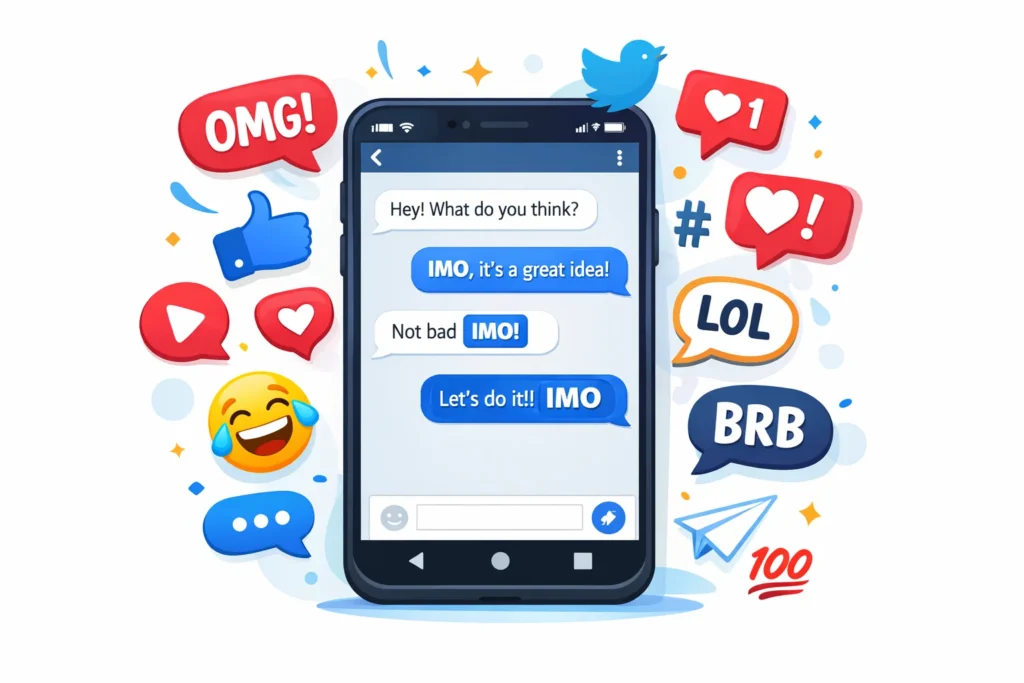
IMO in text means “In My Opinion.” It is an internet abbreviation used to express a personal view or belief in a conversation, often to indicate that what is being said is subjective rather than a fact.
If you’ve ever been texting, scrolling through social media, or reading online comments, chances are you’ve seen the abbreviation “IMO” pop up everywhere. At first glance, it might look confusing, but it’s actually one of the most commonly used internet slang terms in digital communication.
In today’s fast-paced messaging culture, people prefer short forms to express thoughts quickly. That’s where “IMO” comes in—it helps users share opinions in a simple, casual way without writing long sentences.
For example:
- IMO, this movie was the best of the year.
- IMO, you should try studying earlier.
It signals that the statement is just someone’s perspective—not a universal truth.
Origin and Popularity of IMO in Digital Communication
The abbreviation IMO (“In My Opinion”) originated in early internet chatrooms and forums during the late 1990s and early 2000s. As online communication evolved, users began shortening common phrases to type faster and communicate efficiently.
Why IMO Became Popular
- Speed of communication: People wanted quicker responses in chats and forums.
- Character limits: Early platforms like SMS and Twitter encouraged shorter messages.
- Casual tone: It softens opinions, making statements less aggressive.
- Global usage: English internet slang spreads quickly across platforms worldwide.
Today, IMO is widely used on:
- Social media platforms (Instagram, X/Twitter, Facebook)
- Messaging apps (WhatsApp, Snapchat, Telegram)
- Online forums (Reddit, Quora, Discord)
It has become a standard part of modern digital language.
How IMO Is Used in Real Conversations
The phrase IMO (In My Opinion) is mostly used when someone wants to express a personal belief without sounding too forceful or absolute.
Common Uses of IMO:
- Giving advice
- Sharing preferences
- Making suggestions
- Softening disagreements
Tone Variations of IMO
| Tone Type | Example Sentence | Meaning |
|---|---|---|
| Friendly | IMO, pizza is better than burgers 🍕 | Personal preference |
| Neutral | IMO, this app is quite useful | Simple opinion |
| Disagreeing | IMO, that decision wasn’t the best | Soft criticism |
| Supportive | IMO, you did really well | Encouragement |
IMO helps make conversations feel more respectful and less confrontational.
Examples of IMO in Text Messages
Here are real-life style examples to help you understand how IMO is used in different situations:
Casual Chat Examples
- IMO, that song is really catchy 🎧
- IMO, we should go out tomorrow instead.
- IMO, this weather is perfect for a walk.
Social Media Examples
- IMO, this trend is overrated.
- IMO, this actor deserves more recognition.
- IMO, this update improved the app a lot.
Advice-Based Examples
- IMO, you should take a break and relax.
- IMO, studying in the morning is more effective.
- IMO, that career path suits you better.
Disagreement Examples
- IMO, that’s not the right approach.
- IMO, you misunderstood the situation.
- IMO, there’s a better solution to this problem.
These examples show how flexible and widely used IMO is in everyday digital communication.
IMO vs Other Common Internet Abbreviations
To understand IMO better, it helps to compare it with similar texting abbreviations.
Comparison Table
| Abbreviation | Full Form | Meaning | Usage Difference |
|---|---|---|---|
| IMO | In My Opinion | Personal viewpoint | Casual, neutral opinion |
| IMHO | In My Humble Opinion | Polite opinion | Softer or more respectful tone |
| TBH | To Be Honest | Honest feeling or truth | More direct and candid |
| FYI | For Your Information | Sharing information | Not opinion-based |
| IDC | I Don’t Care | Indifference | Negative or dismissive tone |
Key Insight
- IMO is neutral and widely acceptable.
- IMHO is slightly more polite or humble.
- TBH focuses more on honesty than opinion.
Alternate Meanings of IMO
Although IMO mostly means “In My Opinion,” it can have other meanings depending on context:
1. International Maritime Organization
A UN agency responsible for shipping safety and environmental standards.
2. Internet Slang Context
Still overwhelmingly used as “In My Opinion.”
3. Rare Casual Use
Sometimes used jokingly or creatively in niche online communities.
However, in texting and social media, 99% of the time IMO means “In My Opinion.”
When and How to Use IMO Properly
Using IMO correctly can make your communication sound natural and respectful.
Best Situations to Use IMO:
- Giving personal feedback
- Sharing preferences
- Making suggestions
- Expressing disagreement politely
When NOT to Use IMO:
- Formal academic writing
- Official reports
- Legal or professional documents (unless informal tone is allowed)
Usage Tips:
- Place IMO at the beginning or end of a sentence.
- Keep the sentence conversational.
- Avoid overusing it in every message.
Example:
- IMO, this idea could work better if simplified.
Polite Alternatives to IMO
Sometimes you may want to sound more formal or professional. Here are alternatives:
Professional Alternatives:
- “From my perspective…”
- “I believe that…”
- “In my view…”
- “It seems that…”
- “Personally speaking…”
Example Transformations:
| Casual (IMO) | Formal Alternative |
|---|---|
| IMO, this is a good idea | In my view, this is a strong idea |
| IMO, we should wait | I believe we should wait |
| IMO, it’s not necessary | From my perspective, it may not be necessary |
These alternatives are useful in workplace or academic communication.
Real-World Context: Why IMO Matters in Digital Language
IMO is more than just an abbreviation—it reflects how modern communication works. People want to:
- Speak faster
- Express opinions clearly
- Avoid misunderstandings
- Keep conversations light and friendly
It also helps reduce conflict in discussions because it clearly signals that a statement is subjective.
For example:
- Saying “This is wrong” can sound harsh.
- Saying “IMO, this might not be right” sounds softer and more respectful.
FAQs:
1. What does IMO stand for in texting?
IMO stands for In My Opinion, used to express personal views.
2. Is IMO formal or informal?
IMO is mostly informal and used in casual conversations.
3. What is the difference between IMO and IMHO?
IMO is standard opinion, while IMHO means In My Humble Opinion, which sounds more polite.
4. Can IMO be used in professional emails?
It’s better to use formal alternatives like “In my view” in professional emails.
5. Is IMO rude?
No, IMO is not rude. It actually softens opinions and makes them more respectful.
6. What does IMO mean on social media?
On social media, IMO means In My Opinion, used in posts or comments.
7. Does IMO always mean opinion?
Yes, in texting it almost always means personal opinion.
8. What is the opposite of IMO?
There is no direct opposite, but phrases like “factually speaking” or “objectively” contrast with IMO.
Conclusion:
The abbreviation IMO (In My Opinion) is a simple yet powerful part of modern internet language. It allows people to express thoughts clearly while making it obvious that the statement is personal, not absolute.
Whether you’re texting friends, commenting online, or sharing views on social media, IMO helps you communicate in a more natural and respectful way.
Understanding IMO makes online communication easier, clearer, and more expressive.
Discover More Related Articles:
- What does similar mean in math: Complete Beginner’s Guide In 2026
- A Bed Bug Look Like: Size, Shape & Color In 2026