

Definition
Imminent means about to happen very soon or likely to occur in the near future.
When something is imminent, it is expected to happen at any moment or within a very short time.
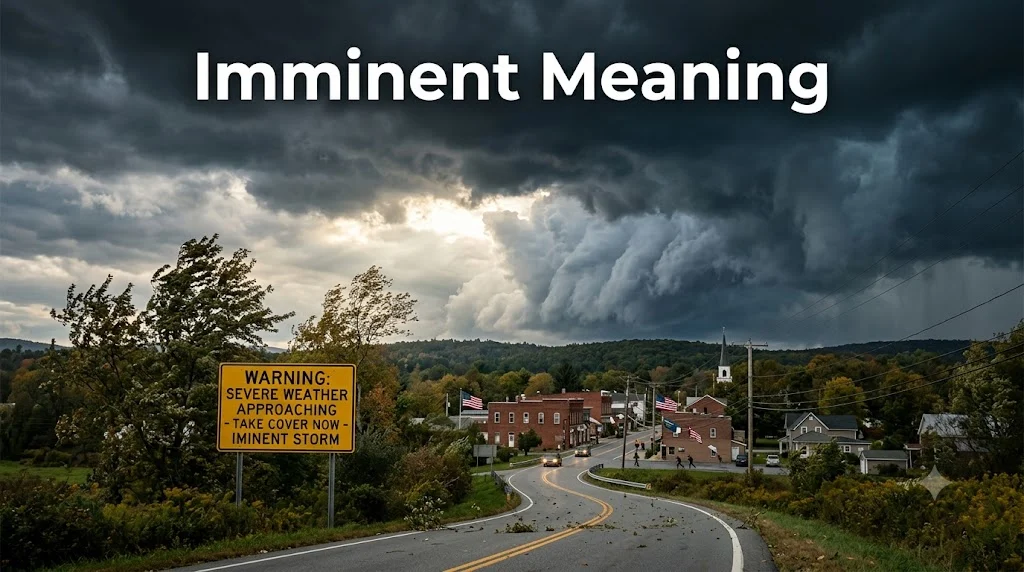
Picture this. The sky turns an ugly greenish-gray. The wind dies completely. Every bird vanishes. You don’t need a weather app to know what’s coming you can feel it.
That feeling? That’s imminent.
It’s one of those words that carries real weight. Not just “something might happen someday” weight. More like “this is happening, and it’s happening now” weight. Whether you’re reading a legal brief, watching a news broadcast, or writing a thriller novel, knowing exactly what imminent means and when to use it makes all the difference.
This guide covers everything. The definition, the pronunciation, how it compares to similar words, real sentence examples, and how it plays out in law, business, literature, and everyday communication. By the end, you’ll use this word with complete confidence.
What Does Imminent Mean?
Let’s start simple.
Imminent means about to happen very soon and with a strong sense of unavoidability. It’s not a vague “someday” or a hopeful “maybe next week.” When something is imminent, it’s right at the doorstep.
Think of it like a countdown timer that’s already in the single digits.
Here’s the key thing most people miss: imminent doesn’t just mean soon. It carries an undercurrent of certainty. Something looming. Something you can’t sidestep. That’s what separates it from words like “upcoming” or “expected.”
Imminent Definition From Major Dictionaries
Different dictionaries say it slightly differently, but they all land in the same place.
| Dictionary | Definition |
|---|---|
| Merriam-Webster | Ready to take place; happening soon |
| Oxford English Dictionary | About to happen, especially something unpleasant |
| Cambridge Dictionary | Coming or likely to happen very soon |
| Macmillan Dictionary | Likely to happen very soon, especially something bad |
Notice something? Oxford and Macmillan both flag that imminent often carries a negative or threatening flavor. That’s not a coincidence. We’ll dig into that later.
Imminent Meaning in Simple Words
If you had to explain it to a ten-year-old, you’d say: “It’s about to happen any second now.”
Simple as that. The storm is imminent. The baby is imminent. The deadline is imminent. Whatever it is, it isn’t waiting.
Imminent Pronunciation: How to Say It Correctly
This trips people up more than you’d think especially because of another word that sounds almost identical.
Imminent is pronounced: /ˈɪm.ɪ.nənt/
Break it down syllable by syllable:
Im · mi · nent
The stress lands on the first syllable: IM-mi-nent.
The Most Common Mispronunciation
People constantly confuse imminent with eminent in both speech and writing. They’re not the same word not even close in meaning.
| Word | Pronunciation | Meaning |
|---|---|---|
| Imminent | /ˈɪm.ɪ.nənt/ | About to happen soon |
| Eminent | /ˈem.ɪ.nənt/ | Famous, respected, distinguished |
A quick memory trick: Eminent = Elevated status (think of an eminent professor). Imminent = It’s happening Immediately (or just about).
Say it out loud a few times. Imminent. Imminent. Once you get the rhythm, it sticks.
The Etymology of Imminent: Where the Word Comes From
Words carry history. Understanding where imminent comes from actually helps you understand why it means what it means.
The word traces back to Latin specifically the verb imminēre, which meant “to overhang” or “to threaten.” It’s built from two parts:
im- meaning “upon” or “over”
minēre meaning “to project” or “to jut out”
Picture a cliff jutting out over your head. That’s the original image. Something hanging right above you, about to fall. The Romans used it to describe physical threats looming overhead.
Over time, that physical image of something “hanging over” transformed into a temporal one something hanging over you in time, about to descend.
The word entered English around the 15th century and retained that same sense of hovering, unavoidable threat. By the time it settled into modern English usage, it had fully shifted to describe events on the immediate horizon rather than physical overhangs.
That Latin root still echoes in how we use the word today. An imminent danger isn’t just close it’s bearing down on you. That’s the difference between imminent and just “soon.”
Imminent in a Sentence: Real-World Examples That Actually Work
Textbook sentences are boring. Here are examples you’d actually encounter across different tones, registers, and contexts.
Everyday Sentence Examples
“The storm was imminent; the sky had already gone that eerie, flat green.”
“She could feel the argument was imminent the moment he walked through the door.”
“Don’t panic, but the server crash is looking pretty imminent.”
“The rescue team moved fast the dam’s collapse was imminent.”
“His retirement has been imminent for three years, and yet here he still is.”
“Every parent in the school knew the bell was imminent when the hallways went quiet.”
“Scientists warned that an imminent shift in the ocean current could alter weather patterns globally.”
“The company issued a statement as regulatory scrutiny became imminent.”
“She braced herself. The confrontation felt imminent.”
“With black clouds rolling in fast, the farmers knew rain was imminent.”
Short vs. Long: Burstiness in Action
Notice how those examples vary? Some are punchy. Three words do the job. Others build context. That variation is exactly what makes writing feel alive rather than robotic.
Imminent Meaning in Literature
Writers love this word. It does heavy lifting in storytelling because it creates tension without action. The event hasn’t happened yet but the reader already feels it coming. That’s powerful.
Consider how a sentence shifts in weight depending on word choice:
“Rain was coming.” (neutral, flat)
“Rain was imminent.” (heavier, loaded with certainty)
“The storm loomed.” (visual, almost menacing)
Good authors use imminent and its synonyms to build dread. The reader leans forward. They know something is about to break they just don’t know exactly when or how. Suspense literature, in particular, leans on this device constantly.
In journalism, you’ll see it in headlines like:
“Imminent Recession Warning Issued by Central Bank”
“Imminent Threat Assessment Released by Department of Defense”
The word signals that readers should pay attention right now. Not later. Now.
Imminent in Political and Formal Speech
Politicians and public officials use imminent deliberately. It elevates urgency and signals decisive action is either needed or already underway. When a government official says a threat is imminent, that carries legal, military, and diplomatic weight.
Imminent Synonym: Words That Mean Almost the Same Thing
Synonyms aren’t interchangeable robots. Each one has its own flavor, connotation, and best use case. Here’s a deep breakdown.
| Synonym | Nuance | Best Used When |
|---|---|---|
| Impending | Strong threat implied; formal | Describing danger, doom, or negative events |
| Approaching | Neutral; physical or temporal nearness | Weather, deadlines, or events without threat |
| Forthcoming | Neutral to positive; formal | Announcements, reports, or planned events |
| Looming | Large, threatening, visually evocative | Crisis, disaster, major challenges |
| Upcoming | Casual; no threat implied | Everyday schedules, events, meetings |
| Pending | Waiting to be resolved; legal/business flavor | Decisions, verdicts, approvals |
| At hand | Formal; suggests something reachable | Formal writing, academic and legal contexts |
| On the verge of | Conversational; emphasizes the tipping point | Casual speech, emotional moments |
| Near at hand | Slightly archaic but elegant | Literary or formal writing |
| Expected soon | Plain and direct | Neutral everyday communication |
Why You Can’t Always Swap Synonyms Blindly
Here’s the trap. “Imminent danger” carries immediate, visceral urgency. Swap in a softer synonym and watch it collapse:
“Upcoming danger” sounds like a calendar event.
“Forthcoming danger” sounds like a press release.
“Pending danger” sounds like bureaucracy.
The word you choose doesn’t just describe reality it shapes how the reader feels about it. Pick carefully.
Imminent Antonym: The Opposite End of the Spectrum
Understanding what a word is not is just as useful as knowing what it is.
| Antonym | Meaning |
|---|---|
| Distant | Far off in time or space |
| Remote | Unlikely or far removed from the present |
| Unlikely | Not expected to happen |
| Delayed | Pushed further into the future |
| Postponed | Intentionally moved to a later time |
| Eventual | Happening at some unspecified future point |
| Deferred | Put off, often deliberately |
Look at how antonyms completely flip the emotional tone:
“The collapse is imminent.” (Urgent. Act now.)
“The collapse is remote.” (Relax. It’s not happening soon.)
Same subject, same verb, radically different emotional charge. That’s the power of word choice.
Imminent vs. Similar Words: Clearing Up the Confusion
Imminent vs. Eminent
This is the single most common error. Let’s kill it once and for all.
Imminent = about to happen (“The storm is imminent.”)
Eminent = highly respected or distinguished (“She’s an eminent scientist.”)
These words share zero meaning overlap. The only thing they share is similar spelling and pronunciation. Using one when you mean the other is a credibility killer in formal writing.
Memory trick: Eminent raises someone up. Imminent is coming in hot.
Imminent vs. Immediate
These are close but distinct.
Immediate describes something happening right now, this instant. There’s no delay. Zero gap between now and the event.
Imminent describes something that hasn’t happened yet but will very soon.
Here’s the clearest example:
“The explosion was immediate.” (It happened. Right then.)
“An explosion seemed imminent.” (It hadn’t happened. But everyone knew it was coming.)
The difference is about timing. Immediate = present. Imminent = near future, unavoidable.
Imminent vs. Impending
These two are the closest siblings in the synonym family. Most writers use them interchangeably and they’re mostly correct to do so. But there’s a subtle distinction worth knowing.
Impending tends to feel slightly more ominous. More doom-laden. It almost always precedes something negative.
Imminent is slightly more neutral it can describe positive events too. A victory can be imminent. A birth can be imminent. A promotion can be imminent.
“Impending doom” is a fixed phrase for a reason. It just sounds heavier.
Imminent Meaning in Specific Real-World Contexts
This is where the word really shows its range. The definition stays consistent but the stakes shift dramatically depending on the field.
Imminent Danger Meaning
In safety and emergency management, imminent danger has a precise, serious meaning.
Imminent danger refers to any condition where there is a reasonable expectation that a hazard will cause death or serious physical harm before the danger can be eliminated through normal enforcement procedures.
The U.S. Occupational Safety and Health Administration (OSHA) uses this exact language. Under OSHA standards, when an inspector identifies an imminent danger on a worksite, they have authority to request that an employer voluntarily shut down operations immediately. If the employer refuses, OSHA can seek a court order.
Key characteristics of imminent danger:
- The threat is real, not hypothetical
- Harm is expected imminently, not at some vague future point
- Normal timelines for correction are too slow to prevent harm
- The hazard poses a risk of death or serious physical injury
Examples of imminent danger scenarios:
- A crane operator working above workers with a known structural failure in the arm
- Workers exposed to toxic gases without proper respiratory protection
- An electrical panel with live wires exposed in a flooded area
- Scaffolding that inspectors have confirmed is about to collapse
The distinction between imminent danger and potential hazard matters enormously in safety law. A potential hazard might get a written citation and a 30-day correction window. An imminent danger triggers immediate action.
Imminent Threat Meaning
In law enforcement, military operations, and national security, imminent threat is one of the most consequential phrases in the entire vocabulary.
An imminent threat is a threat that is about to be carried out with the capability, opportunity, and apparent intent to cause harm in the very near term.
Here’s why this matters: legal and military action often hinges on whether a threat is deemed imminent. You can’t preemptively strike or legally use lethal force against a possible future threat. But an imminent threat changes the calculus entirely under most legal frameworks.
Three factors typically determine whether a threat qualifies as imminent:
Capability. Does the person or entity have the means to carry out the threat?
Opportunity. Are they in a position to act right now?
Intent. Is there clear evidence they plan to act?
All three must align for a threat to be classified as genuinely imminent. This matters in:
- Self-defense law (can you shoot someone who is threatening you?)
- Military operations (can you strike before an attack is launched?)
- Restraining orders (what level of threat justifies immediate protective action?)
- Counter-terrorism policy (when does intelligence justify a preemptive strike?)
Imminent Risk Meaning in Safety Management
In professional risk assessment, imminent risk sits at the top of the severity scale.
Risk professionals typically classify risk on a spectrum:
| Risk Level | Definition | Response Timeline |
|---|---|---|
| Negligible | Unlikely, minimal impact | Monitor periodically |
| Low | Unlikely but possible | Schedule regular review |
| Moderate | Possible, manageable impact | Address within set timeframe |
| High | Likely, significant impact | Address urgently |
| Imminent | About to occur, severe impact | Immediate action required |
When a risk is classified as imminent, organizations suspend normal decision-making timelines. Everything stops. Resources redirect. The only question is how to prevent or mitigate the harm right now.
Insurance companies, hospitals, construction firms, and emergency services all maintain imminent risk protocols pre-planned response frameworks that activate automatically once a risk crosses that threshold.
Imminent Meaning in Law
Legal systems worldwide treat imminent as a term of art a word with specific, defined meaning within legal doctrine rather than just its everyday sense.
In self-defense law, the concept of imminence is central to whether a defendant’s use of force was legally justified. Under most jurisdictions following the common law tradition, a person may use force in self-defense only when facing an imminent threat of unlawful force.
This creates real legal debates. Consider:
A person is threatened and believes harm is coming. But is it tonight? This week? Eventually? Courts have wrestled with exactly how close “imminent” must be.
Key legal uses of imminent include:
Imminent bodily harm | used in assault cases, self-defense claims, and domestic violence law. The threat must be immediate and credible, not speculative or future.
Imminent domain | wait, that’s eminent domain. A common error worth noting.
Imminent collapse | used in bankruptcy proceedings to describe a company on the verge of financial failure, often triggering court-ordered protection or restructuring.
Imminent danger to self or others | the legal standard in many jurisdictions for involuntary psychiatric hold. A clinician who determines a patient poses an imminent danger to themselves or others can authorize emergency detention without the patient’s consent.
The legal weight of this word cannot be overstated. Entire verdicts have turned on whether a threat was imminent versus eventual.
Imminent Meaning in Business
Business communicators use imminent to signal urgency without panic a careful balance.
Common business contexts include:
Product launches. “With the product launch imminent, the marketing team shifted to final execution mode.”
Market conditions. “Analysts warned that a correction was imminent following three consecutive quarters of overvaluation.”
Regulatory changes. “With imminent changes to data privacy law, compliance teams worked around the clock.”
Mergers and acquisitions. “The acquisition seemed imminent after both boards gave preliminary approval.”
Earnings reports. “With an imminent earnings miss, the company’s stock came under significant pre-market pressure.”
In business writing, imminent accomplishes something specific: it tells stakeholders that the window for preparation is closing. Not closed but closing. It creates urgency without triggering alarm. That’s a useful communicative tool.
One important note for business writers: use imminent only when it’s accurate. If something is actually three months away, imminent is an overstatement. Misusing it erodes your credibility. Save it for things that are genuinely close.
Imminent Meaning in Literature and Rhetoric
Rhetorically, imminent is a tension device. Good writers deploy it to make readers feel the pressure of approaching events.
In narrative writing, it accelerates pacing. When a character knows danger is imminent, readers feel the clock ticking. They don’t put the book down.
In persuasive writing, it creates urgency. “The window for action is closing consequences are imminent.” That structure moves people to act.
In political rhetoric, it justifies action. Leaders throughout history have used the language of imminence to mobilize populations, justify policy decisions, and build consensus around difficult choices.
How to Use Imminent Correctly: A Practical Guide
Even after understanding the definition, people still make usage errors. Here’s a clean guide to getting it right every time.
Imminent is always an adjective. It modifies a noun. You don’t say “the storm imminented” that’s not a thing. You say “an imminent storm” or “the storm was imminent.”
It implies near certainty. Don’t use it for things that might happen. If there’s real doubt, use possible or likely instead. Imminent means it’s basically happening.
It implies nearness in time. Don’t use it for things weeks or months away unless the context genuinely treats that timeline as urgent. In legal or safety contexts, imminent often means hours or days at most.
It often implies a negative or weighty event. You can use it for positive things “victory seemed imminent” but it more naturally gravitates toward serious, high-stakes situations.
Quick Checklist Before Using Imminent
Ask yourself these four questions:
- Is the event actually close in time (hours, days, very soon)?
- Is there a strong sense of certainty or unavoidability?
- Am I using it as an adjective modifying a noun?
- Is the stakes level high enough to warrant this word, or would “upcoming” or “approaching” fit better?
If you answered yes to the first three and the fourth makes you pause good. That’s exactly the kind of precision good writers develop.
Common Phrases and Collocations With Imminent
Some word pairings are so natural they’ve become fixed expressions. Here are the most common collocations you’ll encounter:
| Collocation | Typical Context |
|---|---|
| Imminent danger | Safety, legal, emergency management |
| Imminent threat | Security, defense, law enforcement |
| Imminent risk | Risk management, insurance, medicine |
| Imminent collapse | Structural, financial, political |
| Imminent death | Medical, legal, literary |
| Imminent arrival | Travel, delivery, announcements |
| Imminent change | Business, politics, social commentary |
| Imminent deadline | Business, academic, project management |
| Imminent attack | Military, security, conflict reporting |
| Imminent storm | Weather, metaphorical conflict |
| Imminent decision | Legal, corporate, political |
| Imminent failure | Engineering, business, academic |
| Imminent success | Sports, business, narrative |
Notice how almost every collocation pairs imminent with a noun carrying real weight. You don’t pair it with trivial things. “Imminent lunch” sounds absurd. Context elevates the word.
Imminent Meaning in Text and Casual Communication
Here’s an interesting shift: imminent has migrated into casual digital communication, and it doesn’t always carry its full formal weight there.
You might see it in texts or social media like:
“Okay the meltdown is imminent, wish me luck”
“Final exams are imminent. Please send coffee.”
“My mom’s imminent arrival just triggered a full apartment clean.”
In these cases, the word is being used with a kind of wry, self-aware humor. The speaker knows they’re using a slightly formal word and that contrast is part of the joke. It’s not wrong usage exactly. It’s playful usage.
In formal writing, keep it serious. In casual writing, you can lean into the slight over-formality for effect.
Imminent Meaning in Different Languages
Understanding how other languages express this concept shows you where the word sits on the human spectrum of urgency.
| Language | Word/Phrase for Imminent | Phonetic |
|---|---|---|
| Urdu | قریب الوقوع (Qarib-ul-wuqoo) | Qa-reeb ul wuqoo |
| Hindi | आसन्न (Aasann) | Aa-sun |
| Arabic | وشيك (Washīk) | Wa-sheek |
| French | Imminent | ee-mee-NAWNT |
| Spanish | Inminente | een-mee-NEN-teh |
| German | Bevorstehend | Beh-for-shtay-end |
| Italian | Imminente | im-mi-NEN-teh |
An interesting linguistic note: Arabic’s washīk and Urdu’s qarib-ul-wuqoo both carry the same sense of nearness and inevitability. Languages across very different families arrive at the same emotional territory something hanging close, about to fall.
For Urdu and Hindi-speaking readers especially, the translation helps bridge formal English word study with native-language intuition. The feeling of imminent is universal even when the phonetics differ wildly.
Why Imminent Usually Implies Something Negative
Here’s a nuance worth understanding. Most dictionaries note that imminent frequently (though not exclusively) describes unpleasant or threatening events.
Why?
It comes back to that Latin root imminēre, to hang over and threaten. The word was born in threat. It carries that genetic coding through centuries of use.
Look at the most common collocations again: imminent danger, imminent threat, imminent collapse, imminent death, imminent attack. The pattern is clear.
That said, it can describe positive events:
“Victory is imminent.”
“The birth is imminent.”
“Success seems imminent.”
These work. But they work partly because they’re playing against the word’s usual gravity. The slight surprise of using imminent with something good adds a punch of energy to the sentence.
Skilled writers know this and deploy it deliberately.
Imminent Meaning: Quick-Reference Summary
If you need the core information fast, here it is.
| Feature | Detail |
|---|---|
| Word | Imminent |
| Part of speech | Adjective |
| Pronunciation | /ˈɪm.ɪ.nənt/ — IM-mi-nent |
| Core meaning | About to happen very soon; unavoidable in the near future |
| Latin root | Imminēre — to overhang, to threaten |
| Common synonyms | Impending, approaching, looming, forthcoming, on the verge of |
| Common antonyms | Distant, remote, unlikely, delayed, eventual |
| Typical contexts | Law, safety, business, military, literature, news |
| Negative connotation | Frequent but not universal |
| Common confusion | Imminent vs. eminent (completely different meanings) |
FAQs
What is the meaning of imminent?
Imminent means something is about to happen very soon with a strong sense of certainty and often unavoidability. It’s used when an event isn’t just possible but is genuinely on the immediate horizon.
What’s the difference between imminent and immediate?
Immediate means right now, this instant. Imminent means very soon, but not yet. An explosion that is immediate has already happened. An explosion that is imminent is about to happen.
How do you use imminent in a sentence?
You use it as an adjective before a noun or after a linking verb. For example: “The imminent storm forced the event organizers to cancel.” Or: “The team’s collapse seemed imminent.”
What does imminent danger mean?
Imminent danger refers to a threat so close and certain that serious harm is expected before normal preventive measures can take effect.
What is the synonym of imminent?
The closest synonyms are impending, approaching, looming, forthcoming, and on the verge of. Each carries slightly different connotations in terms of threat level and formality.
What is the antonym of imminent?
The antonyms of imminent include distant, remote, unlikely, delayed, deferred, and eventual. These words push the event further away in time or probability.
How do you pronounce imminent?
Pronounce it IM-mi-nent three syllables, with the stress on the first. The phonetic spelling is /ˈɪm.ɪ.nənt/.
What does imminent mean in law?
In legal contexts, imminent describes a threat that is immediate, credible, and certain enough to justify defensive or preventive action. Self-defense law, for example, typically requires that a threat be imminent before force is legally justified in response.
Conclusion:
Go back to that opening image. The sky turning green. The wind stopping. The birds gone.
You felt something, didn’t you? That’s what imminent does when it’s used well. It doesn’t just describe an event it creates a physical sensation of time compressing, of the gap between now and something big shrinking to almost nothing.
That’s rare for a single adjective.
Understanding imminent in its full depth its etymology, its legal weight, its business applications, its literary function, and its subtle differences from near-synonyms gives you a more precise, more powerful command of English. You stop reaching for vague words like “soon” or “upcoming” when the moment calls for something sharper.
The next time the stakes are high, the event is close, and the outcome feels inevitable? You’ll know exactly which word to reach for.
Discover More Related Articles: