
Have you ever said something in total sincerity trusted someone completely, believed a promise without question and someone else turned to you and said, “You’re so naive”? It stings a little, doesn’t it? But what exactly does that word mean? Is it an insult? A compliment in disguise? Something people text each other on TikTok with a winking emoji?
“Naive” is one of those words that carries more layers than most people realize. It shows up in dictionary definitions, in heated relationship arguments, in social media comments, and in political debates. Understanding it fully not just the surface meaning gives you a real edge in communication, both in English and across languages.
This guide covers everything: the core definition, pronunciation, word origin, emotional and social contexts, slang uses across platforms, synonyms, antonyms, translations in Urdu and Hindi, and real-world examples. By the end, you’ll know exactly how to use the word and more importantly, what it reveals about the people it describes.
What Does Naive Mean? The Core Definition
Let’s start at the foundation.
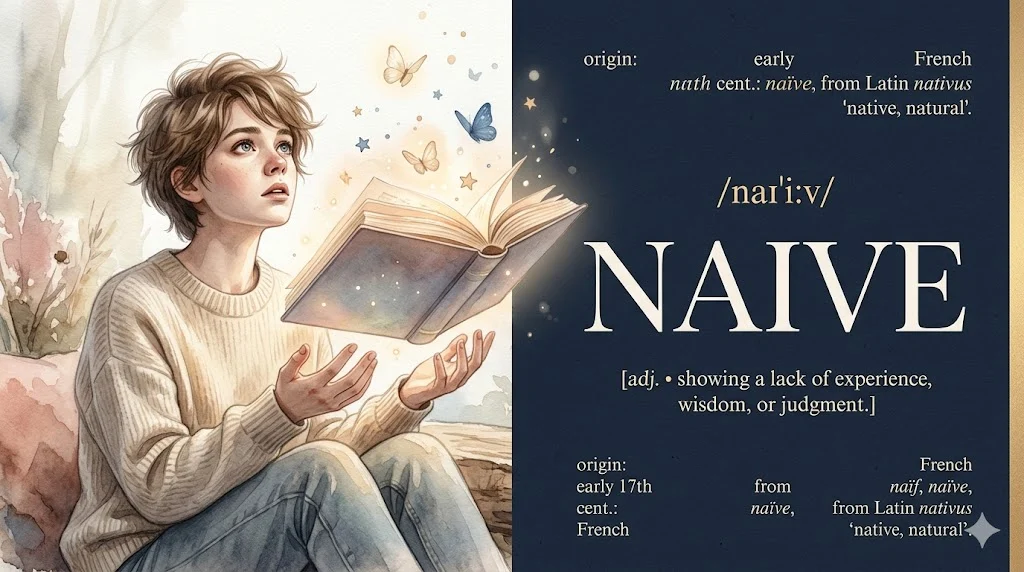
Naive (also spelled naïve with a diaeresis over the “i”) is an adjective that describes someone who lacks experience, wisdom, or critical judgment. When you call someone naive, you’re saying they see the world in an overly simple or trusting way often because they haven’t encountered enough of its complications yet.
The Merriam-Webster definition nails it cleanly: naive means “deficient in worldly wisdom or informed judgment.” Oxford adds another dimension “showing a lack of experience, wisdom, or judgment; natural and unaffected.”
Notice that second part: natural and unaffected. That’s important. Naive isn’t always negative. Sometimes it describes a refreshing, uncorrupted perspective.
Here’s a quick-reference breakdown:
| Feature | Detail |
|---|---|
| Word | Naive / Naïve |
| Part of Speech | Adjective |
| Pronunciation | /naɪˈiːv/ |
| Core Meaning | Lacking worldly experience or sound judgment |
| Tone | Neutral to mildly negative (context-dependent) |
| Variant Spelling | Naïve (French-influenced, with diaeresis) |
| Noun Form | Naivety / Naïveté |
Both spellings naive and naïve are correct in standard English. The version with the diaeresis is closer to the French original. Most American publications drop the accent marks entirely; British publications sometimes retain them. Either way, you’re right.
Naive Pronunciation | How to Say It Without Second-Guessing Yourself
A lot of people stumble on this one. It looks like it should be pronounced “naive” the way it’s spelled but it isn’t.
The correct pronunciation is: nai-EEV (/naɪˈiːv/)
- The first syllable rhymes with “eye” nai
- The second syllable rhymes with “eve” eev
- The stress falls on the second syllable: nai-EEV
Common mispronunciations include NAY-eve, nayve, and NAH-ive. These all sound off to a native English speaker, even though the logic behind them is understandable given English’s chaotic spelling rules.
The word has two syllables. Don’t rush through it. Say it slowly once: nai… eev. Then speed it up. You’ve got it.
Where Did “Naive” Come From? The Word Origin
Words carry history. Knowing where “naive” comes from explains a lot about why it means what it means today.
Naive entered English from French in the mid-17th century. The French word naïf (masculine) and naïve (feminine) meant natural, unaffected, or born in a place. This came from the Latin word nativus, meaning “native” or “produced by birth.”
Think about that for a moment. Originally, this word had no negative tint at all. It just meant: this is how someone was born. Pure. Unprocessed. Without pretense.
Over time, as European societies grew more complex more politically layered, more socially sophisticated being “natural” or “unaffected” started to look less like a virtue and more like a liability. Someone who was naïf hadn’t learned the game yet. And so the word picked up its current undertone: well-meaning, but possibly unequipped.
That historical arc matters. It’s saying they haven’t been shaped or scarred by enough experience yet.
Naive in Everyday Conversation | How People Actually Use It
In daily life, “naive” pops up more than you’d think. It’s a versatile word. People use it affectionately, critically, sarcastically, and self-referentially.
Here are the most common real-world uses:
In relationships: “I was naive to think he’d actually change.”
At work: “She was a bit naive about how office politics actually work.”
About money: “Investing your entire savings in one stock is financially naive.”
In politics: “Believing every campaign promise at face value is hopelessly naive.”
Self-deprecating: “Okay, I was naive I genuinely thought the landlord would fix it.”
Warmly: “There’s something genuinely sweet about her naive enthusiasm for everything.”
Notice how the tone shifts entirely depending on the situation. The word itself is neutral enough to carry warmth or criticism depending on who’s using it and why. Context is everything.
Naive Meaning in Different Emotional and Social Contexts
“Naive” isn’t a one-context word. It attaches to specific areas of life in precise ways and each context reveals something different.
Emotionally Naive Meaning
Emotional naivety is one of the most common and most painful versions of this trait. An emotionally naive person trusts people before earning that trust back. They misread intentions. They ignore red flags because they assume everyone operates with the same good faith they do.
Signs of emotional naivety in relationships:
- Giving partners the benefit of the doubt repeatedly, even after deception
- Interpreting manipulation as misunderstanding
- Believing people will eventually “come around” without any evidence
- Not recognizing love-bombing as a tactic
- Confusing intensity with genuine connection
Here’s what’s interesting though: emotional naivety and emotional openness are sometimes the same thing wearing different outfits. The person who loves deeply without guards is called naive by cynics and “beautifully open” by romantics. Which label applies often depends on how things turn out.
“The most emotionally intelligent people aren’t the ones who’ve never been naive. They’re the ones who learned from it without becoming cold.”
Socially Naive Meaning
Social naivety means missing the unwritten rules. Every social environment an office, a school, a friend group, a family has its own invisible code. Socially naive people haven’t cracked that code yet.
This shows up as:
- Saying something honest at completely the wrong moment
- Missing sarcasm and taking things literally
- Being oblivious to subtle power dynamics in a group
- Not realizing when someone is performing kindness rather than feeling it
- Sharing too much personal information too early
Social naivety isn’t a character flaw. It’s usually a combination of personality type and limited exposure to varied social environments. Introverts, people who grew up in very homogeneous communities, and neurodivergent individuals often encounter the “socially naive” label not because they’re less intelligent, but because certain social codes didn’t come pre-loaded.
Politically Naive Meaning
Political naivety is its own distinct category and it has real-world consequences.
A politically naive person believes that:
- Politicians mean what they say during campaigns
- Systems are fundamentally fair and self-correcting
- Good intentions automatically produce good outcomes
- One vote or one petition will straightforwardly change things
None of these beliefs are necessarily wrong as ideals. But a politically experienced person understands that systems are messier, more compromised, and more resistant to change than they appear. Political naivety leaves people vulnerable to manipulation by those who know how to exploit optimism.
That said the people who drive meaningful political change often start out naive enough to believe it’s possible. There’s a reason movements are often led by the young.
Naive Meaning in Text, Chat & Social Media
Language lives online now. And “naive” has found plenty of digital territory to occupy.
Naive Meaning in Text and Chat
In text messages, “naive” almost always carries a tone either affectionate teasing or genuine frustration. The context clues are everything.
Affectionate use:
“Omg you actually believed him?? You’re so naive lol”
That “lol” softens it. The speaker isn’t being cruel they’re laughing with the person.
Frustrated use:
“I told you this would happen. You were naive to trust them.”
No emoji. Full sentence. This is someone genuinely expressing exasperation.
Self-aware use:
“I was so naive thinking long distance would be easy 😭”
This is probably the most common text use: people calling out their own past thinking with a mix of humor and regret.
Naive Slang Meaning
In modern slang, “naive” hasn’t mutated dramatically it retains its core meaning, but people use it with a layer of irony now. The sarcastic “how naive of me” construction is everywhere:
- “How naive of me to think the wifi would work at this café.”
- “Naive of me to expect the package to arrive on time.”
It’s self-mockery. You’re not actually criticizing yourself as a person you’re just noting that you expected the world to function reasonably and it didn’t. Again.
Naive Meaning on TikTok
TikTok has birthed a mini-trend around the “naive era” concept. You’ll see captions and voiceovers like:
- “Me in my naive era thinking he actually liked me”
- “My naive era: believing hustle culture was the answer”
The “naive era” framing is retrospective it’s people looking back at a past version of themselves with fondness and gentle mockery. It’s not self-loathing. It’s growth content dressed in humor. Videos using this framing typically rack up high engagement because they’re deeply relatable.
Naive Meaning on Snapchat
On Snapchat, “naive” tends to appear in one-on-one or small group conversations. It’s more personal, more direct. Friends call each other naive in the same warm-but-honest way they’d say it face to face.
You’ll also see it in reaction snaps someone screenshots a ridiculous news story or a bad relationship text and captions it: “The naivety here is sending me.
Naive Meaning on Instagram
Instagram uses “naive” in a few distinct ways:
Caption culture: “Younger me was naive but she was also fearless. I miss her.” This framing turns the word into something almost tender.
Call-out posts: Activist accounts use “naive” to challenge audiences “It’s naive to think this policy doesn’t affect you.”
Aesthetic content: Some creators have built entire content pillars around “soft life” aesthetics that celebrate a kind of intentional naivety choosing wonder over cynicism, trust over suspicion, joy over guardedness. Here, naive becomes almost aspirational.
Naive Example Sentences | Seeing the Word in Action
The best way to internalize a word is to watch it work. Here are original example sentences across different contexts and sentence structures:
| Context | Example Sentence |
|---|---|
| Everyday | Leaving your laptop unattended in a coffee shop is genuinely naive. |
| Emotional | She wasn’t foolish just naive about how quickly people could turn cold. |
| Political | Expecting a corporation to self-regulate is politically nave at best. |
| Self-aware | Looking back, I was breathtakingly naive about how difficult freelancing would be. |
| Positive | His naive excitement about the project was honestly contagious. |
| Social | Bringing up salary at the first team meeting was socially naive, but forgivable. |
| Sarcastic | Oh, how naive of me to assume the 8 AM flight would actually depart at 8 AM. |
| Formal | The policy reflects a naive understanding of how supply chains actually function. |
| Relational | Trusting him a third time wasn’t love it was naive. |
| Growth | She used to be naive about money; now she reads financial statements for fun. |
Mix these patterns up in your own writing and conversation. Short punchy uses work well verbally. Longer, more formal uses belong in essays and professional writing.
Naive Synonyms | Words That Mean the Same Thing
Synonyms are rarely perfect. Each word in this family carries a slightly different charge. Here’s how they compare:
| Synonym | Core Nuance | Positive or Negative? |
|---|---|---|
| Gullible | Easily deceived and manipulated | Negative |
| Innocent | Free from guilt or corrupt knowledge | Often positive |
| Credulous | Too ready to believe without evidence | Mildly negative |
| Unsophisticated | Lacking refinement or worldly knowledge | Neutral to negative |
| Trusting | Disposed to believe in people’s goodwill | Neutral to positive |
| Inexperienced | Hasn’t gone through enough yet | Neutral |
| Green | Brand-new to a situation or field | Informal, neutral |
| Simple-minded | Limited in thinking depth | More negative |
| Childlike | Possessing the openness of a child | Often positive |
| Unworldly | Not versed in practical realities | Neutral |
The most important distinction here: naive ≠ gullible. A naive person may not be easy to fool they just haven’t developed the framework to know when they should be skeptical. A gullible person is specifically susceptible to being deceived, regardless of experience level. Naive is about inexperience. Gullible is about vulnerability.
Naive Antonyms | The Opposite End of the Spectrum
Understanding what a word isn’t sharpens your understanding of what it is.
| Antonym | What It Represents |
|---|---|
| Worldly | Experienced with how systems and people actually work |
| Sophisticated | Refined, multilayered understanding of social dynamics |
| Cynical | Distrustful of people’s motives opposite extreme |
| Savvy | Practically sharp and street-smart |
| Astute | Mentally quick; not easily deceived |
| Shrewd | Calculated and perceptive, especially in self-interest |
| Experienced | Has been through enough to know better |
| Jaded | So experienced that wonder and trust have eroded |
Worth noting: the opposite of naive isn’t always a compliment. Cynical, jaded, and even shrewd carry their own baggage. A cynical person may never be naive again but they also can’t fully experience genuine connection or hope. There’s a real cost to that.
The goal, for most people, isn’t to eliminate naivety altogether. It’s to replace blind trust with informed trust, and to keep enough openness to still be surprised by good things.
Naive vs. Gullible vs. Innocent | The Real Difference
This comparison trips people up constantly. Let’s settle it.
Naive
Naive is about inexperience and underdeveloped judgment. A naive person hasn’t built up the mental models to recognize complexity. They’re not being careless they just haven’t encountered enough situations to know what to look for. It’s a starting position, not a permanent one.
Gullible
Gullible is specifically about susceptibility to deception. A gullible person believes things too easily even when evidence should make them skeptical. Importantly, gullibility can persist even after experience. Some people know better and still fall for it. That’s the difference.
Innocent
Innocent carries a moral dimension. It’s about the absence of wrongdoing, guilt, or corrupt intent. An innocent person hasn’t done harm. They may also be unaware of harm but the emphasis is on moral purity, not just lack of experience.
The analogy that makes it click:
Imagine three people who’ve never been pickpocketed. The naive person walks through a crowded market without worrying because it hasn’t occurred to them to worry. The gullible person gets distracted by a stranger pointing at something in the sky and gets pickpocketed. The innocent person refuses to pickpocket others even when they easily could their innocence is about their choices, not their awareness.
Is Naive an Insult? Or Can It Be a Compliment?
Here’s where it gets genuinely interesting.
When “Naive” Functions as an Insult
When used critically, naive implies that someone is dangerously uninformed r worse, willfully blind. In arguments, it often gets deployed as a dismissal:
- “That’s a naive way to look at it.” (Translation: your view is simplistic and I’m more sophisticated than you.)
- “Only a naive person would believe that.” (Translation: you’re out of your depth.)
In these uses, naive is condescending. It signals that the speaker considers themselves significantly more experienced or wise and doesn’t have the patience to meet the other person where they are.
When “Naive” Is Actually a Compliment
Some of the most important people in history got called naive before they got called visionary. Nelson Mandela was called naive for believing reconciliation was possible. Early civil rights activists were called naive for thinking segregation could end. Steve Jobs was called naive for thinking a computer could be beautiful and intuitive.
Naive optimism the kind that ignores conventional wisdom about what’s impossible is often the engine behind real change. The people who already “know better” tend to maintain the status quo. The people who haven’t learned the limits yet are the ones who push past them.
In creative fields especially, the “beginner’s mind” a concept from Zen Buddhism is actively cultivated. It’s the deliberate return to naivety: looking at a problem without the weight of assumptions, seeing possibilities that experience has taught others to dismiss.
“In the beginner’s mind there are many possibilities. In the expert’s mind there are few.” Shunryu Suzuki
So: is naive an insult? It depends entirely on who’s using it and why.
Signs of a Naive Person | Traits and Behaviors to Recognize
How do you actually spot naivety in yourself or others? These behavioral patterns tend to show up consistently:
- Takes people at face value without asking questions or seeking evidence
- Gives trust before it’s earned offers loyalty before there’s a track record
- Assumes good intentions even when the evidence points elsewhere
- Struggles to recognize manipulation like guilt-tripping, love-bombing, or gaslighting
- Believes promises without following up on whether they’re kept
- Doesn’t ask “why” when something seems too good or too convenient
- Avoids conflict by assuming things will sort themselves out naturally
- Shares too much too soon personal information, feelings, vulnerabilities
- Can’t spot double standards what applies to others doesn’t seem to apply in their situation
- Gets surprised by predictable outcomes because they hadn’t seen the pattern before
None of these are moral failures. Most of them are correctable with exposure and reflection. The key insight: naivety is usually about pattern recognition, not intelligence. A naive person may be extraordinarily smart they just haven’t seen this particular type of situation enough times to know what it leads to.
Naive Meaning in Urdu | Translation and Context
For Urdu speakers, “naive” maps most closely to two expressions:
سادہ لوح (Saada Loah) Literally: “simple-hearted.” This is the most direct Urdu equivalent. It describes someone who takes the world at face value not foolish, but unguarded. It’s used warmly more often than critically in Urdu conversation.
بھولا بھالا (Bholaa Bhalaa) Literally: “innocent and unaware.” This phrase carries a softer, more affectionate connotation. It’s often used for children, or for adults who’ve retained a childlike openness. Calling someone bholaa bhalaa in Urdu rarely feels like an insult it’s more often a fond observation.
Example in Urdu conversation: “Woh bohat saada loah hai har kisi par bharosa kar leta hai.” Translation: “He’s very naive he trusts everyone.”
The Urdu framing tends to be gentler than English usage, rooted in a cultural value placed on sincerity and uncalculating behavior.
Naive Meaning in Hindi | Translation and Context
Hindi offers similarly warm equivalents:
भोला-भाला (Bhola-Bhala) The most common Hindi equivalent. It combines bhola (innocent, simple) with bhala (good, well-meaning). Together, they describe someone who is guileless and trusting not cunning or strategic. The word is used affectionately for children and, less critically than in English, for adults.
अनुभवहीन (Anubhavheen) More formal Hindi. Literally: “lacking experience.” This is the closer dictionary equivalent, used in formal writing or when being more precise. It lacks the warmth of bhola-bhala and reads more like a clinical assessment.
Naive in Hindi conversation: “Woh bahut bhola-bhala hai use sab par vishwas ho jaata hai.” Translation: “He’s very naive he ends up trusting everyone.”
Both Hindi and Urdu framings reveal something interesting: South Asian languages tend to treat this trait more charitably than modern English usage does. In these cultures, guile is the quality that needs explaining not its absence.
Naive in Daily Life | Scenarios Most People Recognize
Abstract definitions are useful. Real-life examples are better. Here are situations most people have lived through or watched someone else live through:
The naive job seeker: Fresh out of university, she took the recruiter’s enthusiasm as a guarantee. Nobody told her recruiters are always enthusiastic. Three weeks of excited emails later, she didn’t get the offer.
The naive lender: He lent money to a friend without a word about repayment terms because asking felt awkward. The friend “forgot.” He never brought it up again. Two years of quiet resentment for fifty dollars he was too naive to protect.
The naive voter: She voted for the candidate who promised the most. By year two, the same broken promises that always break had broken again. She called it a betrayal. Her more cynical friends called it Tuesday. Now she reads policy papers instead of speeches.
The naive romantic: He saw every red flag as a yellow flag something to slow down for, not stop. She was inconsistent, unreliable, and occasionally cruel. He kept explaining it away. Eventually he stopped. Not because he became cynical, but because he finally learned what the pattern meant.
The naive investor: She put money into a “can’t lose” opportunity a friend pitched at dinner. No prospectus, no research, no questions. Lost it all. Expensive lesson but she only paid for it once.
What connects every one of these stories? Not stupidity. Not weakness. Just an underdeveloped pattern recognition system experience they hadn’t yet accumulated. Most of them went on to be sharper, not colder.
Can You Grow Out of Being Naive?
Yes. But the path matters.
The antidote to naivety isn’t cynicism it’s calibrated trust. That means learning to assess situations accurately instead of defaulting to either blind trust or blanket suspicion.
Here’s what the process typically looks like:
Stage 1 | Naive trust: You give people the benefit of the doubt automatically. You haven’t been burned enough to know the difference between genuine goodwill and performed goodwill.
Stage 2 | The wake-up: Something goes wrong. Someone betrays your trust, exploits your openness, or simply doesn’t meet the expectations you never voiced. It stings.
Stage 3 | Overcorrection: Some people swing hard into cynicism here. They close up, distrust everyone, assume the worst. This is the equal-and-opposite mistake.
Stage 4 | Calibration: The mature position. You learn to ask better questions, look for track records, and extend trust incrementally rather than all at once. You’re not naive and you’re not cynical. You’re discerning.
The difference between naive and willfully naive is important. Once you’ve been shown how a game works and you choose to keep pretending you don’t know that’s no longer naivety. That’s something else entirely.
Critical thinking is the actual cure. Not suspicion, not guardedness just the habit of asking “what evidence do I actually have for this?” before committing trust, money, or emotional energy.
Naive Personality Traits | A Closer Look
Naivety isn’t just a single behavior. It tends to cluster around a recognizable personality profile:
Optimism bias: The belief that things will work out, often without a concrete reason. Naive people tend to weight positive outcomes more heavily than negative ones when predicting the future.
High agreeableness: In the Big Five personality model, naivety correlates with high agreeableness the tendency to go along, avoid conflict, and assume others have good intentions.
Low need for cognition: Not in terms of intelligence, but in terms of motivation to analyze. Naive people often don’t want to be suspicious analysis feels uncomfortable when it might lead somewhere dark.
Idealism: A strong attachment to how things should work, sometimes at the expense of how they do work.
Empathy surplus: Naive people often project their own good intentions onto others. Because they wouldn’t deceive someone, they don’t expect deception in return.
These traits aren’t defects. In healthy contexts, they produce warmth, creativity, and genuine connection. In predatory contexts, they create vulnerability. The personality doesn’t change the environment determines whether it’s an asset or a liability.
Quick-Reference Summary Table
| Category | Detail |
|---|---|
| Word | Naive / Naïve |
| Part of Speech | Adjective |
| Pronunciation | /naɪˈiːv/ nai-EEV |
| Core Meaning | Lacking worldly experience or sound judgment |
| Origin | French naïf/naïve, from Latin nativus (natural, born) |
| Top Synonyms | Gullible, innocent, credulous, unsophisticated, trusting |
| Top Antonyms | Worldly, savvy, sophisticated, shrewd, astute |
| Urdu Translation | سادہ لوح (Saada Loah), بھولا بھالا (Bholaa Bhalaa) |
| Hindi Translation | भोला-भाला (Bhola-Bhala), अनुभवहीन (Anubhavheen) |
| Can Be Positive? | Yes openness, beginner’s mind, optimism |
| Can Be Negative? | Yes easily deceived, dangerously uninformed |
| Slang Use | Ironic self-mockery; “naive era” trend on TikTok |
| Noun Form | Naivety (American English) / Naïveté (French-influenced) |
FAQs
Is naive always a negative word?
No. Context determines tone entirely. In creative and philosophical contexts, naivety is often celebrated as beginner’s mind or childlike wonder. In practical contexts — finance, politics, relationships — it tends to carry a cautionary edge.
What’s the noun form of naive?
Two options: naivety (more common in American English) and naïveté (the French-influenced form, used in British English and formal writing). Both mean the same thing: the quality of being naive.
Can a smart person be naive?
Absolutely. Intelligence and experience are different things. Highly intelligent people are naive all the time — especially in domains they haven’t explored. A brilliant physicist can be completely naive about how newsrooms work. A gifted artist can be naive about contracts. Smarts don’t automatically transfer across contexts.
Is naive an insult?
It can be deployed as one condescendingly, to dismiss someone’s view. But by itself, the word is descriptive, not abusive. Whether it feels like an insult depends entirely on tone and intent.
What’s the difference between naive and innocent?
Naive is about experience or the lack of it. Innocent is about morality specifically the absence of wrongdoing or corrupt intent. Someone can be experienced and innocent. Someone can be naive and guilty.
Conclusion
Here’s the thing nobody tells you about naivety: everyone is naive about something. The person who calls you naive about relationships might be completely naive about money. The friend who laughs at your political innocence might be spectacularly naive about how their own workplace functions. Naivety isn’t a fixed trait that some people have and others don’t. It’s a gap a space where experience hasn’t filled in yet.
The goal isn’t to become immune to naivety. It’s to keep shrinking the gaps, one hard-won lesson at a time, without letting those lessons make you cold.
Stay curious. Stay open. Just learn what the patterns look like.
That’s not naive. That’s wisdom.
Discover More Related Articles: