
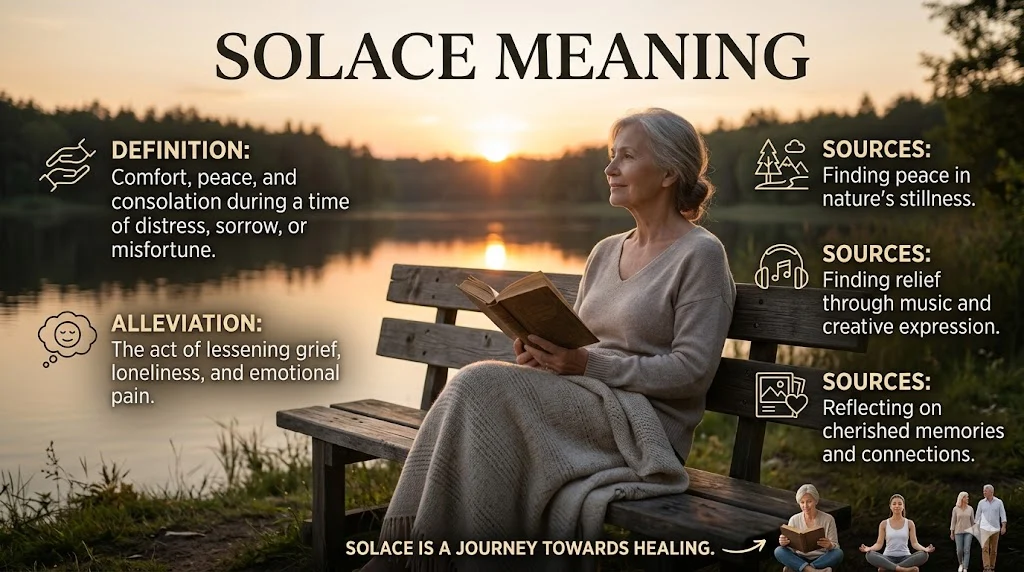

Definition
Solace means comfort or consolation received during a time of grief, distress, or hardship. It’s the feeling of relief emotional, mental, sometimes spiritual that arrives when something eases a heavy burden.
There are moments in life when words simply fail you. You lose someone you love. A dream collapses. A relationship ends. And then slowly, almost unexpectedly something brings you back. A song. A walk in the rain. A friend who just sits with you in silence. That feeling, that quiet relief after the storm, has a name.
It’s called solace.
It’s one of those words that carries real emotional weight. Not flashy. Not overused. Just honest. If you’ve ever wondered what solace means, where it comes from, how to use it correctly, or why writers and poets reach for it again and again you’re in exactly the right place.
This guide covers everything: the definition, pronunciation, examples, synonyms, antonyms, literary uses, multilingual translations, and much more. Whether you’re a student building vocabulary, a writer searching for precision, or just someone who stumbled across this word and felt it resonated let’s dig in.
What Does Solace Mean?
Let’s start simply.
Merriam-Webster defines it as “comfort in grief or anxiety” and also as “a source of relief or consolation.” Oxford Languages describes it as “comfort or consolation in a time of distress or sadness.”
But here’s what the dictionary doesn’t quite capture: solace isn’t just comfort. It’s earned comfort. It implies that something painful came first. You can’t really find solace unless you were suffering to begin with. That’s what gives the word its particular emotional texture it’s relief with a backstory.
Think of it this way. Comfort is a warm room on a cold day. Solace is finally coming inside after walking through a blizzard for hours.
Quick Reference: Solace at a Glance
| Feature | Detail |
|---|---|
| Primary Meaning | Comfort or consolation during grief or hardship |
| Part of Speech | Noun (primary), Verb (secondary) |
| Pronunciation | /ˈsɒl.ɪs/ (British), /ˈsɑː.lɪs/ (American) |
| Syllables | sol·ace (2 syllables) |
| Origin | Latin solacium, Old French solas |
| Register | Formal to semi-formal |
| Common Phrase | “take solace in” |
How to Pronounce Solace
Pronunciation trips people up more than you’d think. Here’s the breakdown:
British English: /ˈsɒl.ɪs/ the first syllable rhymes with “doll” American English: /ˈsɑː.lɪs/ the first syllable sounds like “sol” in “solar”
Both are correct. The stress falls on the first syllable in both versions. You say SOL-iss, not sol-ISS.
Say it out loud: “She found SOL-iss in the music.” That’s right.
The Origin of the Word Solace
Words tell stories. And the story behind “solace” goes back over two thousand years.
The word traces to the Latin solacium, derived from solari, meaning “to console” or “to soothe.” From Latin, it passed into Old French as solas, which carried the same sense of comfort and relief. By the 13th century, Middle English had borrowed it as solace, and it’s stayed with us ever since.
What’s fascinating is how stable the meaning has been. For 800 years, this word has meant essentially the same thing: the comfort that comes after suffering. Languages and cultures change constantly but the human need for solace apparently doesn’t.
Solace as a Noun vs. Solace as a Verb
Most people know “solace” as a noun. But it actually works as a verb too, even if that usage is rarer.
Solace as a Noun
This is its most common form. As a noun, solace refers to the feeling of comfort itself, or to the thing that provides that comfort.
Examples:
- “Music was his solace during the long months of illness.”
- “She sought solace in prayer after the accident.”
- “The letters from home were a great solace to the soldiers.”
- “He found unexpected solace in gardening.”
Solace as a Verb
As a verb, “to solace” means to give comfort or consolation to someone. It’s a more literary usage but grammatically solid.
Examples:
- “She tried to solace her grieving sister with kind words.”
- “Nothing could solace him after such a devastating loss.”
Comparison Table
| Form | Role | Sample Sentence |
|---|---|---|
| Noun | Receiving/having comfort | “Books were his solace.” |
| Noun | Source of comfort | “She was a solace to everyone around her.” |
| Verb | Giving comfort actively | “He solaced the children with stories.” |
The noun form dominates in modern usage. If you use the verb form in writing, it reads as intentionally literary which can be a strength in the right context.
Solace Meaning With Examples: Seeing It in Real Sentences
The best way to understand any word is to watch it work. Here are examples across different emotional registers and life situations, from simple to more complex:
Simple and direct:
- “She found solace in her morning coffee and quiet routines.”
- “His dog was his only solace during the divorce.”
Grief and loss:
- “After her mother died, she took solace in old photographs and handwritten letters.”
- “They found little solace in the official explanation.”
Nature and solitude:
- “The mountains had always been his solace wide, quiet, indifferent to human problems.”
- “Walking along the beach brought her solace she couldn’t find in conversation.”
Work and purpose:
- “When everything else fell apart, she took solace in her work.”
- “Creating art was his solace and his survival.”
Spiritual and religious contexts:
- “He drew solace from scripture during the darkest weeks of his illness.”
- “Prayer offered solace when logic couldn’t.”
Relationships:
- “Their friendship became her solace through years of difficulty.”
- “She was, to him, a solace that no place or thing could match.”
The Phrase “Take Solace In”
This is the most common phrasing you’ll encounter. It means to draw comfort or reassurance from something to let it ease your pain.
“Take solace in the fact that you did everything you could.” “You can take solace in knowing the decision wasn’t yours alone.
It’s a gentle, affirming expression. You’ll hear it in condolence messages, therapy sessions, eulogies, and everyday conversations when someone tries to help another person find peace.
Solace Synonym: Words That Walk the Same Path
Solace has several close relatives in the English language. But they’re not identical twins each carries a slightly different flavor. Choosing the right one matters, especially in writing.
| Synonym | Core Nuance | Best Used When… |
|---|---|---|
| Comfort | Broad emotional or physical ease | The situation involves general distress, not just grief |
| Consolation | Relief when nothing fully fixes the pain | Loss is present but the wound stays open |
| Relief | Removal or reduction of burden | The focus is on what lifted, not what replaced it |
| Reassurance | Calming of specific fears or doubts | Someone needs to be told things will be okay |
| Refuge | Safety, shelter from something hostile | Escape or protection is the primary need |
| Serenity | A lasting inner calm, often spiritual | The state of peace has already been reached |
| Tranquility | External or internal stillness | The environment or mind has grown quiet |
| Succor | Immediate aid in distress | The help is urgent and practical |
| Balm | Something that soothes gently | The healing is slow and gradual |
So when should you choose “solace” over these options?
Use “solace” when you want to emphasize that peace was found despite pain that comfort arrived in the middle of hardship, not after it completely disappeared. It implies both the wound and the healing simultaneously. That’s a nuance none of its synonyms quite replicate.
Solace Antonym: The Other Side of the Coin
Understanding what solace isn’t sharpens your sense of what it is. These antonyms represent the emotional territory solace helps us escape:
| Antonym | What It Captures |
|---|---|
| Distress | Active, present emotional pain |
| Anguish | Deep, often unrelenting suffering |
| Misery | Prolonged unhappiness with no relief |
| Grief | Raw emotional response to loss |
| Torment | Sustained mental or emotional torture |
| Despair | The loss of all hope |
| Desolation | Complete emotional emptiness |
| Agony | Intense, overwhelming pain |
Notice something? Solace and its antonyms occupy the same emotional universe they’re all responses to suffering. The difference is direction. The antonyms point toward pain. Solace points away from it, toward some form of peace.
The Difference Between Solace and Comfort
People often use these words interchangeably. They’re close. But they’re not the same.
Comfort is broader. It covers physical ease (a comfortable chair), emotional warmth (comforting words), and general well-being. You can be comfortable without ever having suffered. A baby is comfortable in its mother’s arms. That’s not solace that’s just warmth and safety.
Solace implies prior pain. It’s specifically about finding peace within or after hardship. The word carries an emotional weight that “comfort” doesn’t always bring.
Here’s a side-by-side comparison:
| Scenario | Comfort? | Solace? |
|---|---|---|
| Sitting in a cozy chair on a Sunday | Yes | Not quite |
| Finding peace after a loved one’s death | Yes | Yes , more precise |
| A reassuring hug after bad news | Yes | Yes |
| Air conditioning on a hot day | Yes | No |
| Music that gets you through grief | Yes | Yes , especially this |
The rule of thumb: If suffering came before the peace, “solace” is probably the more precise word.
An analogy that works: Comfort is a bandage. Solace is what you feel when the wound actually starts to heal.
Solace in Literature and Poetry
Writers have loved this word for centuries. And it’s easy to see why solace does something few words can. It holds grief and relief in the same breath.
Why Writers Reach for It
In literature, precision matters. “Comfort” is fine. “Solace” is memorable. It signals that the character or speaker has been through something and found their way not out of pain exactly, but through it. That’s dramatic and emotionally resonant.
How It Appears in Classic Literature
Throughout English literature, solace has anchored some of the most emotionally powerful passages in the language.
In elegies poems written to mourn the dead solace appears constantly. The poet seeks it, questions whether it exists, and sometimes finds it in the act of writing itself. That recursive quality (writing about grief as a form of solace from grief) fascinated Romantic and Victorian poets especially.
In Victorian prose, solace often appears in the context of religious faith, nature, or duty. Characters find solace in service, in God, in the natural world. Think of it as the 19th century’s emotional vocabulary for mental health.
In modern literary fiction, the word is used more sparingly which actually increases its impact. When a contemporary novelist writes that a character “found solace in an unexpected place,” readers feel the earned quality of that peace.
Solace in Poetry: A Conceptual Look
Poets use “solace” when they want to mark a turning point the moment in a poem when sorrow begins to soften. It often appears near the end of a poem, not as resolution exactly but as a breath. Not all is well but I can breathe again.
That’s the word’s real literary power. It doesn’t claim happiness. It claims survivability.
Solace Meaning in the Bible
The word “solace” doesn’t appear frequently in most modern Bible translations. Different translations make different vocabulary choices some prefer “comfort,” others “consolation.” But the concept of solace runs through the Bible from beginning to end.
Key Biblical Passages That Capture Solace
Psalms is perhaps the richest source of biblical solace. Psalm 23 “Yea, though I walk through the valley of the shadow of death” describes exactly the kind of peace-amid-suffering that solace means. The comfort doesn’t come from the absence of danger but from presence within it.
Isaiah 40:1 opens with “Comfort, comfort my people, says your God” a passage that speaks directly to solace as divine emotional support after collective suffering.
Matthew 5:4 “Blessed are those who mourn, for they shall be comforted” is essentially a promise of solace. Grief is acknowledged. Comfort is coming.
2 Corinthians 1:3 refers to God as the “Father of compassion and the God of all comfort” a description that positions divine solace as both a gift and a relationship.
The Spiritual Dimension of Solace
For millions of people, spiritual solace is the deepest kind. It’s the peace that arrives not from circumstances changing but from an inner shift in how suffering is understood. Faith traditions across the world not just Christianity build frameworks specifically for this kind of comfort.
The concept of sabr in Islam (patient endurance), the Buddhist teaching of dukkha and its release, the Hindu idea of surrender to divine will all of these are cultural architectures for finding solace in the face of unavoidable pain.
Solace Meaning in Other Languages
This word isn’t unique to English. Every language has its way of expressing earned comfort after hardship. Here’s how “solace” translates across several major South Asian and global languages:
| Language | Word for Solace | Transliteration | Deeper Meaning |
|---|---|---|---|
| Urdu | تسلی | Tasalli | Also implies reassurance; used in condolences |
| Hindi | सांत्वना | Saantvana | Soothing words specifically; common in grief contexts |
| Tamil | ஆறுதல் | Ārutal | Literally “calming down”; used when consoling someone |
| Marathi | सांत्वन | Saantvan | Very close to Hindi; used in emotional support |
| Bengali | সান্ত্বনা | Shantona | Used for both verbal and physical comfort in grief |
| Arabic | عزاء | Azaa | Consolation; used formally in condolences |
| French | Réconfort | Réconfort | Warmth-focused comfort |
| Spanish | Consuelo | Consuelo | Close to “consolation”; common in religious contexts |
| German | Trost | Trost | Comfort, often with a sense of hope attached |
What’s striking across all these languages is a shared pattern: the concept of solace almost always carries emotional and communal weight. It’s rarely just about feeling better. It’s about being held by something a person, a belief, a practice while you hurt.
Is Solace a Positive Word?
Short answer: Yes. But it’s complicated in a beautiful way.
Solace is technically a positive word it refers to comfort, relief, and peace. But it’s positive the way a scar is meaningful. You only have it because something hurt. The positivity of solace is earned positivity. It’s not cheerfulness or happiness or pleasure. It’s the specific relief of still being here, of finding your footing after stumbling.
That makes it one of the most emotionally honest words in English. It doesn’t pretend the pain wasn’t real. It just says something helped.
Difference Solace vs. Happiness:
- Happiness can exist without prior suffering
- Solace cannot it presupposes a wound
Using Solace vs. Joy:
- Joy is expansive and energizing
- Solace is quiet and restoring
Solace vs. Peace:
- Peace is a state you can settle into
- Solace is the bridge that gets you there
Can a Person Be Someone’s Solace?
Absolutely and this is one of the most moving uses of the word.
When you say “She was his solace,” you’re not describing what she did. You’re describing what she was to him. Her presence itself provided comfort. Just being near her eased his pain. That’s a profound thing to say about a person.
This usage appears frequently in literature, poetry, and personal writing love letters, eulogies, tributes. It elevates the subject beyond their actions. They didn’t just help. They became the peace someone needed.
Examples:
- “Through every loss he suffered, his grandmother was his solace.”
- “The child didn’t understand the grief in the house but somehow she was a solace to everyone in it.”
- “He had been her solace for thirty years the one constant in a life full of uncertainty.”
If you ever want to tell someone they matter profoundly, calling them your solace is one of the most precise and generous things you can say.
Solace Meaning in Text and Casual Communication
Here’s an honest question: do people actually use “solace” in text messages?
Not often. It’s a formal-to-literary word, and casual texting tends toward simpler vocabulary. You’re more likely to text “this song really helped” than “this song was my solace.”
But “solace” does show up in:
- Personal essays and blog posts about grief or healing
- Social media captions with a reflective or poetic tone
- Condolence messages especially written ones
- Creative writing shared online
- Journaling and self-reflection
The word fits anywhere the tone is thoughtful rather than casual. If someone is sharing something meaningful a tribute, a reflection, a moment of hard-won peace “solace” belongs there.
A good rule: if you’d feel comfortable saying it in a conversation with a close friend during a serious moment, use it. If you’re dashing off a quick reply, a simpler word probably fits better.
Solace in Everyday Life: Where People Actually Find It
The word is formal. The experience is universal.
People find solace in wildly different places and that’s exactly the point. There’s no single source and whatever works for you is valid. Here are the most commonly reported sources of everyday solace:
Music
Music is possibly the most universal solace on earth. It doesn’t require explanation or effort. You press play and it meets you where you are. Studies from psychology and neuroscience consistently show that music reduces cortisol (the stress hormone), triggers emotional release, and activates the brain’s reward systems even or especially during sadness.
Nature
Forests, oceans, mountains, rain, open sky. There’s a reason people instinctively want to go outside when they’re overwhelmed. Research in environmental psychology shows that time in natural settings reduces anxiety, lowers blood pressure, and restores cognitive function. Nature doesn’t judge. It just continues, indifferent and vast, and somehow that helps.
Creative Work
Writing, painting, cooking, building any form of making something with your hands or mind can become solace. The act of creation externalizes internal pain. You give the shapeless feeling a form. Many artists describe their craft not as something they chose but as something they needed to survive.
Human Connection
Sitting with someone who doesn’t try to fix anything but just stays that’s solace in its purest interpersonal form. Research consistently shows that social connection is one of the strongest predictors of psychological resilience. You don’t need words. Presence is enough.
Ritual and Routine
Morning coffee. Evening walks. Weekly calls with a sibling. Routine creates a container for grief. It says: the world still has a structure and you still belong in it. That’s genuinely comforting when everything else feels uncertain.
Faith and Prayer
For billions of people, spiritual practice is the primary source of solace. Prayer, meditation, religious community, reading sacred texts these practices provide both meaning and comfort simultaneously. They address the why of suffering, not just the what.
Books
Reading transports you but more importantly, it tells you that others have felt what you feel and found language for it. When a reader finds a passage that perfectly describes their grief, they often describe it as relief. That’s solace through literature in its most direct form.
Solace Meaning for Students: A Simple Summary
If you’re learning English or studying vocabulary, here’s the clearest possible breakdown:
What it means: Comfort during a hard time
When to use it: When someone or something helps ease pain, grief, or worry
Part of speech: Usually a noun; sometimes a verb
Pronunciation: SOL-iss
Common mistake to avoid: Don’t use “solace” in lighthearted situations. It’s not for ordinary comfort (“this pillow is solace”). It’s for emotional relief during genuine difficulty.
Memory tip: Think sol (like “soul”) + ace (as in excellent). Solace is excellent medicine for the soul.
Practice sentences:
- “After the argument, she found solace in a long walk.”
- “Books gave him solace when nothing else could.”
- “They took solace in each other’s company.”
Solace in Grammar: English Language Notes
A few grammatical points worth knowing:
Article usage:
- You can say “a solace” or “some solace” or just “solace” (without an article)
- “Music is a solace” (countable) and “music brings solace” (uncountable) are both correct
Prepositions that pair with solace:
- “Find solace in something” (most common)
- “Seek solace from something”
- “Take solace in the fact that…”
- “Offer solace to someone”
Common grammatical patterns:
| Pattern | Example |
|---|---|
| Find solace in + noun | “She found solace in painting.” |
| Take solace in + noun/clause | “Take solace in knowing you tried.” |
| Seek solace in/from | “He sought solace in faith.” |
| Offer/provide solace to | “She offered solace to the grieving family.” |
| Something as a solace | “Reading was her solace.” |
Why the Word “Solace” Matters Beyond Its Definition
Here’s something worth sitting with. Language shapes how we experience reality. When you have a precise word for something, you’re better able to recognize it when it happens and better able to seek it deliberately.
A lot of people go through grief or hardship and don’t realize they’re already finding solace. They think they’re “just going for a walk” or “just listening to music.” But naming what’s happening recognizing that the walk is bringing them emotional relief, that the music is doing something necessary actually amplifies its effect.
Having the word “solace” in your vocabulary means you can:
- Ask yourself intentionally: “Where am I finding solace right now?”
- Recognize what helps before you’re desperate for it
- Offer it more deliberately to others: “I hope this brings you some solace”
- Write and speak about grief with more precision and honesty
Language is a tool. And “solace” is one of those tools that, once you really understand it, you find yourself reaching for more often because it describes something real that life keeps presenting you with.
FAQs
What is the meaning of solace in simple words?
Solace means comfort or relief during a hard time. It’s the feeling of peace that comes when something helps ease your grief or pain a person, a place, an activity, or a belief.
How do you use solace in a sentence?
The most natural way is “find solace in” or “take solace in.” For example: “She found solace in her garden after the loss.” You can also say “He was a great solace to her” when referring to a person.
What is the difference between solace and comfort?
Comfort is broad and can apply to physical or emotional ease in any situation. Solace specifically implies that suffering came first. It’s comfort that has earned its name through difficulty.
Is solace a positive word?
Yes but it carries the shadow of what it heals. Solace is positive the way recovery is positive: it presupposes a wound. It’s one of the most emotionally honest positive words in English.
What does “take solace in” mean?
It means to draw comfort or reassurance from something. To let something ease your pain. “Take solace in the fact that you did everything right” means: let that truth comfort you.
Can a person be someone’s solace?
Absolutely. Saying “she was my solace” is a profound statement it means her presence itself brought comfort and peace. It’s one of the most meaningful things you can say about a person.
What are the best synonyms for solace?
Comfort, consolation, relief, reassurance, refuge, and balm are all close. But solace specifically combines grief and comfort simultaneously none of its synonyms do that with quite the same precision.
What is the origin of the word solace?
It comes from Latin solacium (consolation), from solari (to console). It passed through Old French into Middle English by the 13th century and has meant essentially the same thing ever since.
Conclusion
Some words are just vocabulary. Solace is something more. It names a human need that’s as old as suffering itself the need for comfort that doesn’t deny the pain, doesn’t rush the healing, doesn’t promise everything will be fine.
Finding solace doesn’t mean the grief is over. It means you’ve found something to hold onto while it lasts. That something might be a person. A song. A memory. A belief. A quiet morning. A book that understood you before you understood yourself.
Whatever it is for you that’s your solace. And having a word for it makes it more real, more searchable, more yours.
The next time life gets hard and it will, because that’s what life does you’ll know what you’re looking for. And maybe, more importantly, you’ll recognize it when you find it.
Discover More Related Articles:
- Ditto Meaning | From a Girl or Guy In 2026
- Naive Meaning | Chat, Social Media & Everyday Conversation In 2026
- Sigma Meaning | Text Messages, Memes & Online Chats In 2026