
Raise your hand if you’ve typed “ditto” in a text and then immediately wondered wait, does the other person actually know what I mean? You’re not alone. Millions of people search for the ditto meaning every single month, and that’s not a coincidence. It’s a word that’s deceptively simple on the surface but carries surprising depth once you dig in.
Whether you stumbled across it in a text conversation, heard it in a movie, or spotted it in a formal document, ditto shows up everywhere. And it means something slightly different in each of those places. This guide covers all of it the ditto definition, its Italian roots, how people use it in texting and on platforms like Snapchat and TikTok, its synonyms, and a whole lot more.
Let’s get into it.
What Does Ditto Mean? The Core Definition
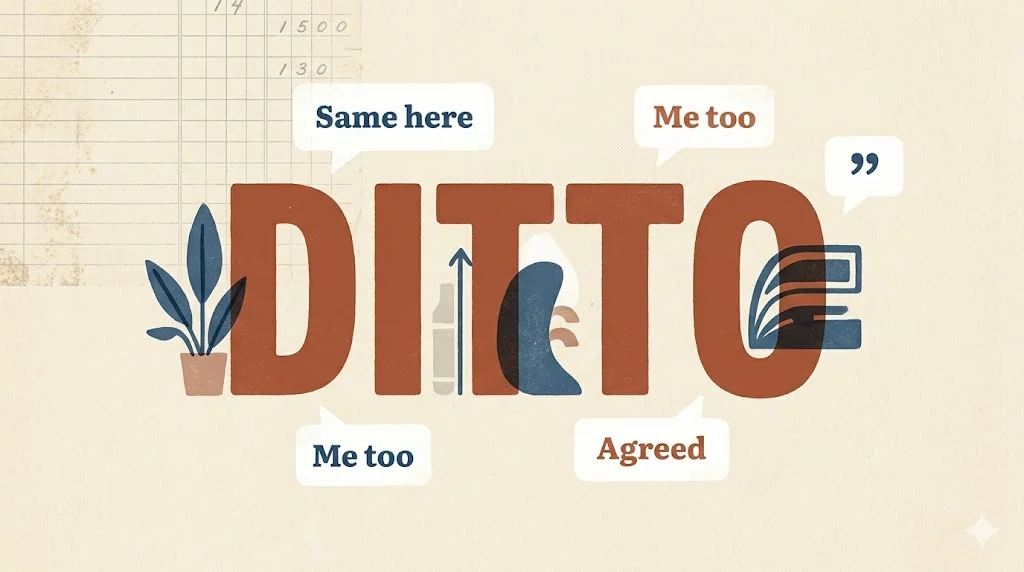
At its most basic, ditto means “the same” or “as previously stated.” It signals that whatever just came before a word, a phrase, a feeling, an entire sentence applies again, right now, in this moment.
You don’t need to repeat yourself. You just say ditto.
It works as multiple parts of speech, which is part of why it’s so versatile:
- As a noun: “Put a ditto next to that item in the list.”
- As an adverb: “She loved the film, and ditto for her brother.”
- As an adjective: “We need ditto copies of this form.”
- As an interjection: “I’m exhausted.” “Ditto.”
The interjection form is by far the most common in everyday speech. It’s punchy, expressive, and carries a warmth that plain words like “same” or “agreed” just don’t quite match.
The Formal vs. Informal Ditto | A Side-by-Side Look
| Context | Meaning | Example |
|---|---|---|
| Formal/written | Same as above; repeat of previous item | Ditto marks in tables and invoices |
| Informal speech | “Same here” / “Me too” / “I agree” | “I need coffee.” — “Ditto.” |
| Texting/chat | Quick agreement or echo response | “That was so awkward.” — “Ditto lol” |
| Slang | Emphasizing sameness or solidarity | “Ditto that 100%” |
| Social media | Relatability signal | “Ditto this entire video” |
Where Did Ditto Come From? The Word Origin & History
Here’s where it gets interesting. Ditto didn’t start as slang. It started as a bookkeeping tool.
The word traces back to the Tuscan dialect of Italian specifically from detto, the past participle of dire, meaning “to say.” That gives you detto “said” or “as has been said.” In Latin, the root is dictus, from dicere same meaning. Spoken. Said. Already stated.
Merchants and clerks in 17th-century Italy used detto (later shortened to ditto in English) in their ledgers to avoid rewriting the same item over and over. If you sold five bolts of cloth on Monday and five more on Tuesday, you didn’t rewrite “five bolts of cloth.” You wrote ditto it meant “same as above.” Efficient. Clean. Smart.
English speakers adopted the word around the late 1600s, first in commercial writing, then gradually in everyday speech. By the 18th and 19th centuries, it had crept firmly into conversational English. By the 20th century, it was in pop songs, movies, and casual conversation. By the 21st, it was in text messages and TikTok comment sections.
That’s a 400-year journey from a Florentine ledger to your phone screen. Not bad for two syllables.
The Ditto Mark (″)
The ditto mark that small double quotation-like symbol (″) placed beneath a word in a list is the visual form of the same concept. It means: repeat what’s directly above me.
You still see it in:
- Military supply tables
- Old-fashioned accounting ledgers
- Shipping manifests and packing lists
- Some British and European administrative documents
It’s largely been replaced by digital formatting tools, but it hasn’t disappeared entirely.
A Quick Timeline
| Era | How Ditto Was Used |
|---|---|
| 1600s | Italian ledgers and Tuscan commerce (detto) |
| Late 1600s–1700s | English bookkeeping and formal writing |
| 1800s | Everyday English speech, informal writing |
| Early 1900s | Common conversational interjection |
| 1990 | Pop culture explosion via Ghost (more on that below) |
| 2000s–2010s | Texting and early social media slang |
| 2020s | TikTok, Snapchat, Instagram, and beyond |
Ditto in Everyday English | How People Actually Use It
Using Ditto to Express Agreement
This is the big one. When someone says something you completely agree with and you don’t want to repeat the whole thing back you say ditto.
“I really don’t want to go back to work tomorrow.” “Ditto.”
That single word does the heavy lifting of: I feel exactly the same way, I understand where you’re coming from, and I share this sentiment entirely. It’s economy of language at its finest.
The reason it feels warmer than “same” or “agreed” is subtle. “Same” is flat. “Agreed” sounds like a business meeting. But ditto carries a slight vintage charm, a conversational intimacy. It says: I’m so on the same page with you that I don’t even need to use full sentences.
Using Ditto to Avoid Repetition in Writing
In writing especially lists, tables, or structured documents ditto or the ditto mark tells the reader: the item above applies here too. This was, historically, its entire purpose.
Example in a supply list:
| Item | Quantity |
|---|---|
| Blue pens | 12 |
| Red pens | ″ (ditto) |
| Black pens | ″ (ditto) |
Modern usage replaces this with copy-paste or merged cells. But in handwritten records and older printed documents, the ditto mark saved enormous amounts of time.
Ditto Used in a Sentence
Sometimes the best way to understand a word is to see it working. Here are ten natural, real-world examples:
- “She loved the concert.” | “Ditto for her entire family.”
- “I don’t trust that company.” | “Ditto, honestly.”
- “The first draft needs work, and ditto the second.”
- “Ditto what she said | this plan won’t work.”
- “I’m starving.” | “Ditto. Let’s order something.”
- “She ordered the grilled salmon. Ditto for me, please.”
- “That meeting could have been an email.” | “Ditto that.”
- “His attention to detail is remarkable, ditto his work ethic.”
- “Ditto marks in old ledgers saved clerks hours of writing.”
- “Can’t make it Saturday.” | “Ditto | sorry!”
Notice how naturally it slots into conversation. It never sounds forced when used correctly. It just fits.
What Does Ditto Mean in Texting?
If you’ve received a “ditto” in a text and wondered what the sender meant, here’s the simple answer: they completely agree with or relate to whatever you just said.
Texting rewards brevity. Nobody wants to write a paragraph when one word does the job. “Ditto” thrives in that environment it’s quick, it’s warm, and it carries more personality than a thumbs-up emoji.
Common Texting Contexts for Ditto
Expressing shared feelings:
“I feel like I haven’t had a real break in months.” “Ditto 😩”
Agreeing with an opinion:
“That restaurant was overrated.” “Ditto, never going back.”
Mirroring enthusiasm:
“I’m so excited for the weekend!” “Ditto!! Can’t wait.”
Low-key acknowledgment:
“I just want to sleep for a week.” “Ditto lol same”
The lowercase, often-emoji-paired version of “ditto” in texting is softer and more casual than the spoken word. It signals not just agreement but a kind of comfortable, easy connection. You said it so I don’t have to.
Ditto Meaning in Chat
In back-and-forth chat conversations, “ditto” pops up as a conversational shortcut. When someone’s already expressed a feeling or thought perfectly, echoing it with “ditto” acknowledges their words without making the conversation feel transactional.
It also does something interesting it validates. Saying “ditto” to someone who’s vented or shared something personal says: I hear you, and I feel it too. That’s more than just agreement. That’s connection.
Ditto Meaning on Snapchat | What It Really Signals
Snapchat culture is built around quick, expressive communication. A snap caption, a mood, a vibe and people respond in kind. On Snapchat, ditto usually means “same energy” or “right back at you.”
If someone posts a snap with the caption “exhausted but making it work” and you reply “ditto,” you’re saying: same, I’m in the exact same boat. It’s solidarity, compressed into one word.
You’ll also see “ditto” used in Snapchat streaks and casual replies where the conversation is light and quick. It’s not deep it’s just a cheerful, breezy acknowledgment that you’re on the same frequency.
Common Snapchat uses of ditto:
- Responding to mood posts: “Ditto, same mood all week”
- Echoing a caption: “Ditto this entire vibe”
- Quick agreement to a story: “Ditto lol”
Ditto Meaning on TikTok | The Relatability Marker
TikTok turned “ditto” into something slightly different. In comment sections, ditto functions as a maximum relatability signal. When a creator says something that resonates whether funny, emotional, or painfully real comments like “ditto,” “ditto this,” or “ditto the entire video” flood in.
It’s the TikTok equivalent of “this is literally me” or the single-word “same” that dominates comment sections. But “ditto” carries a little more weight. It feels more deliberate. More considered. Someone who types “ditto” in a TikTok comment is saying: I don’t just relate to this, I am this.
Examples from TikTok-style usage:
- Under a video about being overwhelmed at work: “Ditto, been like this for six months”
- Under a relatable anxiety video: “Ditto this entire thing omg”
- Under a funny observation about social situations: “Ditto, why is this so accurate”
There’s also a K-pop connection worth mentioning. NewJeans released a song called “Ditto” in late 2022 that became a massive hit. The song uses the word to express deep longing and the desire for a feeling or moment to be returned ditto as a plea, not just an agreement. That cultural moment refreshed the word for an entirely new generation of listeners and introduced the ditto meaning to millions of people who may not have used it much before.
Ditto Meaning in Social Media
Across Twitter/X, Reddit, Instagram, and beyond, ditto works as a discourse marker of shared experience. It’s a one-word comment that means: I’ve been there. I feel that. I agree completely.
On Reddit threads, “ditto” often appears when someone shares a niche experience and another commenter has lived the exact same thing. On Instagram, it appears under captions that tap into universal feelings. On Twitter/X, it’s used to echo a point someone made a quick, visible show of agreement.
Why ditto works so well on social media:
- It’s faster than writing “I feel the same way”
- It sounds human and warm not robotic
- It carries a slight nostalgic charm that sets it apart from “same” or “this”
- It’s unambiguous when you say ditto, everyone knows exactly what you mean
Ditto Slang Meaning | The Informal and Pop Culture Side
The Ghost Effect
If you ask people where they first really felt the word ditto, many will point to one place: the 1990 film Ghost, starring Patrick Swayze and Demi Moore.
In one of cinema’s most iconic scenes, Moore’s character says “I love you” to Swayze’s character and instead of saying it back, he replies: “Ditto.”
It’s understated. It’s warm. It says everything while technically saying nothing. That scene turned “ditto” from a casual word into an emotionally loaded one. It gave the word a romantic, tender dimension it hadn’t fully carried before. Even today, saying “ditto” in response to “I love you” carries that echo affectionate, a little guarded, deeply felt.
Modern Slang Variants
Language never stands still. Today you’ll hear and read variations like:
- “Ditto that” | stronger emphasis, often used to firmly agree with a point just made
- “Hard ditto” |internet slang for emphatic agreement; equivalent of “absolutely same”
- “Big ditto energy” | TikTok and social media shorthand for deeply relatable vibes
- “Ditto 100%” | texting shorthand for total, enthusiastic agreement
Can Ditto Be Sarcastic?
Absolutely. Like most short, punchy words, ditto flips completely depending on tone. Said flatly with a slight drawl “Oh sure, ditto” it signals the exact opposite of genuine agreement. It becomes a dry, slightly passive-aggressive acknowledgment that you don’t actually agree but can’t be bothered to argue.
Context is everything. The word itself is neutral. The delivery makes it.
Is Ditto Formal or Informal?
This question trips people up because the honest answer is: both, depending entirely on context.
When Ditto Is Formal
- In printed tables, lists, and ledgers the ditto mark (″) is perfectly professional
- In legal and administrative documents referencing previous entries
- In academic or historical writing discussing repeated items
- In structured business documents like inventories or supply lists
When Ditto Is Informal
- In any spoken conversation
- In text messages, DMs, and social media comments
- In casual emails between friends or close colleagues
- In creative writing or journalistic prose
When NOT to Use Ditto
| Situation | Why to Avoid It |
|---|---|
| Formal business emails | Sounds too casual; use “likewise” or “as above” |
| Academic essays or papers | Use precise language; ditto is colloquial |
| Job interviews or formal speeches | Too breezy for the context |
| Responding to emotional disclosures (in some cases) | Can read as dismissive if not used carefully |
The rule of thumb: if you’d feel awkward saying it out loud in that setting, write something else.
Ditto Synonyms | All the Other Ways to Say It
Sometimes “ditto” isn’t quite the right fit. Here are the closest alternatives, with notes on tone and best use:
| Ditto Synonym | Tone | Best Used When… |
|---|---|---|
| Likewise | Neutral to formal | Responding politely; suitable in professional settings |
| Same here | Casual | Expressing a shared feeling in conversation |
| Me too | Casual to emotional | Relating personally to someone’s experience |
| As above | Formal | Written documents, structured lists |
| Agreed | Neutral | Confirming a point in discussion |
| Same | Informal | Quick, low-effort texting reply |
| Seconded | Semi-formal | Group discussions, meeting contexts |
| Echoing that | Conversational | Reinforcing someone’s well-made point |
| Idem | Very formal / Latin | Legal, academic, or classical writing |
| Hear, hear | Enthusiastic | Expressing strong public agreement |
| Exactly | Emphatic | When precision matters as much as agreement |
Likewise is the closest formal cousin to ditto. It works in professional emails, polite conversation, and formal writing. But it lacks ditto’s warmth and specificity “likewise” can mean “similarly” in a general sense, while “ditto” means “the exact same thing.”
Me too is emotionally resonant but has acquired additional cultural weight since the #MeToo movement, so context matters when you choose it.
Idem is the Latin equivalent the same and you’ll find it in legal documents, classical music notation, and academic citations. Almost nobody says it out loud.
Ditto Meaning in Urdu | How It Translates
Ditto is an English word, but it’s widely used in Urdu-English code-switching, especially among urban speakers in Pakistan and India. In those conversations, ditto slots in exactly the way it does in English as a quick, expressive marker of agreement.
The closest Urdu equivalent is “وہی” (wohi), meaning “the same” or “that very thing.” You might also hear “بالکل وہی بات” (bilkul wohi baat) “exactly the same thing.”
In practice, Urdu speakers use the English word “ditto” far more often than its Urdu equivalent in casual conversation. It’s been absorbed into everyday Pakistani and Indian English seamlessly.
Example in Urdu-English conversation:
“Aaj ki meeting bilkul bekar thi.” “Ditto, yaar. Total waste.”
Ditto Meaning Across Other Languages & Cultures
The word’s Italian roots give it a surprisingly broad recognition across Romance language speakers:
| Language | Formal Equivalent | Casual Equivalent |
|---|---|---|
| Italian | idem / detto | uguale (“same”) |
| French | idem | pareil (“same thing”) |
| Spanish | ídem | igual / lo mismo |
| Portuguese | idem | mesmo |
| German | desgleichen | ditto (English borrowed back) |
Interestingly, German has actually borrowed “ditto” back from English in modern casual speech you’ll hear younger German speakers use it informally the same way English speakers do.
Common Questions About Ditto | Answered
What does ditto mean when someone says it after “I love you”?
It means “I love you too” with a layer of emotional restraint. It became iconic through Ghost (1990) and carries a gentle, understated warmth. It’s affectionate but not effusive. Some people find it deeply romantic precisely because it holds something back.
Is saying ditto rude?
Not inherently. But tone and context shape everything. If someone shares something deeply personal or painful and you respond with just “ditto,” it can come across as dismissive like you didn’t take their words seriously. In emotionally charged moments, a more explicit response usually serves better. In casual conversation? Ditto is perfectly warm and fine.
What’s the real difference between ditto and likewise?
“Likewise” is more versatile and formal. It means “in the same way” or “similarly,” which makes it slightly broader than ditto. “Ditto” is more specific it means the exact same thing, not just something similar. “Likewise” works in a business email; “ditto” feels more human in casual speech.
Can ditto be used sarcastically?
Yes, and quite effectively. The word’s brevity makes it a perfect vehicle for dry sarcasm. Deliver it flatly after something absurd or irritating and it reads as sharp, understated mockery. That said, written sarcasm is tricky without vocal tone, “ditto” can be misread as genuine agreement. Use carefully in text.
Why do people say ditto instead of just “same”?
“Same” is functional but flat. “Ditto” has character. It’s a little retro, a little warm, carries a history and somehow, that extra syllable makes it feel more intentional. When someone says “ditto,” it reads as deliberate agreement. “Same” is practically a filler word at this point.
What does ditto mean on Snapchat specifically?
On Snapchat, “ditto” almost always means “same energy” or “right back at you.” It’s used to mirror someone’s mood, vibe, or statement. When someone snaps a tired Monday morning caption and you reply “ditto,” you’re both commiserating and connecting at the same time.
How do you use ditto correctly in writing?
In formal writing, use ditto marks (″) beneath a repeated item in a list or table. In informal writing, use “ditto” as you would “same” or “likewise” as a quick signal of agreement or repetition. Don’t use it in academic papers, legal briefs, or formal reports where clarity and precision matter above all else.
How to Use Ditto Correctly | A Quick Reference Guide
Not sure when to reach for it? Here’s a simple checklist:
Use ditto when:
- ✅ You want to agree with something just said without repeating it
- ✅ You’re texting and want a warm, quick reply
- ✅ You’re writing a list or table and need to indicate a repeated item
- ✅ You’re writing casually or conversationally
- ✅ The statement you’re echoing is short, clear, and obvious in context
Don’t use ditto when:
- ❌ You’re writing a formal email to a client or employer
- ❌ The previous statement needs context to understand
- ❌ Someone has shared something emotionally complex and needs a thoughtful response
- ❌ You’re writing academic, legal, or formal professional content
- ❌ The repeated item could cause confusion without being stated explicitly
Fun Facts About Ditto
Here are a few things most people don’t know about this familiar little word:
- The ditto mark (″) looks like a quotation mark but it’s technically a distinct typographic symbol with its own Unicode character: U+3003 in East Asian character sets.
- Italian merchants in Florence used it as early as the 1600s in trade ledgers to speed up recordkeeping long before it entered English conversation.
- “Ditto suit” was a real British fashion term in the 19th century, describing a three-piece suit where all pieces were made from the same fabrimatching set, hence “ditto.”
- Ghost (1990) turned ditto emotionally famous worldwide the film’s iconic “ditto” scene is still referenced in pop culture more than three decades later.
- The Pokémon character Ditto the amorphous, shape-shifting creature that can transform into any other Pokémon takes its name directly from this concept of “the same” or duplication.
- NewJeans’ “Ditto” debuted at number one on South Korea’s Gaon Digital Chart in 2022 and introduced the word to millions of Gen Z listeners globally.
Ditto vs. Similar Expressions | A Deep Comparison
It helps to understand ditto in relation to the words people use interchangeably with it. They’re not always true synonyms.
Ditto vs. Same Here
“Same here” is explicit and conversational. It makes clear that I am experiencing the same thing. “Ditto” is slightly more abstract it echoes the statement rather than asserting a personal connection. In practice, they’re nearly interchangeable in casual speech.
“I haven’t slept well all week.” “Same here.” (slightly more personal) “Ditto.” (slightly more echo-like)
Ditto vs. Me Too
“Me too” is personal and emotional. It foregrounds you your feeling, your experience. “Ditto” foregrounds the statement it mirrors the words rather than centering the speaker. In emotional conversations, “me too” often lands more warmly.
Ditto vs. Agreed
“Agreed” signals rational consensus. It’s what you say in a debate or a meeting when someone makes a point you endorse. “Ditto” is more about emotional or experiential alignment it’s what you say when someone expresses a feeling you share, not just an argument you support.
Ditto vs. Likewise
“Likewise” is the formal, versatile sibling. It works across registers where ditto would sound too casual. But it can feel stiff in personal conversation. “Ditto” wins on warmth; “likewise” wins on professionalism.
Ditto in Grammar | A Closer Look at How the Word Functions
Linguistically, ditto is what’s called a pro-form a word that stands in for something else to avoid repetition. In that sense, it functions similarly to pronouns (“she” stands in for a name) or pro-verbs (“do so” stands in for a previously mentioned action).
More specifically, it operates as a kind of anaphoric expression it refers back to something already stated. When you say “ditto,” you’re performing coreference: pointing at a previous statement and claiming it applies here too.
This is actually linguistically sophisticated, even if it doesn’t feel that way. You’re compressing a whole sentence of meaning into two syllables by exploiting the listener’s shared context. That’s efficient, elegant communication.
In natural language understanding (NLU) the field of AI that deals with how computers interpret human language ditto is a classic challenge. Computers have to understand what it refers back to, which requires parsing context. It’s a simple word that does complex work.
Why Ditto Has Lasted 400 Years
Most words don’t survive four centuries of language change. New words flood in, old ones fade out, slang burns bright and disappears. Ditto has outlasted entire languages.
It fills a genuine gap.
There’s no other single word that does exactly what ditto does particularly in its emotional register. “Same” is close but cold. “Likewise” is formal. “Me too” is personal. Ditto sits in a sweet spot.
It’s phonetically satisfying.
Two syllables, identical vowel sound in both, clean t consonant. It’s easy to say, easy to hear, easy to type. Language keeps the words that feel good in the mouth.
It keeps reinventing itself.
From bookkeeping shorthand to conversational English to pop culture touchstone to TikTok slang ditto has shifted meaning and register while keeping its core intact. That adaptability is rare.
It carries emotional memory.
The Ghost moment, the K-pop hit, the text messages ditto has emotional associations that keep it alive across generations. People don’t just know what it means. They feel what it means.
Conclusion
Here’s what it comes down to: ditto means “the same” but it does so with a warmth, efficiency, and versatility that few words can match.
It started in a 17th-century Italian counting house and ended up in a TikTok comment section. Along the way, it passed through English ledgers, casual speech, a Patrick Swayze film, and a K-pop chart-topper. It’s been formal, informal, romantic, sarcastic, nostalgic, and fresh sometimes all in the same week.
Understanding the ditto definition is simple. But understanding why it persists why people reach for it instinctively across centuries and across platforms is actually a small lesson in what makes language human. We like words that feel good. We keep the ones that save us time while still saying something true.
Ditto is one of those words. And there’s a reason you’re still reading about it in 2025.
Discover More Related Articles:
- HB Meaning in Slang | How People Use It on WhatsApp and Instagram In 2026
- PSA Meaning Slang | Why People Use It Online In 2026