

Definition
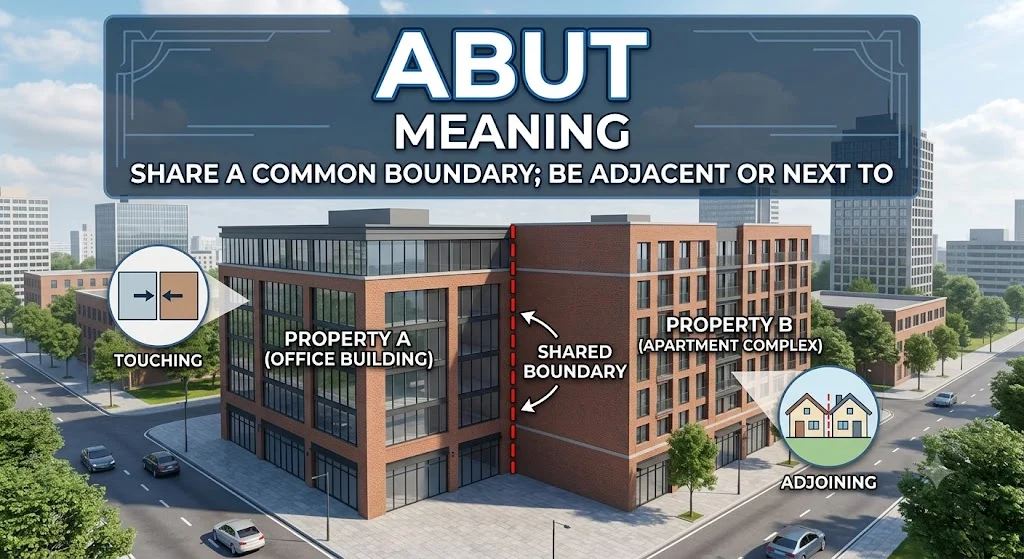
Abut means to touch along a shared edge or boundary. Two things meet. But they don’t overlap. They don’t leave a gap. They just touch at their edges.
Let’s be honest. You’ve seen the word “abut” in a legal document or a land survey. Or maybe you stumbled across it while reading about architecture. It looks short and simple. But getting the exact meaning wrong can cause real confusion. A property line dispute. A misread construction blueprint. A zoning violation.
So let’s fix that right now.
This guide gives you everything. The plain English definition. The legal and real estate meanings. Construction and surveying usage. Grammar rules. Example sentences. Synonyms and antonyms. Pronunciation. And tables that actually help. No fluff. No filler. Just useful knowledge you can apply today.
The Simple Definition of Abut
Think of two pieces of paper on a table. Put them side by side so their edges touch perfectly. That’s abutting. Now slide them so one sits on top of the other. That’s overlapping, not abutting. Pull them apart. Now there’s a gap. That’s not abutting either.
Key fact: Abut always implies direct edge to edge contact. No space. No overlap. Just a clean meeting line.
The word functions as a verb. You can use it transitively or intransitively.
- Transitive example: “Our fence abuts the neighbor’s driveway.”
- Intransitive example: “The two properties abut.”
See the difference? In the first sentence, the fence directly touches something else. In the second sentence, the two properties touch each other.
What Does Abut Mean?
Have you ever seen the word abut in a property document, legal paper, map, or construction plan and wondered what it means? You’re not alone. Many people search for abut meaning, what does abut mean, or define abut because it’s a common term in real estate, engineering, and everyday English, yet it isn’t used often in casual conversations. Understanding this simple word can make legal documents and property descriptions much easier to read.
In the simplest terms, the abut definition is “to touch, border, or share a boundary with something else.” For example, one piece of land may abut another property, a road, or a river. This is also known as the abutting definition, which describes two things that meet directly without any space between them.
This guide explains what does abut mean in plain English with real-life examples, pronunciation tips, and common uses. Whether you’re reading a land survey, buying property, or simply expanding your vocabulary, you’ll quickly understand the meaning of abut and how to use it correctly.
How to Pronounce Abut Correctly
Say it like this: uh BUT
Stress the second syllable. The first syllable is quick and soft. The second syllable gets the emphasis. It rhymes with “cut,” “hut,” or “butt.”
Common mistakes to avoid:
- AY but (wrong)
- AB ut (wrong)
- a BOOT (very wrong)
Phonetic spelling: /əˈbʌt/
Here’s a trick. Say “a button” quickly but drop the “ton” sound. You’re left with “uh but.” That’s close enough to get you started.
Abut vs Adjacent vs Adjoining: Stop Confusing Them
People mix these up all the time. Even native English speakers. Even real estate agents sometimes get it wrong. But the differences matter, especially in legal and technical writing.
Let’s break it down with a table.
| Term | Meaning | Requires Physical Touch? | Example |
|---|---|---|---|
| Abut | Touch at a shared edge | Yes | “The property abuts the river.” |
| Adjacent | Next to, but possibly with a gap | No | “The adjacent lot is for sale.” |
| Adjoining | Connected, often by a door or hallway | Yes, but differently | “The adjoining room has a bathroom.” |
Notice the nuance. Adjacent only means “near” or “beside.” You can have adjacent properties with an alley between them. You cannot have abutting properties with any space between them. Zero space.
Adjoining implies a physical connection too. But it often means connected by a shared element like a door, a wall, or a hallway. Two houses can adjoin through a shared wall. Two rooms can adjoin through an interior door.
Real world test: If you can slide a piece of paper between two things, they do not abut. If you cannot slide anything between them, they abut.
Abut in Real Estate and Property Law
This is where abut becomes critically important. Real estate documents use this word with surgical precision. A deed. A survey. A zoning ordinance. A property tax record. They all rely on the exact meaning of abutting.
What Does Abutting Property Mean?
An abutting property shares a common boundary line with another property. No street in between. Just the boundary line itself.
Example: Your backyard fence sits exactly on the property line. Your neighbor’s driveway runs right up to that same line. Your property abuts their property along that entire fence length.
Legal Language You Will See
Attorneys and surveyors write phrases like this in legal descriptions:
“The northern boundary of Lot 7 abuts the southern boundary of Lot 8.”
“Said parcel abuts County Road 42 on its eastern side.”
“The abutting landowner is responsible for maintaining the shared fence.”
Why Abutting Matters for Property Rights
When your property abuts another property or a public way, you gain certain rights and responsibilities.
- Maintenance duties: In many jurisdictions, abutting landowners must maintain the shared boundary line. This includes fences, walls, and vegetation.
- Access rights: A property that abuts a public road typically has a right of ingress and egress.
- Setback requirements: Zoning laws often measure setbacks from the abutting property line, not from the center of the road.
Fact: In some states, if two properties abut for more than 20 years without dispute, an easement by prescription can arise. That means one neighbor might gain legal rights to use the other’s land.
Abutting Land vs Adjacent Land in Tax Records
Tax assessors draw a clear line between these two terms. Abutting land touches the subject property directly. Adjacent land sits nearby but does not touch.
Here is a common tax map note:
| Term on Tax Map | Meaning |
|---|---|
| Abuts Smith Road | Property line touches road right of way |
| Adjacent to Smith Road | Near the road but separated by another parcel or strip |
Abut in Construction and Architecture
Builders and architects use abut constantly. The word appears on blueprints, in engineering reports, and on material specifications.
Abutting Walls
A wall abuts another wall when its end meets the other wall’s face. Imagine a hallway. A cross wall runs perpendicular and its end touches the longer corridor wall. That end “abuts” the corridor wall.
Example sentence: “The new partition wall abuts the existing concrete shear wall at grid line C 5.”
Construction crews need this precision. If the blueprint says “abuts,” the workers know they cannot leave a gap. They also know they cannot overlap. The materials must meet exactly at the specified edge.
Abutment in Bridges
Here is a fascinating connection. The word “abutment” comes directly from “abut.” A bridge abutment is the structure that supports the end of a bridge. It abuts the solid ground on either side of a river or valley.
Fact: A typical highway bridge has two abutments, one at each end. The bridge deck rests on these abutments. The abutments transfer the weight of the bridge and its traffic into the ground.
Without abutments, bridges would collapse. The abutment literally abuts the earth, holding everything in place.
Abutting in Material Joinery
Woodworkers and metal fabricators use abutting joints. A butt joint is the simplest example. Two boards meet at their ends. No fancy interlocking. No overlapping. Just two flat ends touching.
This joint is weak compared to a dovetail or mortise and tenon. But it is fast and easy. And when you add glue or fasteners, it works fine for many applications.
Example: “The trim pieces abut at the corner. We will fill the seam with caulk before painting.”
Abut in Land Surveying
Surveyors live in a world of precise boundaries. For them, abut is not a casual word. It carries legal weight.
What Surveyors Mean by Abutting
When a surveyor writes that Parcel A abuts Parcel B, they certify the following:
- The two parcels share a common boundary line.
- No gap exists between them.
- No other parcel lies between them.
- The line is mathematically defined (usually by metes and bounds).
Abutting Roads and Rights of Way
A property can abut a road even if the property owner does not own the road. The road sits within a right of way owned by the municipality or state. The property line touches that right of way.
This matters for driveway permits. In most towns, you need a permit to create a new driveway that abuts a public road. The permit ensures your driveway entrance meets safety standards for sight distance and drainage.
Fact: If your property abuts a state highway, you may need a permit from the state Department of Transportation, not just the local town.
Abutting Water Bodies
Properties can abut rivers, lakes, and streams. This creates riparian rights. The landowner typically has the right to reasonable use of the water. But they do not own the water itself.
Example: “Our family’s property abuts the Mill River for 300 feet along the eastern bank.”
Riparian rights vary by state. Some states follow reasonable use rules. Others follow prior appropriation. But the common thread is the abutting relationship between the land and the water.
Synonyms of Abut
You do not have to use “abut” every time. Sometimes a synonym fits better. But choose carefully. Each synonym carries a slightly different shade of meaning.
| Synonym | Best Use Case | Example |
|---|---|---|
| Adjoin | Slightly more formal, often used for rooms or buildings | “The two hotel rooms adjoin through a locking door.” |
| Border | Very common, less technical | “Canada borders the United States to the north.” |
| Touch | Simplest, most conversational | “The fence touches the house at the corner.” |
| Meet | Good for lines and boundaries | “The two property lines meet at the iron pin.” |
| Butt against | Informal, vivid, physical | “The shed butts against the garage wall.” |
| Neighbor (verb) | Rare but acceptable in real estate | “The parcel neighbors the county park.” |
| Connect | Implies more than just touching | “The trail connects to the main path.” |
| Join | Suggests a more intentional connection | “The two pipes join at the fitting.” |
Important nuance: “Adjoin” and “abut” are close but not identical. Adjoining often implies a shared wall or door. Abutting only implies touching along an edge. A fence can abut a road. That same fence does not adjoin the road because they do not share a wall or door.
Antonyms of Abut
Sometimes the best way to understand a word is to study its opposite.
| Antonym | Meaning | Example |
|---|---|---|
| Separate | To move apart or keep apart | “The alley separates the two buildings.” |
| Disconnect | To break a physical connection | “We disconnected the downspout from the drain.” |
| Divide | To insert something between | “A planted buffer divides the properties.” |
| Detach | To remove from contact | “Detach the garage from the house.” |
| Distance | To create space | “The new setback distances the house from the road.” |
Key takeaway: If something separates, disconnects, divides, detaches, or distances, it does the opposite of abutting.
Abut Grammar Rules and Conjugations
Let us get the grammar exactly right. Abut is a regular verb. That means its past tense and past participle follow the standard ed pattern. But there is one small twist.
Conjugation Table
| Tense | Form | Example Sentence |
|---|---|---|
| Base form | abut | The two lots abut along the fence line. |
| Third person singular | abuts | The property abuts a busy street. |
| Past tense | abutted | The wall abutted the old barn before the renovation. |
| Present participle | abutting | The abutting properties share a drainage easement. |
| Past participle | abutted | They have abutted the same boundary for decades. |
The Double T Rule
When adding “ed” or “ing,” you double the final “t.” This follows the standard rule for one syllable verbs ending in a single consonant after a single vowel.
- abut + ed = abutted (not abuted)
- abut + ing = abutting (not abuting)
Compare to other similar verbs:
- submit + ed = submitted
- omit + ed = omitted
- permit + ed = permitted
Same pattern. Abut follows it perfectly.
Common Grammar Mistakes
Mistake 1: Using “abutting” as a noun.
Incorrect: “The abutting between the properties is clear.”
Correct: “The abutment between the properties is clear.” (Or rephrase entirely.)
Mistake 2: Adding a preposition unnecessarily.
Incorrect: “The fence abuts up against the wall.”
Correct: “The fence abuts the wall.”
Mistake 3: Using “abut” with a gap.
Incorrect: “The properties abut with a six foot alley between them.”
Correct: “The properties are adjacent with a six foot alley between them.”
Mistake 4: Forgetting the double t in past tense.
Incorrect: “The two lots abuted each other.”
Correct: “The two lots abutted each other.”
Abut Usage in Different Contexts
Let us expand beyond real estate and construction. Abut appears in several surprising places.
Abut in Geography
Geographers use abut to describe how landforms and political boundaries touch.
Example: “Germany abuts nine different countries. These include France, Switzerland, Austria, and Poland.”
Mountain ranges often abut valleys. A ridge can abut a plain. A delta can abut the sea.
Fact: The Sahara Desert abuts the Sahel region along a transition zone nearly 3,000 miles long.
Abut in Civil Engineering
Civil engineers discuss abutments constantly. A bridge abutment transfers load from the superstructure to the ground. Without it, the bridge would sink or shift.
But abut also appears in other civil contexts. Retaining walls abut existing slopes. Culverts abut stream banks. Pavements abut curbs and gutters.
Example: “The new box culvert abuts the natural stream bed at an elevation of 342 feet above sea level.”
Abut in Urban Planning
Planners use abut to describe zoning district boundaries. A commercial district might abut a residential district. A historic district might abut a transit corridor.
These abutting zones create interesting challenges. Noise, light, and traffic can cross the boundary. Planners use buffers, setbacks, and transition zones to manage these conflicts.
Example: “The downtown core abuts the warehouse district along 5th Street. The city requires a 20 foot landscape buffer between them.”
Abut in Everyday Conversation
You can use abut casually, but it will sound slightly formal. Most people say “touches” or “borders” in daily speech.
Casual: “Our yard touches the park.”
Formal: “Our yard abuts the park.”
Choose based on your audience. A conversation with a neighbor calls for “touches.” A letter to the zoning board calls for “abuts.”
The History of Abut: A Quick Etymology
Understanding where a word comes from helps you remember it. Abut entered English in the 13th century. It came from Old French “abouter.” That word meant “to join end to end.”
The Old French word had two parts: “a” meaning “to” and “bouter” meaning “to strike or push.” So literally, “to push up against.”
This origin explains the modern meaning perfectly. Abut describes something pushing up against something else. Not merging. Not overlapping. Just pushing until they touch.
The noun “abutment” came later, around the 17th century. Engineers needed a word for the structure that pushes against the earth to hold up a bridge. Abutment fit perfectly.
Fun fact: The word “butt” as in “butt joint” comes from the same Old French root. A butt joint is the simplest abutting joint. Two ends meet. No overlap. Just a clean push.
Abut in Legal Documents: What to Watch For
If you read a deed, easement, or survey, pay close attention to “abut” and “abutting.” These words create legal obligations.
Deed Language
A typical deed might say: “The subject property abuts the grantor’s retained parcel along the western 150 feet.”
This means the two properties touch along that specific 150 foot segment. If you buy the subject property, you share that boundary with the grantor. You have responsibilities for fencing, vegetation, and maintenance.
Easement Language
An easement might say: “A 10 foot wide utility easement abuts the northern property line.”
The easement touches the line. It does not cross the line. It runs alongside it. This affects where you can build. Most zoning codes forbid structures within an easement, even if the easement abuts rather than crosses.
Zoning Ordinance Language
A typical zoning rule: “No structure may abut a fire lane.”
Fire lanes must remain clear. If your building abuts the fire lane, emergency vehicles cannot access that side of the building. So the code forbids abutting entirely.
Real world consequence: A restaurant owner built a dumpster enclosure that abutted the fire lane. The fire marshal ordered it removed within 48 hours. The owner paid $3,000 in removal and relocation costs.
Abut vs Overlap: A Critical Distinction
Let me make this crystal clear. Abut does not mean overlap. Overlap means one thing lies partly on top of another. Abut means two things meet exactly at their edges.
| Comparison | Abut | Overlap |
|---|---|---|
| Contact type | Edge to edge | Surface to surface |
| Gap | No gap | No gap (but different geometry) |
| Example | Two floor tiles touching | Shingles overlapping on a roof |
| Boundary | Line | Area |
Why does this matter? In real estate, overlap creates a cloud on title. If two deeds overlap, neither owner has clear ownership of the overlapping area. Courts must resolve the dispute.
Abutting creates no cloud. Two properties that abut have a clean, unambiguous boundary. Everyone knows who owns what.
Fact: Title insurance companies charge higher premiums when a survey shows potential overlaps. They charge standard rates for clean abutting boundaries.
Quick Reference Card for Abut
Print this section or save it for later.
Word: Abut
Pronunciation: uh BUT
Part of speech: Verb
Definition: To touch along a shared edge or boundary
Forms:
- Abut
- Abuts
- Abutted
- Abutting
Synonyms: Adjoin, border, touch, meet, butt against
Antonyms: Separate, disconnect, divide, detach
Example sentence: “Our property abuts the county road.”
Common contexts: Real estate, surveying, construction, architecture, bridge engineering, geography
Mistake to avoid: Do not use “abut” if there is a gap. Use “adjacent” instead.
FAQs
What does abut mean in simple words for a child?
Two things touch at their edges. Like two puzzle pieces. Or your bed touching the wall.
Is abut only used for land?
No. You can abut walls, roads, rivers, floors, ceilings, and even abstract boundaries. But land and property are the most common uses.
Can a house abut a street?
Yes. If the house’s property line touches the street’s right of way, the property abuts the street. This usually means the homeowner can have a driveway directly onto that street.
What is the difference between abutting and adjacent?
Abutting means touching. Adjacent means near but not necessarily touching.
How do you use abut in a sentence about two houses?
“The two houses abut along their shared driveway.” Or “Our house abuts the neighbor’s house at the garage wall.”
What is an abutting owner?
An abutting owner owns property that touches another property or a public way. Abutting owners often have special rights and duties under local law.
Can a river abut land?
Yes. A river can abut the land on its banks. The landowner typically has riparian rights to the water.
Is abut a common word?
It is common in legal, surveying, construction, and real estate contexts. It is uncommon in casual conversation.
Conclusion
Here is what you learned.
Abut means edge to edge touch. No gap. No overlap. Just a clean meeting line.
Real estate deeds use abut to describe property boundaries. Surveyors certify abutting lines. Builders follow abutting specifications on blueprints.
The word comes from Old French meaning “to push against.” Its noun form, abutment, names the structures that hold up bridges.
Do not confuse abut with adjacent. Adjacent allows a gap. Abut does not.
Do not confuse abut with adjoin. Adjoining often implies a shared door or wall. Abut only requires touching at an edge.
Use the word confidently in legal, technical, and professional writing. Use “touches” or “borders” in casual conversation.
Now go read that property deed or land survey. You will spot “abut” immediately. And you will know exactly what it means. No confusion. No guessing. Just clear, precise understanding.
Discover More Related Articles:
- Pentacles Meaning | Symbolism & Spiritual Significance In 2026
- Rizz Meaning | Understanding the Internet’s Favorite Dating Slang In 2026
- Disposition Meaning | Psychology, Law & Daily Life In 2026