
Definition:
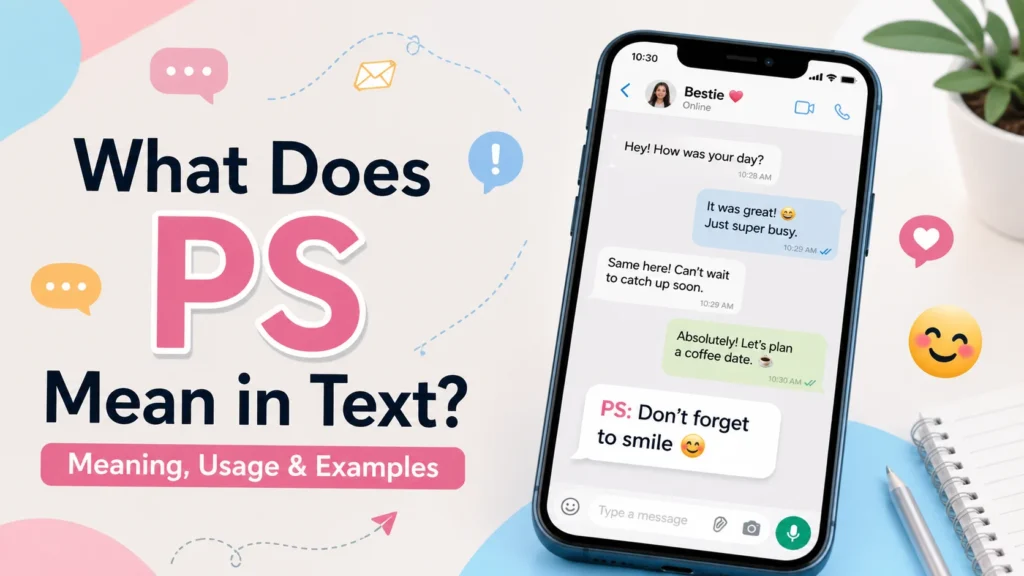
PS in text means “postscript,” a short message added after the main body of a text, message, or letter to include extra information, reminders, or thoughts that were forgotten or added afterward.
In today’s fast-paced digital world, texting abbreviations are everywhere—short, quick, and designed for convenience. One of the most commonly used yet sometimes misunderstood abbreviations is “PS”. You may have seen it at the end of messages, emails, or social media captions and wondered what it actually means and how to use it correctly.
This guide breaks down everything you need to know about what PS means in text, including its origin, real-life usage, tone variations, examples, and comparisons with similar abbreviations. Whether you’re texting friends, writing emails, or posting online, understanding “PS” will help you communicate more clearly and naturally.
Origin and Popularity of PS
The term “PS” comes from the Latin phrase “post scriptum,” which translates to “written after.” It was originally used in handwritten letters before the digital era.
In traditional letter writing, people often finished their message, signed their name, and then remembered something important afterward. Instead of rewriting the entire letter, they would simply add:
P.S. I forgot to mention…
Over time, this practice became standardized and shortened to “PS.”
Why It Became Popular in Texting
Even though we no longer rely on handwritten letters, PS remains popular because:
- It feels natural and conversational
- It adds a personal touch to messages
- It allows people to add extra thoughts without editing the main message
- It works well in emails, texts, and social media captions
Today, PS is widely used in both formal and informal communication, especially in digital writing.
Meaning and Usage of PS in Texting
In modern texting, PS is used to add extra information after the main message is finished.
It usually appears at the end of a message and can be used for:
- Adding a reminder
- Sharing an afterthought
- Emphasizing a final point
- Making a humorous or emotional comment
Common Usage Examples
- Friendly tone:
Hey! See you tomorrow. PS: Don’t forget the snacks 😄 - Reminder tone:
Meeting at 5 PM. PS: Bring your notebook. - Emotional tone:
Miss you so much. PS: Can’t wait to see you again ❤️ - Playful tone:
I finished all my work today. PS: I deserve a pizza 🍕
Real-World Examples of PS in Text
Here’s how PS appears in different communication situations:
Example Table
| Situation | Message Example |
|---|---|
| Friendly chat | “Had a great time today! PS: You owe me coffee next time ☕” |
| “Looking forward to your response. PS: Attached is the document you requested.” | |
| Social media | “Best vacation ever! PS: I never want to come back 😂” |
| Work message | “Please review the report. PS: Deadline is tomorrow at 3 PM.” |
As you can see, PS works across casual and professional contexts.
Tone Variations of PS
The meaning of PS doesn’t change, but the tone depends on context.
1. Friendly Tone
Used among friends and family:
- Light, casual, and fun
- Often includes emojis
2. Professional Tone
Used in emails or workplace messages:
- Polite and informative
- Avoids slang or emojis
3. Playful or Humorous Tone
Used in jokes or social media:
- Adds personality
- Often sarcastic or funny
4. Serious Tone
Used to emphasize important reminders:
- Direct and clear
- No extra decoration
Comparison with Related Text Abbreviations
Many people confuse PS with other abbreviations. Here’s a simple comparison:
| Abbreviation | Meaning | Usage Difference |
|---|---|---|
| PS | Postscript | Extra message added after main text |
| BTW | By the way | Used within the message, not at the end |
| FYI | For your information | Used to inform, not add afterthought |
| P.S. | Same as PS | Just a stylized version with periods |
| IMHO | In my humble opinion | Used for expressing opinion |
Key Difference:
- PS = afterthought at the end
- Other abbreviations = used within the message flow
Alternate Meanings of PS
Although “postscript” is the main meaning, PS can also mean different things depending on context:
- PlayStation (gaming console by Sony) 🎮
- Photoshop (Adobe software) 🎨
- Power Supply (technology/engineering context) ⚡
- Public School (education context)
However, in texting and social media, PS almost always means postscript.
Polite and Professional Alternatives to PS
If you want to avoid using PS or sound more formal, you can use:
- “Additionally…”
- “One more thing…”
- “Just a quick note…”
- “Before I forget…”
- “As a final point…”
Example:
Instead of:
PS: Please send the file.
You can write:
Additionally, please send the file when you have time.
Common Mistakes When Using PS
Even though PS is simple, people sometimes misuse it.
Mistakes to Avoid:
- ❌ Using multiple PS sections repeatedly in one message
- ❌ Placing PS in the middle of a text
- ❌ Overusing it in professional writing
- ❌ Confusing PS with unrelated meanings (like PlayStation)
- ❌ Forgetting punctuation consistency (P.S. vs PS)
Best Practice:
Use PS once per message for a final thought or reminder.
FAQs
1. What does PS mean in text messages?
PS means “postscript,” used to add extra information after a message is finished.
2. Is PS formal or informal?
It can be both, but it is more commonly used in informal or semi-formal communication.
3. Can I use PS in emails?
Yes, PS is commonly used in emails to add extra notes or reminders.
4. What is the difference between PS and BTW?
PS is used at the end of a message, while BTW is used within the message.
5. Is PS still used today?
Yes, PS is still widely used in texting, emails, and social media.
6. Does PS always mean postscript?
In texting, yes. However, it can also mean PlayStation or Photoshop in other contexts.
7. Can I use multiple PS in one message?
It’s better not to. One PS per message is considered standard and clear.
8. Is PS rude or polite?
PS is neutral—it can be polite, funny, or casual depending on tone.
Conclusion
Understanding what PS means in text helps you communicate more naturally and effectively in both casual and professional settings. Originating from the Latin post scriptum, PS has evolved from handwritten letters into a widely used digital communication tool.
It is mainly used to add extra thoughts, reminders, or emotional notes after a message is completed. Whether you’re texting friends, writing emails, or posting on social media, PS remains a simple yet powerful way to enhance your message.
Discover More Related Articles:
- B Width Mean in Shoes: Fit, Sizing, and Comfort Tips for 2026
- Repentance Mean in the Bible: Powerful Truth Most People Miss In 2026