

Definition
At its heart, voilà is a French interjection used to draw attention to something, signal a reveal, express satisfaction, or wrap up a completed action. The simplest voilà definition? It means “see there” or “look there.”
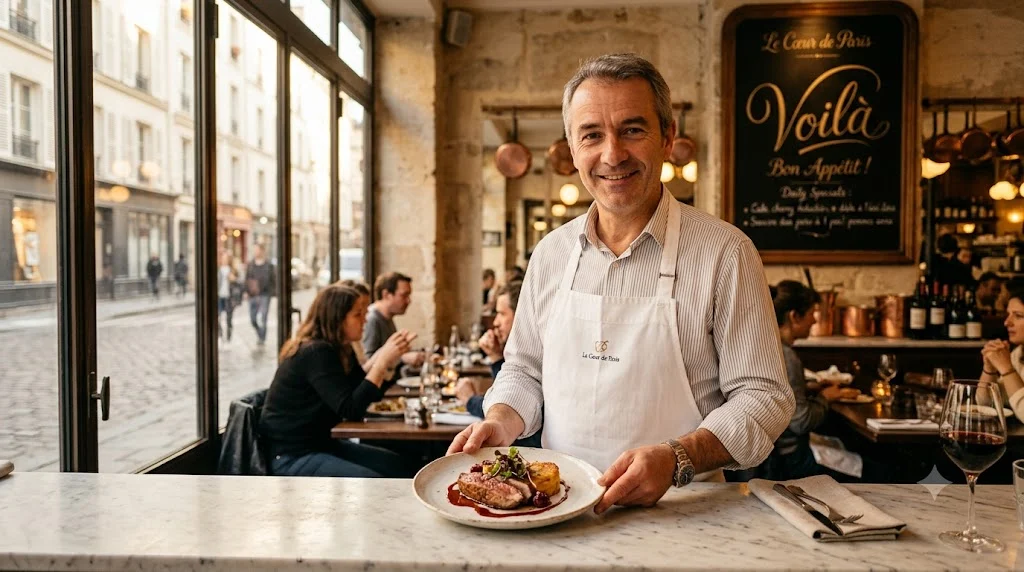
Think about the last time someone pulled off something impressive right in front of you. Maybe a chef slid a perfect dish across a marble counter. Maybe a friend finished a DIY project in record time. Or maybe a magician whipped a rabbit out of thin air. And what did they say in that exact moment? Nine times out of ten, it was voilà.
It’s a tiny word. Five letters, two syllables. Yet somehow it manages to carry the weight of “look at this,” “I did it,” “there you go,” and “ta-da” all rolled into one satisfying little package. No English word quite does what voilà does. That’s precisely why English borrowed it from French and never gave it back.
This guide covers everything you need to know about voilà meaning, where it comes from, how to pronounce it without embarrassing yourself, how people use it in real conversation and texting, and why this word has survived centuries of language evolution and is still going strong today.
What Does Voilà Mean?
But that literal translation doesn’t really capture how it feels to use it. When you say voilà, you’re not just pointing at something. You’re presenting it. You’re giving it a moment.
In everyday English, voilà functions across several slightly different meanings depending on context:
| Context | What Voilà Communicates |
|---|---|
| Presenting something | “Here it is” or “There you go” |
| Completing a task | “And it’s done” or “Done!” |
| Summarizing a result | “And there we have it” |
| Dramatic reveal | “Ta-da!” |
| Expressing inevitability | “That’s just how it is” |
| Showing off a finished product | “Look what I made” |
It’s worth pointing out what voilà is not. It isn’t a verb. You can’t say “she voilà-ed the project.” It isn’t a noun either. It doesn’t describe anything. It’s purely an interjection, which means it works as a standalone exclamation that punctuates a moment rather than building a sentence’s grammatical structure.
That might sound like a limitation. It’s actually what makes it powerful. Voilà doesn’t need to explain itself. It just shows up, does its job, and lets the result speak.
The Origin of Voilà: Where Did This Word Actually Come From?
The origin of voilà stretches back to Old French, at least as far as the 15th and 16th centuries. It started life as two separate words: voi and là.
Voi comes from voir, the French verb meaning “to see.” Specifically, voi was the imperative form, which means it was a command: “see!” or “look!”
Là simply means “there.”
So the original meaning was literally “see there” or “look there” as a direct command. Over time, the two words fused into a single expression and took on a broader range of uses.
Some fascinating facts about voilà’s history:
- The Merriam-Webster Dictionary officially defines voilà and lists it as an English word, not just a foreign borrowing
- French itself evolved the word from an even older Latin root: videre, meaning “to see”
- English has borrowed hundreds of French words, and voilà sits comfortably alongside genre, résumé, cliché, café, fiancé, and ballet
- Unlike some French borrowings that feel dated, voilà has grown more popular in English over time, not less
That last point matters. Voilà isn’t a relic. It’s actively used in everyday speech, social media, professional writing, and casual conversation right now. The word has aged the way good wine does.
Voilà Pronunciation: How to Say It Without Getting It Wrong
Here’s where a lot of English speakers slip up. The voilà pronunciation trips people up because the spelling looks like it should be pronounced one way but it actually sounds completely different.
Correct pronunciation: vwah-LAH
Let’s break it down phonetically: /vwɑːˈlɑː/
The stress falls on the second syllable: vwah-LAH. Not VWA-lah. The accent mark (à) is there for a reason: it tells you exactly where the emphasis belongs.
The trickiest part is that opening “vw” sound. In French, this comes naturally. For English speakers, it feels strange because English almost never combines v and w at the start of a word. The trick is to begin saying “v” and let your lips round into a “w” position almost simultaneously. Practice it slowly: vwah… then speed it up: vwah-LAH.
Common mispronunciations to avoid:
| Wrong | Right | Why It’s Wrong |
|---|---|---|
| voy-LAH | vwah-LAH | The “oi” combo misleads English speakers |
| VEE-oh-la | vwah-LAH | That’s a musical instrument, completely different |
| wah-LAH | vwah-LAH | Dropping the “v” entirely |
| VOY-la | vwah-LAH | Stressing the wrong syllable |
Quick tip: Think of the French word “oui” (yes), which English speakers often approximate as “wee.” The “vw” in voilà is similar to that rounded French vowel sound. Say “v-wee” quickly, then swap the vowel to “ah”: vwah. You’ve got it.
A note on the accent: The accent grave over the à is part of the correct French spelling: voilà. In English writing, you’ll see both voilà (with accent) and voila (without). Both are widely accepted. If you’re writing formally or want to be technically precise, use the accent. In casual texting or social media, voila without the accent is perfectly fine and almost universal.
Voilà Meaning in French vs. Voilà Meaning in English
Here’s something interesting: the word means the same thing in both languages but it works very differently.
In French, voilà is a versatile, high-frequency word that native speakers use constantly. It goes far beyond dramatic reveals. French speakers use it to:
- Point to something nearby (“voilà mon livre” = “there’s my book”)
- Summarize a situation (“voilà, c’est tout” = “that’s it, that’s everything”)
- Fill conversational pauses, similar to how English speakers say “so” or “well then”
- Confirm something (“voilà exactement” = “exactly right”)
- Indicate resignation (“voilà la vie” = “that’s life / such is life”)
It’s so common in French conversation that removing it from everyday speech would feel like removing “well” and “so” and “there you have it” from English all at once. It’s that embedded.
Side-by-side comparison:
| Situation | French Usage | English Usage |
|---|---|---|
| Frequency | Extremely common, almost filler | Occasional, used for emphasis |
| Tone | Neutral to conversational | Slightly theatrical, playful |
| Range of meaning | Very broad | Narrower, mostly reveal or completion |
| Formality level | Used in all registers | Slightly informal, occasionally formal |
The difference is a bit like how English speakers use “c’est la vie” (another French borrowing). French speakers use it to mean a broad range of things from mild disappointment to philosophical acceptance. English speakers use it almost exclusively in a slightly dramatic, resigned shrug sort of way. Same word, same origin, different energy depending on which side of the Channel you’re standing on.
How to Use Voilà in a Sentence: Real Examples That Actually Work
Knowing the voilà definition is one thing. Knowing how to use it naturally is another. Here’s the key rule: voilà works best right at the moment of reveal. It appears either just before or just after the thing being presented or completed.
Using voilà to complete a task:
- “I spent two hours sanding, priming, and painting the old dresser. Voilà, it looks brand new.”
- “She added the final stitch, tied off the thread, and held up the quilt. Voilà.”
- “Mix equal parts vinegar and baking soda, pour it down the drain, wait five minutes, and voilà, no more clog.”
Using voilà to present something:
- “He pulled back the curtain to reveal a fully renovated kitchen. Voilà.”
- “I ordered your favorite flowers and had them delivered to your office. Voilà.”
Notice how voilà almost always comes at a turning point. Before voilà, there’s a process or buildup. After voilà, there’s a result. The word sits at the junction between effort and outcome. That’s its natural home.
Voilà Meaning in Text, Chat, and Social Media
Language evolves. And in the digital age, voila (always without the accent in text speak) has carved out a solid place in online communication, social media captions, and casual messaging.
In texting and chat, voila typically signals:
- “Done!” (after fixing something or finishing a task)
- “Look at this” (before sharing a photo or result)
- “See?” (when making a point that’s just been proven)
- “I figured it out”
Example text exchanges:
“Hey, can you fix the link in the doc?” “Done. Voila.”
“I thought those jeans didn’t fit anymore?” “Tailored them myself. Voila 😊”
“How did you get that stain out?” “Cold water, dish soap, let it sit for 10 minutes. Voila.”
On social media, voila is especially popular in:
- Cooking and food content: Recipe videos almost always end with a voila moment when the finished dish appears
- DIY and home improvement: Before-and-after reveals are practically built around the word
- Fashion and style: Outfit transformation posts, styling tips, wardrobe hacks
- Beauty and makeup: The reveal of a finished look after a tutorial
- Tech and productivity: Showing a completed app, design, or project
A typical Instagram or TikTok caption might look like:
“Thrifted this coat for $8, added new buttons and a belt, voila ✨ Custom coat that cost basically nothing.”
“Three ingredients, 15 minutes, voila 🍝 Weeknight pasta sorted.”
The tone in social media use is confident and a little cheeky. It’s not arrogant, it’s celebratory. It says, “I did the thing, and here’s the proof, and yes, I’m pretty pleased about it.” That energy resonates. Voila as a caption word performs well because it communicates satisfaction without gloating.
Voilà meaning in slang stays close to its core meaning, just wrapped in a more casual package. You might see it spelled creatively online (“wala,” “wallah,” “wa-la”), though these are technically misspellings. The correct form, even in casual digital contexts, is voila or voilà.
Voilà Synonyms: What Else Can You Say Instead?
Nothing truly replaces voilà. That’s the honest answer. But depending on the tone and situation you’re going for, these alternatives can work:
| Synonym | Tone | Best Used When |
|---|---|---|
| Ta-da | Playful, theatrical, slightly silly | Lighthearted, informal moments |
| There you go | Casual, functional, everyday | Handing something over directly |
| Here it is | Neutral, direct, matter-of-fact | Simple presentations without flair |
| And there we have it | Formal, conclusive | Wrapping up a presentation or argument |
| Behold | Dramatic, archaic, almost ironic | Theatrical moments or when joking |
| Done! | Abrupt, simple, efficient | Quick task completions |
| Look at that | Conversational, understated | Drawing attention without ceremony |
| Presto | Magical, retro | Magic-adjacent reveals |
Here’s the nuance that matters: voilà occupies a specific middle ground that none of these alternatives quite hit. It’s more elegant than “ta-da” but less stiff than “behold.” It’s warmer than “here it is” but more focused than “look at that.”
When English speakers use voilà, they’re reaching for a word that feels polished without feeling pretentious, theatrical without feeling silly, and conversational without feeling flat. That combination is rare, and it’s exactly why voilà stuck around after English borrowed it.
Voilà vs. “Here It Is”: Is There Really a Difference?
Functionally, voilà and “here it is” often mean the same thing. But using one instead of the other changes the entire feel of a moment.
Consider these two versions of the same sentence:
“I spent the whole weekend repainting the kitchen. Here it is.”
“I spent the whole weekend repainting the kitchen. Voilà.”
The first version is fine. It’s clear. It communicates what happened. The second version does all of that and adds something extra. It suggests that the speaker is genuinely proud of what they’ve done. It gives the reveal a slight flourish.
That’s the real difference. “Here it is” is informational. Voilà is experiential. One tells you something. The other shows it to you with intention.
Think of it as the difference between a waiter setting a plate on the table and walking away versus a chef emerging from the kitchen, placing the plate in front of you, and saying voilà. The food might be identical. The experience is completely different.
This is why voilà shows up so reliably in cooking, design, performance, and craftsmanship. These are fields where the result is meant to be experienced, not just acknowledged. Voilà honors that distinction.
Common Mistakes People Make With Voilà
Even people who love the word sometimes use it wrong. Here are the most common errors and how to fix them.
Spelling it as “wa-la,” “walla,” or “wallah”
These are phonetic approximations that became misspellings. They show up surprisingly often in informal writing. The issue is they’re pulling from the sound of the word without knowing the actual spelling. The correct forms are voila (anglicized) or voilà (French original). Nothing else is correct.
Confusing voilà with viola
Voilà: vwah-LAH. A French exclamation. Viola: vee-OH-lah. A stringed instrument that looks like a large violin.
These words sound different, look different, and mean completely different things. The confusion comes from spelling similarity, but there’s no excuse once you’ve heard them pronounced correctly.
Overusing it
Voilà earns its power from being used at the right moment. Drop it into every other sentence and it loses its effect entirely. It works because it signals a genuine moment of completion or reveal. Use it when something actually deserves that spotlight.
Using it as a verb
It can’t be conjugated. You can’t “voilà” something. It doesn’t take a subject or an object. It stands alone as an interjection or it appears just before or after the thing being revealed. That’s its role and it plays it perfectly, but only in that role.
Assuming it sounds pretentious
Some people avoid voilà because they think it’ll come across as trying too hard. It won’t, as long as it fits the situation naturally. Using it genuinely in a moment that actually calls for a reveal sounds confident and warm. Forcing it where it doesn’t belong is what sounds pretentious. The word itself is perfectly fine.
Voilà in Culture: Why Does Everyone Say It?
Voilà didn’t become embedded in English by accident. It rode in on the coattails of French cultural influence, and once it arrived, it found a home in the specific corners of English-speaking life where artistry and craft matter most.
Culinary culture is probably the biggest driver. French cuisine dominated fine dining globally for centuries. French cooking techniques, vocabulary, and attitudes toward food became the default language of professional kitchens worldwide. Chefs adopted voilà as the natural punctuation mark for the moment of presentation, and it never left. Today, cooking show hosts and home cooks alike use it constantly, from Michelin-starred restaurants to five-minute recipe videos online.
Magic and performance contributed as well. Stage magicians built their entire craft around the moment of reveal, and voilà captures that moment better than any English word does. Presto competed for a while, but voilà won. It felt more sophisticated, more convincing, more like something an actual craftsperson would say rather than a cartoon conjurer.
Design and fashion kept it alive in professional contexts. Interior designers, fashion designers, and creative directors adopted voilà as a presentation word, a way of stepping back from a completed work and inviting someone to see it clearly. It’s still common in these industries today.
Everyday speech eventually took it from these specialized domains and made it universally available. Now anyone can use voilà, not just chefs and magicians. A parent helping a child with homework, a mechanic finishing a repair, a programmer who fixed a stubborn bug. The word belongs to everyone now.
What’s remarkable is that voilà carries these layers of cultural association without feeling heavy. It’s simultaneously a word with real historical depth and a completely natural thing to say when you’ve just made something work.
The Psychology Behind Voilà: Why This Word Feels So Satisfying
There’s a reason voilà works so well and it goes deeper than just meaning. Linguists and psychologists who study language and emotion note that interjections (words like wow, oops, oh, and voilà) activate a slightly different part of the brain than regular words do. They’re processed faster, felt more immediately, and remembered more vividly.
Voilà also signals confidence. When you use it, you’re implying that the result is worth presenting. You’re not hedging, not apologizing, not adding qualifiers. You’re saying: here it is, look at it, it’s done and it’s good. That confidence is contagious. It makes the listener or reader trust the result more.
This explains why voilà survived the transition from specialized culinary and performance vocabulary into everyday English. It delivers a psychological hit that no equivalent English word provides. Borrowed languages often fill gaps in native vocabulary, and voilà fills an emotional and psychological gap as much as a semantic one.
How Voilà Compares to Similar Expressions Across Languages
English isn’t the only language that borrowed or developed a voilà equivalent. Many languages have their own single-word or short-phrase version of the dramatic reveal or completion signal.
| Language | Expression | Literal Meaning | Used Similarly to Voilà? |
|---|---|---|---|
| Spanish | ¡Aquí está! | “Here it is!” | Yes, though more words |
| Italian | Ecco! | “Here!” or “There!” | Very closely, yes |
| German | Bitte! | “Please” or “Here you are” | When handing something over |
| Japanese | Jya-n! | Onomatopoeia for “ta-da” | In casual reveals |
| Portuguese | Pronto! | “Ready!” or “Done!” | For completions |
| Arabic | Haa! | “Here!” | In quick presentations |
| Hebrew | Na! | “Here, take it” | Informal handover |
Notice something interesting: Italian’s ecco is the closest linguistic cousin to voilà. Both come from imperative commands meaning “see” or “look.” Both evolved into single exclamations used for the same situations: presenting something, marking completion, drawing attention. Italian and French share Latin roots, so that parallel evolution makes perfect sense.
What’s striking about voilà specifically is that it carries more elegance and more theatrical range than most of these equivalents. Ecco is punchy and Italian in the best way. But voilà carries the particular je ne sais quoi (another French borrowing, fittingly) that makes it feel both sophisticated and accessible at the same time.
English borrowed voilà rather than inventing its own equivalent because, simply put, voilà was better than anything English could have made. Sometimes the right word already exists in another language and the honorable thing to do is to borrow it gratefully.
Voilà in Everyday Speech: When to Say It and When to Hold Back
Knowing voilà’s meaning is straightforward. Knowing when to reach for it takes a little more judgment. Used well, it elevates a moment. Overused or misplaced, it starts to feel affected.
Here are the situations where voilà fits naturally and earns its place:
When voilà works perfectly:
- After completing a multi-step process and showing the result
- When presenting something you made, built, cooked, designed, or fixed
- At the end of a demonstration or tutorial
- When a solution to a problem reveals itself
- In a lighthearted or playful moment of showing off a finished product
- When the result genuinely deserves a small celebration
The golden rule is this: voilà should mark a genuine moment. If you’re presenting something real, something finished, something worth a look, voilà fits. If you’re using it as filler or for ironic detachment too often, it deflates.
A useful internal test is to ask yourself: “Am I actually presenting something right now?” If yes, voilà. If no, choose a different word or no word at all.
Voilà in casual conversation:
This is where voilà truly thrives. Cooking dinner for someone, fixing a bike, decorating a room, putting together an outfit: these everyday moments of completion are exactly where the word feels most natural and most human.
French Words Used in English: Voilà Among Its Peers
Voilà doesn’t live in isolation in the English language. It belongs to a rich family of French borrowings that English absorbed over centuries. Understanding the company voilà keeps helps explain why it feels at home in English despite being unmistakably French.
French words now standard in English:
| French Word | English Use | Original Meaning |
|---|---|---|
| Café | Coffee shop | Coffee |
| Genre | Category of art or literature | Kind, type |
| Résumé | Professional CV document | Summary |
| Cliché | Overused expression | Printing plate (originally) |
| Ballet | Dance form | Dance |
| Fiancé/Fiancée | Engaged partner | Betrothed |
| Critique | Critical analysis | Criticism |
| Debut | First public appearance | Beginning |
| Étiquette | Social rules of conduct | Label, ticket |
| Ensemble | A group performing together | Together |
| Voyeur | Someone who watches secretly | One who sees |
| Entrepreneur | Business founder | One who undertakes |
Every one of these words fills a specific niche in English that no native word quite covered. That’s the pattern. When English encounters a concept for which it lacks an elegant or precise word, it borrows from French (or Latin, or Greek, or countless other languages) without a second thought.
Voilà belongs to a specific subset of this list: words that English uses expressively rather than just descriptively. Café describes a place. Cliché describes a type of expression. But voilà does something. It performs a function in the moment of speaking that no English word can replicate. That’s rare and it’s why voilà has staying power.
The French language continues to contribute to English. Words like selfie have no French equivalent in common use, but French keeps exporting culture and English keeps taking vocabulary from it. Voilà is one of the oldest and most successfully transplanted examples of this ongoing exchange.
Voilà in Writing: How Journalists, Authors, and Bloggers Use It
Writers love voilà for the same reason everyone else does: it’s compact, vivid, and versatile. But skilled writers use it strategically, not casually.
In journalism and nonfiction, voilà often appears when the writer is walking the reader through a process and wants to mark the moment the result arrives. It speeds up the pacing and gives the reader a small moment of satisfaction.
“She combined the two solutions in a test tube, waited thirty seconds, and voilà: the liquid turned bright blue.”
In creative writing, voilà can add a wry, slightly ironic edge, especially when the “reveal” being described is underwhelming or anticlimactic.
“After three hours of assembly, eighteen stripped screws, and one missing instruction page, I stepped back. Voilà. A bookshelf. Possibly.”
In blog writing and content marketing, voilà signals the payoff moment at the end of a list of steps. Recipe posts and tutorial articles almost always end with it because it tells the reader: you’ve done the work, here’s your result, enjoy it.
The best use of voilà in writing is always at a genuine turning point. When the reader has followed a process, absorbed some information, or waited for an outcome, voilà gives them a moment to recognize that the destination has arrived. It’s a small gift to the reader and it costs exactly one word.
Quick Reference: Everything You Need to Know About Voilà Meaning
Here’s a clean summary of all the key facts about voilà in one place.
Core facts:
- Meaning: “See there” or “look there”; used to present, reveal, or complete something with flair
- Origin: French, from voir (to see) + là (there); dates to at least the 15th century
- Part of speech: Interjection
- Pronunciation: vwah-LAH (stress on second syllable)
- Phonetic spelling: /vwɑːˈlɑː/
- Spelling variants: Voilà (French, with accent) and voila (anglicized, without accent)
- Language family: French loanword, now a standard English word
- Registered in Merriam-Webster: Yes, as an official English word
Usage at a glance:
| Category | Examples |
|---|---|
| Presenting | “Voilà, your coffee.” |
| Completing | “Fixed the engine. Voilà.” |
| Summarizing | “Cut costs, improved workflow, voilà, higher profits.” |
| Revealing | “She lifted the cloth. Voilà.” |
| In texting | “Done editing your photo. Voila.” |
| In cooking | “Simmer for 20 minutes and voilà, perfect risotto.” |
What voilà is NOT:
- Not a verb (you can’t voilà something)
- Not a noun (it can’t be “a voilà”)
- Not pronounced like the instrument viola
- Not spelled wa-la, walla, or wallah
- Not pretentious when used naturally
FAQs
What does voilà mean in English?
Voilà means “see there” or “look there” in English and is used to present something, signal a completed task, or mark a moment of reveal. It carries a sense of satisfaction and theatricality.
What does voilà mean in French?
In French, voilà has a broader range of meanings. It means “there it is,” “here you go,” “that’s it,” and is also used as a conversational filler similar to “well then” or “so there you have it.”
How do you pronounce voilà correctly?
The correct pronunciation is vwah-LAH, with stress on the second syllable. The phonetic spelling is /vwɑːˈlɑː/. The opening “vw” sound is the trickiest part for English speakers.
Is voilà a French word?
Yes, voilà is originally French. However, it has been officially adopted into English and is listed in major English dictionaries including Merriam-Webster.
Is it spelled voila or voilà?
Both are correct. Voilà with the accent grave is the original French spelling and the most technically accurate form. Voila without the accent is the anglicized version and is widely accepted in English, especially in informal writing.
How do you use voilà in a sentence?
Place voilà just before or just after the thing being revealed or completed. Example: “She mixed the ingredients, poured them into the mold, and let it set overnight. Voilà, handmade soap.”
What does voila mean in texting?
In texting, voila (usually without accent) means “done,” “look at this,” or “see?” It typically appears after completing a task or when sharing a result or outcome.
Why do people say voilà?
People say voilà because it captures a moment of completion or reveal better than any native English expression does. It’s compact, satisfying, and carries a slight theatrical quality that makes moments feel more intentional.
Conclusion:
Voilà has been working hard for a very long time. It started life as a two-word command in medieval French, crossed the Channel and the Atlantic through centuries of cultural exchange, and landed permanently in the English language because it does something no other word quite manages.
It turns a moment into a presentation.
Whether you’re finishing a home renovation, plating a meal, closing a sales pitch, fixing a bug in your code, or captioning a transformation video at midnight, voilà gives that moment a small but genuine sense of ceremony. It honors the effort behind the result.
Use it the next time you actually finish something. Not ironically, not awkwardly, just naturally: the way someone reaches for the right word and finds it’s already there, waiting.
Discover More Related Articles:
- Blue Collar Meaning | Jobs, Salaries & Future In 2026
- ICYMI Meaning | Understanding This Popular Internet Slang In 2026