
Definition
A purl is a type of stitch used in knitting where the yarn is brought to the front and worked in the opposite direction of a knit stitch. It creates a bumpy texture and is commonly used to form patterns like ribbing.
You have probably seen the word “purl” in two very different places. One place is a knitting pattern. The other place is an old poem about a stream. Same spelling. Same sound. Completely different meanings.
So which one do you need right now?
Let me clear this up fast. The purl meaning depends entirely on your context. Holding yarn and needles? You are looking at a knitting stitch. Reading a nature description? You are watching water ripple.
This guide gives you both meanings with real examples, clear tables, and zero fluff. No confusing explanations. Just the facts you actually need.
Let us start with the one that most people search for.
What Does Purl Mean in Knitting
For the vast majority of searches, the purl word meaning ties directly to knitting. In fact, if you ask ten people what does purl mean, eight of them will show you a knitting needle.
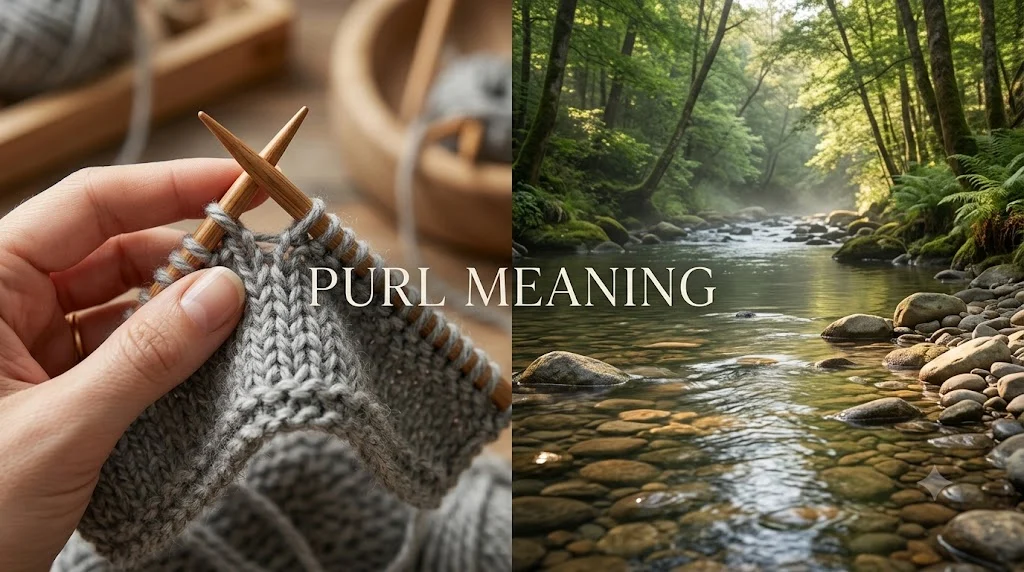
The purl in knitting meaning is simple. It is a specific stitch. You make it by bringing your working yarn to the front of the needle. Then you insert the right needle from right to left into the front of the stitch on the left needle. Wrap the yarn counterclockwise. Pull the new loop through. Slide the old stitch off.
That sounds mechanical. But here is the human way to think about it.
The purl stitch creates a tiny horizontal bump. Imagine a small pearl lying sideways on your fabric. Each bump sits right below the next one. That bumpy texture is the signature of a purl.
Purl definition (knitting context): A stitch where the yarn crosses the front of the needle creating a horizontal ridge on the fabric surface.
The purl noun meaning describes the stitch itself. “Work one purl.” The purl verb meaning describes the action. “Purl the next four stitches.”
The Bumpy Truth About Purl Stitches
Let me show you why this stitch matters.
Every knitted fabric comes from two basic moves. The knit stitch and the purl stitch. That is it. Every sweater, scarf, hat, and blanket you have ever seen uses only these two stitches in different combinations.
The knit stitch makes a smooth V shape. It looks like tiny columns of arrows pointing down. The purl stitch makes a bumpy wave. It looks like little horizontal dashes.
When you alternate them, magic happens.
Here are the fabrics you can make with just knit and purl:
- Stockinette stitch (knit one row, purl one row) gives you smooth V shapes on one side and bumpy waves on the other. This is the classic sweater fabric.
- Garter stitch (knit every row) gives you horizontal ridges on both sides. No purls needed at all.
- Ribbing (knit one, purl one repeating) gives you vertical stretchy columns. You see this on hat brims and sock cuffs.
- Seed stitch (knit one, purl one alternating every row) gives you tiny textured dots. It looks like scattered seeds.
- Moss stitch (knit two, purl two over multiple rows) gives you deeper textured blocks.
Every single one of these comes from the same two basic moves. That is why understanding the purl meaning opens up the entire world of knitting.
Knit Versus Purl: The Side By Side Truth
This table shows you exactly how these two stitches differ.
| Feature | Knit Stitch | Purl Stitch |
|---|---|---|
| Yarn position during stitch | Behind the work | In front of the work |
| Needle insertion direction | Left to right | Right to left |
| Resulting fabric texture | Smooth V shapes | Bumpy horizontal ridges |
| Fabric curl tendency | Curls toward knit side | Curls toward purl side |
| Yarn consumption | Slightly less | Slightly more (about 2-3 percent) |
| Difficulty for beginners | Very easy | Moderately easy (feels awkward at first) |
Real talk: The purl stitch is not harder than the knit stitch. It just feels different. Your hands learn the knit motion first because it is more natural. The purl motion requires holding the yarn in front. That feels strange for about fifteen minutes. Then it clicks.
Once you master both, you can make anything.
How to Purl in Five Real Steps
Let me walk you through this without the overly complex instructions that confuse beginners.
Step one: Hold your needle with the existing stitches in your left hand. The working yarn (the yarn attached to your ball) should hang in front of the needle. Not behind. Front.
Step two: Insert your right needle into the front of the first stitch on your left needle. Go from right to left. The right needle will end up pointing left and sitting in front of the left needle.
Step three: Wrap your working yarn counterclockwise around the right needle. Do this from right to left. You will feel the yarn cross between the two needles.
Step four: Pull the right needle backward through the stitch. It brings the wrapped yarn with it. You now have a new loop on your right needle.
Step five: Let the old stitch slide off the left needle. Congratulations. You just made a purl.
A helpful mental image: Think of a scooping motion. The knit stitch feels like stabbing from the back. The purl stitch feels like scooping from the front. Both end with a loop. Both make fabric. Just different textures.
What Is the Purl Stitch Used For
You cannot make professional looking knitting without the purl stitch. Here is why.
Ribbing requires purls. That stretchy edge on a hat or sock needs alternating knit and purl columns. Without purls, ribbing does not exist.
Textured patterns require purls. Seed stitch, moss stitch, basketweave, and hundreds of other patterns use purls as the bumpy contrast to smooth knits.
Stockinette fabric needs purls. To get that smooth V side, you must purl the return row. If you knit every row, you get garter stitch instead.
Purl side texture is beautiful. Some patterns use the bumpy side of stockinette as the public face. It gives a cozy, nubby look that many people love.
Here is a concrete example: Look at the bottom of any store bought knit hat. See those vertical stretchy columns? That is one knit stitch next to one purl stitch repeated around the whole circle. No purls means no stretch. No stretch means the hat falls off your head.
Common Mistakes When Learning Purl
Let me save you some frustration.
Mistake one: Holding the yarn in back. You cannot purl with the yarn behind the work. It will not work. Keep that yarn in front. If you keep forgetting, wrap the yarn around your pinky to remind yourself.
Mistake two: Inserting the needle from left to right. That makes a twisted knit stitch, not a purl. Always insert from right to left for a true purl.
Mistake three: Wrapping the yarn clockwise. Counterclockwise is correct. Clockwise twists the stitch and changes your fabric dramatically.
Mistake four: Pulling too tight. New purlers often yank the yarn tight after each stitch. This makes the next row nearly impossible to enter. Keep your tension relaxed. Let the needle do the work.
A quick fix: If your purl row looks much tighter than your knit row, you are pulling the yarn after wrapping. Stop that. Just wrap and pull through without an extra tug.
How to Read Your Purls
This skill separates beginners from confident knitters.
When you look at your fabric, each purl bump looks like a little pearl. A horizontal dash. The back of a knit stitch looks exactly like a purl stitch. So a purl from the front and a knit from the back are the same thing.
Here is the useful fact: If you see a V shape on the needle, that stitch wants to be knitted. If you see a bump on the needle, that stitch wants to be purled.
You can read your last row to know what to do next. No need to memorize patterns. Just look at the stitch below your needle.
If the stitch below shows a V, knit it. If it shows a bump, purl it. This works for ribbing, seed stitch, and any pattern where you alternate stitches.
The Other Purl Meaning: Water in Motion
Now let me take you away from yarn and needles. Walk outside to a small stream.
The purl meaning in English has a second life. It describes the sound and movement of gently flowing water. Think of a brook sliding over smooth stones. Think of a small creek bubbling through mossy rocks. That soft, rippling motion is purling.
Purl definition (water context): To flow with a gentle swirling motion and a soft murmuring sound.
This use is older. You will find it in 19th century poetry and classic nature writing. Modern English speakers rarely use it in casual conversation. But it still appears in literature, descriptive writing, and as a beautiful vintage word.
Example sentence: The clear spring purled between the ferns and wild mint.
Example sentence: She listened to the brook purling over the limestone bed.
This purl verb meaning has no connection to knitting. The two meanings developed separately from different roots. They just happen to sound and look identical. A classic case of linguistic coincidence.
Where Did This Water Meaning Come From
The water version of purl comes from an imitative origin. That means the word sounds like the thing it describes.
Say “purl” out loud. Purl. Now imagine a stream bubbling. The soft plosive P followed by the liquid ur sound mimics the gentle splash of water over stones.
Linguists trace this water meaning to the 16th century. It likely came from a Scandinavian or Low German word meaning “to ripple.” Compare it to similar sounding words like burble, gurgle, and swirl. All imitate water sounds.
The knitting meaning, by contrast, likely came from the Italian word “pirlo” meaning a twist or curl. Different origin. Same spelling. Pure coincidence.
Here is a helpful fact for word lovers: English has many of these double meaning words. Bark (tree skin and dog sound) is another example. Bat (flying animal and sports equipment) is another. Purl joins this family of happy accidents.
When Should You Use the Water Meaning
Almost never in daily conversation.
If you tell a friend “I watched the river purl today,” they will look confused. They might think you dropped your knitting in the water.
Use the water purl meaning in these situations:
- Creative writing or poetry
- Descriptive nature essays
- Vintage style prose
- Word nerd discussions about rare vocabulary
- Teaching someone about homographs
For everything else, stick with the knitting meaning. Or just say “ripple,” “bubble,” or “gurgle.” Those words communicate clearly without confusion.
Purl Pronunciation and Word History
Let me clear up any pronunciation questions.
Purl pronunciation: /pɜːrl/ in phonetic spelling. Rhymes perfectly with “curl,” “whirl,” and “hurl.” One syllable. Short and crisp. The vowel sound is the same as in “her” or “bird.”
Some people mistakenly pronounce it like “pearl.” That is a different word. A pearl is a gem from an oyster. A purl is a stitch or a ripple. Close in sound but not identical.
Purl meaning in English pronunciation tip: The R is fully pronounced in American English. In some British dialects, the R is softer. But the vowel stays the same.
Word History Facts You Can Use
The knitting purl entered English in the early 16th century. Needlework was a common household skill. The word stuck because it described a specific motion that nothing else captured.
The water purl entered English around the same time. Both words coexisted for 500 years without major confusion. Context always made the meaning clear. A knitter never talked about streams. A poet never talked about yarn.
The word stayed stable. No new uses in modern technology. Purl remains what it always was. A simple word for two simple things.
Here is a surprising fact: Some dictionaries list a third purl meaning related to embroidery or lace making. This is extremely rare today. You will almost never encounter it unless you study antique needlework patterns from the 1700s.
Disambiguation: Which Purl Meaning Do You Need
Let me help you choose the right meaning instantly.
Ask yourself these three questions:
Question one: Are you holding yarn or reading a knitting pattern?
- Yes → knitting meaning
- No → keep going
Question two: Are you reading nature writing or an old poem?
- Yes → water meaning
- No → keep going
Here is a decision table for clarity:
| Your situation | The correct purl meaning |
|---|---|
| Following a knitting pattern | Knitting stitch |
| Learning to make a sweater | Knitting stitch |
| Reading a Wordsworth poem about a brook | Water ripple |
| Describing a mountain stream | Water ripple |
| Seeing “Purl” as a last name | Proper noun (surname) |
| Watching a knitting tutorial video | Knitting stitch |
| Searching for craft supplies | Knitting stitch |
The shortcut rule: If there is no yarn, it is probably the water meaning. If there is no water, it is probably the knitting meaning. If there is neither, check for a surname or brand name.
Purl as a Name and Brand
The word purl also appears as a rare surname. You will find families named Purl mostly in English speaking countries. The name likely came from a nickname for someone who lived near a stream or someone who worked as a knitter. Or it could have come from a completely different root. Surname origins are often messy.
Current facts: The surname Purl is uncommon. According to public records, fewer than 500 people in the United States carry this last name. No major celebrities or politicians use the name Purl. It remains a quiet, rare family name.
Some small businesses also use Purl in their brand names. Purl Soho is a famous yarn shop in New York City. Purl Bee is their popular knitting blog. These brands lean into the knitting meaning of the word.
No major companies use the water meaning as a brand. It is simply too obscure for mass market appeal.
Real Examples of Purl in Sentences
Let me show you the word working naturally in both contexts.
Knitting examples:
She purled the next ten stitches before setting down her work.
The pattern said knit two, purl two for four inches.
His scarf had perfect purl ridges every other row.
You must purl the wrong side to get stockinette on the right side.
Water examples:
The little creek purled through the meadow all afternoon.
He fell asleep listening to the fountain purling in the courtyard.
Clear water purled over the ancient mill dam.
Mixed context (showing confusion):
She read the word “purl” in her novel and reached for her knitting needles. But the character was walking beside a stream. Different purl entirely.
The Technical Side of Purl Stitches
For the knitters who want deeper knowledge.
Stitch anatomy: A purl stitch has a horizontal bar across its face. This bar crosses the front of the stitch from right to left. The back of a purl stitch looks exactly like the front of a knit stitch. That symmetry is why stockinette has a smooth side and a bumpy side.
Gauge differences: Purl stitches are slightly wider than knit stitches when measured at the same tension. A purl can be 5 to 8 percent wider depending on yarn weight and needle size. This matters for intricate colorwork but not for basic projects.
Tension tips: Your purl tension should match your knit tension. If one is looser than the other, your fabric will show horizontal stripes of loose and tight rows. To fix this, practice purling without pulling the yarn tight after each stitch. Relax your grip.
Combination knitting: Some knitters use a technique called combination knitting. They wrap the purl stitch clockwise instead of counterclockwise. This twists the stitch. Then they untwist it on the next row by knitting through the back loop. This method uses less motion and can be faster. But it confuses most pattern instructions.
Why Understanding Purl Meaning Matters
You might wonder why anyone needs a guide to one small word.
Here is why.
If you are learning to knit and you search purl meaning, you need a clear answer. Not a dictionary page with twelve definitions. Not a blog post that rambles for 2000 words before answering. You need someone to say “it is a stitch that makes bumps” and then show you what to do with it.
If you are a writer or a curious reader, you need the water meaning. You want to know that the stream in that old poem is not knitting. You want the historical context and the pronunciation.
If you are an English learner, you need both meanings. Homographs confuse everyone. Knowing that one word can mean two completely unrelated things helps you read with confidence.
The meaning of purl is not complicated. It is just two different things sharing one spelling. Now you know both. No confusion remains.
FAQs
Does purl mean the same thing as pearl?
No. A pearl is a gem. Purl is a stitch or a ripple. They sound similar but have no connection. However, some old knitting patterns used the spelling “pearl” for the purl stitch. That was a historical variation, not the modern standard.
Is purling harder than knitting?
No. It just feels different. Your hands need about fifteen minutes to adjust to the new motion. After that, purling becomes as automatic as knitting.
Can you knit without ever purling?
Yes. Garter stitch uses only knit stitches. You knit every row back and forth. That gives you a ridged fabric that does not curl. But you cannot make ribbing, stockinette, seed stitch, or most textured patterns without purling.
What does purlwise mean?
It means “insert your needle as if you were going to purl.” You might see this instruction in a pattern even when you are not actually purling that stitch. It only describes the needle insertion direction.
Does the purl stitch use more yarn than the knit stitch?
Yes, but only slightly. Measurements show purl stitches consume about 2 to 3 percent more yarn per stitch than knit stitches. The difference is too small to affect most projects. You will not run out of yarn because of purl stitches.
Why does my purl row look different from my knit row?
That is normal. Purl rows create bumps. Knit rows create V shapes. They are supposed to look different. If your fabric looks uneven, check your tension. New purlers often pull tighter than they should.
Conclusion:
In conclusion, the word purl has different meanings depending on the context in which it is used. In general English usage, it often refers to a soft, gentle sound of flowing water, like a stream or river moving smoothly over stones. This gives the word a calm and peaceful association in descriptive writing.
In knitting, however, purl has a completely different meaning. It is a basic knitting stitch that creates a textured pattern on fabric. The purl stitch is the opposite of the knit stitch, and together they are used to make different designs in clothing, scarves, and other handmade items.
Historically, the word “purl” has been used in literature to describe soothing, murmuring sounds, especially related to nature. This poetic usage helps writers create vivid imagery and a relaxing mood in their descriptions.
Overall, purl is a versatile word with both creative and technical meanings. Whether referring to nature’s gentle sounds or an important knitting technique, it plays a useful role in language and craft.
Discover More Related Articles:
- Grifter Meaning | Slang, Politics & Everyday Language In 2026
- Masochist Meaning | Signs, Traits & Relationship In 2026
- FUPA Meaning | What Does It Stand For In 2026