
Definition
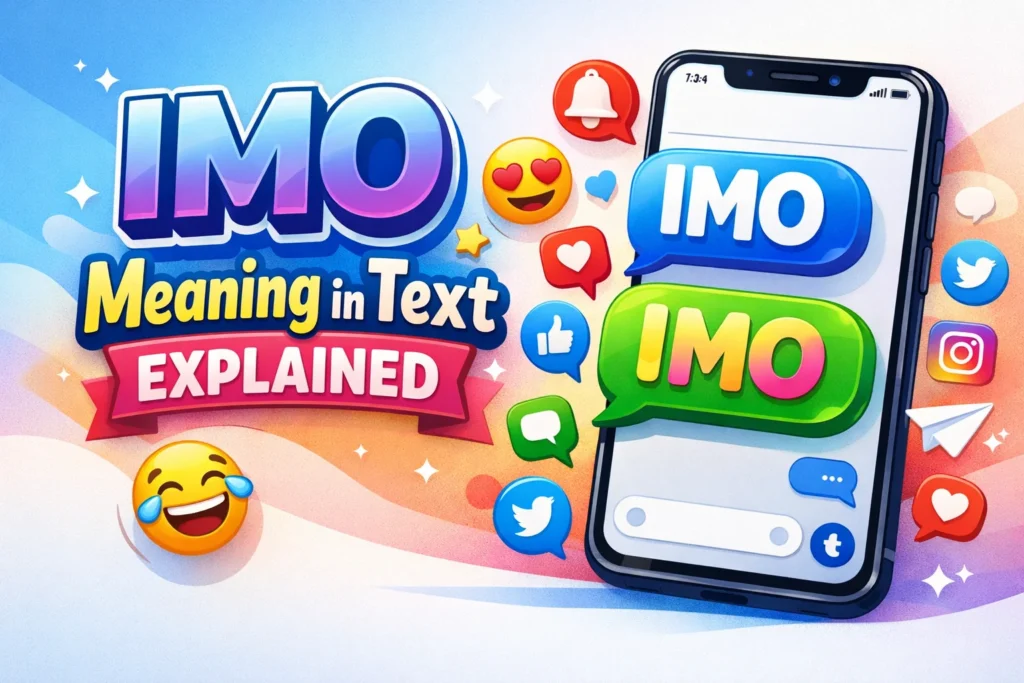
IMO in text messaging stands for “In My Opinion.” It is a commonly used internet abbreviation that people use to express their personal thoughts or viewpoints in a casual, polite, and conversational way online.
If you’ve ever seen someone write “IMO, that movie was amazing” or “IMO, you should try it,” you might already know that IMO is one of the most widely used texting abbreviations on the internet.
It appears everywhere—WhatsApp chats, Instagram comments, Reddit discussions, TikTok debates, and gaming conversations. The reason it’s so popular is simple: it lets people share opinions quickly without sounding too direct or harsh.
Understanding what IMO means in text helps you communicate more naturally in online conversations and also interpret what others are really saying.
Origin and Popularity of IMO
The abbreviation IMO started in early internet forums and email culture, where users needed quick ways to express personal opinions.
Over time, it became a standard part of internet slang and is now used globally across:
- Social media platforms (TikTok, Instagram, X/Twitter)
- Messaging apps (WhatsApp, Messenger, Snapchat)
- Online forums (Reddit, Quora)
- Gaming chats and Discord servers
Its popularity comes from its simplicity and usefulness in expressing opinions politely.
What Does IMO Mean in Text?
IMO = In My Opinion
This is the most common and widely accepted meaning.
Example:
- “IMO, pizza is better than burgers 🍕”
- “That ending was confusing IMO.”
👉 Meaning: The person is sharing a personal opinion, not a fact.
Tone: Polite, subjective, conversational
How IMO Is Used in Real Conversations
Casual Conversation Example
- A: “Do you like this song?”
- B: “IMO, it’s really good 🎧”
👉 Meaning: Personal opinion, not a universal truth
Social Media Example
- “IMO, this trend is overrated 😬”
👉 Used in comments to express disagreement politely
Friendly Advice Example
- “IMO, you should rest instead of overworking yourself.”
👉 Soft way to give suggestions
Table: Usage Examples of IMO
| Context | Example Sentence | Meaning |
|---|---|---|
| Opinion sharing | IMO, this game is fun | Personal view |
| Debate | IMO, that’s not correct | Disagreement |
| Advice | IMO, you should wait | Suggestion |
| Social media | IMO this outfit is perfect | Personal judgment |
Tone Variations of IMO
IMO is flexible and changes tone based on context:
Neutral Tone
- “IMO, the update is fine.”
Positive Tone
- “IMO, this is the best version 😍”
Critical Tone
- “IMO, that idea doesn’t work.”
👉 It softens statements so they don’t sound rude.
IMO vs Similar Abbreviations
Difference IMO vs IMHO
- IMO: In My Opinion (neutral)
- IMHO: In My Humble Opinion (more polite/humble tone)
Example:
- IMO, that’s wrong.
- IMHO, that might not be correct.
Using IMO vs TBH
- IMO: Opinion-based statement
- TBH: “To Be Honest” (truth-focused)
Comparing IMO vs IDC
- IMO: Respectful opinion
- IDC: “I Don’t Care” (dismissive tone)
When to Use IMO
Good situations:
- Giving opinions online
- Sharing preferences
- Commenting on social media
- Friendly discussions
Avoid IMO in:
- Formal academic writing
- Professional reports
- Legal documents
- Customer service communication
👉 In formal settings, use:
- “In my opinion”
- “I believe that”
- “From my perspective”
Polite Alternatives to IMO
| IMO Meaning | Better Alternative |
|---|---|
| In My Opinion | “I think that…” |
| Casual opinion | “From my perspective…” |
| Soft suggestion | “It might be better to…” |
Why IMO Is So Popular in Digital Communication
IMO is widely used because:
- It is short and easy to type
- It makes opinions sound less direct
- It works across all social media platforms
- It helps avoid arguments in online discussions
- It feels natural in everyday conversation
In short, IMO helps people express themselves without sounding too strong or offensive.
What Does IMO Mean in Text?
IMO stands for “In My Opinion.” It is used when someone wants to clearly show that what they are saying is their personal view, not a fact. People use it in chats, comments, and discussions to express thoughts politely.
Usage of IMO in Daily Conversations
IMO is very common in everyday texting and social media. It helps people share opinions without sounding too direct. For example, “IMO, this movie is really good” shows a personal preference rather than a universal truth. It makes communication softer and more friendly.
Examples of IMO in Different Contexts
IMO can be used in many ways depending on the situation. In casual chats: “IMO, that game is fun 🎮.” In advice: “IMO, you should try again.” In social media: “IMO, this trend is overrated.” These examples show how flexible the abbreviation is.
Difference Between IMO and IMHO
IMO means “In My Opinion,” while IMHO means “In My Humble Opinion.” IMHO sounds more polite and modest, whereas IMO is more neutral. Both are used to express personal views, but IMHO is slightly softer in tone.
When to Use IMO and When to Avoid It
IMO is perfect for casual chats, social media posts, and friendly discussions. However, it should be avoided in formal writing, business emails, or academic work. In those cases, it is better to use the full phrase “In my opinion” for clarity and professionalism.
FAQs
1. What does IMO mean in texting?
IMO means “In My Opinion,” and it is used when someone is sharing their personal thoughts or views in a conversation.
2. Is IMO formal or informal?
IMO is mostly informal, but it can sometimes be used in semi-formal writing when expressing personal viewpoints.
3. What is the difference between IMO and IMHO?
IMO is a neutral way of giving an opinion, while IMHO (“In My Humble Opinion”) sounds more polite and modest.
4. Can IMO be used in professional writing?
It’s better to avoid IMO in formal or professional documents and instead write the full phrase “In my opinion.”
5. What does IMO mean on social media?
On social media, IMO is commonly used in captions and comments to share personal opinions about topics, trends, or posts.
6. Is IMO rude?
No, IMO is not rude. It is actually a soft and respectful way to express an opinion.
7. Can IMO be used in arguments?
Yes, IMO is often used in discussions or debates to present opinions in a calm and non-aggressive way.
8. What should I say instead of IMO in formal writing?
Instead of IMO, you can use phrases like “In my opinion,” “I believe,” or “From my perspective.”
Conclusion
To sum it up, IMO stands for “In My Opinion” and is one of the most widely used abbreviations in online communication. It allows people to express their thoughts in a polite, casual, and non-confrontational way.
Whether used in social media comments, texting, or online discussions, IMO helps make conversations smoother and more respectful. However, in formal writing, it’s better to use full phrases instead of abbreviations.
Discover More Related Articles:
- What Does Melanoma Look Like | Signs, Symptoms & Early Detection In 2026
- What Does Poison Ivy Look Like: Symptoms, Stages & Pictures In 2026
- What Does a Cavity Look Like | Signs, Stages, Causes & Treatment In 2026