
Definition
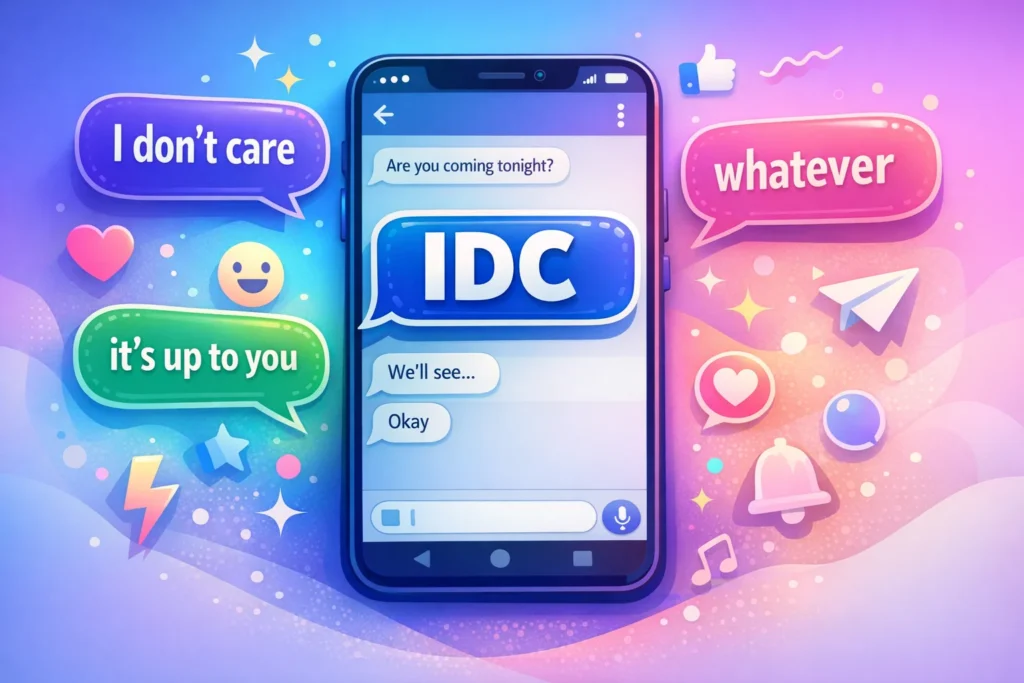
IDC in chat stands for “I Don’t Care.” It is an informal internet slang abbreviation used in texting and online conversations to show indifference, lack of interest, or emotional detachment toward a topic, situation, or question.
In today’s fast-paced digital world, people don’t always type full sentences when chatting online. Instead, they rely on short forms and slang to communicate quickly and efficiently. One of the most commonly used expressions you’ll see in texting, social media, and even gaming chats is “IDC.”
At first glance, it may look confusing, but it actually carries a very simple meaning. Whether someone is avoiding drama, showing disinterest, or just letting you make a decision, IDC is a quick way to say a lot with just three letters.
In this article, we’ll break down everything you need to know about IDC meaning in chat, including its full form, usage in real conversations, tone variations, examples, and even polite alternatives so you can use it correctly without sounding rude or unclear.
What Does IDC Mean in Chat?
The abbreviation IDC (I Don’t Care) is one of the most commonly used slang terms in texting culture, especially among teenagers and social media users. It is short, quick, and conveys a strong message in just three letters.
In modern digital communication, where speed matters, people often prefer abbreviations like:
- IDC → I Don’t Care
- IDK → I Don’t Know
- TBH → To Be Honest
Among these, IDC is often used when someone wants to dismiss a topic or show they are not emotionally invested in it.
Origin and Popularity of IDC
The phrase “I don’t care” has always existed in spoken English, but the abbreviation IDC became popular with the rise of:
- SMS texting (character limits encouraged short forms)
- Online chat rooms (early 2000s)
- Social media platforms like Facebook, Twitter, Snapchat, and Instagram
- Gaming chats and Discord conversations
Why IDC Became Popular:
- Saves time while typing
- Easy to understand globally
- Works across informal digital platforms
- Fits fast-paced conversations
Today, IDC is widely used across meme culture and Gen Z texting style.
How IDC is Used in Chat
The meaning of IDC can change slightly depending on tone and context. It is not always rude—it can also be casual or humorous.
Common Ways People Use IDC:
- To show disinterest
- To avoid arguments
- To express frustration
- To sound casual or relaxed
- To dismiss unnecessary topics
Examples of IDC in Conversations
Here are some real-life style chat examples:
1. Casual Use
Friend 1: What movie should we watch?
Friend 2: IDC, you choose.
👉 Meaning: I don’t have a preference.
2. Slightly Dismissive Tone
Friend 1: Did you see what he said about you?
Friend 2: IDC.
👉 Meaning: I’m not interested in this drama.
3. Frustrated Tone
Friend 1: You should apologize first.
Friend 2: IDC anymore.
👉 Meaning: I’m done caring about this situation.
4. Cold or Rude Tone (Use carefully)
Friend 1: Do you even care about this?
Friend 2: IDC.
👉 Meaning: Strong emotional detachment or indifference.
Tone Variations of IDC
The meaning of IDC can change depending on how it is written or used.
IDC Tone Table
| Form of IDC | Meaning | Tone |
|---|---|---|
| IDC | I don’t care | Neutral |
| idc | casual indifference | informal |
| IDC!! | strong emotion or frustration | angry |
| idc 🙂 | sarcastic or passive-aggressive | mixed tone |
| IDC… | emotional exhaustion or disappointment | sad/frustrated |
👉 Small changes in punctuation or emojis can completely change the meaning.
Comparison: IDC vs Similar Chat Abbreviations
Many people confuse IDC with other slang terms. Here’s a simple comparison:
IDC vs IDK
| Abbreviation | Full Form | Meaning |
|---|---|---|
| IDC | I Don’t Care | Shows indifference |
| IDK | I Don’t Know | Shows lack of knowledge |
👉 Example:
- IDC → I don’t care about the answer
- IDK → I don’t know the answer
IDC vs IGAF (Informal)
| Abbreviation | Meaning | Tone |
|---|---|---|
| IDC | I don’t care | mild |
| IGAF | I give a f*** | strong/rude |
👉 IDC is much softer than IGAF.
IDC vs Whatever
| Term | Meaning | Emotion |
|---|---|---|
| IDC | I don’t care | detached |
| Whatever | I don’t mind / I’m done arguing | dismissive |
Alternate Meanings of IDC
Although “I Don’t Care” is the most common meaning, IDC can also stand for different terms in other contexts:
Other Possible Meanings:
- Internet Data Center (technology/business use)
- Invasive Ductal Carcinoma (medical term related to breast cancer)
- Initial Data Capture (data processing term)
- International Data Corporation (market research company)
👉 However, in chat and texting, IDC almost always means “I Don’t Care.”
When to Use IDC in Chat
Understanding when to use IDC is important because tone matters a lot in online communication.
Good Situations to Use IDC:
- Casual conversations with friends
- When giving someone decision freedom
- When you are not emotionally involved
- Informal gaming chats
Avoid Using IDC When:
- Talking to elders or teachers
- Professional conversations
- Sensitive emotional discussions
- Arguments where feelings are involved
Polite Alternatives to IDC
Sometimes IDC may sound rude, so it’s better to use softer expressions.
Better Alternatives:
- “I don’t have a preference”
- “It’s up to you”
- “I’m okay with anything”
- “I’m not too bothered”
- “Doesn’t matter to me”
These phrases help keep conversations respectful and friendly.
Example Table: IDC in Real Chat Situations
| Situation | Chat Example | Meaning |
|---|---|---|
| Planning | “Where should we go?” – “IDC” | No preference |
| Conflict | “Do you even care?” – “IDC” | Emotional detachment |
| Decision making | “Pizza or burger?” – “IDC” | Letting others decide |
| Drama | “Did you hear what happened?” – “IDC” | Avoiding gossip |
Why People Use IDC So Often
The popularity of IDC comes from modern digital behavior:
Main Reasons:
- Fast communication style
- Avoiding long explanations
- Emotional shielding in conversations
- Social media influence
- Meme and Gen Z culture
People prefer short expressions because they feel more natural in online chat environments.
Psychological Meaning Behind IDC
Sometimes, IDC is not just slang—it can reflect emotions:
- Indifference → truly not caring
- Frustration → tired of a topic
- Emotional defense → avoiding emotional pain
- Avoidance behavior → not wanting conflict
So, IDC can sometimes carry deeper emotional meaning depending on context.
FAQs
1. What does IDC mean in texting?
IDC means I Don’t Care, used to show indifference in chat.
2. Is IDC rude?
It can be rude depending on tone, but it is often casual among friends.
3. What is IDC short for?
IDC is short for I Don’t Care.
4. Is IDC used in professional chats?
No, it is mostly informal and not suitable for professional communication.
5. What is the difference between IDC and IDK?
IDC means “I don’t care,” while IDK means “I don’t know.”
6. Can IDC be polite?
Yes, but it is better to use polite alternatives like “I’m okay with anything.”
7. Why do people type IDC instead of full sentence?
Because it is faster, easier, and widely understood in texting culture.
8. What are similar slang words to IDC?
Similar terms include “whatever,” “doesn’t matter,” and “IDK” (in different context).
Conclusion
The abbreviation IDC (I Don’t Care) is a widely used internet slang term that expresses indifference or lack of interest in online conversations. It is short, fast, and commonly used in texting, gaming, and social media.
However, its meaning can change based on tone, punctuation, and context. While it is convenient in casual chats, it should be used carefully because it may sound rude in sensitive situations.
Understanding IDC helps you:
- Communicate better online
- Interpret chat tone correctly
- Avoid misunderstandings in digital conversations
👉 In short, IDC is simple—but powerful—slang that reflects modern fast-paced communication.
Discover More Related Articles:
- 220+ Best Responses To How Are You: That Feel Natural for 2026
- 260+ Best Responses To Nice To Meet You: That Spark Attraction in 2026