
Definition
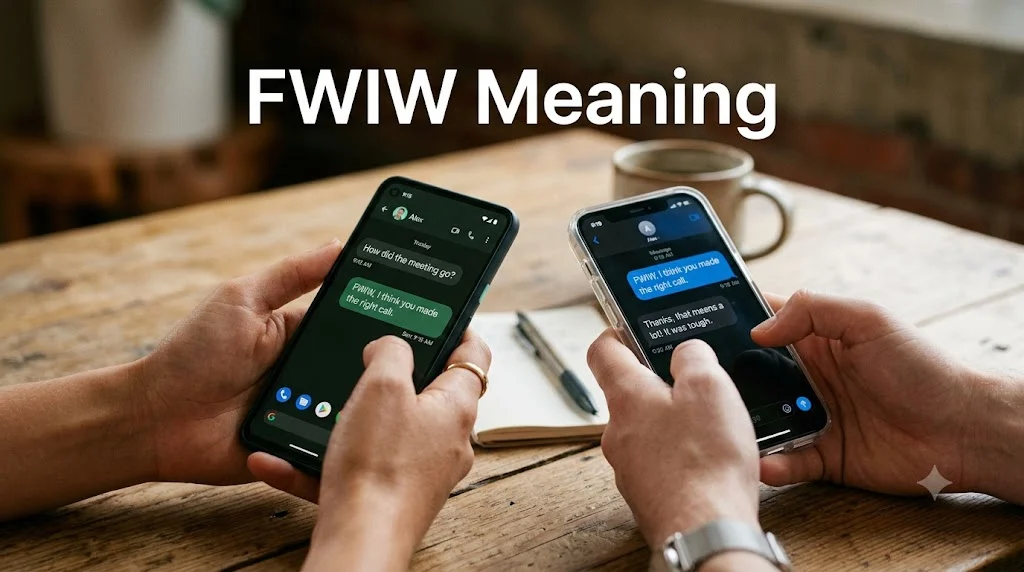
FWIW stands for “For What It’s Worth.”
FWIW (For What It’s Worth) an acronym used in digital communication to introduce a comment, opinion, or information in a casual, non-pushy way. It signals that what follows is optional input, not a command or judgment.
Picture this: you’re scrolling through a group chat, half-paying attention, and suddenly someone fires off “FWIW, the new place downtown isn’t worth the hype.” You stop. You squint.
Sound familiar?
You’re not alone. Internet slang moves fast and “FWIW” is one of those acronyms that’s everywhere once you notice it. Reddit threads, WhatsApp groups, Slack channels, comment sections it pops up constantly. And once you actually know what it means and how to use it, you’ll start spotting it (and using it) all the time.
So let’s crack it open completely. This guide covers the full FWIW meaning, where it came from, how to use it on every major platform, what it really signals about tone, and how it stacks up against similar slang like IMO, FYI, and TBH.
No fluff. Just everything you actually need.
What Does FWIW Mean?
Let’s get straight to it.
It’s a phrase you drop before sharing an opinion, piece of advice, or bit of information especially when you’re not sure the other person asked for it or needs it. Think of it as a verbal shrug. You’re saying: “Here’s my take. Take it or leave it. No pressure.”
It’s humble by design. When you say “FWIW,” you’re acknowledging that your input might not change anything and that’s okay. You’re offering perspective, not demanding agreement.
| Field | Detail |
|---|---|
| Full Form | For What It’s Worth |
| Type | Acronym / Internet Slang / Texting Abbreviation |
| Tone | Casual, humble, non-pushy |
| Common Platforms | Texting, WhatsApp, Reddit, Twitter/X, Slack, Email |
| First Widespread Digital Use | Early 1990s (IRC, Usenet, email forums) |
| Related Terms | IMO, IMHO, FYI, YMMV, TBH, NGL |
| Typical Position in Sentence | Beginning of the message or clause |
The Origin of FWIW: Older Than the Internet
Here’s something most people don’t realize: “for what it’s worth” isn’t a product of the internet age. The phrase existed in spoken and written English long before anyone typed it into a chat box.
As an idiom, “for what it’s worth” has been used in English for well over a century. It carries the spirit of offering something freely information, a perspective, a recommendation without forcing it on anyone. Historians and scholars used it in correspondence. Politicians used it in speeches. It’s genuinely old-school English hedging language.
Then came the internet.
In the early 1990s, digital communication was exploding through channels like IRC (Internet Relay Chat), Usenet newsgroups, and email listservs. These were wordy, text-heavy environments where people typed a lot. Naturally, users started compressing common phrases into acronyms to save time. That’s when “for what it’s worth” became FWIW.
FWIW Meaning Across Every Major Platform
Context shapes everything with slang. “FWIW” doesn’t land the same way in a Reddit comment as it does in a work email. Here’s how it plays out across the platforms where you’re most likely to encounter it.
FWIW Meaning in Text Messages
This is the most common place you’ll see FWIW. In one-on-one texting, it works as a gentle entry point for advice or observations that weren’t necessarily requested.
Imagine a friend is venting about a restaurant that disappointed them. You might reply:
“FWIW, I had the same experience there last month. The reviews are misleading.”
You’re just offering a data point, take it or leave it. That’s exactly what FWIW does in texting it keeps the tone light and non-confrontational.
FWIW Meaning in Chat
Workplace chat tools like Slack and community platforms like Discord have their own communication norms. In Slack particularly, FWIW is a professional-but-casual way to weigh in on a discussion without stepping on anyone’s toes.
Say your team is debating two design directions in a Slack thread. Someone who’s not directly involved might write:
“FWIW, users in the last survey said they preferred the simpler layout.”
It contributes to the conversation without hijacking it. That’s a powerful function in team environments where hierarchy and tone matter.
In Discord communities, the usage is more casual and often ironic someone might use FWIW to gently challenge a popular opinion in a server.
FWIW Meaning on Reddit
Reddit is basically FWIW’s natural habitat. The platform runs on debate, opinion-sharing, and commentary and FWIW fits all three perfectly.
You’ll see it constantly in threads like r/AmITheAsshole, r/personalfinance, r/relationships, and tech subreddits. Commenters use it to offer a perspective they know might be unpopular or tangential:
“FWIW, I went through something similar and therapy helped a lot more than I expected.”
It signals epistemic humility a Reddit virtue when done right. It says: “I’m not the authority here. But here’s my experience.”
FWIW Meaning on Twitter and X
On Twitter/X, where brevity rules and hot takes are currency, FWIW pulls off something clever. It lets you offer nuance without sounding wishy-washy.
A tweet might read:
“FWIW the data actually shows the opposite trend but sure, keep the narrative going.”
There’s a little edge there. On Twitter, FWIW can carry irony more easily than in other contexts. The platform’s combative tone means the same acronym that sounds humble in a text can sound pointed in a tweet.
Watch your tone here. Context and phrasing determine whether FWIW reads as humble or passive-aggressive on X.
FWIW Meaning on Instagram and TikTok
On Instagram comment sections and TikTok, FWIW tends to appear in a more playful, sometimes ironic register. Younger users on these platforms are more likely to use it sarcastically or humorously.
A TikTok comment might say:
“FWIW nobody asked but this is literally the best pasta recipe I’ve ever made”
It’s self-aware. The person knows they’re volunteering information. FWIW signals that self-awareness and makes it charming instead of intrusive.
FWIW Meaning on Facebook
Facebook’s user base skews slightly older, and on this platform FWIW shows up most in community group posts and long comment threads. Think neighborhood groups, parenting communities, or local buy/sell groups.
Someone in a local recommendations group might write:
“FWIW, that contractor quoted me 40% more than everyone else I spoke to.”
It’s genuine, helpful, and low-key exactly how Facebook group communication tends to work at its best.
FWIW Meaning on WhatsApp
WhatsApp groups are social pressure cookers. Family chats. Friend groups. Work teams. In those environments, FWIW softens the blow of potentially contentious input.
Imagine someone in a family group chat suggesting a vacation destination that half the family doesn’t want. A cousin might reply:
“FWIW, I looked it up and it’s actually really expensive in August might be worth considering September?”
The FWIW makes it a suggestion, not a criticism. That’s socially intelligent communication.
FWIW Meaning in Emails
This is where FWIW requires the most judgment. In semi-formal emails between colleagues who know each other well, it can work fine:
“FWIW, I ran into a similar issue with the API last quarter happy to share what we did.”
But in formal professional writing client-facing documents, official reports, emails to senior leadership skip it entirely. FWIW signals informality and that’s not always appropriate.
Rule of thumb: If you’d use a contraction in that email, FWIW is probably fine. If the email starts with “Dear Mr. [Name],” leave FWIW out.
How to Use FWIW Correctly: Real Examples in Action
Knowing what FWIW means is one thing. Using it well is another. Let’s break down the mechanics.
FWIW almost always opens a sentence or message. It functions like “by the way” or “just so you know” a framing device that signals the type of information about to arrive.
Here are the three main tones it carries, with real examples:
Tone 1: Sharing Unsolicited Advice Gently
You have something useful to say but nobody asked. FWIW lets you say it without being preachy.
- “FWIW, that airline has a terrible cancellation policy I’d check before booking.”
- “FWIW, she mentioned last week that she prefers surprises so a party might actually land well.”
- “FWIW, I tried that diet for three months and felt worse, not better.”
Tone 2: Adding Context or Information Humbly
You’re not giving an opinion, just a relevant fact. FWIW makes it feel like a contribution, not a correction.
- “FWIW, the documentation updated last week and the old method is now deprecated.”
- “FWIW, the store on Fifth closes at 6pm on Sundays.”
- “FWIW, they changed the submission deadline it’s now the 15th, not the 30th.”
Notice something consistent across all these? FWIW never demands a response. That’s the social contract built into the acronym. You’re offering; you’re not insisting.
Common mistakes to avoid:
- Using FWIW when you’re actually very confident it undersells your point
- Putting it in the middle or end of a sentence (awkward and unusual)
- Using it in formal writing or with people you don’t know well
- Overusing it to the point where it becomes meaningless filler
FWIW vs. Similar Acronyms: What’s the Real Difference?
English internet slang has a lot of hedging acronyms. They’re not interchangeable. Each one carries a distinct flavor and gets misused constantly. Here’s a clean breakdown:
| Acronym | Stands For | Tone | Best Used When |
|---|---|---|---|
| FWIW | For What It’s Worth | Humble, soft, optional | Offering input no one specifically requested |
| IMO | In My Opinion | Direct, confident | Stating a clear personal view |
| IMHO | In My Humble Opinion | Self-deprecating, softer than IMO | Sharing opinions in debates, forums |
| FYI | For Your Information | Neutral, factual | Sharing information with no opinion attached |
| YMMV | Your Mileage May Vary | Disclaimer-heavy | When results differ by person or situation |
| TBH | To Be Honest | Candid, sometimes blunt | Admitting something frank or unexpected |
| NGL | Not Gonna Lie | Raw, casual, vulnerable | Confessing something genuine or surprising |
| JMO | Just My Opinion | Very soft, non-confrontational | When you want even less authority than IMO |
FWIW vs. FYI is also worth clarifying. FYI is purely informational no softening, no opinion. FWIW can carry either information or opinion, but always with that layer of “take this lightly.”
When Not to Use FWIW
Not every situation calls for a hedge. Sometimes directness is kinder, clearer, and more professional than softening language. Here’s when to leave FWIW out:
In formal professional contexts
Reports, client proposals, official memos, presentations to leadership. These formats demand clear, confident language. FWIW signals “I’m not sure this matters” the opposite of what you want in high-stakes professional writing.
When you’re actually certain
If you know something is wrong, say it directly. “FWIW, that calculation seems off” is weaker than “That calculation has an error here’s the correct figure.” Certainty deserves directness.
When someone needs real help urgently
If a friend is in crisis, facing a big decision, or needs genuine guidance, FWIW can feel dismissive. “FWIW, therapy might help” lands differently than “I really think talking to someone could make a real difference here.”
When you’re overusing it
Like any phrase, FWIW loses meaning through repetition. If every second message from you starts with FWIW, it stops reading as humility and starts reading as a verbal habit. Use it when it earns its place.
When communicating with people unfamiliar with internet slang
Older relatives, formal acquaintances, or non-native English speakers might not know what FWIW means. Spell it out or use the full phrase instead.
Is FWIW Positive, Negative, or Neutral?
Technically, FWIW is neutral. It doesn’t carry positive or negative meaning on its own. But here’s the thing context can charge it in either direction fast.
When FWIW sounds warm and considerate:
“FWIW, you handled that really well. A lot of people would’ve lost their cool.”
That’s supportive. It feels like a genuine compliment delivered without pressure.
When FWIW sounds passive-aggressive:
“FWIW, I said this would happen months ago.”
Ouch. The same acronym now reads as “I told you so” dressed up in humility clothing. The FWIW doesn’t soften it it almost makes it worse by pretending to.
The lesson: FWIW inherits the tone of everything around it. If the message beneath it is kind, FWIW amplifies the kindness. If the message has an edge, FWIW can sharpen that edge by adding a layer of false modesty.
Read your own messages before you send them. Would this sound passive-aggressive without the FWIW? If yes, the FWIW won’t fix it.
FWIW Across Generations: Who Uses It and How
Slang isn’t age-neutral. Different generations have different relationships with FWIW.
Gen X (born 1965–1980)
Many Gen X users actually adopted FWIW during its early internet days IRC, email lists, Usenet forums. For this generation, FWIW is natural and carries no irony. It means exactly what it says.
Millennials (born 1981–1996)
The primary current users of FWIW in texting and Slack. Millennials inherited the acronym from early internet culture and brought it into everyday digital communication. Usage is sincere, frequent, and contextually varied.
Gen Z (born 1997–2012)
Gen Z uses FWIW but sometimes with ironic distance. They’re also more likely to use the full phrase “for what it’s worth” written out, or to replace it with phrases like “idk just my take” or “not that anyone asked.” FWIW feels slightly dated to the youngest users though it’s far from dead.
Baby Boomers (born 1946–1964)
Less frequent usage but growing. Facebook groups and email are the main contexts. Boomers who use FWIW tend to have picked it up from younger family members or coworkers.
Fun Facts About FWIW and Internet Slang
- FWIW appeared in early internet style guides as early as 1993, making it one of the oldest surviving chat acronyms still in regular use
- “For what it’s worth” as a spoken idiom appears in literature as far back as the 18th century in British English correspondence
- FWIW belongs to a family of “epistemic hedge” phrases linguistic tools used to signal uncertainty about the relevance or accuracy of information
- According to linguistics researchers, hedging phrases like FWIW actually increase trust in online communication because they signal honesty about the speaker’s limitations
- The phrase “for what it’s worth” has a measurable presence in English literature, legal writing, journalism, and political speech across the last 200 years FWIW just compressed it for the digital age
A Quick Note on Capitalization and Punctuation
You’ll see FWIW written in several ways online:
- FWIW (all caps most common, most recognizable)
- fwiw (all lowercase very casual, often in quick texts)
- Fwiw (sentence case rare, sometimes seen in more careful writers)
All versions mean the same thing. The all-caps version is the standard you’ll see in most contexts. In very casual texting, all-lowercase is completely fine nobody’s grading your acronym capitalization.
As for punctuation: you don’t need a comma after FWIW before continuing the sentence, though many people include one out of habit:
- “FWIW I think you’re right about this.” ✓
- “FWIW, I think you’re right about this.” ✓
Both work. The comma version just mirrors how you’d punctuate the full phrase: “For what it’s worth, I think you’re right.”
FWIW in Professional Settings: A Deeper Look
There’s real nuance here worth exploring. The workplace use of FWIW deserves its own section because it’s where the acronym gets misused most often and where getting it right actually matters.
When FWIW works at work:
Think peer-to-peer communication. Two colleagues who know each other well, collaborating on a project, exchanging ideas in Slack or email. That’s fertile ground for FWIW.
“FWIW, we tried this approach in Q3 last year and ran into scaling issues around 50k users. Might be worth a quick check before committing.”
That’s genuinely valuable. It’s humble, it’s specific, and it respects the other person’s autonomy to take the information or leave it.
When FWIW creates problems at work:
Using it to soften something that should be said directly. If there’s a serious error in a report or a compliance issue, “FWIW, this might be a problem” doesn’t serve anyone. State the problem clearly.
Using it upward in hierarchy. Saying “FWIW” to your CEO reads differently than saying it to a peer. The humility can read as a lack of confidence especially in high-stakes environments where authority and certainty are valued.
Using it as a preface for criticism. “FWIW, I think this entire approach is flawed” is just criticism with a polite fig leaf. If you’re going to critique something seriously, own it directly.
The professional sweet spot for FWIW:
Peer communication. Casual Slack messages. Non-urgent information-sharing. Situations where you genuinely are uncertain whether your input is relevant. That’s the zone where FWIW does its best work.
How FWIW Shapes Conversation Dynamics
Let’s zoom out for a moment and think about why FWIW even exists as a communication tool. It’s not random. It fills a real social need.
Human communication is full of face-threatening acts situations where saying something might damage someone’s pride, contradict their choices, or put them on the defensive. Linguists call this “face theory,” developed by Erving Goffman in the 1950s and expanded by Penelope Brown and Stephen Levinson in the 1980s.
Hedging phrases like “for what it’s worth” are face-saving strategies. They let you share potentially unwelcome information or opinions while minimizing the threat to the other person’s sense of autonomy and self-image.
In simpler terms: FWIW is polite. It’s a way of saying “your choices are still yours I’m just contributing to the information available to you.”
That’s why it feels different from just blurting out an opinion. And it’s why people reach for it instinctively when they want to be helpful without being pushy.
In group chats especially, this matters enormously. Nobody wants to be the person who barges into a conversation with unsolicited advice. FWIW makes the advice feel like a quiet suggestion rather than a loud proclamation.
FAQs
What does FWIW mean in texting?
FWIW stands for “For What It’s Worth.” In texting, it’s used to introduce an opinion, suggestion, or piece of information in a casual and non-pushy way.
Is FWIW formal or informal?
It’s informal. Use it in casual texts, friendly emails, Slack messages with colleagues you know well, and social media. Avoid it in formal documents, client-facing communications, or professional emails to people you don’t know.
Can FWIW come across as rude?
Not usually but sometimes yes. If the message that follows FWIW has a passive-aggressive edge, the acronym won’t neutralize it it might actually highlight the problem.
What’s the difference between FWIW and IMO?
IMO (“In My Opinion”) directly and confidently states a personal view. FWIW goes one step further in humility it questions whether its own input is even useful.
How do you pronounce FWIW?
Spell it out: “F-W-I-W.” Or just say the full phrase “for what it’s worth” especially in professional spoken contexts where acronyms can feel out of place.
What does FWIW mean on Snapchat and Instagram?
Exactly the same thing “For What It’s Worth.” On these platforms it sometimes carries a slightly ironic or humorous tone, especially among younger users, but the core meaning doesn’t change.
Is FWIW always at the beginning of a sentence?
Almost always yes. It works as an opener that frames everything that follows. Putting it in the middle or end of a sentence is grammatically awkward and rarely seen in practice.
What’s the difference between FWIW and FYI?
FYI (“For Your Information”) is purely factual and carries no opinion. FWIW can be factual or opinion-based but always carries that extra layer of “take this lightly.” FYI is more neutral; FWIW is more humble.
Conclusion
Here’s what it all comes down to.
FWIW is a small acronym doing surprisingly sophisticated social work. It lets you be helpful without being pushy. It lets you share opinions without demanding agreement.
“For what it’s worth” has been in the English language for centuries. The internet compressed it into four letters but didn’t change what it fundamentally does: it signals respect for the other person’s judgment while still offering something potentially useful.
Use FWIW when you genuinely mean it. When you really are uncertain whether your input will land well. When you want to give someone information or perspective without pressure.
Don’t lean on it as a verbal habit. Don’t use it to disguise passive aggression.
And maybe most importantly: don’t panic the next time someone drops it in your group chat at 11pm. You know exactly what it means now.
FWIW, that’s about as complete a guide as this topic gets.
Discover More Related Articles:
- Ethereal Meaning | A Word for Beauty Beyond Reality In 2026
- Purl Meaning | How It Is Used in Crafting For 2026
- Atria Meaning | Structure & Function in Human Heart For 2026