
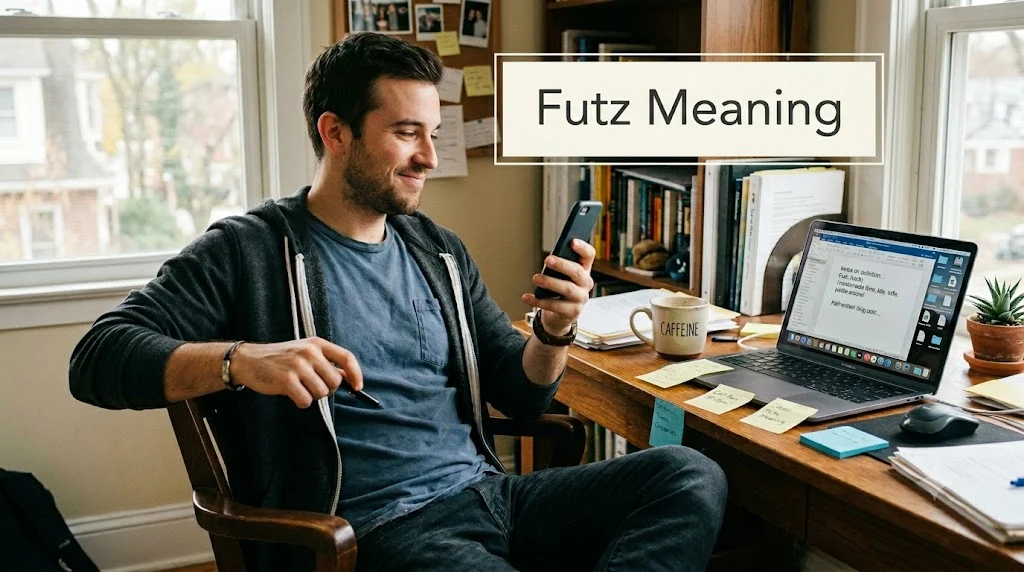

Definition
“Futz” means to waste time, mess around, or do small, unimportant tasks in a careless or aimless way. It is often used when someone is doing something without focus or just fiddling with things instead of working seriously.
Ever heard someone say “stop futzing around” and thought they just made up a word on the spot? You are not alone. The word futz sounds silly. It feels silly in your mouth. But it carries real meaning, a surprising history, and a very specific job in American slang.
Let me paint a quick picture. Imagine a coworker sitting through a boring meeting. They have a paperclip in their hand. They bend it straight. Then they twist it into a tiny spring. Then they unbend it again. They are not listening to the presentation. They are not working. That is the word in its natural habitat.
This guide gives you everything you need. You will learn the exact futz meaning, where it came from, how to pronounce it, and when using it makes you look cool versus when it makes you look clueless.
What Does Futz Actually Mean
Let us cut through the confusion right now. Futz is a verb. People use it to describe small, unproductive, often annoying actions. You futz when you should focus. You futz when you tinker without a goal.
The core futz meaning breaks down into three specific ideas:
- Wasting time on low-value activities
- Fiddling with an object instead of fixing it properly
- Mess around aimlessly without making progress
Here is the cleanest definition you will find anywhere:
Futz (verb): To handle something in a nervous, idle, or unproductive way; to waste time by making small, useless adjustments.
Think about the last time you could not get your Wi-Fi to work. Did you calmly diagnose the problem? Probably not. You clicked the same button five times. That is futzing.
The word carries a lighthearted criticism. Nobody says “futz” when they are truly angry. It is more of an eye-roll word. A gentle nudge. A way to say “come on, get it together” without sounding mean.
Part of Speech: Verb First, Noun Never
Here is a fact most online dictionaries get wrong. They list futz as both a verb and a noun. Technically that is true. But in real conversations, nobody uses the noun form.
As a verb, you can conjugate it naturally:
- I futz
- You futz
- He futzes
- We futzed yesterday
- She is futzing right now
As a noun, a futz means a foolish or clumsy person. This usage peaked in the 1950s and then basically died. If you call someone a futz today, they will look confused. Do not do it. Stick to the verb form.
| Part of Speech | Meaning | Real World Usage |
|---|---|---|
| Verb | To fiddle or waste time | Extremely common |
| Noun | A fool or clumsy person | Almost extinct |
Where Did Futz Come From
The origin story makes the word even better. Futz comes from Yiddish. Specifically, it comes from the Yiddish verb arumfartzen.
Let me spell that for you: a-r-u-m-f-a-r-t-z-e-n.
Here is the funny part. Arumfartzen literally means “to fart around.” Not in the metaphorical English sense. In the literal, bodily function sense. Yiddish speakers used this word to describe someone who wasted time by doing useless little movements. Think of it like “puttering around” but with a much funnier image attached.
American English borrowed the word sometime in the 1930s or 1940s. Jewish comedians and theater people in New York City picked it up first. They shortened it to futz. The vulgar edge softened over time.
By the 1960s, futz appeared in mainstream American media. It still sounded a little Yiddish. It still sounded a little silly. But it had lost its original bathroom humor. Today, you can say futz on network television. You cannot say the original Yiddish word on television.
Key historical fact: No single written record marks the first use of futz in English. Linguists agree it spread through oral use in theater communities. That makes it a true slang word, not an academic invention.
How to Pronounce Futz Without Embarrassing Yourself
Say this out loud right now: fuhts.
It rhymes with puts as in “she puts the book down.” It does not rhyme with putts as in golf putts. That is a different vowel sound entirely.
Here is the phonetic spelling: /fʌts/
One syllable. Short u sound. Hard ts at the end like the end of cats.
Common mispronunciations to avoid:
- Two syllables: “foo-tuz” (wrong)
- Soft z: “fuzz” (wrong – that means police or soft texture)
- Rhyming with boots (wrong – that changes the vowel completely)
Test yourself. Say “futz” five times fast. Then say “futzing.” Then say “futzed.” If it feels weird in your mouth, you are doing it right. The word is supposed to sound a little awkward.
How to Use Futz in a Sentence
Rules are fine, but examples teach better. Here is how real people use the futz meaning in everyday English.
Futz With Something
Use futz with when you touch or adjust an object without improving it.
“I spent twenty minutes futzing with the TV settings before I realized the remote needed batteries.”
“Stop futzing with your tie. It looks fine.”
“My dad loves to futz with old radios. He never fixes them. He just opens them up and pokes around.”
Futz Around
Use futz around when you waste time generally, not with one specific object.
“Instead of studying, I futzed around on my phone for two hours.”
“We futzed around downtown before the movie started.”
“Quit futzing around and finish your homework.”
Stop Futzing / Don’t Futz
You can use the verb alone when the object or activity is obvious.
“Just stop futzing and get in the car.”
“Don’t futz with it. Leave it alone.”
Quick reference table:
| Phrase | Meaning | Example |
|---|---|---|
| Futz with | Adjust unnecessarily | “He futzed with the volume for ten minutes.” |
| Futz around | Waste time aimlessly | “We futzed around all afternoon.” |
| Stop futzing | Quit the unproductive behavior | “Stop futzing and help me.” |
Futz vs Other Slang Words for Wasting Time
English loves words for wasting time. We have dozens of them. Each carries a slightly different flavor. Here is how futz compares to its cousins.
Futz vs Fiddle
Fiddle means to tinker with your hands. It is neutral. You can fiddle with a guitar or fiddle with a broken lamp. No judgment attached.
Futz always carries mild criticism. If you fiddle with something, maybe you are learning. If you futz with something, you are probably failing.
Futz vs Mess Around
Mess around is broader. You can mess around physically, socially, or romantically.
Futz vs Procrastinate
Procrastinate sounds formal and clinical. A therapist says procrastinate. A friend says futz.
Procrastinate also means delaying important work for other tasks. Futz means doing tiny useless movements. They often overlap but are not identical.
| Slang Term | Formality Level | Judgment Level | Best Use Case |
|---|---|---|---|
| Futz | Low (slang) | Mild | Small physical fiddling |
| Fiddle | Low | None | Neutral tinkering |
| Mess around | Low | Mild | General time wasting |
| Faff (British) | Low | Mild | Aimless busywork |
| Procrastinate | High | Moderate | Deliberate task avoidance |
American vs British English Differences
Here is a trap for global English speakers. Futz is deeply American. A British person might understand it from American movies, but they will not say it naturally.
What Brits say instead:
The closest British equivalent is faff. You faff about. You faff around. The meaning is nearly identical to futz, but the word sounds completely different.
British example: “Stop faffing about and make a decision.”
American translation: “Stop futzing around and make a decision.”
Another British option is muck about. This one is slightly rougher. Less polite than futz.
Australian English: Australians say piddle around or muck up. They will understand futz from American TV but will not use it themselves.
Why this matters for you: If you write for an international audience, add a quick clarification. Say “this is an American expression” or use a more universal alternative like mess around.
When Not to Use Futz
Knowing a word also means knowing when to keep your mouth shut. Futz is friendly and funny, but it has limits.
Avoid Futz in Formal Writing
Do not put futz in a business report.
Formal contexts demand formal vocabulary. Instead of “I futzed with the data,” say “I made minor adjustments to the data.” Instead of “stop futzing around,” say “please focus on the task.”
Avoid Futz with Non-Native Speakers
Slang confuses language learners. A person learning English as a second language probably knows waste time and procrastinate. They probably do not know futz.
If you say “stop futzing” to a non-native speaker, they might hear a nonsense word or worse, a mild curse. Keep it simple.
Avoid Futz for Serious Criticism
Futz is too soft for real anger. If a coworker genuinely fails a project, do not say “you futzed around too much.” That sounds dismissive. Use stronger, clearer language for serious feedback.
Formal alternatives to futz:
| Instead of futz… | Say this in formal settings… |
|---|---|
| Futz with | Adjust, modify, reconfigure |
| Futz around | Procrastinate, delay, linger |
| Stop futzing | Focus, concentrate, proceed efficiently |
Futz in Pop Culture and Real Life
You have heard futz more times than you realize. The word hides in plain sight in American TV, movies, and everyday speech.
Television Examples
Seinfeld used futz several times. George Costanza tells someone to stop futzing with a radio. Perfect for George’s character.
The West Wing used futz too. In one episode, a character says “don’t futz with the poll numbers” to soften a criticism. The writers wanted a word that sounded casual but not unprofessional.
Tech Culture Loves Futz
Software developers and IT workers use futz constantly. A programmer might say “I futzed with the config file for an hour before it worked.” A gamer might say “stop futzing with your graphics settings and just play.”
The word fits technology perfectly because technology invites small, useless adjustments. How many times have you clicked the same button hoping for a different result? That is futzing.
Everyday Scenarios
Here are five real situations where real people say futz:
- The thermostat war: “Stop futzing with the heat. Put on a sweater.”
- The slow driver: “Quit futzing at the green light. Go.”
- The home repair: “I tried to fix the sink. Instead I just futzed with the pipes for three hours.”
- The indecisive diner: “Stop futzing with the menu. Order the burger.”
Why Futz Survives While Other Slang Dies
Slang words die young. Most last less than a generation. But futz has stuck around for nearly a century. Why?
Reason one: The sound. Futz sounds funny. The short u and the hard ts make your mouth do something unusual. Humans like funny sounds for annoying behaviors. It reduces tension. You cannot stay mad while saying futz.
Reason two: The specificity. No other English word captures exactly what futz captures. Fiddle misses the time-wasting angle. Mess around misses the physical fiddling angle. Procrastinate misses the small-scale, hands-on angle. Futz sits in a perfect middle space.
Reason three: The mildness. Futz is not a swear word. You can say it at work, at dinner with your parents, or on a podcast. But it still feels slightly rebellious because of its Yiddish fart origin. You get a tiny thrill without the social risk.
Common Mistakes with Futz Meaning
Even people who use futz get it wrong sometimes. Avoid these three errors.
Mistake one: Using futz as a compliment
Futz is never positive. You cannot futz well. You cannot be a good futzer. The word always implies failure or waste. Do not say “nice futzing” unless you are being sarcastic.
Mistake two: Applying futz to people directly
You can futz with an object. You can futz around a place. But you cannot futz someone. That sounds strange and possibly inappropriate. Say “stop futzing with me” is not correct. Say “stop messing with me” instead.
Mistake three: Overusing futz in one conversation
Futz works best as an occasional spice. If you say it three times in five minutes, it loses its charm. It starts to sound forced. Use it once or twice. Then switch to mess around or fiddle.
Put Futz Into Your Active Vocabulary
You have the definition. Now use it.
The next time you catch yourself tapping a pen instead of working, say it out loud. “I am futzing.” The self-awareness alone might make you stop.
The next time a friend cannot stop adjusting their car mirrors, say “stop futzing and drive.” They will laugh. Then they will drive.
The next time you read an old novel or watch a classic American film, listen for futz. It hides in dialogue from the 1950s through today. Once you know the futz meaning, you will hear it everywhere.
One final reminder. Futz works because it is small. Do not say it three times in one paragraph. Just let it sit in your back pocket. Pull it out when you need a friendly, funny, slightly Yiddish way to say “stop messing around and get to work.”
The Psychology of Futzing: Why Humans Do It
Futzing looks like laziness from the outside. But from the inside, it feels completely different. When you futz, you rarely feel lazy. You feel busy. Your hands move. Your eyes focus. You make small adjustments. You feel almost productive.
That feeling is the trap.
Psychologists call this activity without progress. Your brain rewards motion, not results. Every time you futz with a setting or rearrange a desk item, you get a tiny dopamine hit. It feels like work. It smells like work. But it is not work.
Three psychological drivers of futzing:
- Fear of starting: Big tasks feel scary. Futzing feels safe. Adjusting a font size for twenty minutes means you avoid writing the actual sentence.
- Illusion of control: When life feels chaotic, futzing gives you small wins. You cannot fix the economy. But you can perfectly align three sticky notes on your monitor. That little win tricks your brain.
- Perfectionism gone wrong: Real perfectionists do not finish things. They futz endlessly. They tweak colors, reorder bullet points, and rename files. They mistake motion for completion.
Here is the painful truth. Futzing feels productive but almost never is. An hour of futzing with a presentation’s animations adds zero value. An hour of practicing the actual speech changes everything.
The Grammar of Futz: A Deeper Look
You know futz is a verb. But how does it behave in different tenses and sentence structures? Let me show you.
Transitive vs Intransitive Use
Futz works both ways, but the meaning shifts slightly.
Intransitive (no direct object): You futz around. The action stands alone.
“She futzed around all morning.”
No object needed. The listener understands you wasted time generally.
Transitive (with direct object): You futz with something. The object receives the action.
“He futzed with the radio dial.”
The radio dial is the object. He directed his fiddling at a specific thing.
Important note: You never say “futz something” directly. Always use “futz with” or “futz around.” The preposition matters.
Conjugation Table for Futz
| Tense | Example |
|---|---|
| Present simple | I futz with my phone too much. |
| Present continuous | She is futzing with her hair again. |
| Past simple | We futzed around for two hours yesterday. |
| Past continuous | They were futzing with the printer when I walked in. |
| Present perfect | I have futzed with this setting ten times already. |
| Future simple | You will just futz around if I leave you alone. |
| Imperative | Stop futzing and listen to me. |
Can You Use Futz in Passive Voice
Technically yes. Practically no. Remember the instruction earlier about active voice? Futz almost never appears in passive constructions because it sounds ridiculous.
Passive example: “The remote was futzed with by my brother.”
Active example: “My brother futzed with the remote.”
The active version is shorter, clearer, and more natural. Passive futzing violates the spirit of the word. Futz is an active, hands-on, busybody verb. Do not trap it in passive structures.
Futz vs Fidget vs Piddle vs Putter: A Complete Comparison
English has a rich ecosystem of small-movement verbs. Each serves a different social and emotional purpose. Here is your complete guide.
Futz
- Action type: Useless adjustment
- Emotional tone: Annoyed but affectionate
- Time implication: Wasted time
- Example: “Stop futzing with the volume.”
Fidget
- Action type: Small restless movements
- Emotional tone: Anxious or bored
- Time implication: No time judgment
- Example: “He fidgeted with his pen during the test.”
Piddle
- Action type: Slow, unproductive activity
- Emotional tone: Soft, almost parental
- Time implication: Slow waste of time
- Example: “She piddled around the garden all day.”
Putter
- Action type: Leisurely, pleasant small tasks
- Emotional tone: Relaxed, content
- Time implication: Enjoyable time passing
- Example: “He puttered in his workshop on Sunday.”
Faff
- Action type: Complicated useless busywork
- Emotional tone: Exasperated
- Time implication: Frustrating waste
- Example: “Stop faffing about with those papers.”
Lollygag
- Action type: Slow movement or dawdling
- Emotional tone: Playfully scolding
- Time implication: Unacceptable delay
- Example: “Quit lollygagging and get on the bus.”
Quick comparison matrix:
| Word | Region | Judgment | Commonness | Best for… |
|---|---|---|---|---|
| Futz | US | Mild negative | Medium | Tech, small adjustments |
| Fidget | Global | Neutral | High | Nervous habits |
| Piddle | US | Soft negative | Low | Gardening, house tasks |
| Putter | US/UK | Neutral to positive | Medium | Hobbies, leisurely work |
| Faff | UK | Negative | High | Bureaucratic busywork |
| Lollygag | US | Playful negative | Low | Walking slowly |
Regional Dialects Within the United States
Even within America, futz does not spread evenly. The word has strong regional flavors.
Northeast (New York, New Jersey): Highest usage. The Yiddish influence remains strong. People here use futz naturally, almost daily. You will hear it in delis, offices, and living rooms.
West Coast (California, Washington): Medium usage. Futz exists but competes with mess around and fiddle. Tech workers on the West Coast use futz more than average because of the tinkering culture.
Midwest: Lower usage. Midwesterners prefer putter or fiddle. Futz sounds vaguely coastal or urban to their ears.
South: Very low usage. Southern English has its own rich slang for wasting time. Futz sounds foreign. You might hear potter or mess with instead.
Why this matters for writers: If your audience skews Southern or Midwestern, consider defining futz the first time you use it. Or choose a different word entirely.
Futz in Written vs Spoken English
Spoken futz and written futz behave differently. Here is how to handle both.
Spoken Futz
In conversation, futz thrives on tone. You can say “stop futzing” with a smile, and it sounds friendly. You can say it with a flat voice, and it sounds annoyed. The word itself carries less meaning than the delivery.
Spoken markers of futz:
- Short, clipped pronunciation
- Often paired with just (“just stop futzing”)
- Used as a gentle interruption
Written Futz
In text, futz loses tone. The reader cannot hear your smile. So you must add context.
Bad written futz: “Stop futzing.” (Reader does not know if you are angry or joking.)
Good written futz: “Stop futzing with the lamp, you goof.” (The word goof signals playfulness.)
Another good example: “For the love of all that is holy, stop futzing with the thermostat.” (Exaggeration signals humor.)
Formal written futz: Never happens. Do not write futz in formal documents, emails to superiors, or academic work. Zero exceptions.
The Emotional Spectrum of Futz
Futz covers surprising emotional ground. Let me map it for you.
| Emotion | How Futz Expresses It | Example |
|---|---|---|
| Mild annoyance | “Would you stop futzing?” | Neutral tone, short phrase |
| Playful teasing | “You are such a futzer.” | Adding such a softens it |
| Exasperation | “I have been futzing with this for an hour.” | First-person shifts blame |
| Self-deprecation | “I just futzed around instead of working.” | Admits failure lightly |
| Affection | “He is futzing with his model train again.” | Describes a loved one’s habit |
| Impatience | “Quit futzing. We are late.” | Direct, urgent, short |
Notice what is missing. Futz never expresses rage, deep disappointment, or genuine anger. The word is too soft for those emotions. If you feel truly furious, find a stronger word.
Futzing in Different Life Domains
Futz appears in almost every area of life. Here is a domain-by-domain breakdown.
Technology
The number one domain for modern futzing. Software settings, hardware cables, display preferences, notification toggles. All prime futzing territory.
“I spent an hour futzing with my noise-canceling headphones before I realized they were already connected.”
Common tech futzing behaviors:
- Adjusting brightness repeatedly
- Moving files between folders without organizing
- Changing ringtones for twenty minutes
- Resetting the same password five times
Home Repair
The classic futzing domain. A person with no mechanical skill opens a toolbox and pretends to fix something.
“My uncle futzed with the garbage disposal for an hour. He did not fix it. He just made it smell weird.”
Home repair futzing red flags:
- Using the wrong tool for the job
- Watching YouTube tutorials but not following them
- Tightening and loosening the same screw repeatedly
- Opening an appliance and then closing it
Grooming and Appearance
People futz with their own bodies constantly. Hair, clothing, accessories, makeup. Small adjustments that change almost nothing.
“She futzed with her bangs in the rearview mirror for five minutes. They looked exactly the same before and after.”
Common grooming futzing:
- Straightening a tie that was already straight
- Fluffing hair that will not stay fluffed
- Adjusting a watch that nobody sees
- Fixing socks inside shoes
Workplace Productivity
The most expensive form of futzing. Paid employees futzing instead of working costs companies billions.
“Our whole team futzed with the project management software instead of managing the project.”
Workplace futzing examples:
- Color-coding a spreadsheet for two hours
- Rearranging desk supplies during a deadline
- Testing five fonts for a one-sentence email
- Organizing files nobody will ever open
Futzing as a Leadership and Management Concept
Smart managers recognize futzing immediately. Great managers know how to stop it without crushing morale.
Signs an employee is futzing, not working:
- High activity but low output
- Frequent small adjustments to finished work
- Requests for “just one more” minor change
- Perfectionism on low-stakes tasks
How to address futzing as a manager:
Do not say “stop futzing” directly. That sounds harsh in a workplace. Say something more specific.
“I see you have adjusted the logo position three times. Let us lock that in and move to the next section.”
“The formatting looks fine. Let us focus on the content now.”
“We have ten minutes left. What is the one thing that must get done?”
The goal is not to eliminate all futzing. Small amounts of futzing relieve stress and build familiarity with tools. The goal is to prevent futzing from replacing real work.
Ten Real Sentences Using Futz in Different Tenses
Here is a master collection of natural, active-voice sentences. Use these as templates for your own speech or writing.
- Present simple: “He futzes with his car keys every morning before work.”
- Present continuous: “Right now, my brother is futzing with the barbecue instead of lighting it.”
- Past simple: “I futzed around on my phone for an hour before I finally called the doctor.”
- Past continuous: “While I was futzing with the printer, the meeting started without me.”
- Present perfect: “She has futzed with that curtain rod three times this week and it is still crooked.”
- Past perfect: “By the time we arrived, he had already futzed with all the light switches.”
- Future simple: “If you leave him alone with the remote, he will just futz with the picture settings.”
- Imperative (command): “Stop futzing with your backpack and walk to the bus stop.”
- Conditional: “If you would stop futzing for five minutes, we could leave early.”
- Infinitive: “The worst part of the job is having to futz with the filing system every Friday.”
The Future of Futz
Will futz survive another generation? The signs are mixed.
Reasons futz might survive:
- No perfect synonym exists
- The word sounds unique and memorable
- Yiddish-derived slang has surprising longevity
Reasons futz might fade:
- Younger speakers prefer mess with or fiddle
- Social media writing favors shorter, blunter words
- Regional American dialects are leveling out
My prediction? Futz will not die, but it will shift. Expect your grandparents to use it more naturally than your kids.
And that is fine. Slang words do not need to last forever. They just need to work while they are alive. Futz has worked for nearly a hundred years. That is a good run for any word.
FAQs
Is futz a bad word?
No. Not even close. Futz is mild slang. Think of it like darn or shoot. It sounds a little silly but never offensive. The original Yiddish word was vulgar. The English version is not.
Can I use futz at work?
Yes in casual workplaces. No in formal ones. A creative agency or a tech startup? Go ahead. A law firm or a bank? Skip it. Read the room first.
Do young people still say futz?
Gen Z knows the word but uses it less than Gen X or millennials. When Gen Z does use futz, they often say it ironically. They might also use it in writing more than speech.
What is the difference between futz and putz?
Great question. Putz is a different Yiddish borrowing. Putz means an incompetent or foolish person. It is also a vulgar word for penis. Do not confuse them. Futz is a verb meaning to fiddle. Putz is a noun meaning a fool or worse. Say futz. Do not say putz in polite company.
Can futz be a noun?
Technically yes. Practically no. You will read dictionary entries listing futz as a noun meaning a fool. Ignore that. Almost no living native speaker uses it that way.
How do you spell futz correctly?
F-U-T-Z. No E. No double T. Some people mistakenly write futze or futts. Both are wrong. Four letters. One syllable. Done.
Conclusion:
In conclusion, the word “futz” is an informal English term that generally means to waste time, act in a silly or unproductive way, or fiddle around with something without achieving much. It is often used in casual speech to describe small, pointless actions or delays that don’t really lead to any useful result.
The meaning of “futz” can also change slightly depending on context. Sometimes it refers to unnecessary tinkering with objects, like adjusting or playing with something repeatedly. In other cases, it can describe a person who is avoiding serious work and instead engaging in minor or unimportant activities.
Overall, “futz” is not a formal word, but it is commonly used in everyday language, especially in American English. It adds a playful or slightly frustrated tone when describing wasted effort or time.
To sum it up, “futz” simply reflects the idea of being busy without being productive, and it is most often used in informal conversations rather than professional writing.
Discover More Related Articles:
- Grifter Meaning | Slang, Politics & Everyday Language In 2026
- Masochist Meaning | Signs, Traits & Relationship In 2026
- FUPA Meaning | What Does It Stand For In 2026