

Definition
XD is a popular internet emoticon used in texting and online communication to express laughter, amusement, or extreme happiness. The “X” represents tightly closed eyes, while the “D” symbolizes a wide-open laughing mouth.
Ever received an “XD” in a text and wondered what it actually means? You’re not alone. Many people still ask what does XD mean, what is the meaning of XD, or whether it’s still popular in today’s chats. Even though newer emojis have taken over many conversations, XD remains one of the internet’s most recognizable expressions of laughter. Knowing when and how to use it can help you understand messages without confusion.
If you’re searching for the meaning of XD, the short answer is simple: it’s a text-based emoticon that represents someone laughing with their eyes squeezed shut and their mouth wide open. You’ll often see the XD meaning in chat when friends react to something funny, surprising, or playful. While it may look like just two letters, it carries a clear emotional tone that has been part of online conversations for years.
In this guide, you’ll learn the complete XD meaning, where it came from, how people use it in texting, gaming, social media, and whether it’s still relevant today. We’ve researched common online usage and real conversation examples to provide clear, accurate, and easy-to-understand explanations, so you can use XD with confidence.
Origin of “XD”
Early Internet Culture
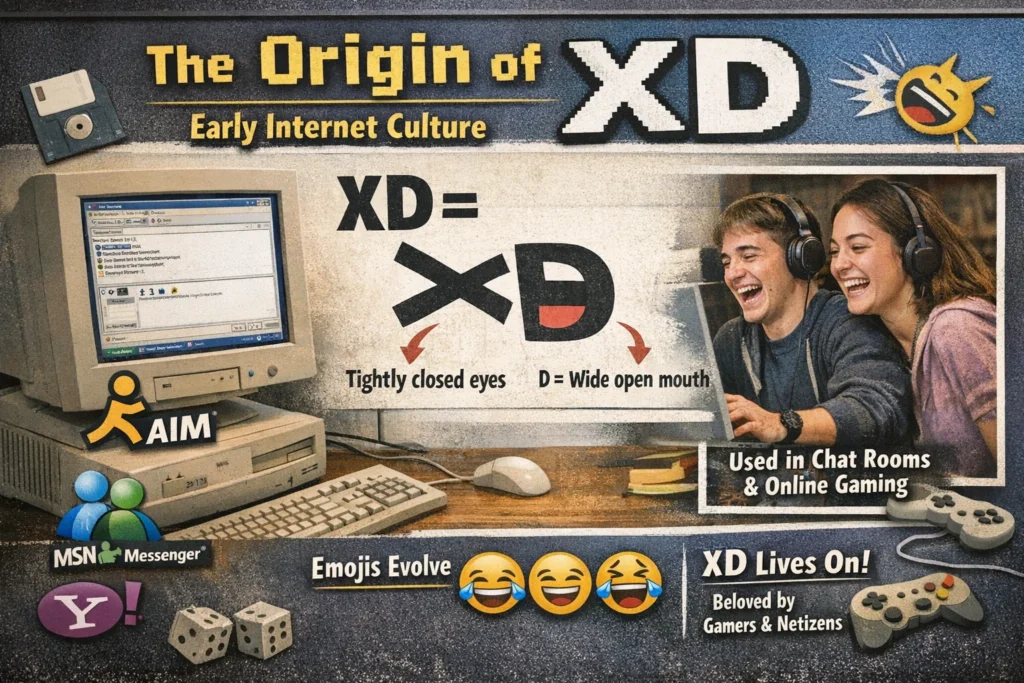
The emoticon XD originated in the late 1990s and early 2000s during the rise of internet chat rooms, forums, and instant messaging platforms such as:
- AOL Instant Messenger (AIM)
- MSN Messenger
- Yahoo! Messenger
- Early online gaming communities
Users sought creative ways to express emotions using only keyboard characters. While smiley faces like :) and :-D were common, XD gained popularity for its exaggerated expression of laughter.
Visual Representation
The emoticon is meant to be viewed sideways:
- X → Represents tightly closed eyes, indicating intense laughter.
- D → Represents a wide-open mouth.
This combination creates the image of someone laughing so hard that their eyes are squeezed shut.
Evolution into Emojis
With the advent of smartphones and emojis, XD has often been replaced by emoji equivalents such as:
- 😂 (Face with Tears of Joy)
- 😆 (Grinning Squinting Face)
- 🤣 (Rolling on the Floor Laughing)
Despite this evolution, XD continues to thrive, especially among gamers and long-time internet users.
Popularity and Cultural Significance
Why “XD” Became So Popular
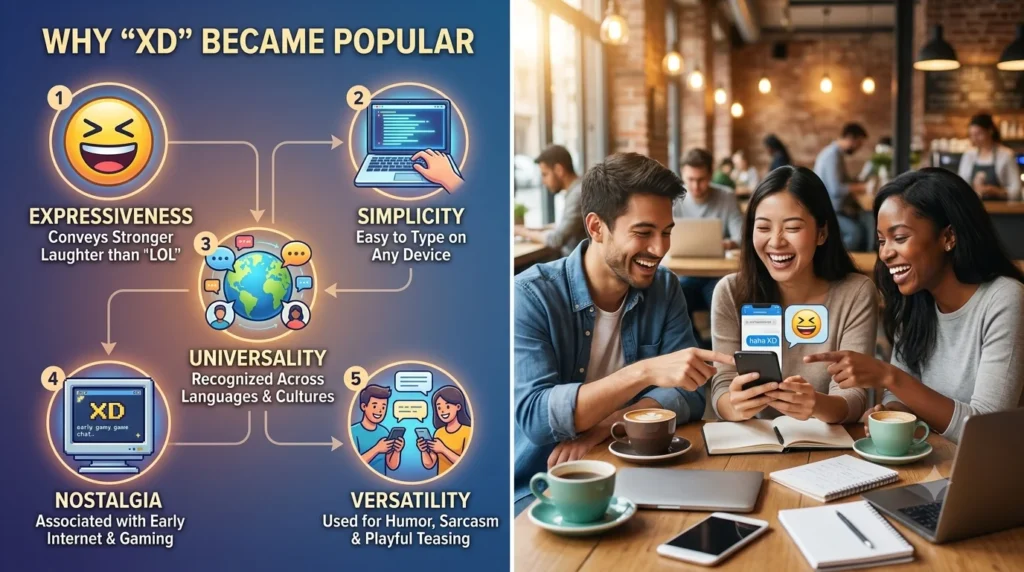
Several factors contributed to the widespread use of XD:
- Expressiveness – It conveys stronger laughter than simple abbreviations like “LOL.”
- Simplicity – Easy to type on any keyboard.
- Universality – Recognized across languages and cultures.
- Nostalgia – Associated with early internet and gaming communities.
- Versatility – Suitable for humor, sarcasm, and playful teasing.
Where You’ll Commonly See “XD”
- Text messages and chats
- Social media platforms (Facebook, Instagram, TikTok, X/Twitter)
- Online gaming communities
- Forums and comment sections
- Streaming chats (e.g., Twitch)
How to Use “XD” in Texting
Basic Usage
XD is typically placed at the end of a sentence to emphasize humor or amusement.
Examples:
- “I just tried to unlock my phone with the TV remote XD”
- “That joke was terrible but still funny XD”
- “You actually believed that? XD”
Tone Variations
Depending on context, XD can convey different tones:
| Tone | Description | Example |
|---|---|---|
| Friendly | Genuine laughter or amusement | “That meme you sent was hilarious XD” |
| Playful | Light teasing or joking | “You’re late again, as usual XD” |
| Sarcastic | Mocking or ironic humor | “Oh sure, that plan will definitely work XD” |
| Awkward | Softening an uncomfortable statement | “I completely forgot your birthday… XD” |
| Dismissive | Minimizing seriousness | “It’s not a big deal, relax XD” |
Labeled Example Table
| Situation | Message | Tone | Explanation |
|---|---|---|---|
| Friend tells a joke | “That was hilarious XD” | Friendly | Shows genuine amusement |
| Teasing a sibling | “You lost again XD” | Playful | Light-hearted teasing |
| Reacting to sarcasm | “Yeah, because that always works XD” | Sarcastic | Implies the opposite meaning |
| Admitting a mistake | “I sent the email to the wrong person XD” | Awkward | Softens embarrassment |
| Downplaying seriousness | “I forgot the assignment, XD” | Dismissive | Makes the situation seem less serious |
Real-World Usage Examples
Friendly Context
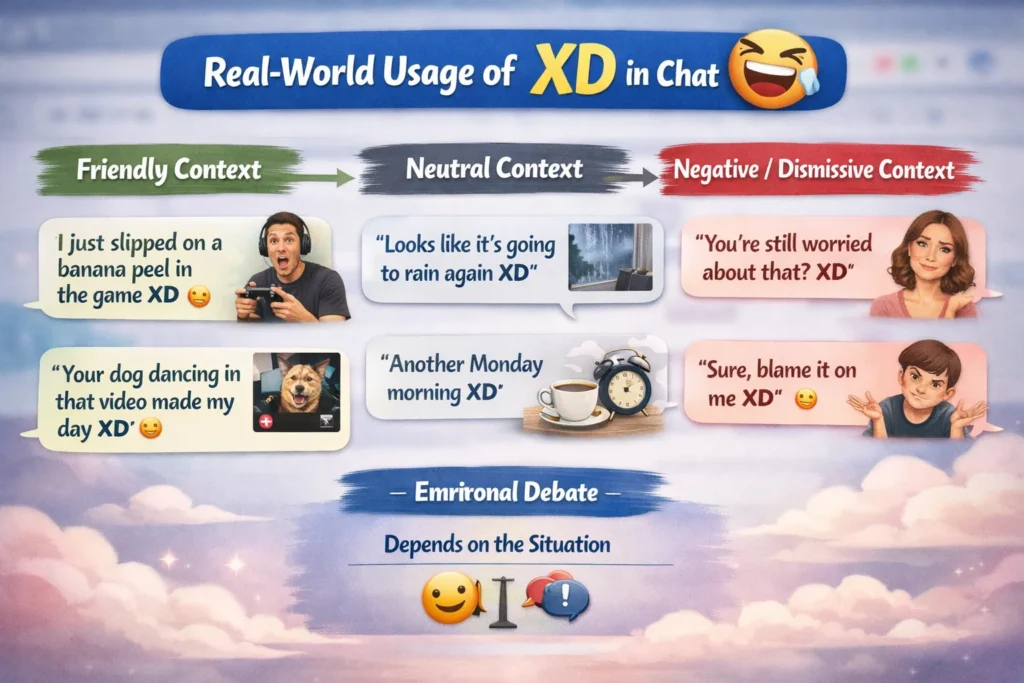
- “I just slipped on a banana peel in the game XD”
- “Your dog dancing in that video made my day XD”
Neutral Context
- “Looks like it’s going to rain again XD”
- “Another Monday morning XD”
Negative or Dismissive Context
- “You’re still worried about that? XD”
- “Sure, blame it on me XD”
These examples demonstrate how context determines whether the emoticon is perceived positively or negatively.
Comparison with Similar Texting Terms
Understanding XD becomes easier when compared with other popular abbreviations and emojis.
| Term | Meaning | Intensity of Laughter | Formality | Emoji Equivalent |
|---|---|---|---|---|
| XD | Eyes closed with laughter | High | Informal | 😂😆 |
| LOL | Laugh Out Loud | Medium | Informal | 🙂😂 |
| LMAO | Laughing My Ass Off | Very High | Very Informal | 🤣 |
| ROFL | Rolling On the Floor Laughing | Extreme | Very Informal | 🤣 |
| Haha | Simple laughter | Low to Medium | Neutral | 🙂 |
| 😂 | Tears of Joy emoji | High | Neutral | — |
Key Differences
- XD vs. LOL: XD is more expressive and visual.
- XD vs. 😂: Emojis are more modern, but XD carries nostalgic charm.
- XD vs. LMAO/ROFL: These abbreviations suggest even stronger laughter but can be more informal or exaggerated.
When to Use “XD”
Appropriate Situations
- Casual conversations with friends or family
- Social media interactions
- Online gaming chats
- Informal group discussions
Situations to Avoid
- Professional emails
- Academic writing
- Formal business communication
- Conversations involving sensitive topics
Polite and Professional Alternatives
When communicating in formal or professional settings, consider using these alternatives instead of XD:
| Informal | Professional Alternative |
|---|---|
| XD | “That’s amusing.” |
| XD | “That made me smile.” |
| XD | “I appreciate the humor.” |
| XD | “That’s quite funny.” |
| XD | “I found that entertaining.” |
These options maintain a friendly tone while ensuring professionalism.
Alternate Meanings of “XD”
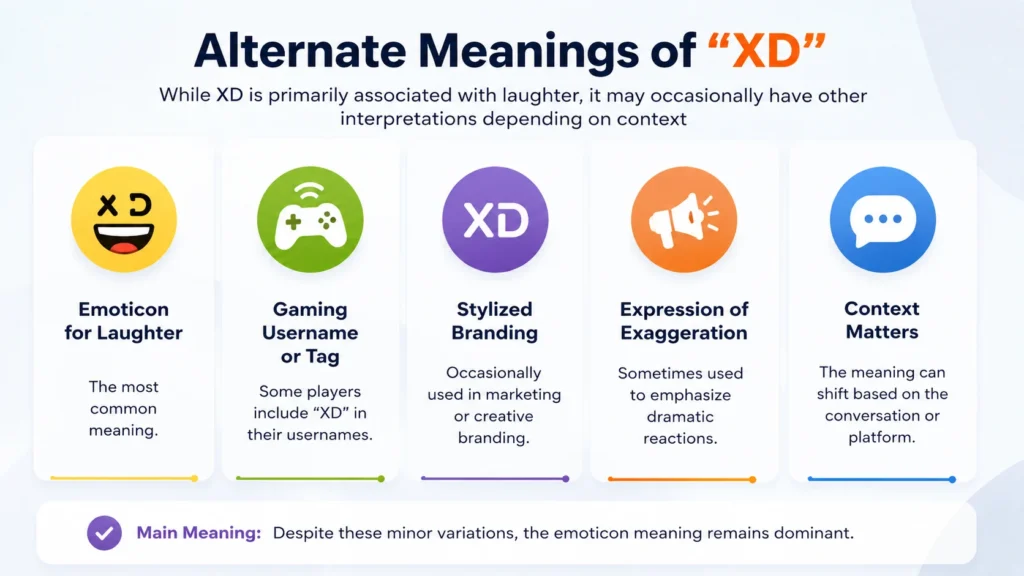
While XD is primarily associated with laughter, it may occasionally have other interpretations depending on context:
- Emoticon for Laughter – The most common meaning.
- Gaming Username or Tag – Some players include “XD” in their usernames.
- Stylized Branding – Occasionally used in marketing or creative branding.
- Expression of Exaggeration – Sometimes used to emphasize dramatic reactions.
Despite these minor variations, the emoticon meaning remains dominant.
Tips for Using “XD” Effectively
- Consider Your Audience: Ensure the recipient understands internet slang.
- Use Sparingly: Overusing XD can reduce its impact.
- Pay Attention to Context: It may be perceived as sarcastic or dismissive.
- Match the Tone: Align it with the conversation’s mood.
- Combine with Emojis: For added emphasis, e.g., “That was hilarious XD 😂”.
FAQs
1. What does XD mean in texting?
XD is an emoticon representing laughter or extreme amusement, with the “X” as closed eyes and the “D” as a wide-open laughing mouth.
2. Is XD still popular today?
Yes, although emojis like 😂 and 🤣 are more common, XD remains popular, especially among gamers and long-time internet users.
3. Is XD considered rude?
Not inherently. However, depending on context, it can appear sarcastic or dismissive, so it should be used thoughtfully.
4. What is the difference between XD and LOL?
XD visually represents laughter, while LOL is an abbreviation for “Laugh Out Loud.” XD often conveys stronger amusement.
5. Can XD be used in professional communication?
It’s best avoided in professional settings. Instead, use phrases like “That’s amusing” or “I appreciate the humor.”
6. How do you pronounce XD?
People typically pronounce it as “ex-dee,” though it is primarily intended as a visual emoticon rather than a spoken word.
7. Is XD an emoji or an emoticon?
XD is an emoticon created using keyboard characters, whereas emojis are graphical representations.
8. What emojis are similar to XD?
Common equivalents include 😂 (Face with Tears of Joy), 🤣 (Rolling on the Floor Laughing), and 😆 (Grinning Squinting Face).
Conclusion
The emoticon XD has stood the test of time as one of the internet’s most recognizable symbols of laughter. Originating from early chat rooms and messaging platforms, it continues to be widely used across texting, gaming, and social media. Its simple yet expressive design makes it an effective way to convey humor, playfulness, or even sarcasm.
However, like all forms of digital communication, context matters. While XD is perfect for casual conversations, it may not be suitable for professional settings. Understanding its tone, alternatives, and comparisons with similar expressions ensures that you can use it effectively and appropriately.
By mastering the use of XD, you can enhance your digital communication and connect more effectively in today’s fast-paced online world.
Discover More Related Articles:
- 167+ Funny Responses to “I Think So”: That Actually Land Well In 2026
- 425+ Best Responses to “I’ve Had Better Days”: Without Being Rude in 2026
- 180+ Best Responses To “I’ve Been Thinking About You” in 2026