
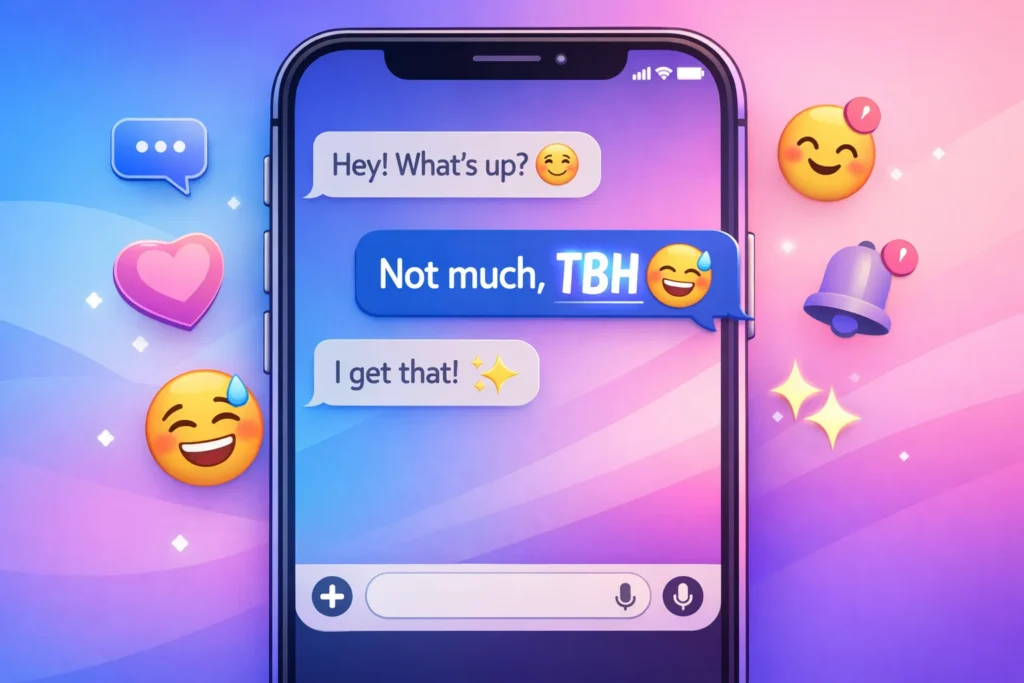

Definition
TBH stands for “to be honest.” It’s a common abbreviation used in text messages, social media, and online chats to signal honesty, sincerity, or a candid opinion. People use “TBH” to express something truthful, sometimes blunt, or to soften a statement by framing it as honest.
If you’ve spent any time texting, scrolling through social media, or chatting online, you’ve probably seen “TBH” pop up everywhere. It’s short, casual, and incredibly versatile. Whether someone is giving a genuine compliment, sharing a blunt opinion, or just being real, “TBH” sets the tone.
But what exactly does it mean in different situations? Is it always polite? Can it sound rude? And how should you use it correctly?
This guide breaks it all down in a clear, practical way—so you can understand and use “TBH” like a pro.
Origin and Popularity of TBH
Where Did TBH Come From?
“TBH” is part of the early wave of internet slang that emerged in the late 1990s and early 2000s, alongside abbreviations like:
- LOL (laugh out loud)
- BRB (be right back)
- IMO (in my opinion)
As texting and instant messaging became more popular, people started shortening phrases to type faster—and “to be honest” quickly became “TBH.”
Rise on Social Media
“TBH” really exploded in popularity with platforms like:
- Snapchat
It even became a trend where users would post:
“Like this post for a TBH”
Meaning they’d give an honest opinion or compliment about someone.
Today, “TBH” is a staple in digital communication across all age groups.
How TBH Is Used in Text Conversations
“TBH” can change tone depending on how it’s used. Here are the most common ways:
1. To Express Honesty
Used to emphasize truthfulness:
- “TBH, I didn’t like the movie.”
- “I’m tired, TBH.”
👉 Adds sincerity and transparency.
2. To Give Opinions
Often used before sharing personal thoughts:
- “TBH, I think you made the right choice.”
- “TBH, that outfit looks great on you.”
👉 Can be positive or critical.
3. To Soften Criticism
It can make a blunt statement feel less harsh:
- “TBH, you could’ve handled that better.”
- “TBH, that wasn’t your best work.”
👉 Sounds more honest than rude—if used carefully.
4. To Give Compliments (Social Media Style)
Common in friendly interactions:
- “TBH, you’re one of the nicest people I know 😊”
- “TBH, I admire your confidence!”
👉 Often warm and supportive.
5. Casual filler in conversations
Sometimes it’s just conversational:
- “TBH, I don’t know what to do.”
- “TBH, same.”
👉 Adds relatability.
Example Table: TBH in Different Contexts
| Context | Example Message | Tone |
|---|---|---|
| Friendly | “TBH, you’re really fun to talk to 😊” | Warm & positive |
| Neutral | “TBH, I forgot about the meeting.” | Honest & casual |
| Negative | “TBH, that idea isn’t very practical.” | Critical but direct |
| Supportive | “TBH, you handled that really well.” | Encouraging |
| Dismissive | “TBH, I don’t really care.” | Blunt/harsh |
Tone Matters: Is TBH Always Polite?
Not always. The tone depends on context, wording, and delivery.
Positive Tone
- “TBH, you’re amazing at this!”
- Friendly, uplifting, and genuine
Neutral Tone
- “TBH, I’m not sure.”
- Honest but not emotional
Negative or Harsh Tone
- “TBH, that was a bad decision.”
- Can sound blunt or even rude
👉 Tip: Always consider how your message might feel to the other person.
TBH vs Similar Abbreviations
Here’s how “TBH” compares to other common texting slang:
| Abbreviation | Meaning | Tone/Use Case |
|---|---|---|
| TBH | To be honest | Honest opinion or truth |
| IMO | In my opinion | More neutral and formal |
| NGL | Not gonna lie | Casual honesty, often relatable |
| FR | For real | Emphasis on truth or agreement |
| ICYMI | In case you missed it | Informational, not opinion-based |
Key Difference
- TBH → Focus on honesty
- IMO → Focus on opinion
- NGL → More casual and expressive
Alternate Meanings of TBH
While “to be honest” is the most common meaning, TBH can occasionally mean:
- “To be heard” (rare, more niche use)
- “To be happy” (very uncommon)
👉 In almost all texting and social media situations, it means “to be honest.”
When to Use TBH (and When Not To)
✔️ Good Situations to Use TBH
- Casual conversations with friends
- Social media comments or captions
- Giving honest but kind feedback
- Sharing personal thoughts
❌ Avoid Using TBH When:
- Writing formal emails
- Communicating professionally
- Giving sensitive criticism
- Talking to someone you don’t know well
Polite and Professional Alternatives to TBH
If you’re in a formal setting, here are better options:
Instead of “TBH,” use:
- “To be honest” (full phrase)
- “In my honest opinion”
- “Frankly speaking”
- “I believe that…”
- “From my perspective…”
Example:
- Casual: “TBH, I don’t agree.”
- Professional: “I respectfully disagree.”
Real-Life Usage Examples
Friendly Chat
- “TBH, I miss hanging out with you 😢”
Work Context (Less Appropriate)
- “TBH, this report is confusing.” ❌
Better: - “This report could use more clarity.” ✔️
Social Media
- “TBH, you glow differently these days ✨”
Honest Opinion
- “TBH, I wouldn’t recommend that place.”
Common Mistakes When Using TBH
1. Using it too often
Repeating “TBH” in every message can feel forced.
2. Sounding unintentionally rude
- “TBH, you’re wrong.”
👉 Can come off harsh.
3. Using it in formal writing
Avoid it in:
- Job emails
- Academic writing
- Professional communication
FAQs:
1. What does TBH mean in texting?
TBH means “to be honest.” It’s used to express honesty or share a truthful opinion in conversations.
2. Is TBH rude or polite?
It can be both. It depends on how it’s used—polite when kind, but potentially blunt if paired with criticism.
3. What does TBH mean on Instagram or Snapchat?
On social media, TBH usually means giving an honest opinion, often as a compliment or friendly shoutout.
4. Can TBH be used professionally?
No, it’s better to avoid it in professional settings. Use full phrases like “to be honest” instead.
5. What is the difference between TBH and NGL?
Both express honesty, but “NGL” (not gonna lie) is more casual, while TBH is slightly more direct.
6. Why do people say TBH before a sentence?
It signals that what follows is honest or candid, sometimes preparing the listener for a blunt opinion.
7. Is TBH still popular?
Yes, it’s still widely used in texting and social media, especially among younger users.
8. What should I reply to TBH messages?
It depends on the context:
- Compliment → “Aww, thank you 😊”
- Criticism → “I appreciate your honesty”
- Neutral → Respond naturally
Conclusion:
TBH” is a simple but powerful abbreviation that stands for “to be honest,” and it plays a big role in modern texting and online conversations. Whether you’re sharing a genuine compliment, offering an opinion, or being straightforward about your thoughts, “TBH” helps signal honesty and authenticity.
However, tone matters. While it can make messages feel more real and relatable, it can also come across as blunt if used carelessly especially in sensitive situations. That’s why it’s best suited for casual chats and social media rather than professional communication.
Discover More Related Articles:
- RD Mean in a Text: On Snapchat, WhatsApp & Instagram in 2026
- Nolle Prosequi Mean in Court: Rights, Risks, and Outcomes in 2026