
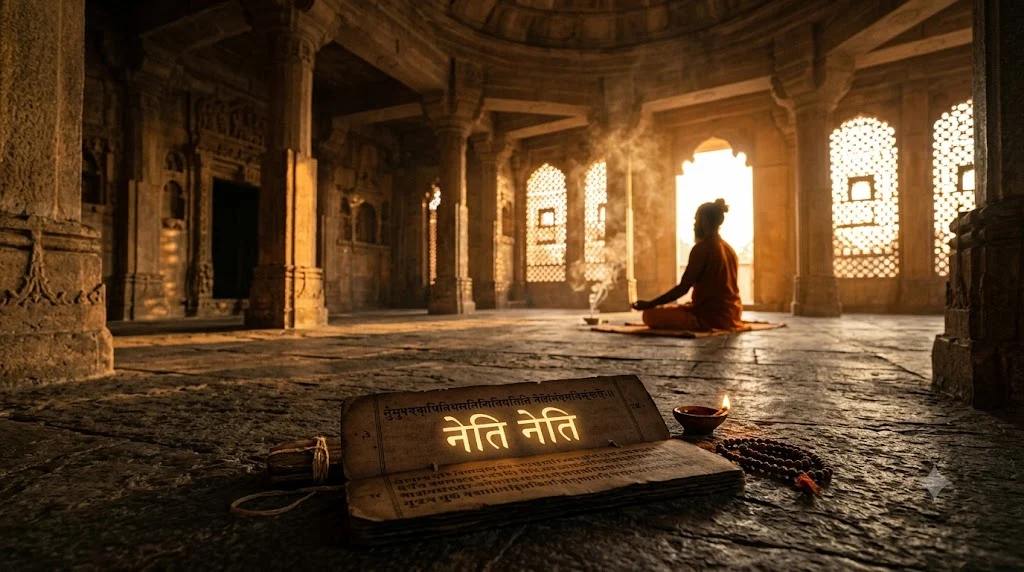

Definition
The word is neti. And once you understand what it means and why it matters, you’ll never look at your own identity quite the same way again.
What if the deepest truth about reality can’t be said out loud? What if the wisest thing an ancient philosopher could do was point at something and say, not this… not this… not this?
That’s exactly what happened in India somewhere around 700 BCE. A sage named Yajnavalkya sat before his students and, when asked to describe the ultimate nature of reality, refused to name it. He kept repeating two small words instead. Those two words became one of the most profound philosophical methods ever recorded.
What Does Neti Mean? The Simple Answer First
Before going deep into the philosophy, let’s get the basics straight. Neti is a Sanskrit word. Its literal meaning in English is “not this” or “not thus.”
That’s it. Two syllables. Four letters. And yet this tiny word carries the weight of an entire philosophical tradition inside it.
In everyday use, neti functions as a negation. It says: whatever you just pointed at, that’s not it. In the context of ancient Indian philosophy, it takes on a far more radical purpose. It becomes a method for pointing toward something that words genuinely cannot describe.
Here’s a quick reference to anchor everything that follows:
| Term | Script | Language | Literal Translation | Philosophical Role |
|---|---|---|---|---|
| Neti | नेति | Sanskrit | “Not this” | Single negation |
| Neti Neti | नेति नेति | Sanskrit | “Not this, not that” | Method of systematic negation |
| Na iti | न इति | Sanskrit (pre-sandhi) | “Not thus” | Original grammatical form |
| Brahman | ब्रह्मन् | Sanskrit | “The Absolute” | What neti neti points toward |
The word itself comes from two Sanskrit components joined through a process called sandhi, which is the Sanskrit term for how sounds merge when placed together in speech.
Na means “not.” Iti is a versatile particle meaning “thus,” “this,” or “so” it often marks the end of a quoted thought, like a closing quotation mark. When na and iti are spoken one after another in natural speech, they fuse into neti. It’s the same kind of phonetic blending you see in English contractions: “do not” becomes “don’t.”
Simple grammar. Enormous implications.
The Neti Meaning in Sanskrit: Why Translation Falls Short
Here’s the honest truth about translating neti: English doesn’t quite have the right word for what iti does in Sanskrit.
In Sanskrit grammar, iti often functions as what scholars call a quotation particle. It ends a thought, closes off a claim, marks a boundary. So “na iti” doesn’t just mean “not this thing in front of me.” It means “not that which you just said not that framing, not that concept, not that name.”
This is why the neti meaning in Sanskrit carries more philosophical muscle than “not this” suggests in English. It’s a rejection of any and every conceptual frame you try to place around ultimate reality. It’s saying: your description, however good it is, still isn’t it.
Think of it like pointing at the moon. No matter how detailed your map of the moon is, the map is not the moon. Neti says: your map, however accurate, is neti. Not this.
The challenge for translators is that English forces you to choose between “not this” and “not thus,” and neither captures the full semantic range of the original. What the Sanskrit really conveys is something closer to: “whatever you just said or thought or conceived that’s not it either.”
Where Neti Neti Comes From: The Original Source
The phrase neti neti first appears in the Brihadaranyaka Upanishad, one of the oldest and most philosophically rich texts in the entire Vedantic tradition. Scholars generally date this text to somewhere between 700 and 500 BCE, making it roughly contemporary with early Greek philosophy.
The specific passage comes from the teachings of the sage Yajnavalkya, who is arguably the most brilliant philosophical mind in the entire Upanishadic corpus. He’s having a series of conversations with other sages and with his wife Maitreyi, trying to point toward the nature of Brahman, which is the Sanskrit term for ultimate reality or pure, infinite consciousness.
Every time someone asks him what Brahman is like, he refuses to give a positive description. Instead, he offers what has become one of the most famous philosophical refrains in human history:
“It is not this, it is not this.”
The repetition matters. He doesn’t say neti once. He says it twice. This doubling is deliberate. The first neti rules out the obvious candidates the body, the senses, material objects. The second neti goes further and rules out even subtler identifications the mind, the intellect, even refined states of consciousness.
Together, neti neti creates a sweeping motion: nothing you can point at, name, or conceive is the thing itself.
Other Upanishadic Texts That Echo Neti
The Brihadaranyaka Upanishad isn’t the only text where this idea appears. The negation method shows up across multiple Upanishads, each adding a slightly different angle:
- Mandukya Upanishad explores the four states of consciousness (waking, dreaming, deep sleep, and turiya) and uses a similar via-negativa approach to describe turiya, the fourth state that transcends all three.
- Chandogya Upanishad approaches the same territory through the famous teaching “Tat tvam asi” (“That thou art”), which is an affirmation, but one that only makes sense after the negations have cleared the ground.
- Taittiriya Upanishad describes Brahman as that from which “words turn back, unable to reach.”
Each of these texts circles the same territory from different angles. The neti neti method is the Brihadaranyaka’s specific contribution: a formal, repeatable method of negation as the path to understanding.
Neti Neti Meaning: The Full Philosophy Unpacked
Here’s where things get genuinely interesting. Neti neti isn’t just a definition. It’s a method possibly the most rigorous method ancient Indian philosophy ever produced for approaching ultimate truth.
The core logic works like this.
Brahman, in Vedantic thought, is infinite, formless, and beyond all attributes. It’s not a thing among things. It’s the ground of being itself, the awareness in which all experience arises. Because it’s infinite, it can’t be captured by any finite description. Every name you give it reduces it. Every quality you assign it limits it.
So how do you talk about something that language can’t hold?
You tell people what it isn’t.
This is the neti neti method. Instead of saying “Brahman is X,” you systematically eliminate every X that Brahman is not. You keep going until there’s nothing left to eliminate. What remains after all the negations that which can’t be negated because it’s the very thing doing the negating that’s what the ancient teachers were pointing at.
A useful analogy: imagine you’re trying to explain water to someone who has never experienced it. You can say it’s not fire, not earth, not air. It has no fixed shape, no color, no smell. The more you eliminate, the closer you get. But of course, the real answer is to just drink it. Neti neti is the elimination process. The drinking is what Vedanta calls direct realization.
What Gets Negated in Neti Neti Practice?
This is the practical breakdown. In the Vedantic framework, a sincere practitioner moves through layers of identity, negating each one:
The Physical Body (Annamaya Kosha) Sensations, appearance, weight, temperature, pain, pleasure. The body changes constantly from birth to death. It wasn’t present before birth and won’t persist after death. So you ask: is this what I ultimately am? Neti. Not this.
The Energy Body (Pranamaya Kosha) The life force, breath, vitality that animates the body. More subtle than flesh and bone but still impermanent, still conditional. Neti. Not this.
The Mental Body (Manomaya Kosha) Thoughts, memories, fantasies, emotions, desires, fears. The inner narrator constantly telling stories about who you are and what you want. Still changing, still conditional. Neti. Not this.
The Wisdom Body (Vijnanamaya Kosha) The intellect, discrimination, deeper insight. Even the part of you that knows things, reasons about things, has spiritual insights. Still an object of awareness, not awareness itself. Neti. Not this.
The Bliss Body (Anandamaya Kosha) Deep peace, joy, the bliss experienced in dreamless sleep or profound meditation. Still a state, still arising and passing. Neti. Not this.
What remains after negating all five? Pure witnessing awareness itself the one thing that can’t be negated because it’s the thing that has been doing all the watching throughout. That, according to Vedanta, is what you actually are. That is Brahman. That is Atman. And neti neti is the method that reveals it.
Why Is Neti Neti Important in Vedanta?
Advaita Vedanta which translates as “non-dual end of the Vedas” is the philosophical system most closely associated with neti neti. Founded and systematized by the 8th-century philosopher Adi Shankaracharya, Advaita teaches a single radical thesis: the individual self (Atman) and ultimate reality (Brahman) are not two different things. They are identical.
This sounds simple. It isn’t. The problem is that every ordinary experience seems to confirm the opposite that you are a separate individual navigating a world of other separate things. This apparent separation, Advaita calls maya, a Sanskrit term often translated as illusion or, more precisely, superimposition.
Neti neti is the primary tool for cutting through maya.
Here’s why it’s so central to Vedanta specifically:
It respects the ineffability of Brahman. Vedanta insists that Brahman has no attributes it’s called nirguna (without qualities). Any positive description (saguna with qualities) is a teaching aid, not the thing itself. Neti neti honors this by refusing to commit to any description as final.
It redirects attention inward. The negation of external objects (body, world) naturally turns attention toward the subject the one who is negating. This inward shift is the heart of self-inquiry.
It addresses misidentification directly. The root of human suffering in Vedanta is mistaking something limited and temporary for what you actually are. Neti neti addresses this precisely by dismantling each false identification, one by one.
It works for all levels of practitioner. A beginner can start by simply disidentifying from the body. An advanced student can work at the subtlest levels of consciousness. The method scales.
Neti Neti vs. Iti Iti: The Two Approaches
Vedanta actually has two complementary methods for approaching Brahman:
| Method | Meaning | Approach | Example Statement |
|---|---|---|---|
| Neti Neti | “Not this, not that” | Via negativa — elimination | “Brahman is not the body, not the mind” |
| Iti Iti | “It is this, it is this” | Via positiva — affirmation | “Brahman is sat (being), chit (consciousness), ananda (bliss)” |
Most teachers regard neti neti as the more philosophically rigorous method because affirmative descriptions, however beautiful, still risk being taken as literal definitions. Neti neti prevents that trap.
Neti Neti in the Upanishads: Wisdom Across the Texts
The Upanishads aren’t a single book. They’re a collection of over 100 texts, 13 of which are considered the principal Upanishads central to Vedanta. Neti neti shows up most explicitly in the Brihadaranyaka, but the spirit of the teaching permeates many others.
Key passages worth knowing:
Brihadaranyaka Upanishad 2.3.6 —Yajnavalkya’s direct teaching: “Regarding this, there is the teaching ‘neti neti’ not this, not this. For there is nothing higher than this, that he is not this.”
Brihadaranyaka Upanishad 3.9.26 Yajnavalkya uses neti neti to describe Atman (the inner self) as that which transcends the senses, mind, and breath.
Brihadaranyaka Upanishad 4.4.22 The teaching appears again in the context of the nature of the liberated sage.
The repetition across chapters isn’t accidental. Yajnavalkya is doing something deliberate: demonstrating that no matter how many times you ask the question from different angles, the answer is always the same pointing gesture neti neti.
Neti Neti and Self-Realization: The Destination
The endpoint of neti neti practice, according to Advaita Vedanta, is moksha liberation. But this word gets misunderstood.
Liberation in Vedanta isn’t something that happens to you in the future. It’s the recognition of what you already are. The self is already free; it was never actually bound. The bondage was the misidentification the mistaking of the body, mind, and ego for what you fundamentally are.
Neti neti doesn’t create liberation. It removes the misidentification that was obscuring the recognition of it.
Two teachers from the modern era brought this understanding to vivid, accessible life:
Ramana Maharshi (1879–1950) taught a practice called Atma Vichara self-inquiry which runs parallel to neti neti. His central question was simple: “Who am I?” For every answer that arises (I am a person, I am a body, I am a mind), the instruction is the same: trace it back further. Notice that all these things are objects appearing in awareness. What is the awareness itself? He called this the direct path.
Nisargadatta Maharaj (1897–1981) taught in Mumbai with stark, uncompromising directness. He consistently pointed students to the recognition: “I am not the body. I am not the mind. I am that in which the body and mind appear.” His approach was essentially neti neti practiced at the speed of direct pointing.
Both teachers lived the teaching. Both drew students from around the world precisely because the method they were pointing at was not belief-based. It was experiential and direct.
Neti Neti and Self-Inquiry: How They Work Together
Neti neti and self-inquiry aren’t competing methods. They’re complementary. Think of them as two hands of the same practice.
Neti neti moves outward-to-inward: it systematically eliminates what you’re not. Self-inquiry moves directly to the source: it asks who or what is doing the experiencing.
Together they create a pincer movement. Neti neti clears the field. Self-inquiry occupies the revealed ground.
Here’s how Ramana Maharshi described the relationship in simple terms: when you keep asking “who am I?”, every answer that comes up gets negated I am not this thought, not this feeling, not this memory until what remains is the pure sense of being, prior to any specific content.
That’s neti neti in action, just dressed in the language of inquiry rather than formal negation.
Common Misunderstandings About Neti Neti
This teaching gets misread surprisingly often. Let’s clear up the most persistent confusions.
Misunderstanding 1: Neti Neti Means Nothing Exists Neti neti is not nihilism. It doesn’t say the body doesn’t exist, that the world is fake, or that nothing matters. It says the body, world, and mind are not what you ultimately are. They exist just not as the foundation of your identity.
Misunderstanding 2: It’s Pure Intellectual Analysis Neti neti is sometimes read as a purely logical exercise. It’s not. The negation is supposed to be felt, not just thought. When you say “I am not this fear,” the practice requires actually noticing the fear and recognizing the witnessing awareness that sees it not just reciting a philosophical position.
Misunderstanding 3: It’s Pessimistic or World-Rejecting Quite the opposite. Practitioners often report that neti neti leads to a deeper appreciation of experience, not a withdrawal from it. When you stop being the fear, you can experience it fully without being swept away by it.
Misunderstanding 4: It’s the Same as Buddhist No-Self (Anatta) Similar territory, genuinely different destination. Buddhism’s anatta teaching uses a similar negation approach to dismantle the sense of a fixed self but the Buddhist conclusion is that there is no self at all. Advaita Vedanta’s neti neti leads to a different conclusion: there is no limited self, but there is infinite self. The Atman is real. It just isn’t what you thought it was.
| Feature | Neti Neti (Vedanta) | Anatta (Buddhism) |
|---|---|---|
| Method | Systematic negation | Observation of impermanence |
| What’s negated | Limited, conditional self | Fixed, permanent self |
| What remains | Infinite Atman/Brahman | Dependent origination, empty of inherent self |
| Goal | Recognition of Brahman | Liberation from suffering (Nirvana) |
| Ontology | Non-dual consciousness exists | No fixed essence to consciousness |
Neti Neti as a Meditation Practice: Step by Step
The philosophy is rich. But the practice is where it gets real.
Here’s a structured neti neti meditation you can actually try. Set aside 20 quiet minutes.
Preparation Sit comfortably. Close your eyes. Let the breath settle naturally. Don’t try to change anything yet. Just arrive.
Step 1: The Body Turn attention to the physical body. Feel its weight, temperature, any sensations present. Now gently ask: Am I this body? Notice that you are aware of the body. The awareness and the body aren’t the same thing. The body is an object in your awareness. Say inwardly: Neti. Not this.
Step 2: The Breath and Vital Energy Feel the breath moving. The aliveness and energy pulsing through you. Ask: Am I this vitality? Again, you are aware of it. It’s an object of your observation. Neti. Not this.
Stay here for as long as feels natural.
This practice doesn’t require you to believe anything. It’s a direct investigation. You’re not accepting a philosophical position you’re looking.
Neti in Daily Life: Beyond the Meditation Cushion
The meditation is valuable. But neti neti’s real power shows up in the middle of ordinary life.
Consider what happens when you’re caught in a strong emotion anger, for example. The ordinary experience is: I am angry. The first-person identification is total. The anger feels like you.
Neti neti practice trains a different response: you notice the anger arising, and instead of collapsing into it, you observe it. You recognize that there is awareness present that is watching this anger. The anger is an object in that awareness. I am not this anger. Neti.
This isn’t suppression. You’re not pushing the anger down. You’re changing your relationship to it. You feel it fully but as something appearing in you rather than something that is you.
The practical effects of sustained neti neti practice, as reported by practitioners and teachers across centuries, include:
- Greater emotional resilience without emotional numbness
- Reduced reactivity in difficult situations
- A stable background sense of okayness that doesn’t depend on circumstances
- Decreased identification with self-image and social persona
- A growing sense of spaciousness in experience
None of this requires adopting any religious belief. The practice is essentially empirical. You look, you see, you notice the difference. The philosophy provides a map, but the territory is your own direct experience.
Neti in Other Contexts: The Word Beyond Philosophy
One thing worth clarifying for any reader who has encountered the word elsewhere: neti has at least two entirely distinct usages in Sanskrit and Indian culture.
Jala Neti: The Yoga Practice
In the yogic tradition, jala neti is a nasal cleansing practice using a neti pot to rinse the nasal passages with warm saline water. This is a common practice in Hatha Yoga and Ayurveda for respiratory health and clarity of breath.
This neti comes from a different Sanskrit root meaning “to lead” or “to guide.” It has nothing to do with the philosophical neti of Vedanta. Same word, different lineage, completely different context. If you’ve encountered the word through yoga classes or Ayurvedic health practices, that’s the one.
Neti as a Personal Name
In South Asian cultures, Neti is also used as a personal name particularly for girls in some Indian regional traditions. As a name, it carries connotations of grace and flow. It’s unrelated to the philosophical term, though speakers of Sanskrit-influenced languages are generally aware of the philosophical resonance.
Neti in South Indian Languages
The word travels across multiple South Indian languages with varying usages:
- Telugu: neti (నేటి) often means “of today” or “today’s” a completely different word with the same sound
- Tamil: similar phonological presence but different semantic role
- Kannada: again, distinct meanings in everyday use compared to the philosophical Sanskrit term
This cross-linguistic complexity is worth knowing because searching “neti meaning” can surface results from multiple traditions. The Vedantic philosophical sense is distinct and specific.
Neti Neti Across Philosophical Traditions: You’re Not Alone in This
What’s striking about neti neti is that the same fundamental approach appears, independently, in multiple wisdom traditions around the world. This convergence is powerful. It suggests that the challenge of pointing toward ultimate reality and the strategy of negation as a solution isn’t culturally specific. It’s a response to something universal.
Christian Apophatic Theology (Via Negativa) Christian mystics like Pseudo-Dionysius the Areopagite (5th–6th century CE) developed what they called apophatic or negative theology: the practice of describing God by what God is not. Meister Eckhart, John of the Cross, and the anonymous author of The Cloud of Unknowing all worked in this tradition. The resemblance to neti neti is remarkable.
Taoism and Wu The Tao Te Ching opens with: “The Tao that can be named is not the eternal Tao.” This is neti neti in a single line. The Tao like Brahman escapes every definition. Laozi’s entire first chapter is an extended meditation on this unnameable ground.
Buddhist Madhyamaka Philosophy Nagarjuna’s Mulamadhyamakakarika (2nd century CE) systematically deconstructs every possible claim about the nature of reality, showing that nothing can be asserted or denied with ultimate validity. This prasanga method reduction to absurdity of every position is philosophically related to neti neti, though the Vedantic and Buddhist metaphysical conclusions differ.
| Tradition | Term | Core Idea | Conclusion |
|---|---|---|---|
| Advaita Vedanta | Neti Neti | Negate all that Brahman is not | Brahman/Atman as infinite consciousness |
| Christian Mysticism | Via Negativa | Negate all that God is not | Union with ineffable Divine |
| Taoism | Wu Wei / Nameless Tao | Tao cannot be named or held | Harmony with the Tao |
| Buddhism (Madhyamaka) | Sunyata (Emptiness) | Nothing has inherent existence | Liberation through non-grasping |
Neti Neti in Modern Psychology: The Ancient Meets the Clinical
Here’s something that might surprise you. Some of the most evidence-based modern therapeutic approaches share a striking structural similarity with neti neti.
Acceptance and Commitment Therapy (ACT), developed by psychologist Steven Hayes, uses a technique called cognitive defusion the practice of learning to observe thoughts rather than being fused with them. A therapist might ask: “Notice that you are having the thought ‘I am worthless.’ You are not the thought. You are the one noticing the thought.”
That’s neti neti in clinical language.
Mindfulness-Based Cognitive Therapy (MBCT) teaches patients recovering from depression to recognize that thoughts are not facts and that the self is not defined by its passing mental states. Again structurally isomorphic to the Vedantic teaching.
Internal Family Systems (IFS) therapy explicitly works with the concept of the observing “Self” a stable, compassionate awareness distinct from the various parts, emotions, and sub-personalities that appear in experience. The “Self” in IFS maps closely onto what Vedanta calls the witness consciousness revealed by neti neti.
This convergence isn’t coincidental. It reflects something genuine about human psychology: the capacity to dis-identify from mental content is a real cognitive and experiential possibility, and it has measurable therapeutic benefits.
What ancient Indian sages arrived at through philosophical investigation, modern psychologists have arrived at through clinical research. The maps are different. The territory they’re describing looks remarkably similar.
Why Neti Neti Matters More Than Ever
We live in an era of extreme identity politics, curated self-presentation, and information overload. Everyone is defined often aggressively by their opinions, affiliations, traumas, achievements, and demographics. The pressure to be something, to identify as something, has never been more intense.
Into this comes a 3,000-year-old teaching that says: whatever you think you are, neti. Whatever others say you are, neti. Whatever your past made you, neti.
Not because identity is fake or worthless. But because you are more than any identity can contain.
Neti neti doesn’t ask you to abandon who you are in the world. It asks you to recognize that you are also the space in which who you are appears. That recognition doesn’t shrink your life. It expands it.
People who live from that recognition tend to be more present, less reactive, more genuinely compassionate precisely because they’re not constantly defending a fixed story about themselves. When the story loosens, there’s more room for reality. More room for other people. More room for life.
That’s the practical case for a philosophy born in ancient India.
FAQs
What does neti mean in simple terms?
Neti is a Sanskrit word meaning “not this.” In philosophy, it points toward something so vast and formless that it can only be described by saying what it isn’t.
What is the difference between neti and neti neti?
Neti is the single negation: “not this.” Neti neti is the doubled form: “not this, not that.” The doubling is intentional it signals a sweeping, comprehensive negation covering all possible descriptions, both obvious and subtle.
Where does neti neti originally come from?
It comes from the Brihadaranyaka Upanishad, one of the oldest philosophical texts in the world, dating to roughly 700–500 BCE. The sage Yajnavalkya used it to describe the nature of Brahman.
Is neti neti a meditation or a philosophy?
Both. It’s a philosophical method that is also practiced as meditation and applied as a lived orientation. The philosophy provides the framework; the practice makes it real in your direct experience.
How do you practice neti neti in daily life?
The simplest way is to notice moments of strong identification especially with thoughts, emotions, or roles and gently remind yourself: I am aware of this. I am the observer, not the thing being observed. That’s neti neti in a practical, everyday form.
Is neti neti the same as Buddhist no-self?
They share a similar negation method but lead to different conclusions. Buddhism’s anatta says there is no self at all. Vedanta’s neti neti says the limited self is not what you are, but infinite awareness is.
Conclusion:
Start with a word. Two syllables. Neti. Not this.
Follow it far enough and it takes you somewhere radical: to the recognition that who you are isn’t any of the things you’ve been told not your body, not your story, not your thoughts, not your history. All of those are real, valuable, important. But they’re not the final word on what you are.
The ancient teachers who developed this method weren’t being evasive when they refused to define Brahman directly. They were being precise. They understood that the moment you put a name on something infinite, you’ve already made it smaller than it is.
So they kept pointing. Not this. Not that. Keep going.
That pointing sustained, rigorous, and honest eventually lands somewhere that can’t be pointed at because it’s the one doing the pointing.
Discover More Related Articles:
- Pentacles Meaning | Symbolism & Spiritual Significance In 2026
- Rizz Meaning | Understanding the Internet’s Favorite Dating Slang In 2026
- Disposition Meaning | Psychology, Law & Daily Life In 2026