
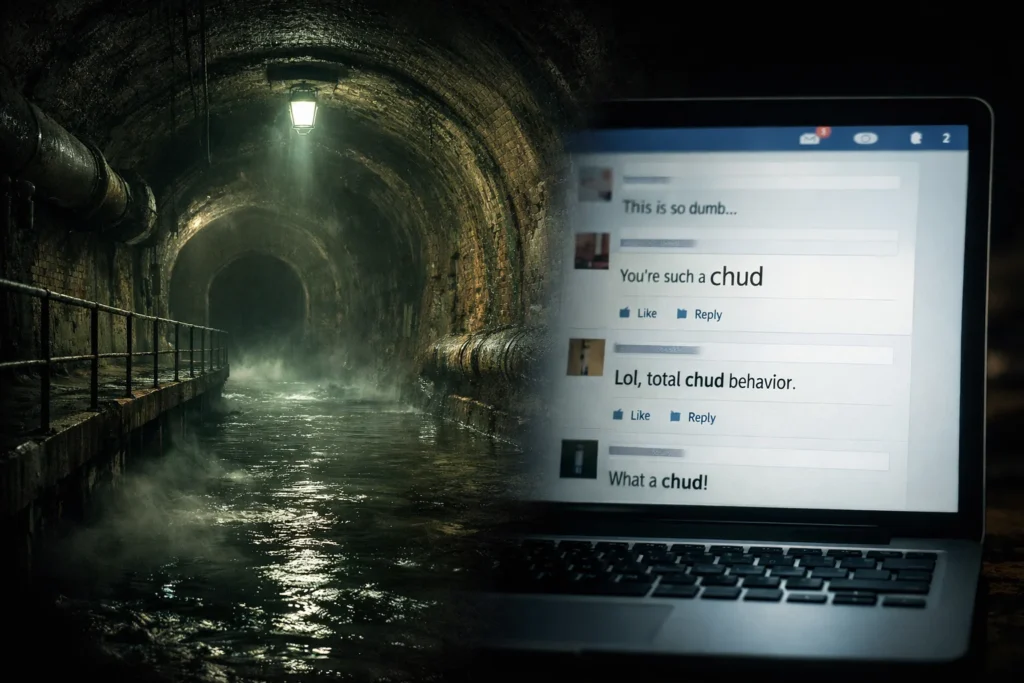

Definition
“Chud” describes someone perceived as aggressively reactionary, far-right, or prone to conspiracy thinking. It’s the left-leaning internet’s go-to shorthand for a certain type of combative online personality.
You’re scrolling through Twitter, Reddit, or a Discord server. Someone drops the word “chud” in a heated comment thread. People laugh. Someone gets offended. And you’re sitting there thinking what on earth does that word actually mean?
You’re not alone. “Chud” has quietly become one of the most used insults in internet culture, especially in politically charged online spaces. Yet most people outside those communities have no idea what it means, where it came from, or why it carries so much weight.
That’s exactly what this guide fixes. By the time you finish reading, you’ll understand the full chud meaning, trace its bizarre origin story from a 1984 horror film to a modern political meme, and know exactly how and when people use it. No jargon, no guessing.
Let’s get into it.
What Does Chud Mean?
Here’s the short answer first.
Chud is a slang term used primarily as an insult online. In modern internet culture, it describes a specific type of person usually aggressive, reactionary, politically extreme, or just unpleasant to interact with. Think of it as a turbocharged version of words like “troll” or “creep,” but with a particular political and cultural flavor baked in.
Now here’s what makes it interesting. The word didn’t start as slang at all. It started as a movie acronym. That’s right. “Chud” has two completely separate lives, and understanding both helps you understand why the word hits the way it does.
Below is a quick reference table covering all three versions of the word you might encounter:
| Version | Meaning | Origin | Tone |
|---|---|---|---|
| C.H.U.D. (1984) | Cannibalistic Humanoid Underground Dwellers | Cult horror film | Neutral / horror |
| Modern Internet Slang | A reactionary, extreme, or unpleasant online person | Left-leaning political communities | Derogatory |
| Casual / Ironic Use | A weirdo, creep, or socially off-putting person | General internet culture | Mildly mocking |
So when someone says “chud” in 2024, they’re almost certainly using the second or third definition. The horror film is mostly trivia at this point though it’s genuinely important trivia that explains how the word got its current visual identity.
The Chud Definition Across Different Contexts
Words don’t live in a vacuum. The chud definition shifts depending on who’s using it and where.
In gaming communities, the word gets used more loosely. A “chud” might just be someone being toxic in a lobby, griefing teammates, or spewing harassment in chat. The political angle is absent here. It’s purely a behavioral label.
In casual everyday internet speech, calling someone or something “chud” often just means gross, unpleasant, or sketchy in a vague way. “That’s giving chud energy” is a real sentence people use with zero political intent whatsoever.
Used ironically, people sometimes call themselves chuds. Staying up until 3am arguing about fictional characters? “Full chud behavior.” Spending Saturday watching obscure horror films instead of going outside? “Living my chud era.” The self-aware version removes the sting entirely.
That flexibility the way the word bends across different communities is actually a huge reason it stuck around.
Where Did Chud Come From? The Full Origin Story
This is where things get genuinely fascinating. The chud origin story is unlike almost any other piece of internet slang.
The 1984 Horror Film That Started Everything
In 1984, a low-budget science fiction horror film hit theaters. The title? C.H.U.D. short for Cannibalistic Humanoid Underground Dwellers.
The premise: toxic waste dumped beneath New York City transforms homeless people living in the sewers into mutant monsters. These creatures eventually crawl up through manholes and start attacking surface dwellers. It’s schlocky, it’s grimy, and it became a cult classic almost immediately.
The film starred John Heard and Daniel Stern, and while it never cracked the mainstream, it built a devoted following over the years through VHS rentals, late-night cable screenings, and eventually online cult film communities.
Here’s the detail that matters for our story: the monsters lived underground, they were grotesque and degenerate, and they were associated with filth and chaos. That imagery was sitting in pop culture’s subconscious for decades before the internet found a use for it.
A few fast facts about the original film:
- Released: August 31, 1984
- Budget: Approximately $1.25 million
- The acronym C.H.U.D. was deliberately chosen for shock value and visual horror
- A sequel, C.H.U.D. II: Bud the C.H.U.D., released in 1989 and leaned fully into comedy
- The film received renewed attention thanks to references in The Simpsons and other pop culture properties
How the Internet Picked It Up
The word “chud” drifted from cult film trivia into online slang gradually through the 2010s. Online communities Reddit, 4chan, Tumblr, and eventually Twitter started using the underground dweller imagery as a metaphor for a specific type of person.
The logic was visceral and direct. These weren’t charming, intelligent people making thoughtful arguments. They were, according to the people using the term, creatures who lived in the dark corners of the internet, feeding on chaos, spreading toxicity, and retreating back underground when challenged.
The sewer metaphor clicked. The word spread.
The Chud Face Meme Changed Everything
Here’s the moment the word went from niche insult to widespread meme vocabulary: the emergence of the “chud face” illustration.
Somewhere in the mid-2010s, a specific caricature drawing began circulating in politically charged online spaces. The image depicted an exaggerated, unflattering face with distinctive physical features meant to mock a certain type of reactionary online persona. The face was angular, dopey-looking, and immediately recognizable.
This visual became the official mascot of the word “chud.” Now the slang had a face. You could drop the image into any argument without typing a single word and everyone in the community knew exactly what you meant.
Memes with the chud face template spread across:
- r/PoliticalCompassMemes
- r/ShitLiberalsSay
- r/Chapotraphouse (before it was banned)
- Twitter political communities
- Leftist Discord servers
- Bluesky, once that platform gained traction
The visual component transformed “chud” from a simple insult into a fully formed cultural symbol. That’s rare for internet slang. Words usually live or die purely on their verbal utility. The chud face gave the word an image, a recognizable shorthand that crossed language barriers and required zero explanation once you knew what you were looking at.
Chud Meaning in Politics
The political dimension of “chud” is impossible to ignore. In fact, for a huge portion of the people using it, the political meaning is the primary meaning.
Who Gets Called a Chud?
In left-leaning online communities, “chud” specifically targets people who are perceived as:
- Reactionary in their politics | hostile to progressive social movements, feminism, or civil rights causes
- Extreme in their views | embracing conspiracy theories, accelerationist politics, or far-right ideologies
- Aggressively anti-social online | trolling, harassment, bad-faith arguments, brigading
- Performatively edgy | using provocative language primarily for shock value or to dominate conversations
- Anti-intellectual | dismissing expertise, science, or nuanced thinking in favor of simple, angry narratives
It’s worth being honest about the political valence here. “Chud” is predominantly a left-coded insult aimed at right-coded targets. Using it signals something about your own political position. This is true of plenty of political slang on all sides of the spectrum, but it’s particularly pronounced with “chud.”
That said, the word has leaked out of purely political spaces into general internet usage, where it gets applied to anyone behaving in an aggressive, unpleasant, or extreme way regardless of ideology.
Chud in Online Political Discourse
Here’s how “chud” actually functions in political debate online. It’s rarely used in genuine back-and-forth argument. Instead, it typically serves one of three purposes:
Dismissal. Labeling someone a “chud” ends the conversation rather than continuing it. “I’m not arguing with a chud” means this person isn’t worth engaging with.
Community signaling. Using the word tells your own community that you recognize the type of person you’re dealing with. It’s in-group language that reinforces shared values.
Mockery. The word is inherently belittling. Calling someone a chud doesn’t engage with their argument it attacks their credibility and social status instead.
This makes “chud” a fascinating linguistic tool. It functions less as description and more as social positioning. Which is, honestly, true of most political slang across the spectrum.
Is Chud an Insult? How Offensive Is It Really?
Let’s be direct: yes, calling someone a chud is meant as an insult. There’s no neutral reading of the word when it’s directed at a real person.
But the level of offense it carries varies a lot depending on context.
High severity situations:
- Directed at a specific individual in a targeted harassment campaign
- Used alongside other derogatory language to pile on someone
- Deployed in bad faith to shut down legitimate political disagreement
Medium severity situations:
- Used in political debate to dismiss an opposing viewpoint
- Applied broadly to a group or community you disagree with
- Repeated as a verbal tic rather than a considered label
Low severity situations:
- Used between friends who understand each other’s humor
- Applied ironically to oneself as self-deprecation
- Used loosely to describe vaguely annoying behavior with no real malice
Is it a slur? No. A slur targets someone’s immutable identity their ethnicity, religion, sexuality, disability. “Chud” targets behavior and political orientation. Both of those things are choices, at least in theory. That puts it in the same category as “troll,” “goon,” or “goblin” insulting, but not in the category of language that causes structural harm.
That said, like any insult, it can be used thoughtlessly or cruelly. Intent and context matter enormously.
Chud Urban Dictionary Meaning
The Urban Dictionary, that chaotic archive of crowdsourced internet vocabulary, has multiple entries for “chud.” They vary in quality and some are clearly partisan, but they give a good snapshot of community consensus.
Most of the top-voted Urban Dictionary entries for “chud” cluster around the same core meaning: an unpleasant, reactionary, or socially repellent person found in online spaces. Several entries specifically mention the political dimension, describing chuds as far-right or extremely regressive online personalities.
A few entries trace the horror film origin. Others skip it entirely and define the word purely in its modern slang context, which tells you something about how completely the original meaning has been overshadowed.
What’s valuable about Urban Dictionary here isn’t any single entry. It’s the pattern across dozens of entries written by uncoordinated people over years. When a majority of those entries land on the same definition independently, that’s about as close to “official” as internet slang gets.
The Urban Dictionary consensus on chud meaning breaks down like this:
- Unpleasant, aggressive, or socially off-putting person: mentioned in most entries
- Specifically political or reactionary connotation: mentioned in majority of recent entries
- Reference to the 1984 horror film origin: mentioned in roughly a third of entries
- Ironic or self-deprecating usage: mentioned in a handful of newer entries
Is Chud an Acronym?
People ask this constantly, and the answer requires a small distinction.
Originally? Yes. C.H.U.D. was absolutely an acronym standing for Cannibalistic Humanoid Underground Dwellers. The periods between letters made that explicit.
In modern slang use? No. When someone calls another person a “chud” in a comment section, they’re not thinking about cannibalistic underground mutants. They’re not unpacking an acronym. The word functions as a standalone noun a label, not an abbreviation.
This kind of evolution is actually pretty common in language. Acronyms shed their full meanings all the time and become freestanding words. “Laser” started as an acronym (Light Amplification by Stimulated Emission of Radiation). Nobody unpacks that anymore. It’s just a word.
“Chud” followed a similar path, just in a more chaotic and internet-flavored direction.
Some online communities have tried inventing backronym expansions new phrases to make the letters stand for something fresh. None of them have caught on widely. The most you’ll see is occasional jokey attempts in meme captions, not genuine competing definitions.
Chud vs. Similar Internet Slang Terms
“Chud” doesn’t exist in isolation. Internet culture has generated a whole ecosystem of terms that occupy similar space insults describing types of online personalities. Understanding where “chud” sits in that ecosystem clarifies its specific meaning.
| Term | Core Meaning | Tone | Political Dimension |
|---|---|---|---|
| Chud | Reactionary, aggressive, or unpleasant online person | Derogatory | Strong (primarily left targeting right) |
| Troll | Someone who provokes others deliberately for reaction | Neutral to negative | Minimal |
| Gremlin | Chaotic, mischievous, or petty online person | Playful to mildly negative | Minimal |
| Goblin | Someone with chaotic anti-social energy | Often ironic or affectionate | Minimal |
| NPC | Someone perceived as unthinking or robotically following a narrative | Mocking | Strong (primarily right targeting left) |
| Brainworm | Someone with a fixated, extreme belief they can’t let go of | Mocking | Moderate (used across spectrum) |
| Edgelord | Someone who uses shock value or extreme statements for attention | Dismissive | Moderate |
| Smoothbrain | Someone perceived as unintelligent or lacking critical thinking | Condescending | Moderate |
Notice something interesting in that table. “Chud” and “NPC” are actually mirror images politically. Chuds get called chuds by left-leaning communities. NPCs get called NPCs by right-leaning communities. Both terms dehumanize the target slightly chuds become underground monsters, NPCs become mindless video game characters. Both function as dismissals that short-circuit actual engagement.
The difference is that “chud” carries more visceral disgust in its imagery. Underground sewers, cannibalism, physical grotesqueness. “NPC” is cold and clinical. “Chud” is dirty and biological. That emotional texture shapes how each word lands.
How Chud Spread Across Different Online Spaces
Not every platform uses “chud” the same way. The word has different flavors depending on where you find it.
Reddit is probably where “chud” got the most concentrated political usage. Subreddits with strong left-political cultures used it constantly to describe users they disagreed with. Even after several of the most prominent left-leaning subreddits were banned or quarantined, the word spread to adjacent communities.
Today you’ll find it in:
- Politically themed subreddits across the left-center spectrum
- r/PoliticalCompassMemes (used by multiple political factions, often ironically)
- General discussion subreddits when political topics come up
- Gaming subreddits when describing toxic player behavior
Twitter and X
Twitter was the amplifier that took “chud” mainstream. Political Twitter moved fast and vocabulary spread quickly. A tweet using “chud” could reach tens of thousands of people overnight.
Post-acquisition, as the platform shifted to X and its political tenor changed, “chud” became even more politically loaded. Left-leaning users on the platform now use it frequently to describe what they perceive as the new dominant political culture there.
Bluesky, the alternative platform that attracted many users who left Twitter, has also adopted the term enthusiasticall
4chan and Imageboards
Interesting case here. 4chan users tend to reclaim insults aimed at them. Some corners of 4chan have adopted “chud” almost as a badge of honor using it to self-identify in a deliberately provocative way. This is a well-documented pattern with internet slang. When a community embraces the insult directed at it, the word loses its sting. Whether “chud” has genuinely lost its sting in those spaces or whether the self-identification is purely performative is an ongoing question.
Meme Culture Broadly
The chud face meme remains active and evolving. New variants appear regularly. The base image gets remixed with different captions, different contexts, different political targets. As long as that visual template stays recognizable and relevant, the word “chud” will stay in circulation.
Real-World Examples of Chud in Sentences
Seeing a word in context is worth more than any definition. Here are real-world style examples of “chud” used across different contexts:
Political discourse:
“Every time I try to discuss climate policy in this thread, three chuds show up and derail the whole conversation.”
“The replies to that article are a chud parade. I’m not even opening them.”
Gaming:
“Kicked a chud from the lobby after he spent five minutes screaming at our support player.”
“Why is every ranked lobby full of chuds tonight?”
Casual/general:
“He showed up to the neighborhood meeting just to argue about everything. Total chud energy.”
“That guy at the coffee shop who started lecturing the barista about the history of espresso for no reason? Prime chud behavior.”
Ironic/self-deprecating:
“Spent my entire Sunday reading political arguments on the internet. Living the chud lifestyle unironically.”
“My friends invited me out and I said no so I could watch a four-hour documentary about medieval siege weapons. Full chud mode activated.”
As an adjective (less common but real):
“That was a very chud take, even for this subreddit.”
“The comments section has gotten extremely chud lately.”
The Linguistic Evolution of Chud
Language researchers would find “chud” genuinely interesting as a case study. Here’s why.
Most slang follows one of two paths. Either it starts organic and specific, then gets diluted as mainstream adoption strips away nuance. Or it starts broad and vague, then gets sharpened by specific communities that need precision.
“Chud” did something unusual. It started as pure fiction, became an insult with very specific political targeting, and then began diluting back outward as it spread beyond its originating communities. The word is simultaneously becoming more mainstream and less precise.
A few specific linguistic patterns worth noting:
Functional shift. “Chud” started as a noun (that person is a chud) and has evolved to work as an adjective (chud behavior, chud energy, very chud) and even occasionally as a verb in informal use (he’s chudding out in the comments). This kind of grammatical flexibility is a marker of a word that’s settling into a language.
Semantic bleaching. When a word gets used more broadly, it often loses intensity. The more people use “chud” to describe any vaguely annoying online behavior, the less punch it has as a specific political label. This is the same process that made “awesome” mean “pretty good” instead of “inspiring awe.”
Community ownership. Different communities have genuinely different versions of the word’s meaning. A progressive political Twitter user and a Discord gaming server moderator use the same word but often mean somewhat different things. This kind of semantic fragmentation is normal for slang that crosses community lines.
Why Does Chud Stick When Other Insults Fade?
This is a question worth sitting with. Internet slang is brutal in its turnover. New words arrive weekly. Most die within months. Why has “chud” survived and kept its cultural relevance while dozens of competing insults evaporated?
Several factors explain it.
The visual component. The chud face meme gave the word something most insults don’t have: a recognizable image. When a word has a face, it survives longer. The image and the word reinforce each other.
The sound of the word. “Chud” is satisfying to say and type. It’s short, punchy, and ugly-sounding in exactly the right way. Single-syllable insults tend to stick. Think “jerk,” “creep,” “goon.” “Chud” slots right into that category phonetically.
The specificity of the imagery. Underground creatures, grotesque and degenerate, living in filth. That’s a powerful metaphor for what people using the word want to communicate. Vague insults fade. Insults with vivid imagery behind them tend to last.
The political utility. As long as political polarization drives online behavior, politically coded insults will stay relevant. “Chud” fills a specific slot in left-online vocabulary that hasn’t been replaced by anything catchier.
The ironic adoption. When both the people using it as an insult and some of the people being called it start using it casually and ironically, the word becomes unkillable. It’s now woven into the culture from multiple directions simultaneously.
Chud Meaning on Social Media Today
The chud meaning on social media in 2024 and 2025 has shifted slightly from its peak political usage a few years ago. It’s still politically loaded but has become more of a generalized insult for aggressive or extreme online behavior.
A few patterns stand out in how the word appears on modern social platforms:
On X (Twitter): Used heavily in political discourse, often in quote-tweet dunks. “This is a very chud thing to say” under a screenshot of someone’s controversial opinion.
On Bluesky: Strong left-leaning political community there means the word appears constantly. Bluesky users who migrated from Twitter brought their vocabulary with them.
On TikTok: Less common but growing. TikTok’s comment culture tends to favor shorter, punchier terms. “Chud” is short enough to fit. You’ll see it in comment wars on political content.
On Instagram: Rare in feed comments, more common in Stories reactions and DMs among politically engaged users.
On Reddit: Still one of the primary habitats for the word. Political subreddits use it regularly. The ironic self-deprecating version also appears frequently in non-political subs.
What Chud Tells Us About Internet Language
Step back for a second from the specific word and consider what “chud” reveals about how language works online.
Internet slang doesn’t just describe the world. It builds community, establishes identity, and wages culture war simultaneously. A single word carries political alignment, humor, disgust, and solidarity all at once. That’s genuinely remarkable for four letters.
“Chud” started as movie trivia and became a political weapon, a meme template, a community signal, and an ironic self-label all within a few decades. Most words take generations to do that. The internet compressed the timeline into years.
The word also illustrates something important about how online conflict works. When communities fight, they don’t just argue positions. They develop vocabularies that demarcate us from them. “Chud” did that job efficiently for a particular political community creating a label that communicated volumes without requiring explanation.
Words like this don’t disappear when the political moment that created them fades. They stick around, drift into general use, and end up in dictionaries eventually. “Chud” is well on its way to that kind of permanence. Language archives history whether we plan it to or not.
FAQs
What does chud mean in slang?
In modern internet slang, a chud is an unpleasant, aggressive, or reactionary person online. It’s most commonly used in political contexts to describe someone with extreme or far-right views who engages combatively online.
What does C.H.U.D. stand for?
C.H.U.D. stands for Cannibalistic Humanoid Underground Dwellers. This was the title and premise of a 1984 cult horror film about mutant creatures living beneath New York City.
Where did the term chud come from?
The term originated with the 1984 horror film C.H.U.D. Online communities, particularly politically engaged ones, picked up the imagery of grotesque underground-dwelling creatures as a metaphor for aggressive, regressive online personalities.
Is chud an insult?
Yes. When directed at a real person, calling them a chud is intended as an insult. It implies they are unpleasant, extreme, or socially repellent.
What does the chud face meme mean?
The chud face is a caricature illustration that became associated with the word “chud” in politically charged online spaces. It depicts an exaggerated, unflattering face meant to mock reactionary or far-right online personalities.
What does chud mean in political discussions?
In political discourse, chud specifically refers to people perceived as reactionary, far-right, or aggressively anti-progressive. It’s primarily used by left-leaning communities as shorthand for a type of combative, conspiracy-prone, or extreme right-wing online personality.
Is chud offensive to certain groups?
“Chud” is not a slur targeting any protected group. It describes behavior and perceived political orientation rather than identity.
How do you use chud in a sentence?
“I’m not going to spend my Sunday arguing with a chud about something this obvious.” Or: “The replies are full of chuds today, I’m muting this thread.”
Conclusion
Here’s everything compressed into one clear takeaway.
Chud has two lives:
The first life: C.H.U.D. was a 1984 cult horror film about cannibalistic mutants living in New York City sewers. It was campy, it was grim, and it built a devoted cult following over decades.
The second life: chud is modern internet slang for an aggressive, reactionary, or politically extreme online person most commonly used by left-leaning communities to describe far-right or combative online personalities. Outside political contexts, it means a gross, unpleasant, or obnoxious person more generally.
The link between those two lives is the imagery. Underground creatures, grotesque and degenerate, living in the dark. The internet found that metaphor irresistible.
Whether you encounter “chud” in a political Twitter thread, a gaming Discord, or someone’s ironic self-description, you now know exactly what they mean, where the word came from, and what it says about the culture that created it.
Internet language moves fast. But knowing the history of the words people use? That never goes out of style.
Discover More Related Articles:
- Pentacles Meaning | Symbolism & Spiritual Significance In 2026
- Rizz Meaning | Understanding the Internet’s Favorite Dating Slang In 2026
- Disposition Meaning | Psychology, Law & Daily Life In 2026