
Definition
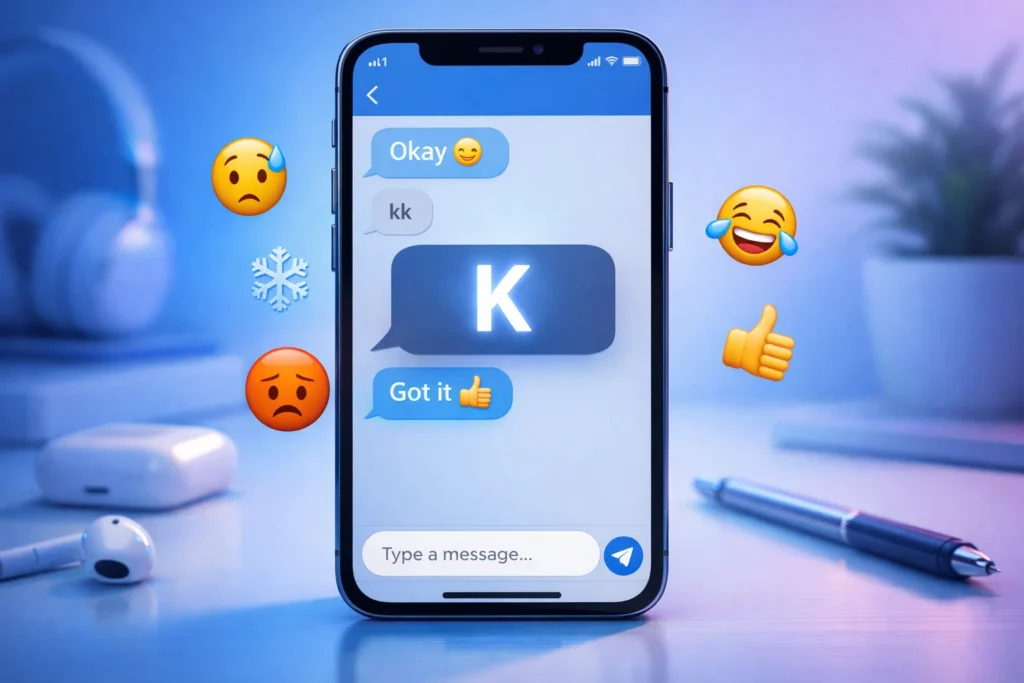
“K” in chat is an informal abbreviation for “OK,” used to acknowledge a message, show agreement, or indicate that something has been understood or accepted.
It is commonly used in texting, social media, and online conversations as a quick, minimal response.
However, depending on tone and context, “K” can feel:
- Neutral (simple acknowledgment)
- Slightly cold or dismissive
- Efficient or casual
In today’s digital communication, people prefer short, fast, and effortless replies. Instead of typing “okay,” many users simply send “K.”
At first glance, it looks like a harmless one-letter message. But in online conversations, even a single letter can change the tone completely.
For example:
- “Okay 👍” feels friendly
- “K” can feel short or even uninterested
That’s why understanding the k meaning in chat is important especially in texting, social media chats, gaming, and workplace messaging.
This guide breaks down everything you need to know: meaning, usage, tone, examples, comparisons, and even better alternatives.
Origin and Popularity of “K” in Chat
The use of “K” comes from the abbreviation of “OK,” which itself originated from the early 19th-century slang “oll korrect” (a playful misspelling of “all correct”).
Why “K” became popular in chats:
- Rise of SMS texting (character limits encouraged shorter words)
- Fast communication culture on apps like WhatsApp, Instagram, and Snapchat
- Gaming chats where speed matters more than grammar
- Minimalist communication style among younger users
Over time, “K” became a universal digital response but also a controversial one because of its tone.
How “K” Is Used in Real Conversations
“K” is not just one meaning it depends heavily on context
Common uses:
- To acknowledge a message
- To end a conversation
- To show agreement
- To respond quickly without emotion
Example usage:
- A: “I’ll be late today.”
B: “K” - A: “Don’t forget the assignment.”
B: “K, got it” - A: “Are you coming?”
B: “K”
Tone Behind “K” in Chat
Even though it looks simple, “K” carries different emotional tones depending on how it is used.
Tone Interpretation Table
| Message | Possible Tone | Meaning |
|---|---|---|
| K | Neutral | Acknowledging message |
| K. | Cold / serious | Slightly distant |
| Okay 😊 | Friendly | Warm acknowledgment |
| kk | Casual / friendly | Relaxed agreement |
| k | Short / blunt | Possibly uninterested |
Important Note:
Tone depends on relationship, situation, and previous messages not just the letter itself.
Real-Life Examples of “K” in Chat
1. Friendly Conversation
- A: “Let’s meet at 5 pm”
- B: “K 👍”
👉 Neutral and fine in casual chats
2. Slightly Cold Response
- A: “I think we should talk later.”
- B: “K.”
👉 May feel emotionally distant
3. Professional Chat
- A: “Please send the report by 3 PM.”
- B: “K”
👉 Too informal for workplace tone
4. Gaming Chat
- A: “Rush mid now!”
- B: “K, on it”
👉 Fast, efficient communication
Why People Use “K” Instead of “Okay”
There are several reasons why “K” is so widely used:
1. Speed
Typing one letter is faster than three.
2. Convenience
No need for punctuation or effort.
3. Habit
People adopt it after seeing others use it.
4. Minimal effort communication
Sometimes people just want to acknowledge without continuing the conversation.
5. Mobile texting culture
Short responses dominate messaging apps.
When “K” Can Be Misunderstood
Even though it seems harmless, “K” can sometimes create confusion.
Situations where “K” may feel negative:
- Arguments or emotional conversations
- Serious discussions
- When someone expects a warm response
- In professional communication
Example:
- A: “I really miss you.”
- B: “K”
👉 This may feel hurtful or dismissive
Comparison: “K” vs Similar Chat Abbreviations
Common Chat Alternatives Table
| Abbreviation | Meaning | Tone |
|---|---|---|
| K | Okay | Neutral / short |
| OK | Okay | Standard |
| kk | Okay | Casual / friendly |
| okk | Okay | Soft agreement |
| ok 🙂 | Okay | Friendly |
| alright | Okay | Polite |
| got it | Understood | Clear & professional |
Alternate Meanings of “K” in Chat
Although “K” usually means “okay,” it can sometimes have other meanings depending on context:
1. Thousand (K)
- “5K followers” = 5,000 followers
2. Kelvin (science context)
- Used in temperature measurement (rare in chat)
3. “Okay” emotion shortcut
- Used as emotional detachment or short reply
However, in everyday texting, “K” almost always means OK.
Is “K” Rude or Normal?
This is one of the most searched questions online.
The truth:
“K” is not inherently rude but it depends on tone and context.
It may feel rude when:
- Used in emotional conversations
- Sent alone without explanation
- Used after conflict or disagreement
It feels normal when:
- Used in casual chat
- Used between friends
- Used in fast-paced conversations
Better Alternatives to “K”
If you want to avoid misunderstandings, here are better options:
Friendly alternatives:
- “Okay 👍”
- “Got it 😊”
- “Alright!”
- “Sure thing”
Professional alternatives:
- “Noted”
- “Understood”
- “Thank you, I’ll do that”
- “Received”
These sound more polite and expressive than a single letter.
Psychological Impact of “K” in Messaging
Communication experts suggest that short responses like “K” can sometimes:
- Feel emotionally distant
- Reduce conversational warmth
- Create misinterpretation in sensitive chats
However, in fast digital environments, people also appreciate its efficiency.
So it’s a balance between:
- Speed vs emotion
- Efficiency vs clarity
When You Should Avoid Using “K”
To avoid confusion, avoid using “K” in:
- Job or office emails
- Serious discussions
- Relationship conversations
- Conflict resolution messages
- Customer communication
Instead, choose clearer responses like “Got it” or “Noted.”
FAQs
1. What does “K” mean in chat?
It means “OK” and is used to acknowledge a message.
2. Is “K” rude in texting?
It can feel rude depending on tone and context, but not always.
3. Why do people reply with “K”?
To respond quickly and keep messages short.
4. What does “kk” mean in chat?
It’s a casual version of “okay,” often more friendly than “K.”
5. Is “K” used in professional chats?
Not recommended because it feels too informal.
6. Does “K” mean anger?
Not directly, but it can be interpreted as cold or dismissive.
7. What should I reply instead of “K”?
You can say “Got it,” “Okay 👍,” or “Noted.”
8. Is “K” still popular in 2026?
Yes, it is still widely used in texting and social media.
Conclusion:
The k meaning in chat is simple on the surface it stands for “OK.” But its real impact depends on tone, context, and relationship between people.
While it is fast and convenient, it can sometimes feel cold or unclear. That’s why choosing the right alternative matters in different situations.
In short, “K” is powerful because it is simple but communication becomes better when clarity and tone are balanced.
Discover More Related Articles:
- 250+ Polite Responses to “Oh Wow”: Funny Conversation Starter for 2026
- 200+ Funny, and Cute Responses to “Oh My Gosh OMG” for 2026