
Definition
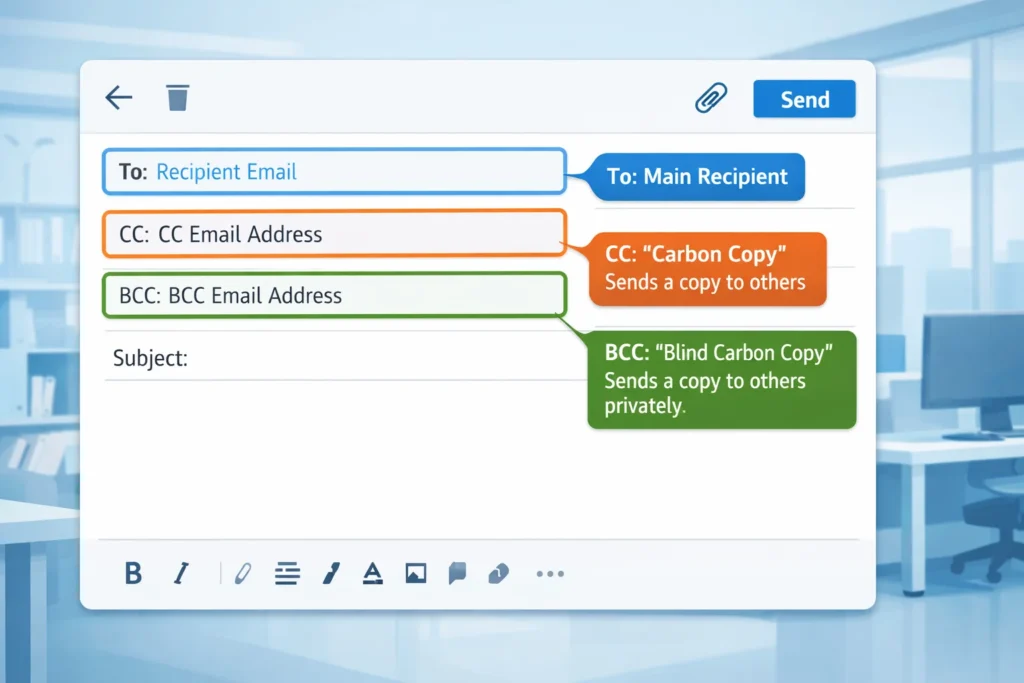
CC in email stands for “Carbon Copy.” It is used to send a copy of an email to additional recipients so they are informed, while keeping the main recipient visible to everyone included in the email thread.
In simple words, CC means:
👉 “I’m sending this email to you, but also keeping others informed.”
Ever sent an email and noticed a “CC” field right under the “To” section? Or maybe someone added you in CC and you wondered, “Am I supposed to reply or just read this?”
Email might feel simple, but small features like CC (Carbon Copy) can completely change how communication flows in workplaces, schools, and even personal messages. Whether you’re emailing your boss, a teacher, or a team, understanding what CC means in email helps you avoid confusion, awkward replies, and miscommunication.
In today’s digital world, email etiquette is just as important as writing skills. And CC is one of those tiny tools that carries a big responsibility.
Let’s break it down in the easiest and most practical way possible.
What Does CC Mean in Email?
CC stands for Carbon Copy.
It is used when you want to send a copy of your email to someone who is not the main recipient but still needs to stay informed.
Simple Explanation:
- To: Main person you are addressing
- CC: People who should see the email but are not required to respond
Example:
If you email your manager about a project and CC your team, it means:
- Your manager is the main receiver
- Your team is just being kept in the loop
Origin of CC (Why It’s Called Carbon Copy)
The term “Carbon Copy” comes from the old typewriter era.
Back then:
- People placed carbon paper between sheets
- When they typed on the top page, a duplicate copy was created underneath
That second copy was called a carbon copy, which later became “CC” in email systems.
Even though we no longer use typewriters, the term stayed because email systems adopted the same concept of duplication for communication.
Why CC Is Popular in Emails Today
CC is widely used because it helps:
- Keep people informed without direct messaging
- Maintain transparency in communication
- Avoid repeating the same email multiple times
- Create accountability in workplaces
- Improve teamwork and visibility
In professional environments, CC is almost as important as the email itself.
How CC Works in Real Life
| Field | Purpose | Who Should Be Included |
|---|---|---|
| To | Main recipient | Person responsible or directly involved |
| CC | Secondary recipients | People who should stay informed |
| BCC | Hidden recipients | People who receive the email secretly |
Real-Life Examples of CC in Email
1. Work Email Example
You email your manager about project updates and CC your teammates.
👉 Meaning: Everyone stays informed, but manager is main decision-maker.
2. School Email Example
A student emails a teacher and CCs a parent.
👉 Meaning: Parent is aware but not directly involved in conversation.
3. Business Communication Example
A client email is sent and CC includes the sales team.
👉 Meaning: Team stays updated for coordination.
4. Formal Complaint Example
You send a complaint email to HR and CC a supervisor.
👉 Meaning: Ensures transparency and documentation.
Tone and Usage of CC in Emails
CC doesn’t change the tone of your email, but it changes the audience awareness.
Neutral Tone:
- Used in workplace updates
- “Please find the report attached (CC’ing the team for visibility).”
Professional Tone:
- Used in formal communication
- “I have CC’d the department head for reference.”
Indirect Warning Tone:
- Sometimes used for accountability
- “CC’ing management for transparency.”
CC vs To vs BCC
| Feature | To | CC | BCC |
|---|---|---|---|
| Main recipient | Yes | No | No |
| Visible to others | Yes | Yes | No |
| Replies expected | Yes | No (usually) | No |
| Privacy level | Low | Medium | High |
| Use case | Direct communication | Informational sharing | Hidden recipients |
Alternate Meanings of CC
Although in email CC means “Carbon Copy,” it can also mean:
- CC (Credit Card) – common financial abbreviation
- CC (Cubic Centimeters) – used in engines and medicine
- CC (Closed Captions) – subtitles in videos
- CC (Creative Commons) – licensing in digital content
But in emails, it almost always means Carbon Copy.
When You Should Use CC in Emails
Use CC when:
- Someone needs information but not action
- You want transparency in communication
- You are keeping a record of shared updates
- Multiple people need awareness of the same message
Avoid CC when:
- It’s unnecessary clutter
- People don’t need the information
- It may overwhelm recipients
Common Mistakes People Make with CC
- CC’ing too many people unnecessarily
- Not explaining why someone is CC’d
- Expecting CC recipients to respond
- Overusing CC instead of direct communication
- Ignoring privacy concerns in group emails
Polite Alternatives to CC Usage
Instead of just CC’ing someone silently, you can say:
- “Keeping you in the loop for awareness.”
- “Adding you for reference.”
- “Including you for visibility.”
- “Sharing this update with you for context.”
These phrases make communication clearer and more respectful.
FAQs:
1. What does CC stand for in email?
CC stands for Carbon Copy, used to send a copy of an email to others.
2. Do CC recipients need to reply?
Usually no, CC is for information only unless stated otherwise.
3. Can CC recipients see each other?
Yes, all CC recipients can see each other’s email addresses.
4. What is the difference between CC and BCC?
CC is visible to everyone, while BCC is hidden from other recipients.
5. When should I use CC in emails?
Use it when someone needs to stay informed but not take action.
6. Is CC professional?
Yes, CC is widely used in professional and formal communication.
7. Can I remove someone from CC?
No, only the sender can decide who is CC’d.
8. Is CC still relevant today?
Yes, CC is still a key feature in modern email communication.
Conclusion
Understanding what CC means in email is essential for clear and professional communication. It helps you keep people informed without overcrowding the main conversation. Whether you’re working in an office, managing school communication, or handling business emails, CC ensures transparency and smooth information sharing.
Used correctly, CC can make you look organized, respectful, and efficient. Used incorrectly, it can cause confusion or unnecessary email clutter.
So next time you hit that CC field, remember—you’re not just copying someone, you’re shaping how information flows.
Discover More Related Articles:
- B Width Mean in Shoes: Fit, Sizing, and Comfort Tips for 2026
- Repentance Mean in the Bible: Powerful Truth Most People Miss In 2026