
Definition
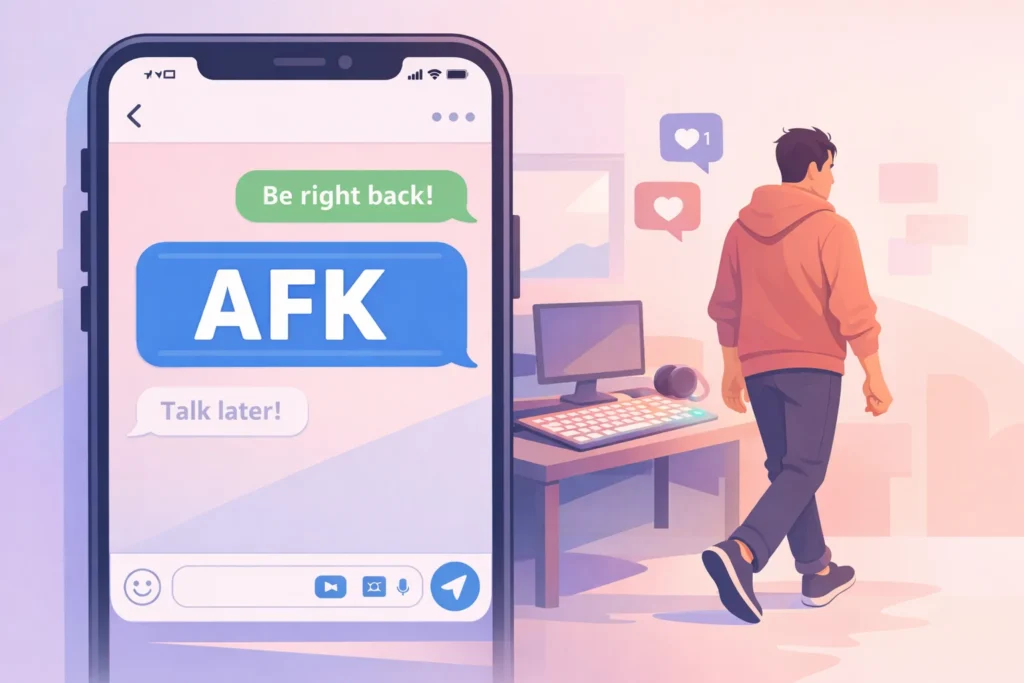
AFK stands for “Away From Keyboard.” It is commonly used in texting, online chats, gaming, and social media to let others know that someone is temporarily unavailable or not actively responding.
If you’ve ever been chatting with someone online or playing a multiplayer game, you’ve probably seen the message: “brb, afk” or just “afk.”
At first glance, it might seem like random internet slang—but it’s actually one of the most widely used abbreviations in digital communication. Whether you’re texting a friend, working remotely, or gaming late at night, AFK is a quick and efficient way to signal that you’re stepping away.
In today’s fast-paced online world, short forms like AFK help people communicate status updates instantly without long explanations. But what exactly does it mean, where did it come from, and how should you use it correctly? Let’s break it all down.
Origin of AFK
The term AFK (Away From Keyboard) dates back to the early days of the internet—particularly during:
- Chat rooms (IRC – Internet Relay Chat) in the 1990s
- Online forums and messaging boards
- Early multiplayer PC games
Back then, conversations were live and continuous. If someone suddenly stopped replying, others wouldn’t know why. So users began typing “AFK” to signal they had stepped away from their computer.
Why It Stuck Around
Even as technology evolved—from desktops to smartphones—the phrase stayed popular because:
- It’s short and easy to type
- It clearly communicates availability
- It works across all platforms (games, chats, apps)
Today, AFK is used not just on computers but also on mobile phones—even though technically there’s no “keyboard” involved anymore.
How AFK Is Used in Text and Online Conversations
AFK is mainly used to indicate that someone won’t respond immediately. It’s especially common in:
- Text messaging
- Online gaming chats
- Work chats (Slack, Teams, Discord)
- Social media DMs
Common Ways to Use AFK
- “AFK for 5 mins, be right back.”
- “Sorry, I was AFK.”
- “Going AFK, dinner time.”
- “AFK rn” (rn = right now)
It can be used on its own or combined with other abbreviations.
Real-Life Examples of AFK in Context
Example Table: AFK Usage in Different Situations
| Scenario | Message Example | Tone |
|---|---|---|
| Gaming | “AFK, don’t start without me!” | Casual |
| Friendly Chat | “Going AFK for a bit 😊” | Friendly |
| Work Chat | “AFK for 10 minutes, back soon.” | Professional |
| Apology Context | “Sorry I was AFK earlier.” | Polite |
| Dismissive Use | “AFK… not dealing with this right now.” | Slightly Negative |
Tone and Meaning: Friendly, Neutral, or Rude?
AFK itself is neutral—it simply describes your availability. But tone depends on how you use it.
Friendly Tone 😊
- “AFK for lunch, talk later!”
- Adds warmth and context
Neutral Tone
- “AFK 5 min”
- Straightforward and efficient
Negative or Dismissive Tone ⚠️
- “AFK, whatever.”
- Can sound uninterested or annoyed
So while AFK isn’t rude, context and wording matter.
AFK in Gaming vs Texting
AFK is especially important in online gaming, where teamwork matters.
In Gaming
- Signals temporary absence
- Helps teammates adjust strategy
- Prevents confusion
Example:
“AFK, someone cover my spot!”
In Texting
- Simply means delayed response
- Less urgent than in games
Example:
“Was AFK, just saw your message.”
Comparison: AFK vs Similar Text Abbreviations
| Abbreviation | Meaning | When to Use |
|---|---|---|
| AFK | Away From Keyboard | When stepping away temporarily |
| BRB | Be Right Back | When returning very soon |
| GTG / G2G | Got To Go | When leaving completely |
| TTYL | Talk To You Later | Ending conversation for later |
| OOO | Out Of Office | Professional/work context |
Key Difference
- AFK = Temporary absence
- GTG = Leaving entirely
Alternate Meanings of AFK
While “Away From Keyboard” is the primary meaning, AFK can occasionally have other interpretations depending on context:
- In gaming slang: Still means inactive or not playing
- Rare or niche meanings:
- “A Free Kill” (gaming humor)
- “Away From Keys” (music context, very uncommon)
However, 99% of the time, AFK = Away From Keyboard.
When NOT to Use AFK
Although AFK is widely understood, it’s not always appropriate.
Avoid Using AFK In:
- Formal emails
- Academic writing
- Professional reports
Instead, use clearer alternatives like:
- “I’m currently unavailable”
- “Stepping away briefly”
- “I’ll respond shortly”
Polite and Professional Alternatives to AFK
If you want to sound more professional or courteous, try these:
Casual Alternatives
- “Be right back”
- “Stepping away for a bit”
- “Back in a few”
Professional Alternatives
- “I’ll be away for a few minutes”
- “Currently unavailable, will respond shortly”
- “Stepping away from my desk”
These are especially useful in workplace communication.
Why AFK Is Still Popular Today
Despite being decades old, AFK remains widely used because:
- It’s universally understood
- Works across platforms and cultures
- Saves time while typing
- Fits perfectly in fast-paced conversations
Even in the age of emojis and voice notes, simple abbreviations like AFK still dominate digital communication.
FAQs:
1. What does AFK mean in texting?
AFK means “Away From Keyboard,” indicating that someone is temporarily unavailable or not actively responding.
2. Is AFK rude to use?
No, AFK is not rude. However, tone depends on how it’s used. Adding context can make it sound more polite.
3. Can AFK be used in professional chats?
Yes, but it’s better to use clearer alternatives like “stepping away” in formal work settings.
4. What is the difference between AFK and BRB?
AFK means you’re away, while BRB (Be Right Back) suggests a quicker return.
5. Do people still use AFK today?
Yes, AFK is still widely used in texting, gaming, and online communication.
6. What does AFK mean in gaming?
In gaming, AFK means a player is inactive or temporarily not participating.
7. Can AFK be used on phones?
Yes, even though it originally referred to keyboards, it’s now used on smartphones too.
8. What should I reply if someone says AFK?
You can simply wait, or reply later. No immediate response is expected.
Conclusion:
AFK is a simple yet powerful abbreviation that has stood the test of time. It means “Away From Keyboard” and is used to let others know you’re temporarily unavailable.
AFK means “Away From Keyboard” and is used in texting, gaming, and online chats to show that someone is temporarily not available. It’s a quick and widely understood way to let others know you’ve stepped away and will respond later.
Although it originally referred to computers, AFK is now commonly used on phones and across all digital platforms. It’s neutral in meaning, but the tone depends on how it’s used—friendly, simple, or sometimes informal.
Discover More Related Articles:
- Benign Mean in Medical Terms: Symptoms & Diagnosis In 2026
- NSA Mean in a Relationship: How to Recognize and Approach It In 2026